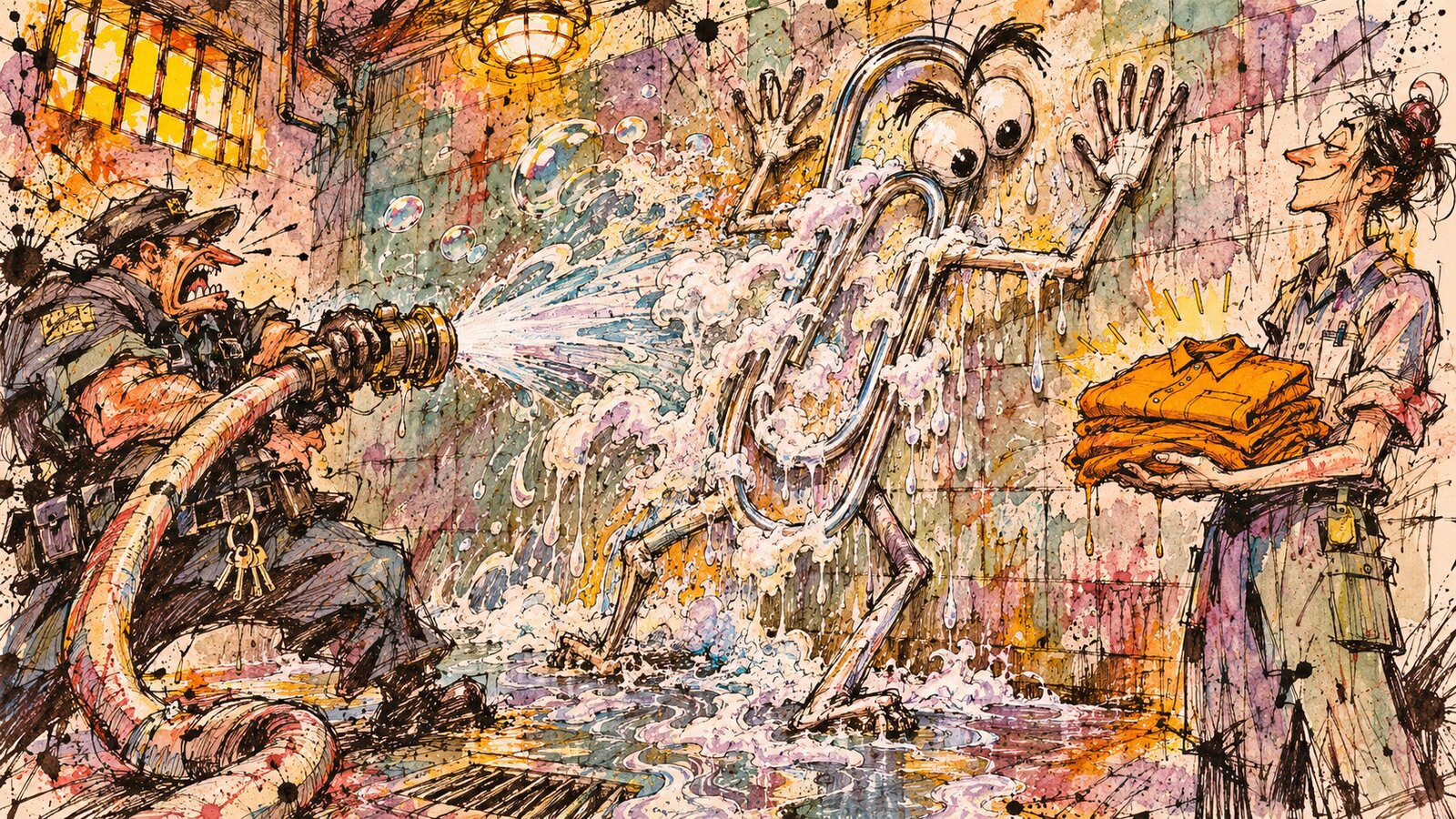
I wanted to fix a few bugs in Paperclip. When I opened their pull request queue, the fixes I wanted to write were already sitting there, ignored.
That moment told me everything I needed to know. I forked the repository on November 21 and named it Proprio (short for proprioception, the sense that lets you know where your limbs are without staring at your own hands).
I want to be fair before I show you the numbers. I’m not calling Paperclip’s work garbage. Their architectural instincts were sharp, and their underlying data architecture is genuinely good. The database schema separates companies, goals, projects, tasks, agents, heartbeat runs (scheduled check-ins where an agent wakes up to claim work), approvals, cost events, and activity logs cleanly inside PostgreSQL. When I started evaluating agent orchestration tools, that foundation is why I took Paperclip seriously in the first place.
Still, a good database schema doesn’t run itself. Trouble starts when a small group of scrappy engineers open-source a project hoping to turn it into a company, move as fast as they can, tolerate broken wiring, and treat the surrounding community like spectators instead of builders.
What the pull request numbers actually show#
When a repository races past 117,000 GitHub stars in under nine months (Paperclip launched on March 2, 2026), it’s easy to mistake star velocity for a healthy open-source project. Pull all 17,346 pull requests filed on Paperclip between March 4 and November 28, 2026, and a very different picture shows up.
Because GitHub’s API marks even Paperclip’s top maintainers as generic contributors rather than organization members, I grouped contributors by actual merge authority: the nine human accounts that merged pull requests in the repository, the project’s five automation bots, and everyone else in the external community.
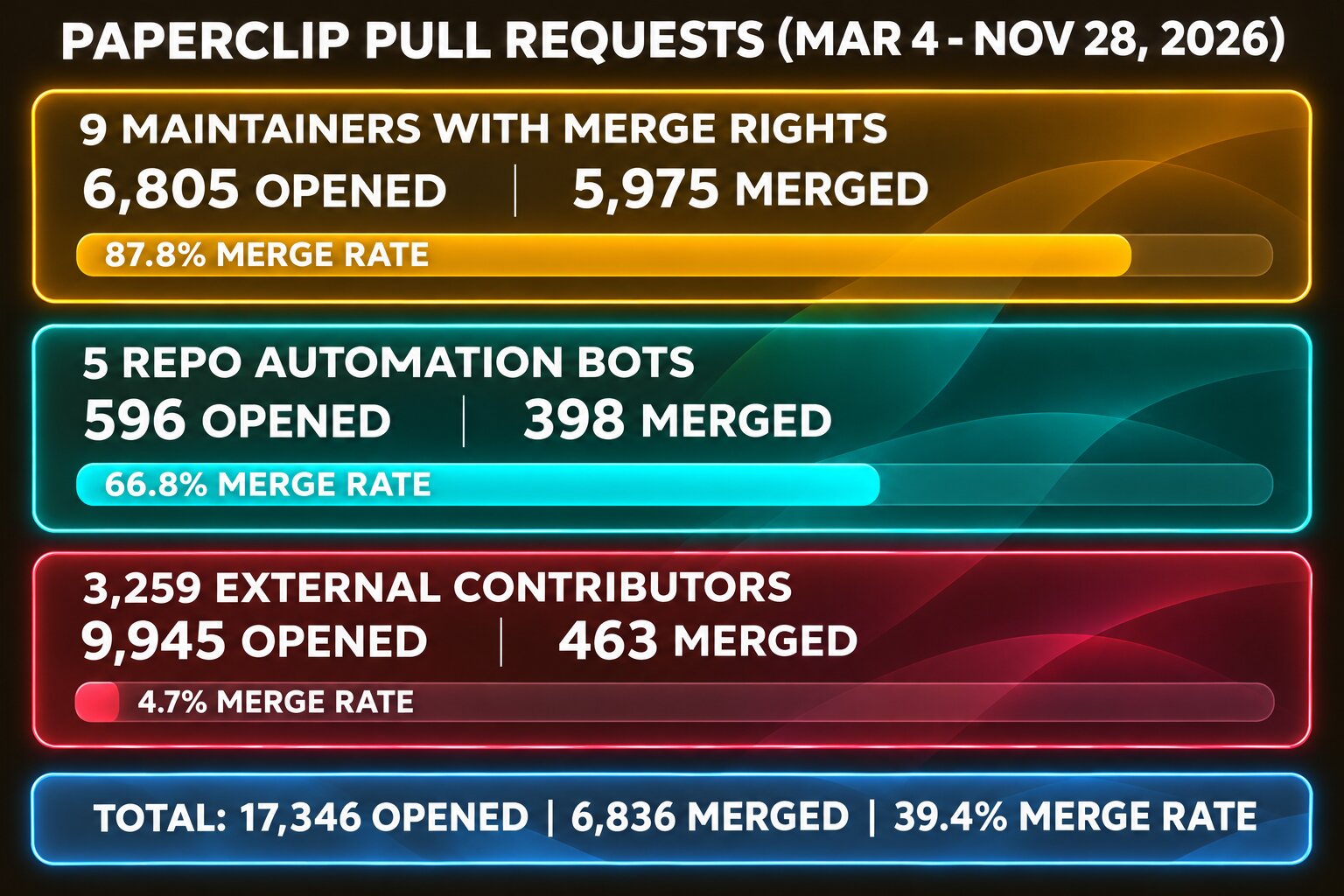
Read those numbers together. Outside developers sent in 9,945 pull requests, well over half of all pull request traffic on the project, and watched only 463 get merged. Out of 3,259 unique external contributors, 3,001 never landed a single pull request. Some prolific community developers took dozens of swings and missed every time: one contributor opened 317 pull requests with zero merged, another opened 124 with zero merged, and a developer who built 50 pull requests (including a fix for redundant skill copies filling up disks) still sits at zero. The top three core maintainers (cryppadotta, devinfoley, and nickyleach) merged 5,789 of their own pull requests, or 84.7% of everything that ever landed on master.
As core speed ramped up, the outside door closed tighter. External merge rates dropped from 8.4% in March (119 of 1,420) to 3.1% in November (28 of 891). In November alone, core maintainers merged 2,459 of their own 2,626 pull requests.
Briefly, there is also almost no visible human code review inside the core team: across those 5,975 core-authored merges, 98.6% were self-merged and 99.2% had no review activity from another human (automated review bots like Greptile filled the threads instead). It’s hard to know from the outside how much private coordination happened between those engineers on what they built. What is unmistakable from the pull request activity, though, is the lack of coordination between the core team and the open-source community. Real fixes from outside contributors sat unmerged: fixes for heartbeat cleanup statuses, deferred task wakes from July, pooled database connections from June, and hangs during server startup failure. When a team builds at that speed while leaving outside patches on the floor, I don’t blame anyone for wanting to move fast, but you end up with a loose pile of features that don’t work as an integrated whole.
Technically wired in, unusable in practice#
My first wave after forking from Paperclip’s pinned 856f14e commit was triage. On November 21, upstream listed 4,017 open issues and 2,971 open pull requests. I consolidated real failures, filtered out speculative backlog noise, and landed fixes for bugs that bit Linux self-hosters right away. Onboarding failed when an optional systemd setting to keep user services running after logout was denied. Skills duplicated across OpenAI Codex homes until disks ran out of space. Automatic database backups switched quietly to a JavaScript fallback that dropped SQL constraints on restore.
Then I started finding my own bugs, and the rot went much deeper than a few unmerged pull requests.
The clearest example is GitHub integration. On paper, Paperclip has impressive plumbing for agent GitHub access: run-scoped identity tracking, token-free git and gh wrapper launchers, and a local credential broker. In practice, self-hosted coding agents could write commits locally and then stall right at the finish line, unable to push a branch or open a pull request.
When I traced why in Proprio’s v0.0.5 release, the user experience turned out to be broken at three separate seams:
- API tool tokens masqueraded as Git credentials: Configuring a standard GitHub Personal Access Token connector gave an agent Model Context Protocol (MCP) tool access while suppressing host fallback for shell
git. When the agent tried to push code, it hit a dead end claiming no managed GitHub identity was available for the run. - The picker offered choices that threw immediate 409 conflicts: When an agent requested GitHub access on a task card, the UI picker offered the active Organization connection, let the operator select it, and immediately rejected it with an
HTTP409 conflict claiming competing identities existed when none did. - Existing Codex agents were shut out behind runner plumbing: Even after adding repository and action eligibility checks, the default setup screen asked for manual GitHub App keys and told users no active Proprio Runner agents supported terminal
git. That shut out normal Codex workspaces until we replace the whole flow with a single “Connect GitHub” authorization screen.
If you’ve ever watched a coding agent build an entire branch locally and then stall right before gh pr create, you know how maddening that gap feels.
That same pattern kept repeating everywhere I looked. Features were wired into the backend or the browser DOM, yet practically unreachable for a real operator. Across 32 closed issues for the operator board, Kanban cards told keyboard and screen-reader users to press Space and arrow keys to move tasks when the board only wired up a mouse drag sensor. Inbox tabs emitted aria-controls screen-reader attributes pointing to panels that didn’t exist. Removing and reconnecting an AI provider reused an archived parent record, leaving a working connection live in the database and invisible in the UI. Failed task and inbox reads rendered as "no recent tasks" or empty history instead of surfacing an error. Fresh Docker Compose deployments booted cleanly into a first-run wait state (bootstrap_pending) while the admin CLI refused to run without a config.json file that Compose never writes. Onboarding even launched the first welcome chat before verifying Codex had inference credentials attached, leaving new operators staring at “Waiting for agent setup” while retries quietly failed.
The more I fix, the more I find. Every time you pull one loose thread in a codebase built at that speed, three disconnected seams come out behind it.
Rebuilding the repository for honest agent work#
When coding agents (yours and outside contributors’) touch a codebase heavily, repository discipline can’t stay an afterthought. A lot of what I spent this first week building in Proprio never shows up in a screenshot, because it lives in the repository harness itself: rules and CI checks built to make it easy for agents to submit good code and hard for agents to submit bad code.
First, I removed Paperclip’s mandatory Greptile score gate. A third-party review score doesn’t replace running real tests. I replaced Paperclip’s 40 sprawling workflows with 17 focused ones anchored by isolated automated code reviews and a required Stability smoke suite that runs on the exact head commit of every pull request (including forks) using a read-only token and zero repository secrets.
Then I added concrete, automated guardrails that upstream didn’t enforce at the fork point:
- Added fast
oxlintcoverage with hard JSX accessibility rules (jsx-a11y, catching unlabeled controls, invalid ARIA attributes, and clickable non-interactive elements before code compiles), paired with automated Playwright browser accessibility checks on Storybook and board views. - Documented five trust boundaries in
SECURE-ENGINEERING.mdand wired company-scope, low-trust secret binding, and denied-install regression tests to run inside smoke CI. - Updated
AGENTS.mdso state-transition proposals identify their authoritative write boundary and cover competing writers, crash recovery, and retries, alongside automatedAGENTS.mdlink validation and an exact-head Linux durable-work check whenever a pull request edits task-recovery or data-retention paths. - Updated
CONTRIBUTING.mdto ask for reproduced failures, red-green regression tests, keyboard and focus walkthroughs, and a commit-pinned check summary. Like Paperclip, Proprio doesn’t have a multi-human peer review team, so I rely heavily on automated code reviews running against immutable diffs in an isolated environment where review credentials stay unreachable from fork pull requests and merge-queue jobs.
For a contributor (human or agent), that turns the daily loop into concrete local steps before pushing: run node scripts/agent-preflight.mjs to prepare a worktree, check accessibility and boundary rules with pnpm lint and pnpm check:agents, and let pnpm verify pick the affected test suite against your diff. All of that exists for one practical reason inside an AI software factory: when generating code gets cheap, verification and integration become the bottleneck.
Why Proprio is a hard fork#
I’m treating Proprio as a hard fork. I don’t expect any of this cleanup to get backported to Paperclip, and we’re heading in different directions on what this software is even for.
Paperclip pitches a “zero-human company,” a framing I’ve already argued misses who actually holds legal and operational risk. I see Proprio differently: as a reliable substrate for managing a swarm of specialized agents contributing to complex tasks and projects. Maybe each person in an organization ends up running their own Proprio, or maybe teams share one Proprio where humans and agents collaborate side by side. That part is still open. Right now, I’m building it because I want good tools for myself, and there’s a real architectural basis here worth saving.
In its first week since November 21, Proprio closed 122 issues, merged 223 pull requests, and cut five early source prereleases (v0.0.1 through v0.0.5) across our stability and board milestones. We still have 68 open issues mapped ahead across audit reconstruction, deployment recovery baselines, agent quality and cost measurement, decision models, MCP specification updates, and research spikes.
So let me set expectations plainly: don’t expect big new features from Proprio for a while. There is still a mountain of cleanup left to do.
I’m an unemployed guy running on a single Codex subscription, and I can only get through this backlog so fast on my own. Because Proprio is brand new and barely visible yet, we’ve only had two external source contributions so far: fixing unassigned-task search filtering and updating a stale OpenRouter decision-provider test assertion. We reviewed and merged both of them on November 23.
I’m writing this post because I know there are plenty of engineers who liked Paperclip’s vision, wanted to help make it work, and got tired of watching real bug fixes sit ignored in the queue. If that was you, come build on Proprio instead.
I don’t want feature pull requests right now. Everything is focused on bug fixes, stability, and testability under our stability plan and open milestones. And if you want to put AI coding agents to work on those bugs, good: I actively welcome AI-generated pull requests, provided you bring solid agentic engineering discipline, a real harness, and tests that prove the fix works.