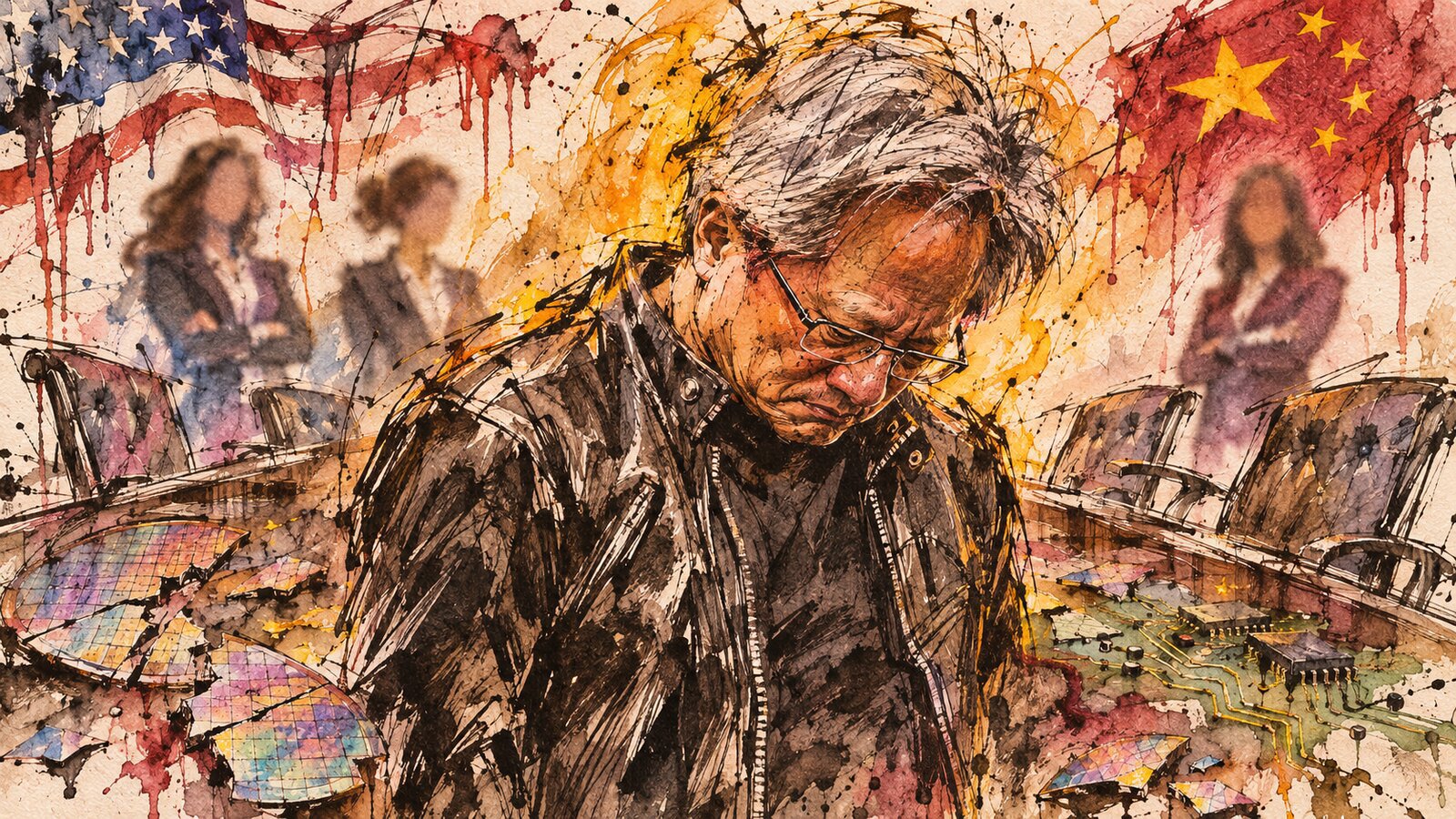
Jensen Huang has stepped down as the chief executive of Nvidia, ending a thirty-three-year reign over the only company he has ever led as CEO since co-founding it at a San Jose Denny’s in 1993.
Nvidia’s board announced his immediate resignation on Thursday morning, instantly throwing the world’s most valuable technology company into an unprecedented leadership vacuum. The stunning detail is not just that he is gone. It is that after more than three decades building a silicon empire worth trillions of dollars, there was no heir apparent, no designated transition period, and no visible succession plan.
He operated Nvidia with an organizational span of control that defied every tenet of traditional corporate management. During a talk at Stanford in 2024, Huang boasted that fifty-five senior leaders reported directly to him. An internal organizational list obtained by Business Insider in October 2025 counted thirty-six direct reports, and by the time of his ouster on Thursday, ABC News and Fortune reported that about sixty executives reported straight into his office. He sat at the center of every single major decision, texting small clients himself and refusing to groom a replacement.
Now he is out, and the board has scrambled to install Chief Financial Officer Colette Kress as interim CEO while leaving her in charge of the company’s books.
This story is about actions and consequences. It is less about trying to guess who wins the corporate throne next, and more about understanding how an absolute corporate monarchy got us to this exact rupture.
The Three Affairs (Known So Far) and the Governance Fault Line#
The scandal that broke Jensen Huang began as a whisper of marital infidelity and rapidly exploded into an international governance nightmare. It started on November 8, when Huang published an extraordinary internal message to Nvidia employees acknowledging that he had been unfaithful to his wife. He named nobody. But reports quickly emerged detailing an extramarital relationship with Alice Huang, a former anchor and journalist for Chinese state television who later became a senior executive and director at Singapore-based data center operator Megaspeed International.
The temperature spiked immediately because Megaspeed was not just any customer. It was an Asia-Pacific data center infrastructure provider that leased computing power and servers loaded with advanced Nvidia hardware. Then CNN reported that a classified May U.S. intelligence assessment had concluded Alice Huang was an intelligence asset for the Chinese Ministry of State Security. While the Singapore Ministry of Home Affairs clarified that its own domestic probe into Megaspeed involved suspected false server declarations rather than espionage, it issued her a stern warning for providing inaccurate statements about her corporate role and barred her from re-entering the country.
Before the board could even begin its independent inquiry with outside counsel Joon H. Kim and Wachtell, Lipton, Rosen and Katz, the second shoe dropped. On Wednesday, The New York Times reported that Huang had engaged in an extramarital affair with one of his own direct reports: Kimberly Powell, Nvidia’s vice president of healthcare. The Times cited five people who worked at the company and described video evidence from a San Jose hotel during Nvidia’s annual GPU Technology Conference in March, though the paper noted it had not viewed the recording itself.
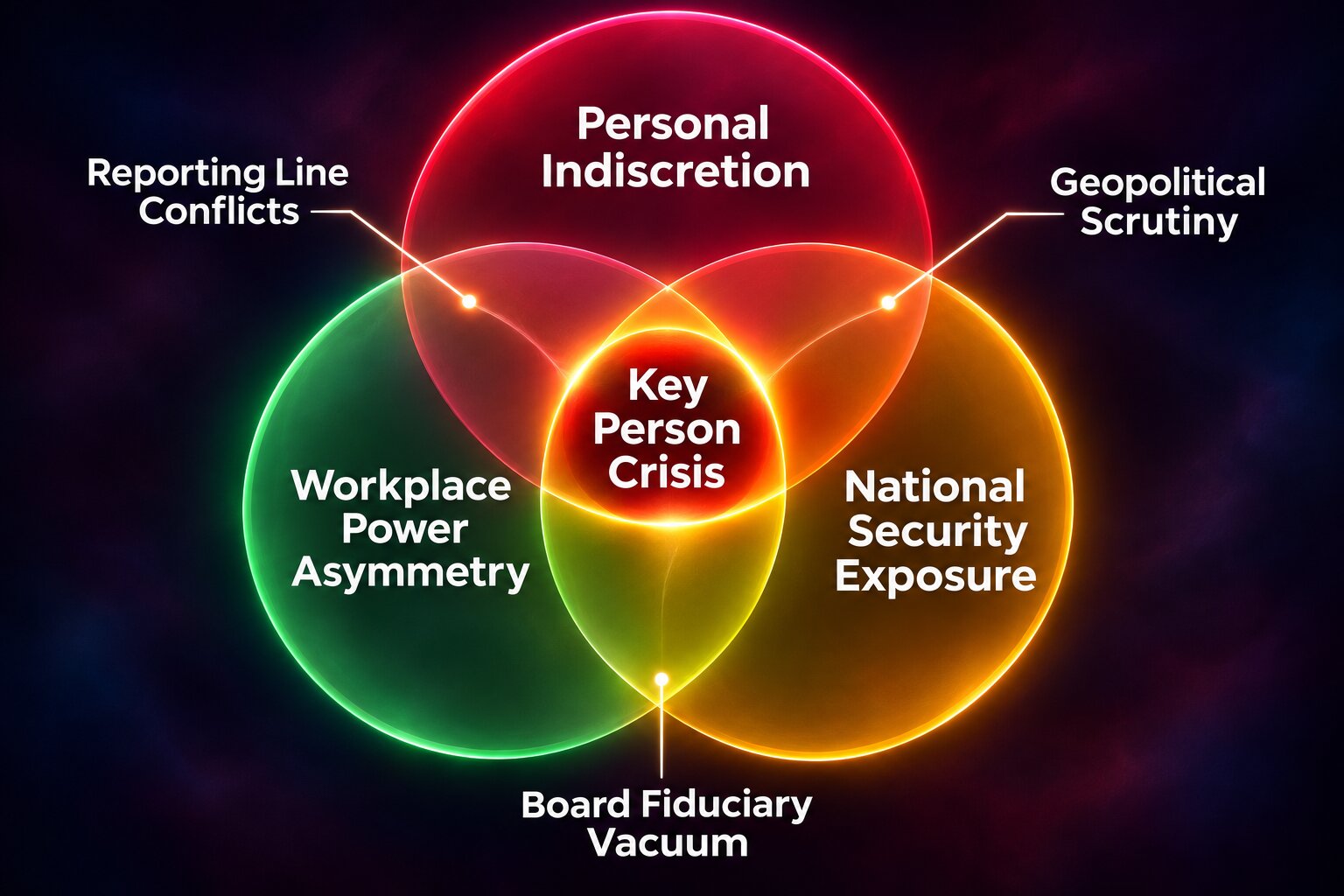
If you thought the revelations had peaked, Thursday brought a third wave. While Wall Street was still digesting Huang’s resignation, Reuters reported that Huang had engaged in an intimate relationship with a second Nvidia employee, citing two people familiar with the matter. Reuters did not name the woman, and attempts to reach her were unsuccessful, but the wire service characterized the cascade of workplace and national security entanglements as the proximate driver of his departure. Three is merely the tally known so far in a ledger that has expanded almost by the hour, and in a developing scandal of this velocity, nobody on Wall Street or in Silicon Valley is betting that the count stops here.
Let’s be completely candid about the workplace dynamics here. When a CEO carries on an affair with a subordinate, it tears the social fabric of an organization to shreds. Even without discussing private motives, the professional consequences are poisonous. According to Kimberly Powell’s public LinkedIn profile, she spent eighteen years rising through Nvidia’s ranks, starting as a worldwide business development director in 2008 before being promoted to senior director of artificial intelligence business development in 2016 and vice president of healthcare in 2017. She has led Nvidia’s medical imaging and life sciences initiatives for years. But the moment an intimate relationship with the chief executive becomes global headline news, her standing inside the company is irrevocably compromised. Coworkers inevitably wonder whether promotions, project budgets, and executive access were earned through professional merit or intimate proximity. That perception is impossible to untangle once the dam breaks. It poisons team morale, creates catastrophic legal exposure for the board, and destroys the perceived fairness of the corporate ladder.
The Flat Empire and the Missing Heir#
To understand why this collapse was so abrupt, you have to look at the eccentric management apparatus Jensen Huang constructed around himself. In the executive leadership circles I have inhabited throughout my career, there is a fundamental rule that you internalize early: you groom your successor. It is not an optional administrative chore. It is a foundational fiduciary responsibility.
Your job as an executive leader is to ensure that if you get hit by a bus, get sick, or step aside tomorrow, the institution does not skip a beat. You build an heir apparent. You delegate real operational authority. You test leaders under fire, give them P&L ownership, and construct an organizational bench strong enough to outlive your personal ego.
Jensen Huang did the exact opposite. He ran Nvidia as an absolute monarchy.
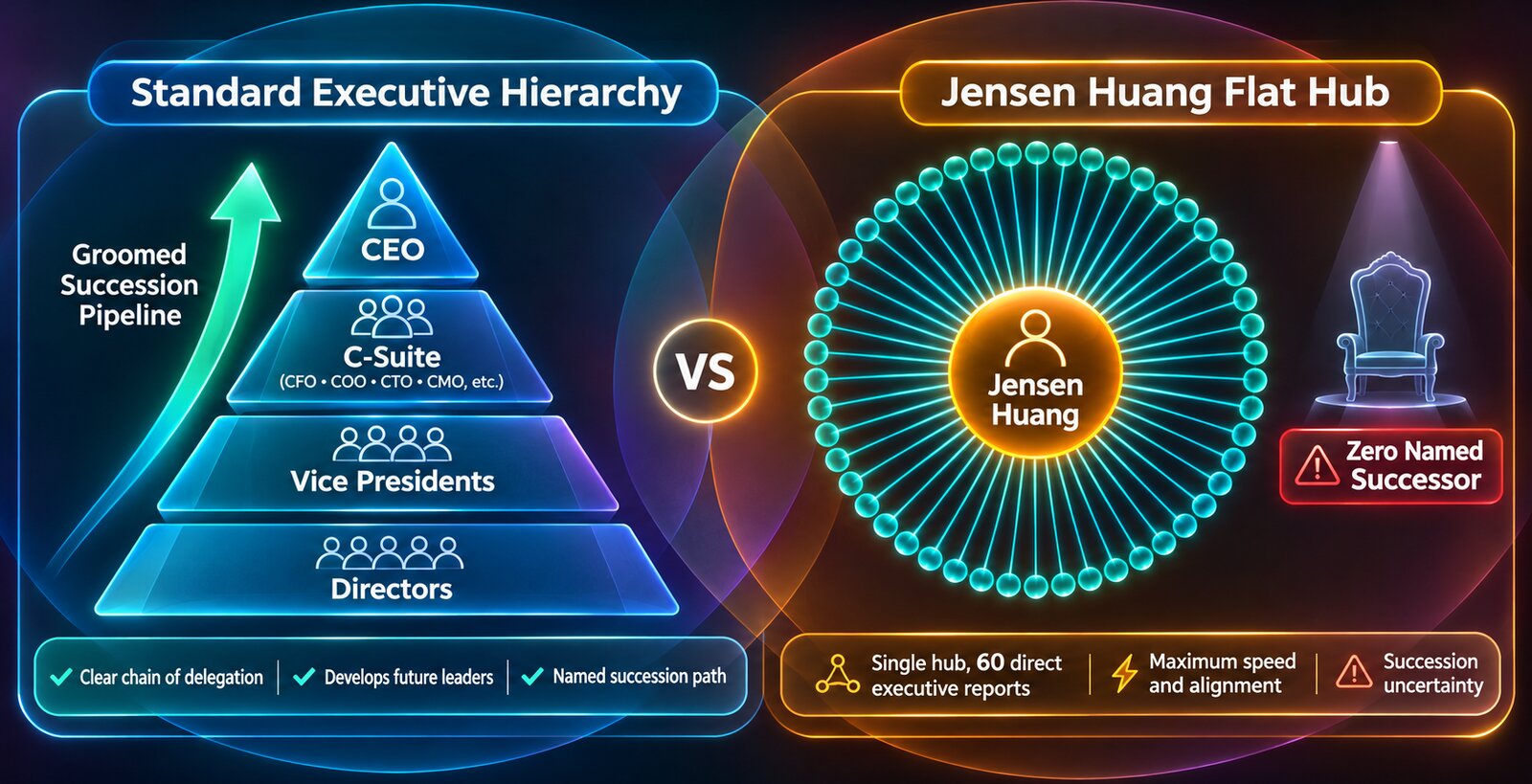
In his March 2024 Stanford talk, Huang laid out his managerial philosophy with unmistakable pride. He argued that senior executives do not need career guidance or one-on-one pampering. He eliminated regular one-on-one check-ins entirely. Instead, he kept his door open for on-demand interventions and insisted that sixty executives reporting straight to him created ultimate organizational agility. In an interview with podcaster Lex Fridman, Huang famously stated that he did not believe in conventional succession planning, claiming instead that his role was to continuously broadcast his strategic reasoning to everyone in the room so the company could absorb his mindset.
That sounds romantic when your stock price is surging seven hundred thousand percent. It is catastrophic when you suddenly vanish.
Because Huang refused to establish a traditional executive hierarchy with a chief operating officer or an anointed second-in-command, Nvidia had nobody prepared to step into his shoes. Look at the emergency triage the board was forced to execute on Thursday morning. They did not promote an experienced product visionary or an operational deputy. They tapped Chief Financial Officer Colette Kress to serve as interim CEO while simultaneously keeping her day job as CFO.
Think about what that tells you. They are asking their CFO to guide global operations, handle delicate customer allocations, and reassure anxious sovereign governments while she continues balancing the balance sheet and preparing for earnings calls. The board is now initiating an open search for internal and external candidates. That leaves the company with two deeply awkward paths: either Kress permanently takes the CEO job and Nvidia has to recruit a new CFO, or Kress merely keeps the engine running as a caretaker while an outside executive is parachuted in to run an insular engineering culture that has only ever known one leader.
To steady the ship, the board also had to appoint its first-ever independent chair, tapping venture capitalist Harvey Jones, who has sat on Nvidia’s board since its incorporation in 1993. For thirty-three years, Jensen ran the board and the executive suite without a separate chairperson. When the monarch fell, the board had to invent corporate governance from scratch in a single emergency meeting.
The Thirty-Three-Year Bet on Parallel Silicon#
The cruelest irony of this entire saga is the timing. Jensen Huang was forced out at the absolute zenith of his career, just as his defining life bet reached its greatest vindication.
When Jensen founded Nvidia alongside Chris Malachowsky and Curtis Priem in 1993, the computing universe belonged entirely to the central processing unit. Intel was king. The CPU was built to execute complex, sequential strings of logic with blistering single-thread speed. Jensen saw a different physical reality: real-world computing, starting with real-time 3D graphics for video games, required processing millions of simple mathematical operations simultaneously.
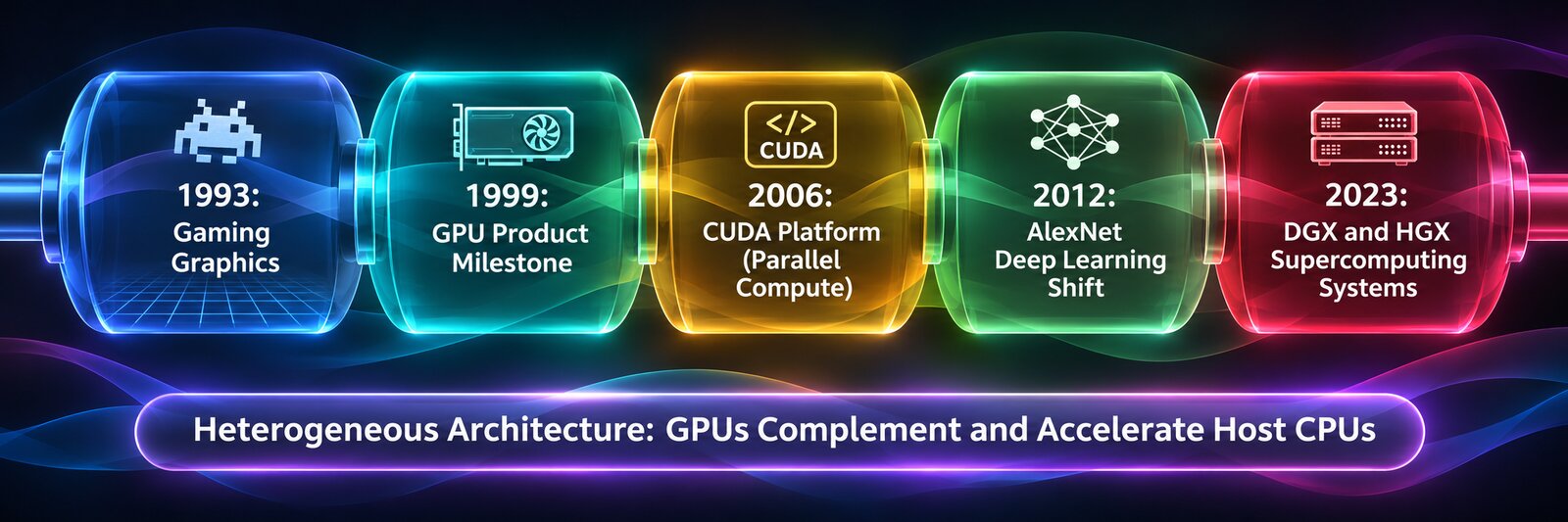
Nvidia’s historical trajectory unfolded in deliberate, compounding steps:
- 1993 Gaming Graphics: The company began with a narrow focus on specialized multimedia and 3D graphics acceleration for personal computers, using consumer video games to finance basic research into parallel chip design.
- 1999 GPU Milestone: Nvidia introduced the GeForce 256, defining the Graphics Processing Unit as a distinct computing category with dedicated hardware transformation and lighting engines.
- 2006 CUDA Architecture: In what was widely considered a reckless financial gamble at the time, Nvidia introduced CUDA, a parallel programming platform that allowed software developers to harness GPU processing power for arbitrary scientific computation outside graphics APIs.
- 2012 AlexNet Breakthrough: University of Toronto researchers Alex Krizhevsky, Ilya Sutskever, and Geoffrey Hinton trained their breakthrough convolutional neural network on two commodity Nvidia GeForce GTX 580 cards, crushing the ImageNet visual recognition contest and proving that GPUs were the native substrate of deep learning.
- 2023 DGX and HGX Supercomputing Systems: As generative AI ignited global demand, Nvidia transitioned from selling discrete graphics cards to delivering multi-million-dollar AI factories, combining thousands of GPUs with high-speed NVLink networking into unified compute engines.
There is a vital technical distinction that many commentators get wrong when they write about this history. GPUs did not replace CPUs. They never will. Modern high-performance computing is an intrinsically heterogeneous architecture. The host CPU acts as the conductor, managing control flow, operating system logic, and sequential dependencies. The GPU acts as the industrial heavy lifter, chewing through billions of matrix multiplications across thousands of parallel cores.
For nearly a decade after launching CUDA in 2006, Wall Street punished Nvidia for sinking hundreds of millions of dollars of margin into compiler support, developer tools, and silicon die space that gamers did not need and enterprise clients did not yet understand. Jensen endured brutal margin hits and shareholder skepticism because he believed that specialized parallel computing was the only way computing power could scale once traditional CPU frequency scaling hit physical thermal barriers.
He was right. When deep learning hit the technology industry like a freight train, Nvidia was the only company on Earth with the silicon, the interconnect fabrics, the optimized mathematical libraries, and the software ecosystem ready to meet it. He turned a graphics card maker into a multi-trillion-dollar geopolitical powerhouse.
Yet, having spent thirty-three years dragging the technology sector into the accelerated computing era, he will not be in the driver’s seat to steer it across the finish line.
The Trade War Fog and the Scramble for the Throne#
Nvidia’s sudden decapitation is not just a boardroom tragedy. It is a geopolitical crisis because Nvidia occupies the most sensitive choke point in global commerce.
Over the past three years, the United States government has made advanced AI silicon the tip of the spear in its economic confrontation with China. The Department of Commerce enacted strict export controls barring Nvidia from shipping its flagship datacenter accelerators to Chinese customers. Huang spent months navigating this minefield, engineering throttled processors like the H20 to comply with federal limits, only to find Washington tightening the screws further. In May, Huang frankly conceded to reporters that Nvidia had largely conceded the Chinese AI chip market to domestic competitor Huawei.
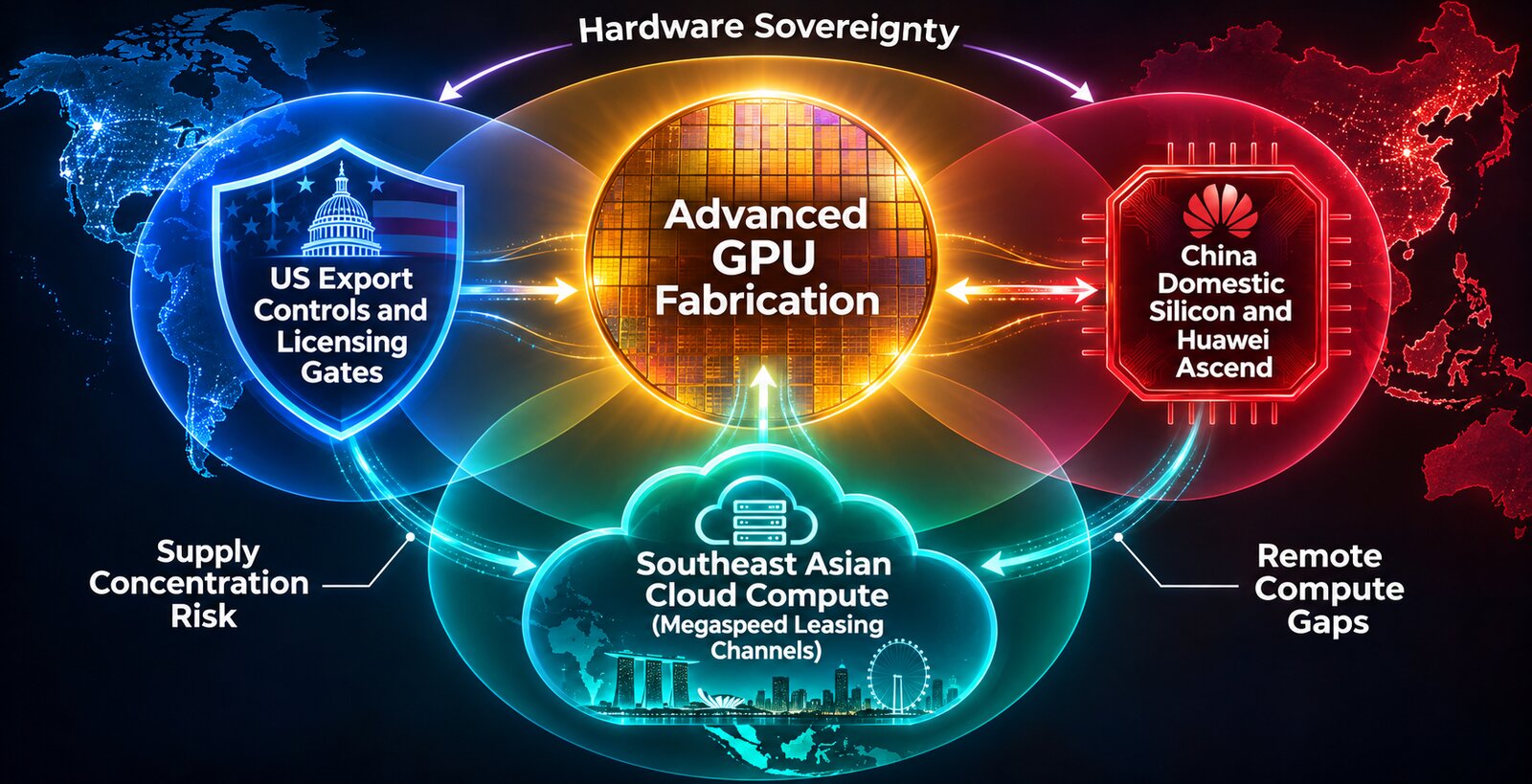
That fragile geopolitical context is why the Alice Huang connection proved so toxic. Did Alice Huang or Megaspeed siphon confidential blueprints, architectural secrets, or strategic allocation forecasts to Beijing? We do not have public evidence proving that trade secrets crossed the Pacific. Nvidia’s board stated on Sunday that it had no reason to believe national security or company secrets were compromised. But in the corridors of power in Washington, the standard of proof is not reasonable doubt. When the chief executive of America’s sovereign AI champion is carrying on an extramarital affair with an executive of a foreign compute-broker suspected of intelligence ties, the national security apparatus does not debate nuance. They demand his removal.
Congressional leaders, including House Foreign Affairs Committee Chairman Brian Mast and Select Committee on China Chairman John Moolenaar, immediately called for closed-door briefings. The board saw the writing on the wall: Nvidia could not maintain its federal contracts, export licenses, and White House access with a compromised founder at the helm.
And yet, Silicon Valley has never been known for moral squeamishness when generational talent hits the waiver wire. Look at how quickly competitors began circling. On Wednesday night, financial blog ZeroHedge posted on X: “Elon please hire Jensen.” A couple of hours later, Elon Musk replied with five words: “That would be an honor.”
Musk’s quip was not a signed employment contract. But it was a glaring signal of how the technology sector really views Jensen Huang. Musk is currently sinking tens of billions of dollars into his Terafab semiconductor venture, custom AI accelerators for Tesla, and massive xAI training clusters. To someone like Musk, Huang’s personal indiscretions and governance failures are irrelevant noise compared to the raw engineering brilliance of the man who engineered modern GPU architecture.
What Stays Behind#
When you build a company so thoroughly in your own image that nobody else can speak without your inflection, what happens when you leave?
Nvidia has issued all the standard corporate assurances. Interim CEO Colette Kress and new board chair Harvey Jones have promised customers, partners, and Wall Street that product roadmaps, shipping schedules, and enterprise commitments will continue without interruption. In the near term, they probably will. Chips that are already taped out at TSMC will be fabricated. Blackwell and Vera Rubin systems will roll off factory lines. Enterprise contracts signed six months ago will be honored.
The rupture will not be felt on the assembly line tomorrow afternoon. It will be felt six months from now, in the rooms where someone has to make the terrifying, non-consensus product calls that made Nvidia great in the first place.
Jensen Huang did not build a three-trillion-dollar empire by following committee consensus. He built it through thirty-three years of obsessive, despotic, high-conviction risk-taking. He drove his engineers to the brink of exhaustion, terrorized competitors, bet the entire farm on CUDA when everyone laughed at him, and personally held the reins of every major customer relationship in the world.
He constructed an empire where only one man was allowed to wield the sword. Now the king is gone, his mistresses have upended the court, and the committee left behind has to figure out how to rule without him.