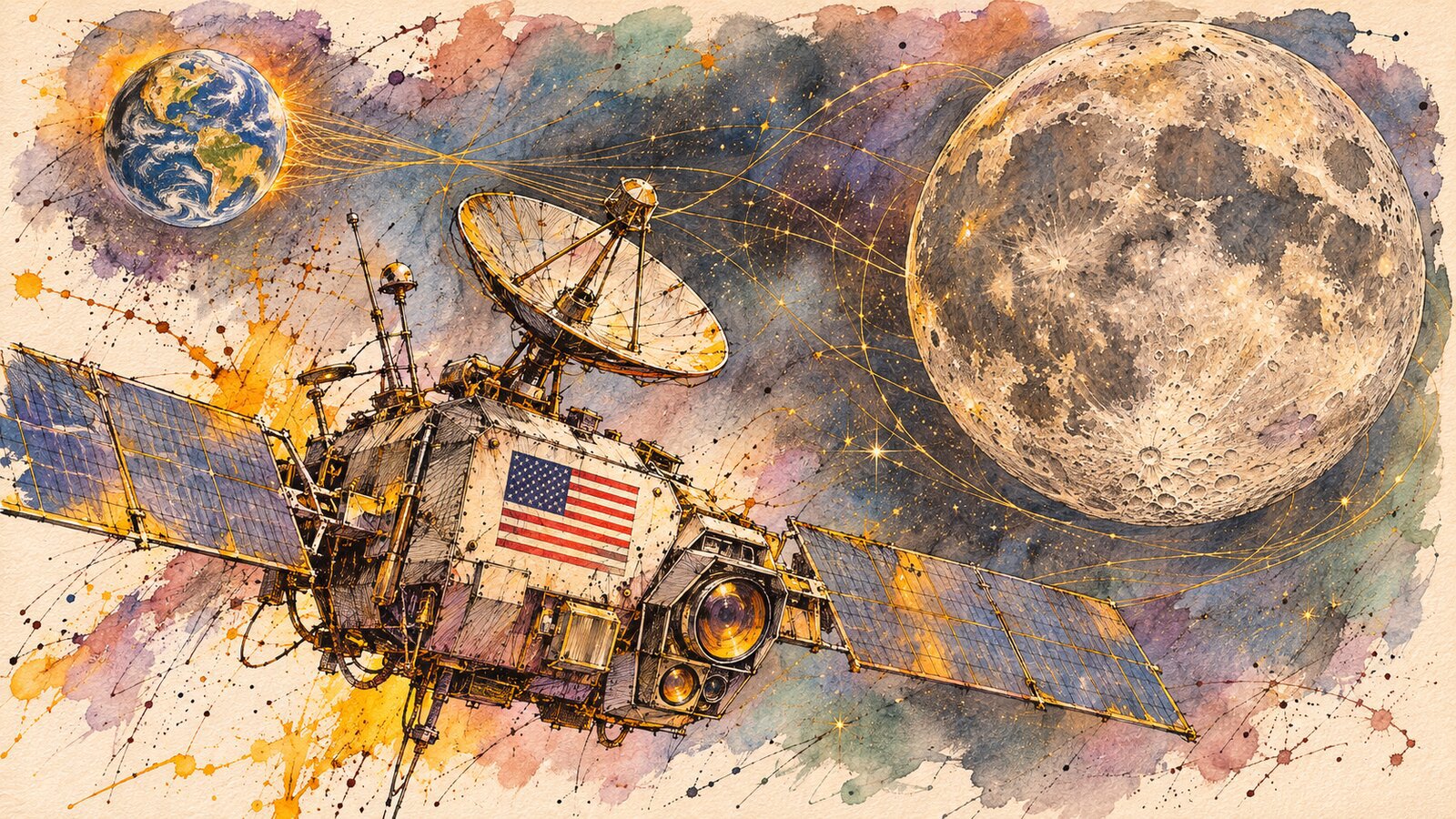
The Department of the Air Force posted a Request for Information on SAM.gov on November 2, quietly sounding out defense contractors on whether industry can deliver up to five military satellites into cislunar space by late 2029.
Ars Technica reported the notice, and the defense commentariat immediately did what it always does: it imagined a ring of armored sentries guarding the Moon. The paperwork itself is much drier, but in some ways more telling. The Air Force describes itself as “notionally interested” in procuring hardware for a Cislunar Space System. Each satellite would carry a government-provided payload, while commercial vendors supply the bus, launch, ground stations, and flight operations. The notice suggests these five initial birds “may serve as seed vehicles that will inform the acquisition strategy for a potential future proliferated cislunar constellation.”
That is procurement-speak for dipping a toe into an ocean of future funding.
The notice does not happen in a vacuum (pun fully intended). In September, Air Force Secretary Troy Meink stood on stage at the Air and Space Forces Association conference and casually confirmed what observers had suspected for years: the Space Force now operates on-orbit space control weapons designed to defend American orbital assets. Meanwhile, the White House has issued space policy directives explicitly commanding the military to detect, characterize, and counter threats across the entire volume of space between Earth and the Moon.
We need to separate the technical reality from the political theater. The RFI does not name the payloads, and nobody outside classified channels can honestly claim these five satellites are weapons platforms. They are almost certainly domain-awareness probes, communications relays, or navigation beacons meant to keep tabs on what China and commercial outfits are doing around the Moon.
That distinction matters, because it splits the core problem into two plain questions: can we maintain a military constellation out there, and will an incoming Congress actually pay for it?
The Orbital Mechanics: Getting There Isn’t the Problem#
If you talk about putting satellites in orbit around Earth, people picture smooth circles. You go fast enough sideways that as gravity pulls you down, the planet curves away beneath you. In low Earth orbit, that circular path is predictable, well behaved, and easy to model.
The space around the Moon is completely different. It is a three-body problem that never stops trying to tear your trajectory apart.
When a spacecraft operates near the Moon, it does not feel a neat, single pull. It sits in a gravitational tug-of-war. Earth pulls on the Moon, but Earth also pulls directly on the spacecraft. Because the distance between the spacecraft and Earth changes as the satellite sweeps along its lunar orbit, Earth’s pull on the craft differs constantly from its pull on the Moon. That difference creates violent gravitational tides. Over weeks and months, those tides twist the orbital plane, stretch circular paths into ellipses, and drive the lowest point of the orbit down toward the lunar dirt.
Get down close to the surface, and the Moon itself makes things worse. The Moon is not a smooth, uniform sphere of rock. It has massive, dense concentrations of cooled basaltic magma sitting beneath its ancient impact basins: features geophysicists call mascons, short for mass concentrations. As a low-flying satellite passes over a mascon, the local gravitational pull spikes sharply downward. Fly a typical circular orbit 50 kilometers above the Moon without intervention, and those uneven gravitational tugs will warp your trajectory so violently that your satellite will smash into the terrain within forty to sixty days.
NASA knows this reality intimately because it spent years wrestling with it on the Lunar Reconnaissance Orbiter (LRO). When LRO was in its primary mapping orbit, flying 50 kilometers above the poles, ground controllers had to fire its thrusters every 28 days just to keep it from diving into a crater. That maintenance burn cycle burned through roughly 143 to 150 meters per second of velocity change (delta-V) every single year. For an operational constellation, burning propellant at that rate is an operational death sentence: your fuel tanks empty, and your satellites crash.
To keep spacecraft alive without hauling massive fuel tankers to deep space, orbital dynamicists rely on mathematical sleight of hand: frozen orbits.
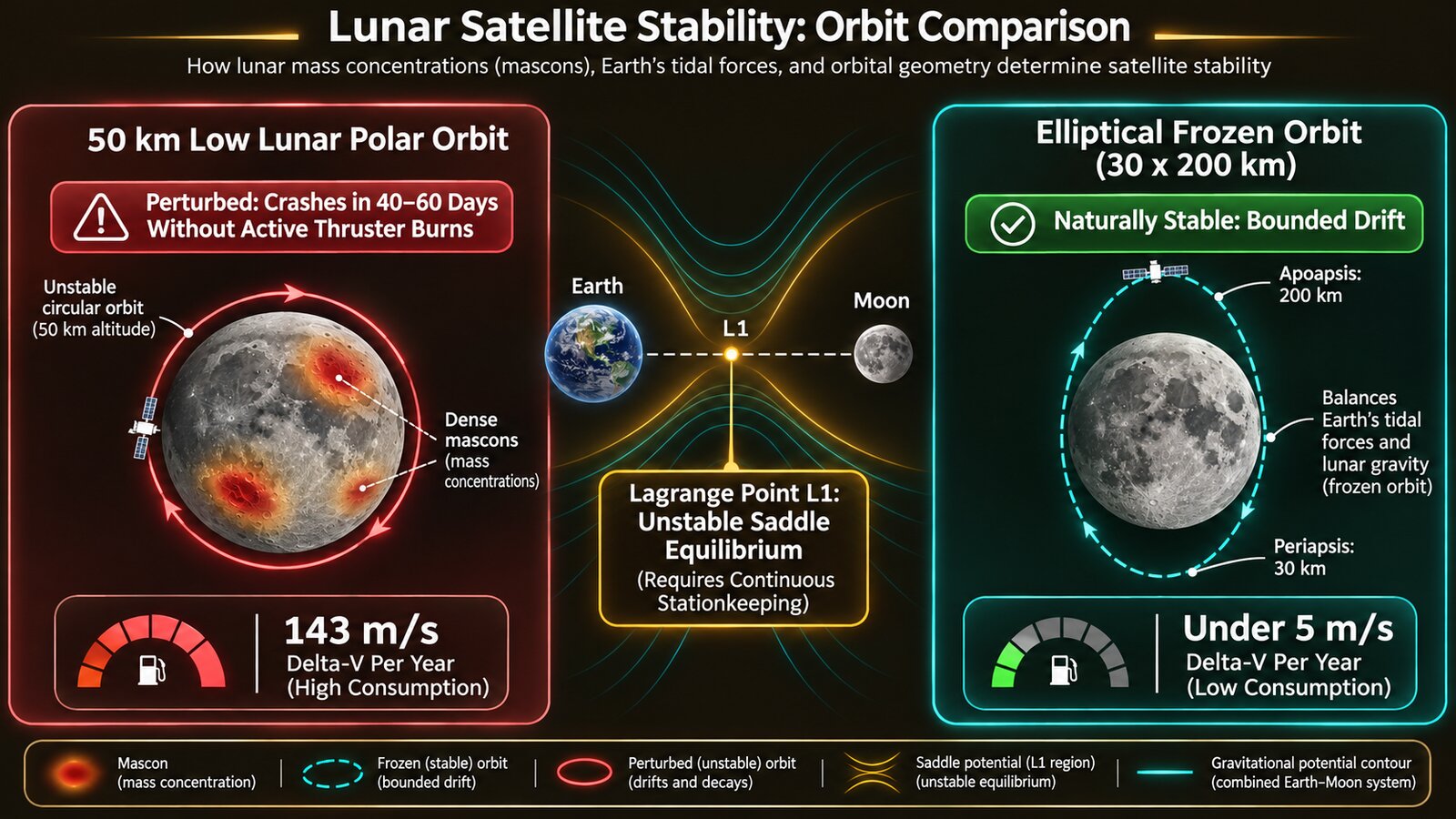
In a frozen orbit, engineers deliberately align the satellite’s altitude, inclination, and orbital orientation so that the gravitational perturbations from the Moon’s mascons, Earth’s tidal pull, and the Sun cancel each other out over time. When NASA transitioned LRO into an elliptical frozen orbit (ranging between roughly 30 and 200 kilometers altitude), its annual fuel requirement collapsed from 143 meters per second down to less than 5 meters per second per year. That is the difference between running out of gas in two years and operating for over a decade.
Move farther out, away from the Moon’s immediate gravitational sphere, and you run into the Lagrange points: spots where the gravitational pull of Earth and the Moon combine with orbital centrifugal effects to create equilibrium zones. But popular accounts often stumble here. The Ars Technica report casually described Earth-Moon Lagrange Point 1 (L1), sitting roughly three-quarters of the way to the Moon, as a “gravitationally stable location.”
It is not. L1, L2, and L3 are saddle points: mathematically unstable equilibria. Parking a spacecraft at Earth-Moon L1 is not like dropping an anchor in a calm harbor; it is like balancing a marble on the peak of a curved bowling ball. If you drift even slightly off the saddle, the combined gravitational field pulls you away. Flying a halo orbit or a quasi-periodic trajectory around L1 does not demand continuous engine burns, but it does require regular stationkeeping maneuvers to manage drift before the trajectory diverges.
The engineering takeaway is clear: keeping satellites alive in cislunar space is mathematically intricate, but it is not magic. NASA, the Chinese space agency, and private operators have proved the math. The real operational headache for the Pentagon isn’t keeping a single bird alive; it is keeping up to five spacecraft phased, synchronized, and continuously communicating with ground networks while managing line-of-sight dropouts behind the lunar limb.
The X-37B and the Cislunar Shadow#
While the Air Force drafts RFIs for lunar satellite buses, the Space Force’s most interesting hardware is already testing deep-space operating concepts.
Boeing’s X-37B Orbital Test Vehicle has become the Swiss Army knife of military space experimentation. The uncrewed spaceplane has logged thousands of days in orbit across eight missions, with its sixth flight alone stretching to 908 consecutive days aloft. It changes orbital planes, maneuvers autonomously, and returns to Earth on a runway whenever the Pentagon decides the experiment is over.
What matters right now isn’t the spaceplane’s thermal tiles or its payload bay doors. It is the payload sitting inside its eighth mission, launched in August 2025.
OTV-8 is flying two explicit technologies that point straight toward deep space: high-bandwidth inter-satellite laser communications and a spaceborne quantum inertial navigation sensor. When the Space Force announced the mission, Space Delta 9 leadership connected the dots: quantum inertial sensing is designed to guarantee precise navigation and maneuver in environments where terrestrial signals cannot be taken for granted. To be clear, Earth’s navigation signals do reach lunar distances: NASA and the Italian Space Agency proved that in early 2025 when their LuGRE experiment on Firefly’s Blue Ghost 1 lander achieved the first GPS and Galileo fixes on the lunar surface. But deep-space military operations cannot assume the luxury of ordinary, high-gain, Earth-style GPS coverage with comfortable signal geometry. Autonomous quantum inertial navigation provides drift-free positioning when external radio fixes are degraded, jammed, or unavailable.
If you were designing a military platform to operate across the lunar neighborhood, you would not build a winged glider. Wings and aerodynamic rudders are dead weight once you leave Earth’s upper atmosphere behind. But you would steal the X-37B’s operational soul: extreme endurance, long-duration autonomous stationkeeping, agile maneuverability, and modular payload bays that let you swap mission gear between operational deployments.

Picture what that looks like in practice: a high-end bus carrying multi-spectral optical cameras, passive radio-frequency snooping arrays, autonomous trajectory engines that track friendly and adversarial traffic without human ground commands, and high-speed optical laser crosslinks that route data back to Earth through a mesh network.
Now ask the uncomfortable question that follows: where does passive inspection stop and active interference begin?
If an autonomous spacecraft has the delta-V, the sensors, and the navigation precision required to match orbits with an uncooperative satellite in deep space, verify its hardware, and loiter fifty meters away, that spacecraft is functionally an escort weapon. It does not need to fire an explosive warhead. It can jam a receiver, dazzle an optical sensor with a directed laser diode, or simply maneuver into a position that blocks a high-gain communications antenna from pointing back at Earth.
In space domain awareness, inspection and interdiction are two sides of the exact same coin. The only difference is intent.
The High Ground Trap: Can You Snipe from the Moon?#
Whenever military planners look at a higher orbit, their first instinct is to treat it like a mountaintop. In terrestrial warfare, if you hold the high ground, you can see farther and rain artillery down on the valley while the enemy struggles to shoot uphill.
That intuition has spawned a recurring thought experiment: could a military platform parked near the Moon serve as an untouchable sniper, threatening satellites in geostationary orbit while remaining safe from Earth-based retaliation?
The Aerospace Corporation dug into this question in its analytical study High Ground or High Fantasy: Defense Utility of Cislunar Space, pitting analysts against each other over whether the Moon actually offers tactical leverage. The physics delivers a blunt verdict: distance cuts both ways, and in orbital warfare, distance imposes severe operational penalties.
First, consider a kinetic interceptor launched from cislunar space toward geostationary orbit. An object falling toward Earth from nearly 400,000 kilometers away does not move in a straight line. It follows Kepler’s laws. On a minimum-energy transfer trajectory, the transit time from lunar distance down to GEO takes roughly three to five days; even on an aggressive, highly energetic burn that burns immense propellant mass, travel time is measured in multiple days rather than minutes. Over a multi-day descent, space surveillance networks on Earth have substantial time to detect the release, calculate the trajectory, and cue target satellites to execute modest evasion maneuvers. In space, evasion burns are cheap, and a kinetic interceptor whose transit takes days gives the defense an enormous reaction window.
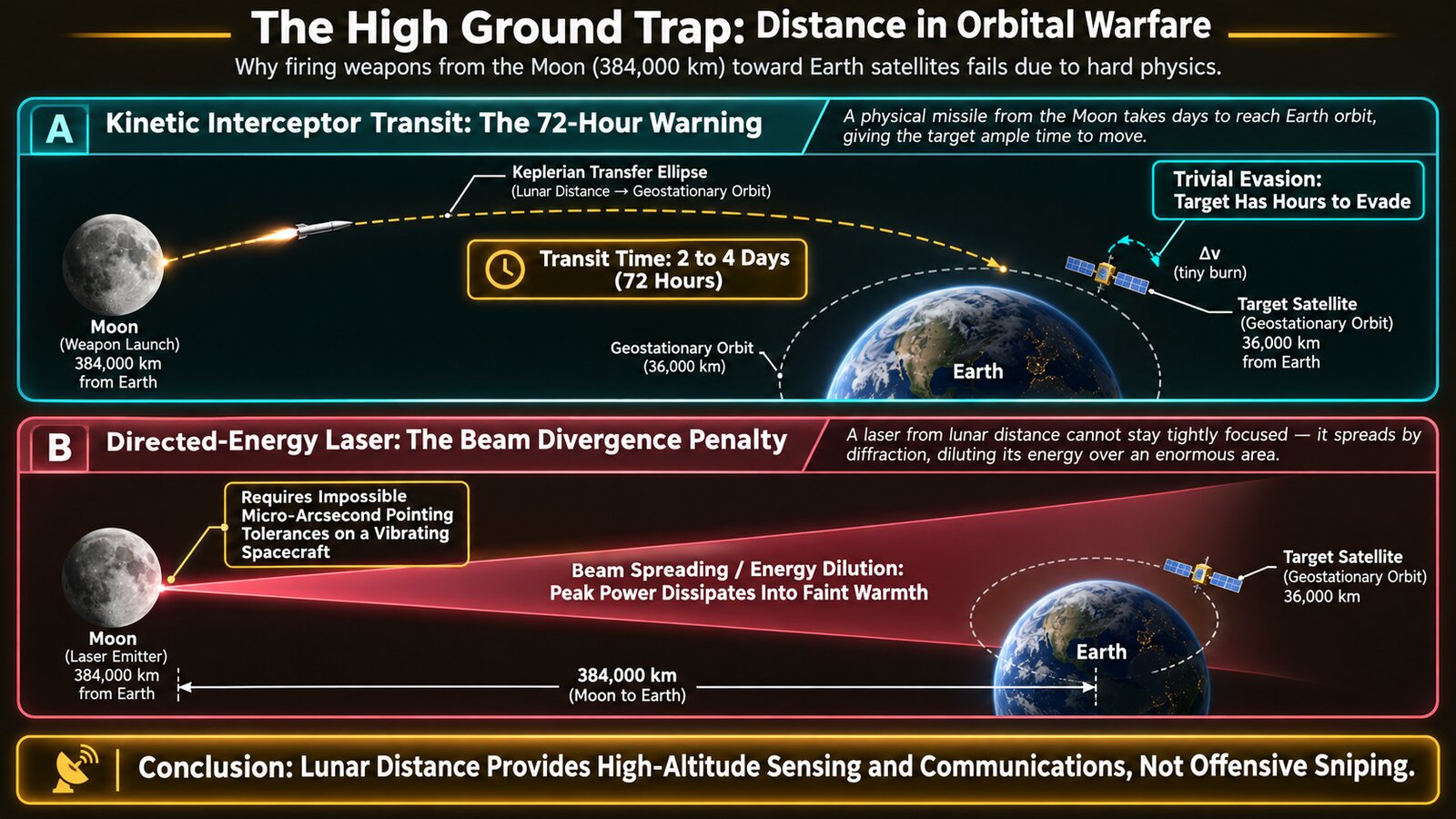
Directed-energy weapons face equally unforgiving constraints. If you fire a laser across cislunar distances toward Earth orbit, physics imposes diffraction: beam divergence scales directly with wavelength and distance, and inverts with aperture size. Over hundreds of thousands of kilometers, even a high-energy optical beam spreads across a broad footprint. Delivering destructive thermal fluence at that range would require massive optical apertures and pointing stability measured in fractional micro-arcseconds, all while maintaining beam control on an operational, maneuvering spacecraft. Shorter pulses or sensor-dazzling effects might require lower energy thresholds than structural destruction, but keeping tight optical custody across hundreds of thousands of kilometers remains an immense technical burden compared to engaging from nearby orbital planes.
If a military platform near the Moon threatens anything closer to Earth, it won’t be through direct kinetic bombardment. It will be through sensing and communications: intercepting transmissions, tracking deep-space trajectories, and serving as a high-altitude lookout.
Treating the Moon as the ultimate combat redoubt isn’t sound military doctrine. It is science-fiction nostalgia masquerading as strategy.
Back on Earth: Who Pays for the Bandwagon?#
When Major General Stephen Purdy, the Space Force’s acquisitions chief for advanced programs, spoke to defense contractors at Space Systems Command’s Industry Days, he did not sugarcoat the service’s recruitment problem: “Please jump on my cislunar bandwagon because I need some more friends here.”
That quote reveals the fundamental vulnerability of the whole enterprise: the Pentagon’s cislunar expansion is an ambition in search of a constituency.
The indicative schedule published in the RFI targets seed-vehicle readiness in late 2029 and initial operational capability around 2031. That calendar pushes the operational phase of the program well beyond the current administration. And back on Earth, the political landscape just shifted under the Pentagon’s feet.
With incoming Democratic majorities preparing to take control of Congress in January 2027, the defense budget is about to encounter a level of scrutiny that ungrounded military space concepts have not faced in years.

Consider how key lawmakers have treated the administration’s other high-profile orbital defense concepts. Senator Mark Kelly has repeatedly challenged space-based interceptor proposals during Senate Armed Services Committee hearings, pointing out that space-based weapons layers face crushing physics hurdles, cost imbalances, and the unavoidable reality that countermeasures are vastly cheaper than orbital interceptors. When a Navy combat veteran, test pilot, and former NASA astronaut tells the Pentagon Comptroller that the physics of space interceptors “does not support a full-scale architecture,” that skepticism carries weight across the aisle.
On the appropriations side, Senator Ed Markey and his colleagues have demanded binding cost caps on sprawling orbital initiatives, introducing amendments requiring complete lifecycle cost estimates, independent National Academy of Sciences reviews, and formal presidential certifications that expanded orbital deployments will not ignite an unconstrained arms race with Russia and China.
None of those congressional challenges were directed specifically at the cislunar RFI, but they establish the exact lines of questioning the Air Force will face when this preliminary market research attempts to graduate into a funded program of record: What is the concrete mission? What does each satellite cost? How much will it cost to launch, replace, and operate them across a twenty-year lifecycle?
Congress has supported strategic lunar investments when the civil and technological mission is clear. Senator Maria Cantwell has consistently backed strategic lunar investments, particularly for NASA’s Artemis program, the Lunar Gateway, and advanced communications and time-synchronization standards. The Biden administration’s own 2022 National Cislunar Science and Technology Strategy made the case for civil space domain awareness, positioning, and environmental monitoring.
There is genuine, bipartisan support on Capitol Hill for scientific exploration, resource mapping, and civilian navigation networks. But there is a massive gulf between funding civil waystations and writing a blank check for an open-ended military constellation whose operational mission the Pentagon refuses to explain.
Possible Is Not an Argument#
The Department of the Air Force’s RFI is a classic piece of bureaucratic exploratory scouting. It tests whether aerospace contractors can build small, standardized spacecraft buses capable of surviving the thermal, radiation, and gravitational realities of cislunar space on commercial timelines.
The engineers can do it. Between frozen orbital paths, electric propulsion, and autonomous navigation architectures inherited from programs like the X-37B, building a small satellite constellation that stays alive around the Moon is entirely feasible.
But technical feasibility is not a justification for a multi-billion-dollar military procurement.
Before the Air Force can turn “notionally interested” into line-item appropriations, it has to answer the questions it left blank in SAM.gov: What specific threats are these five satellites built to deter? Why does the Space Force need dedicated military assets in cislunar space when civil agencies already operate shared tracking networks? And why should American taxpayers finance a permanent military outpost around the Moon when our most critical satellites in low and geostationary orbit remain vulnerable to terrestrial electronic warfare, anti-satellite missiles, and cyber disruption?
With an incoming Congress looking hard at federal spending and demanding rigorous accounting on high-priced defense initiatives, an uncosted, incompletely justified constellation is going to be a very hard sell.
Holding the high ground sounds clean on a briefing slide. Paying for it across three administrations is where reality begins.