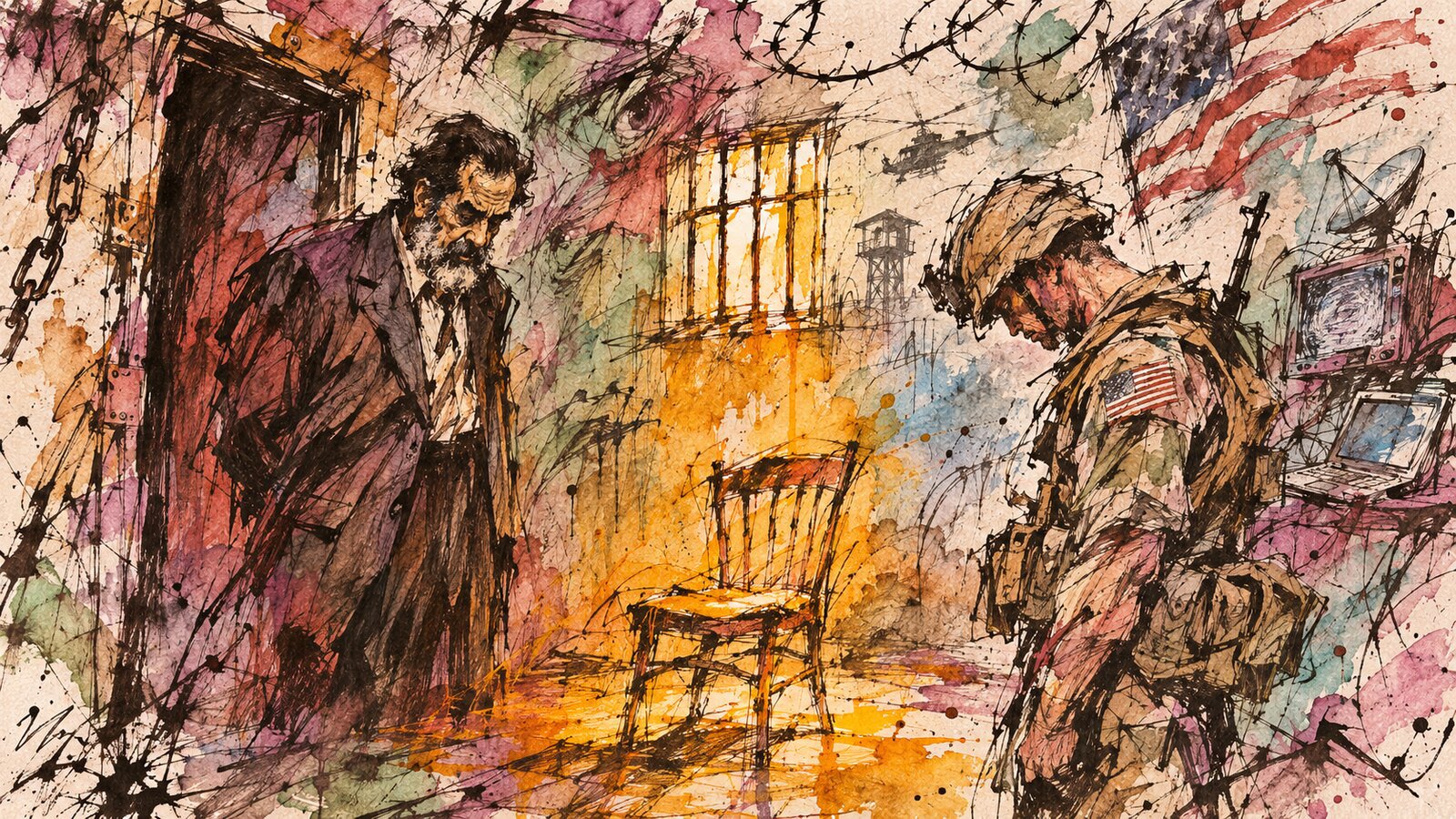
“Just before he walked into the death house he turned around and said goodbye, and said that we were all his friends,” Specialist Adam Rogerson recalled. “Some of us were crying and he was sad.”
The words come from a retrospective interview with Wisconsin Public Radio’s To the Best of Our Knowledge, describing an unexpected parting before Saddam Hussein’s execution on December 30, 2006. In that memory, an American soldier recalled feeling grief for the captive dictator he had been assigned to protect.
Rogerson had spent months watching Saddam, and when the assignment ended at the gallows door, the emotional boundary collapsed. A soldier could find the end of his custodial assignment personally devastating, even while carrying out his orders to the letter.
The crimes behind the sentence#
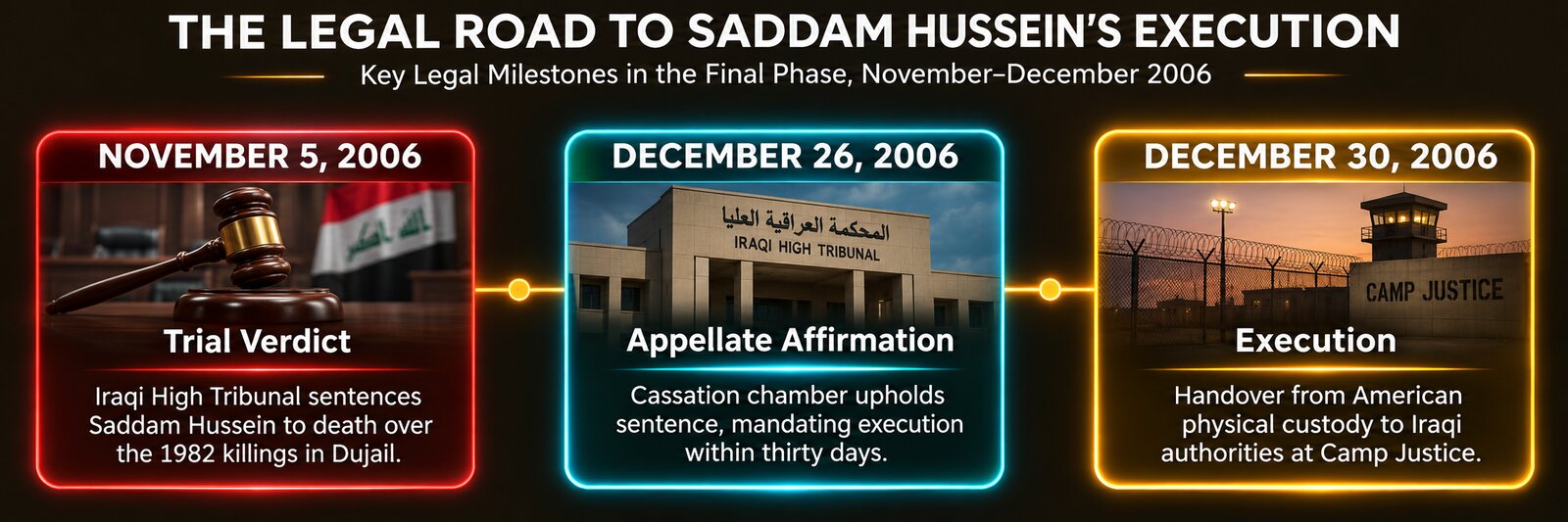
The execution followed a specific prosecution, not a completed judicial accounting of Saddam’s decades in power. On November 5, 2006, the Iraqi High Tribunal sentenced Saddam and two co-defendants to death over the killing of 148 men and boys from the town of Dujail following a 1982 assassination attempt. An appellate chamber affirmed the sentence on December 26, according to Human Rights Watch.
In Judging Dujail, a monitoring report on the tribunal’s first trial, Human Rights Watch documented serious fair-trial flaws, including political interference and failures to protect defense rights. For human rights observers, criticizing the proceedings reflected the principle that legal accountability requires due process.
At his death, Saddam was also on trial for genocide over the 1988 Anfal campaign against Iraqi Kurds. Human Rights Watch warned that an immediate execution would permanently truncate that trial. His death brought a formal end to his own prosecution before a verdict could be reached, while proceedings against other defendants continued.
A duty to protect#
In a 2017 NPR interview, author Will Bardenwerper recounted the assignment of the 12 soldiers from the Army’s 101st Airborne Division who guarded Saddam. By the execution, Bardenwerper said, they had been there for “four months or so.” Bardenwerper’s book, The Prisoner in His Palace, traced the daily interactions and psychological tensions that developed during that confinement.
Rogerson later stated he was willing to lay down his life for Saddam while on duty. The statement captured how deeply he threw himself into the custodial mission.
Protecting a detainee from outside harm required disciplined vigilance. Feeling sorrow at an impending execution did not mean forgiving state terror. Rogerson’s testimony remains striking because it leaves those realities standing side by side without forcing them into a tidy moral resolution.
Other details of Saddam’s final morning emerged through later reporting. In a March 27, 2008 CNN report, Marine Maj. Gen. Doug Stone described the cell where Saddam spent his last period of detention, noting that on the morning of December 30, Saddam bathed and wore his familiar dark suit. Citing notes kept by guards, CNN also reported that Saddam asked that his personal effects be passed to his lawyer and requested a final message be delivered to his daughter.
A separate dispute over timing#
While the soldiers carried out their watch, American and Iraqi officials engaged in contentious procedural debates over the execution’s timing and documentation.
Shortly after the hanging, CNN reported, citing an unnamed Iraqi lawmaker close to Prime Minister Nuri al-Maliki, that a senior U.S. official had suggested postponing the execution by up to two weeks. Separately, Iraqi National Security Adviser Mowaffak al-Rubaie told CBS News that American authorities had urged caution regarding paperwork, including whether formal presidential approval was required.
The formal division of authority was explicitly defined. An official U.S. military statement emphasized that the Iraqi government held legal custody of Saddam, while American forces maintained physical custody of the prisoner until the handover.
Al-Rubaie told CNN that the execution was “an Iraqi operation from A to Z.” Americans were not present at the execution.
What the farewell left behind#
The emotional resonance of the account rests on Rogerson’s candid reckoning with his role: “You know, though I wasn’t the one who dropped the floor out, sometimes I feel like I did.”
His words describe the difficulty of separating the end of a custodial duty from the death that followed. They remain one soldier’s personal memory of what it meant to walk a dictator to the door of the gallows.