
I’ve been looking for a job for a while. The market has been volatile, and being highly qualified to lead AI transformation hasn’t made the search a short one.
Alongside the job search, I’m exploring regrowing my consultancy and sticking a toe into Raleigh’s startup scene.
Today I attended BUILT HERE’s “Built on an Idea,” with Sarah Davis and Shruti Shah. I’m showing up to learn from people with experience building companies, and to think about what building one might look like for me.
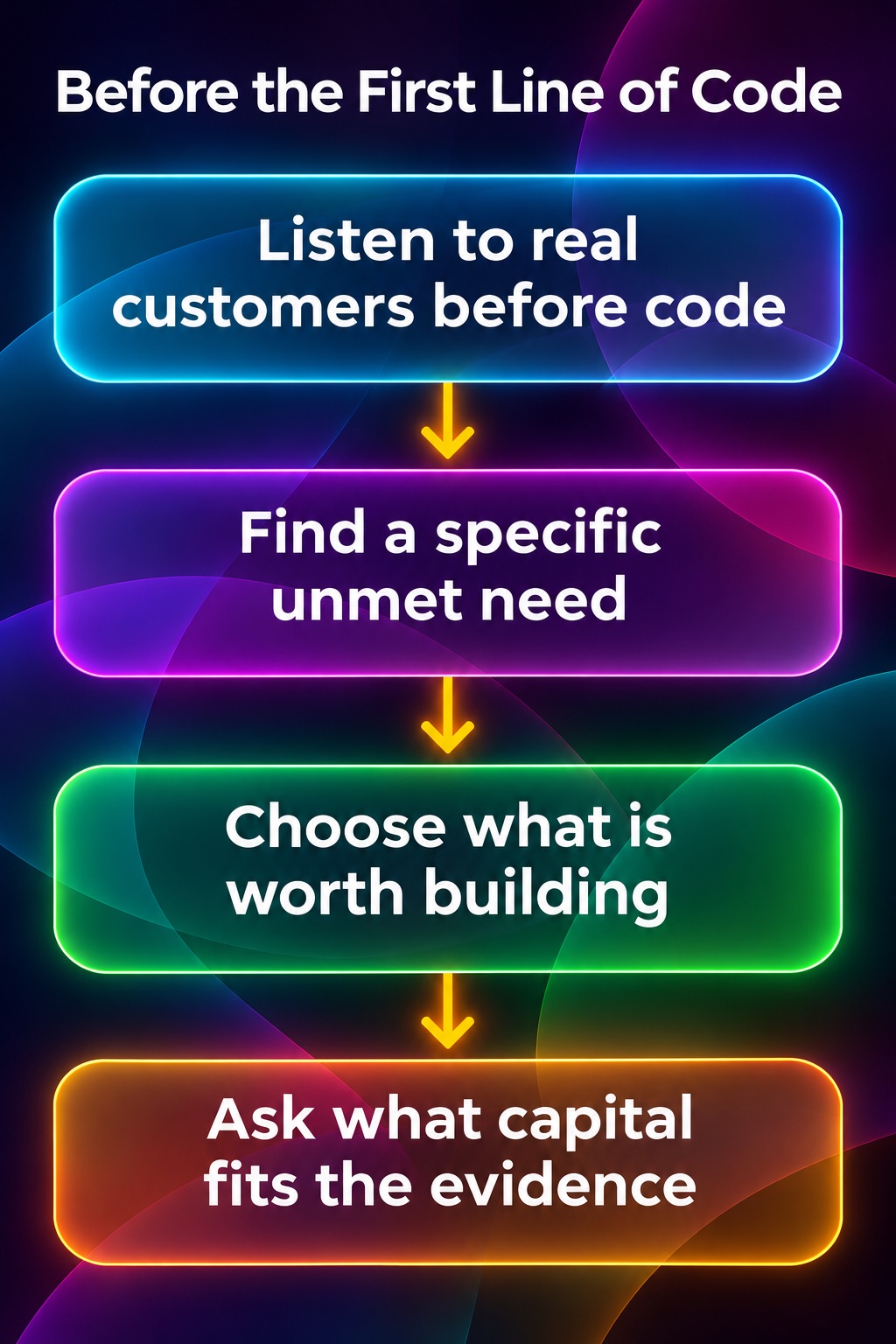
The event’s description focuses on what happens before the first line of code: listening to customers, finding a specific gap, and using feedback to decide what deserves to be built. That’s a useful place to start when the tools make it so tempting to skip ahead and build.
What would make a company worth building?#
I’ve explored small teams and the discipline of doing less, and what can replace some of the work we expect capital to do. At Groktopus, I’ve also written about the limits of keeping a company tiny. Those questions have a more personal application now.
AI can reduce some of the work and cost of getting an idea into a form someone can try. It creates room to test a smaller business with a smaller team. But faster building doesn’t tell you whether anyone needs the thing, will pay for it, or will keep paying. Support, reliability, and the cost of serving customers still count.
Customer discovery matters more when it’s easy to build the wrong thing quickly. Before getting carried away with a platform, I’d want to understand the problem well enough to know what I could leave out.
Venture capital can be a choice#
A customer-funded company isn’t a new invention. Tally’s founders report a team of ten and $6 million in annual recurring revenue, funded by customers. That’s revenue, not profit. 1Password’s cofounder described fourteen profitable, self-funded years before taking a minority investment from Accel. Neither example proves that AI caused the business to succeed. Both show that raising venture capital doesn’t have to be the first move.
The possibility I’m considering is a company designed to become profitable from serving customers, with venture capital as an option to consider later. Having paying customers and a sustainable business could provide more room to choose whether, when, and why to raise. It wouldn’t let me dictate every term, and getting there would still be hard.
For now, I’m looking for a job, exploring my consultancy, and learning what I can from the people building companies around Raleigh. I don’t have to settle the whole question before I start learning.
But it’s a question worth taking seriously: should I build the company I want to work for?