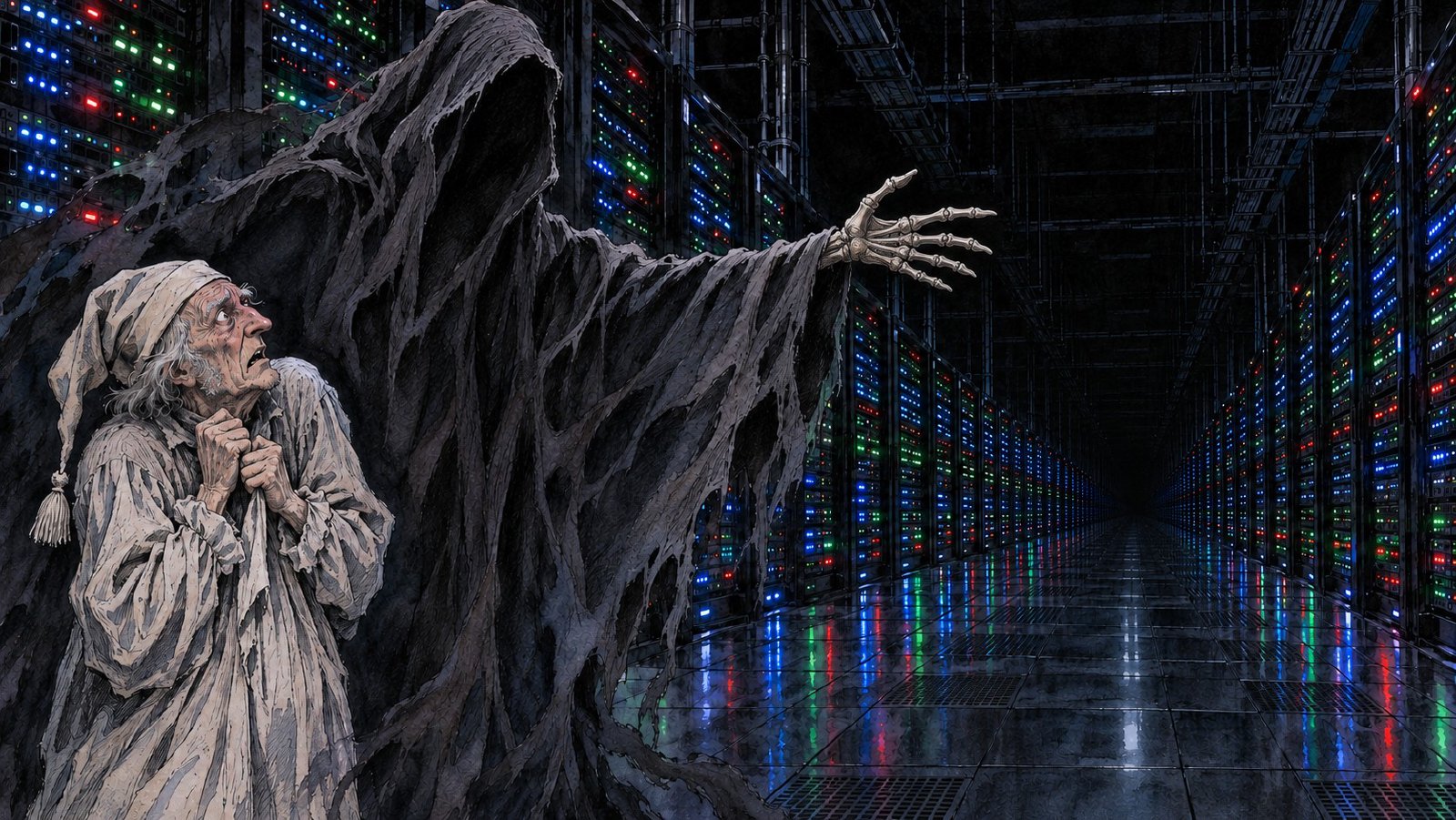
Suppose the breakthrough actually happens.
Suppose that five years from now, in 2031, AI coding agents are no longer fickle assistants that hallucinate package names or drop security checks. Suppose they can reliably scaffold distributed architectures, generate rock-solid regression suites, migrate legacy databases, and deploy immutable infrastructure with verified formal proofs.
If the machines take on the overwhelming mechanical burden of writing code, what should happen to the humans who build software?
The standard corporate answer is predictable: more output. Shorter sprints, higher ticket velocity, leaner headcount, and an endless conveyor belt of features that nobody asked for.
But what if we refused that premise? What if the true promise of automating mechanical drudgery was not to turn humans into high-speed ticket processors, but to return time, agency, judgment, and wonder to the people doing the work?
In Part I of this series, we saw how sixty years of factory metaphors crashed into the messy reality of human discovery. In Part II, we saw how today’s AI software factories are caught in a tug-of-war between autonomous pipelines and human oversight.
Now, we look forward. The rate of technological acceleration is so dizzying that predicting the exact tooling of 2031 is impossible. But the philosophical choices before us are already clear. We are standing at a crossroads with three wildly different futures.
The tools will be different in 2031. The practice will be different too, and it should be. Our capabilities are changing, and methodology is supposed to follow them. What should not change is what we hold important. The values this industry earned over sixty years do not care what generated the code. They are the part that travels with us, and the part we actually get to choose.
Path One: The Dark Factory and the Code Slum#
In the first future, Taylorism wins its ultimate victory.
In this world, management buys completely into the fantasy of the unattended, Level 5 software factory. Autonomous agent swarms ingest high-level business goals, scaffold architectures, write code, run verification suites, and deploy directly into production without human intervention. As StrongDM envisions in their radical manifesto, humans neither write code nor review pull requests; automated test harnesses and synthetic verifiers manage the entire line.
Because generating and shipping code has become virtually free, software systems balloon to monstrous proportions. Monolithic microservice topologies become so vast and tangled that no single human mind understands how data flows across the enterprise. The synthetic verification harnesses confirm that every pull request passes its unit tests and adheres to declared invariants, but no one is asking whether the system as a whole makes coherent sense.
When a catastrophic edge case inevitably slips past the automated gates and crashes critical infrastructure, the organization discovers a terrifying vacuum: there is no one left who understands how the underlying protocols work, and no one with the deep systems intuition required to intervene.
In this dark factory, human engineers have not been freed to innovate; they have been entirely alienated from the craft. Disconnected from the code and stripped of operational context, they are reduced to high-stress incident responders and prompt clerks, spending their days steering and checking autonomous agents rather than mastering architecture. Junior engineers, denied the formative struggle of building and debugging systems, face severe learning decay and comprehension loss, creating a permanent generational knowledge void. This is the dark factory: an environment of frantic, unceasing velocity where software output is maximized, human understanding is lost, and the software becomes an unmaintainable slum.
Path Two: The Living Organism and Disposable Software#
There is a second, far more radical future: what if the very concept of permanent software disappears?
For fifty years, software has been built like civil engineering monuments: massive, brittle codebases designed to be maintained, refactored, and patched over decades. We built them that way because writing code was painfully expensive.
When generating verified code becomes virtually free, software does not have to be a permanent monument. It can become an ephemeral, living organism.
Imagine a world where software is hyper-bespoke and disposable. You do not buy a massive, bloated enterprise SaaS with ten thousand features you never touch. Instead, an agent synthesizes a lightweight, tailored tool specifically for your exact workflow, runs it for three days to solve your problem, and dissolves it when the job is done.
In this future, software shifts from rigid industrial assembly to something resembling biological tissue: adaptive, localized, resilient, and verified by formal mathematical invariants rather than manual regression testing. The engineering challenge shifts entirely from writing syntax to designing specifications, defining system boundaries, and governing the ecological interactions between autonomous systems.
Path Three: The Human Workshop and the Engineering Renaissance#
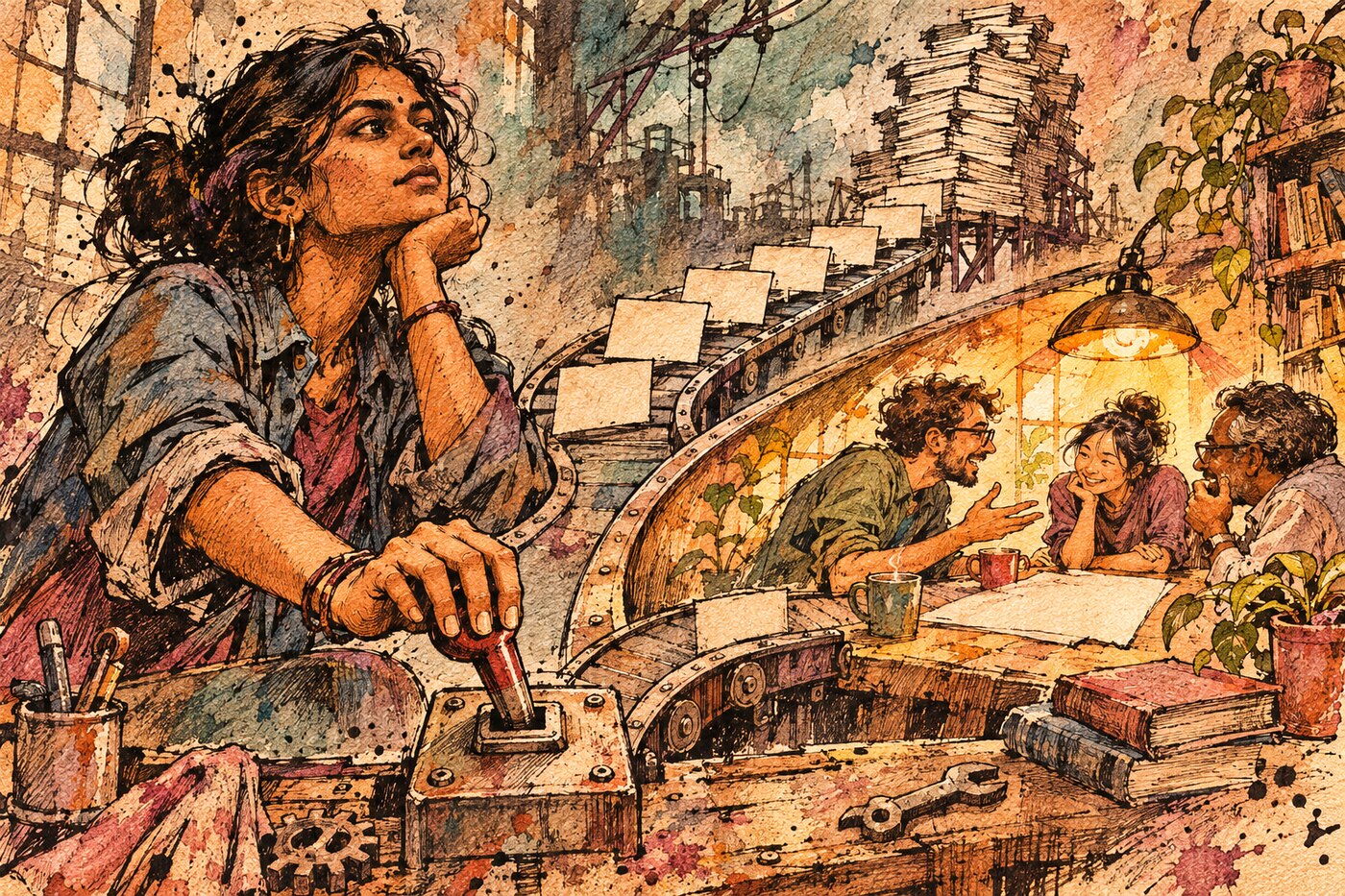
And then there is a third path: the future where we actually take the time back.
In this future, we remember the core truth that the Agile Manifesto articulated in 2001: that software is fundamentally about individuals, interactions, customer collaboration, and responding to human change.
If agents handle routine boilerplate, migrations, and regression tests, we do not simply raise the sprint quota. We redirect recovered human capacity toward the things machines can never do:
- Deep Customer Discovery: Instead of rushing to build features from half-baked Jira tickets, engineers spend days sitting with doctors, teachers, operators, and customers, discovering the subtle, unarticulated human problems that actually need solving. As McGee and Greer proved, the deepest requirements are only discovered through the human process of building and learning.
- Architectural Elegance and Resilience: Engineers spend their cognitive energy crafting simple, robust, secure architectures that last, stripping away accidental complexity rather than piling on more code.
- Interdisciplinary Invention: Freed from the syntax treadmill, software practitioners cross pollinate with biology, material science, civic governance, art, and philosophy, inventing entirely new categories of human-empowering technology.
- Restoring Mentorship: Senior engineers have the spaciousness to sit with junior developers, overcoming the agency tensions and mentorship deficits identified in recent CHI research to teach systems thinking, operational ethics, and the craft of problem formulation.
As Toyota proved in its production system, true operational excellence does not come from treating people as costs to be minimized; it comes from investing in their capacity to learn, improve, and innovate. In their classic Harvard and MIT study, Spear and Bowen showed that Toyota treated production standards not as rigid dogmas, but as testable hypotheses that workers continuously revised.
Empirical research in software confirms this exact balance: Sarma Nidumolu’s 64-project study and field studies of 46 software firms demonstrate that standardization stabilizes execution, but product success requires keeping the human discovery loop wide open.
As Toyota proved in its foundational philosophy, operational systems thrive only when continuous learning is built into the culture. While modern probabilistic agents can now formulate hypotheses and optimize their own code, machines still cannot decide what is worth optimizing for. Only humans can define what makes a life better, what constitutes genuine justice, and which trade-offs are worth making. And as DORA’s guidance for generative AI recommends, sustainable innovation requires psychological safety, continuous learning, and focusing on human outcomes over vanity metrics.
Four Essential Tests for a Humane Software Future#
We do not have to leave this future to chance. We can evaluate every AI platform, architecture, and management strategy against four essential tests:
1. The Andon Cord Test (Authority and Safety)#
In the Toyota Production System, the Andon cord was a literal physical rope that hung above every workstation on the assembly line. In Western auto plants at the time, stopping the line was practically a firing offense: you kept the conveyor moving no matter what, even if you were bolting parts onto a broken chassis. Toyota did something revolutionary: they gave every single worker on the floor, from master technicians to first-day apprentices, the absolute authority and duty to yank that cord and halt the entire factory the moment they spotted a defect or an anomaly. A chime sounded, a light board flashed, and the whole line stopped until the team solved the root cause.
In an AI software factory, where autonomous agents can scaffold architectures, generate tests, and deploy code at blistering speed, the Andon cord is the most critical safety device we have. The Andon Cord Test asks: does the person on the ground have the tooling, the cultural backing, and the frictionless authority to pull the cord and stop the autonomous pipeline? Can an engineer say, “Wait, this prompt misunderstood the business context,” or “This synthetic PR introduces a subtle architectural vulnerability,” and halt the automated rollout without being accused of hurting the team’s velocity metrics? As the Tandem Manifesto insists, human context is scarce and precious, and agents must stop and escalate whenever they encounter consequential ambiguity. A software factory without an Andon cord is not a modern production system; it is just a runaway train shipping hidden bugs at lightspeed.
2. The Comprehension Dilemma (Do We Even Need to Understand the Code?)#
For six decades, software engineering orthodoxy has held that human comprehension is an unbreakable law: if humans do not understand every line, module, and data flow in a codebase, the system is deemed unmaintainable technical debt.
Yet as we move toward true software factories, we have to openly question the question: How much do humans actually need to comprehend?
We don’t know the answer yet, but the question itself is worth sitting with. When we compile high-level code, we don’t inspect the assembly or the microcode running inside the silicon. If a Level 5 software factory can generate code, formally prove it against rigorous behavioral invariants, diagnose regressions, and even synthesize disposable tools on demand, does a human engineer need to read the implementation syntax any more than a driver needs to understand the microsecond fuel-injection timings calculated by an engine control unit?
As early DORA research observed, attempting to manually audit every synthetic line creates an unsustainable cognitive burden. But is relinquishing comprehension a dangerous hubris? What happens when an enterprise relies on millions of lines of synthetic architecture that mathematically satisfy their tests, but no human on earth understands the system when real-world reality collides with an unstated assumption? The choice between demanding line-by-line human mental models and treating code as a disposable, verified artifact is the deepest architectural fork in the road today.
3. The Apprenticeship Test (Generational Craft and Judgment)#
If agents handle the boilerplate, the initial scaffolding, and the routine bug fixes, how do early-career engineers build the mental models required to become the senior systems architects of tomorrow?
Software mastery has always been an apprenticeship craft: you learn system design by wrestling with edge cases, breaking production, and fixing your own messy mistakes. As recent research on AI assistance demonstrates, developers who rely entirely on AI delegation rather than active problem solving suffer steep comprehension declines. If we turn junior developers into passive prompt-clerks who simply accept synthetic code, we risk creating a catastrophic generational knowledge void. The Apprenticeship Test asks: does our factory design deliberately carve out space for junior engineers to struggle with system design, build deep intuition, and receive human mentorship, or are we consuming our own seed corn for the sake of quarterly ticket velocity?
4. The Dividend Test (Recovered Time vs. The Treadmill)#
When an autonomous software factory eliminates thousands of hours of mechanical labor, who receives the dividend?
The default corporate instinct is to turn productivity gains into a faster hamster wheel: higher ticket quotas, compressed deadlines, leaner teams, and an endless conveyor belt of features. But as a 2026 CHIWORK study of workplace tasks proved, workers eagerly delegate meaningless boilerplate while fiercely wanting to retain control over consequential decisions that require empathy, context, and judgment.
The Dividend Test asks: does recovered capacity flow back to the humans who build the software? Are engineers given the spaciousness to sit with real users, understand deep unarticulated problems, craft elegant architectures, and live balanced lives? Or is the time swallowed whole by an accelerating machine?
None of these tests is an abstract academic debate. Each one is a value we already wrote down in the past, asked of a new machine: stop the line when something is wrong, respect human understanding, protect the people who make the thing, and share what the machine gives back.
Groundhog Day Ends When We Choose#
The metaphor of Groundhog Day is instructive. In the film, Phil Connors is trapped in an infinite loop not because of some cosmic malice, but because he keeps trying to manipulate the day for his own selfish convenience. The loop only breaks when he stops treating the town as a game to be optimized and starts caring deeply about the human beings around him.
The technology industry has been trapped in its own software factory loop since 1968. Every few decades, a new wave of industrial abstraction promises to make software development mechanical, frictionless, and human-free.
The values from the past don’t have an expiration date. “Individuals and interactions over processes and tools” was never meant to expire once the tools get clever. “Respect for people” doesn’t stop mattering when the people work alongside machines. Those commitments describe how humans treat one another while building something together, and better tools don’t retire them. The machines are new. The commitments are not.
The choice before us is not whether to adopt AI. We will. The tools are breathtaking, and their potential to relieve human drudgery is real.
The real choice is what kind of world we intend to build with that power. If we treat AI as an excuse to build automated sweatshops of infinite code, we will drown in our own complexity. But if we use it to elevate human judgment, deepen our craft, and reclaim time for genuine discovery, we might finally break the loop.
The future of software is not written in the model weights. It is written in the choices we make today.