
Editorial illustration: a low-running boat dwarfed by the Atlantic.
On November 12, 2026, a French frigate closed in on a small vessel in the Atlantic. Three people jumped overboard. As the boat began to sink, a boarding team moved in to extract a fourth person from the deck.
French authorities detailed the encounter in their November 15 announcement, reported by AFP, stating that the crew had scuttled the craft. The frigate operated with the support of its own helicopter and an American maritime patrol aircraft.
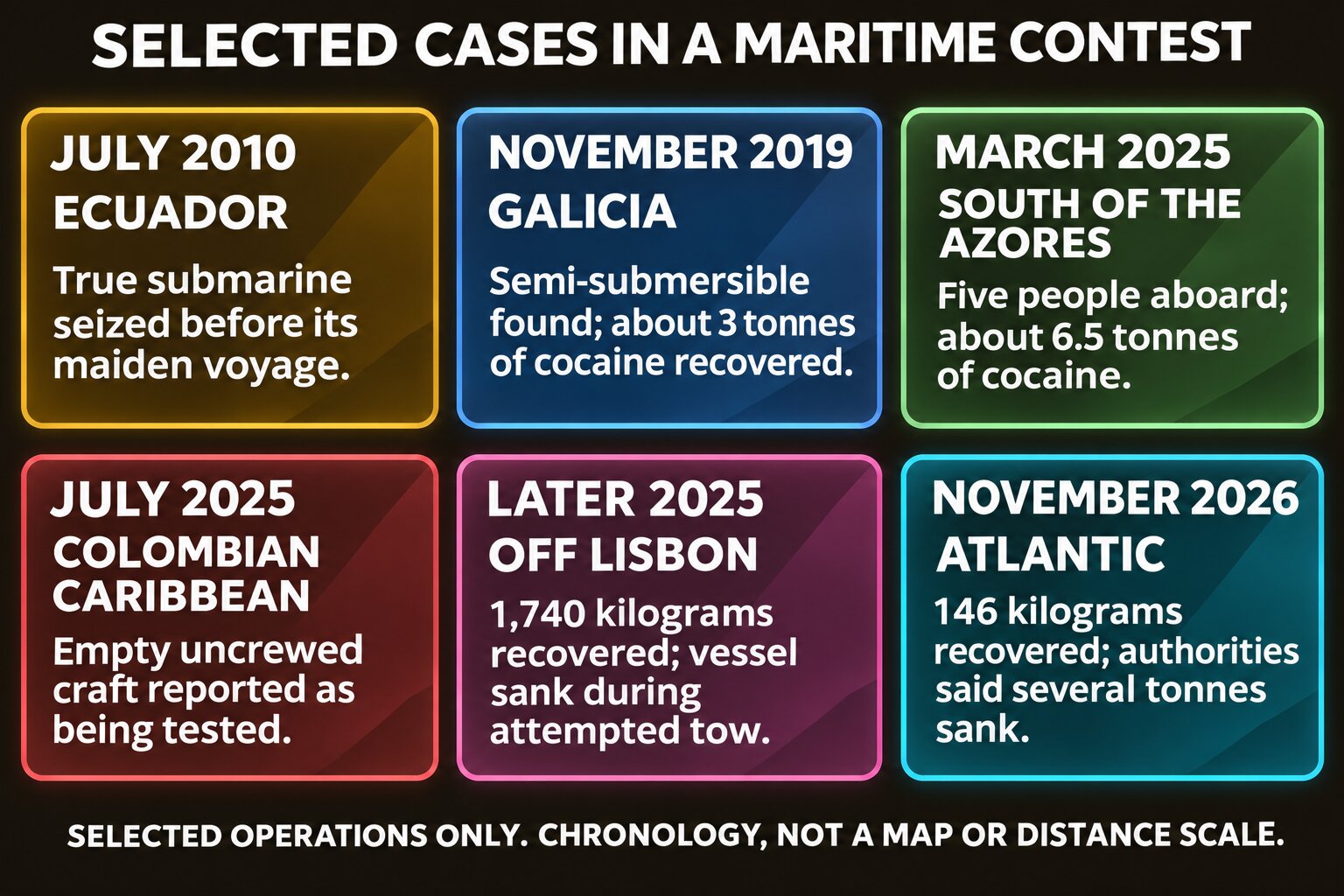
All four people were recovered alive. Authorities recovered bales containing 146 kilograms of cocaine, though they reported that several more tonnes sank with the boat.
RCI placed the interception roughly 1,500 kilometres southeast of Martinique. A single low-running boat had brought a frigate and aircraft together far out at sea.
The craft was a semi-submersible, designed to travel with almost nothing showing above the surface. These are the vessels commonly called “narco-subs.” An Atlantic crossing means fitting people, machinery, fuel, and cargo into that hull for weeks at sea.
Finding a submarine before it sails#
Sometimes the interception comes before the voyage. In July 2010, Ecuadorian police and military authorities, assisted by the US Drug Enforcement Administration, seized a clandestinely built vessel near the Colombian border.
This one really was a submarine, according to the DEA. According to the DEA, the seizure involved a fully operational diesel-electric vessel complete with a periscope. Intelligence had flagged the project, allowing authorities to intercept the craft before its maiden voyage.
That same announcement outlined the diverse toolkit traffickers use to move cocaine: fishing boats, pleasure craft, high-speed boats, and devices towed behind other vessels. Each method offers a different form of concealment. An ordinary-looking boat can blend into maritime traffic. A concealed device can put the cargo out of sight. A low-running hull leaves less of the carrier showing.
Across the Atlantic, then waiting#
In November 2019, Spanish authorities discovered a semi-submersible in the ría de Aldán, an inlet in Galicia on Spain’s northwestern coast. Spain’s Guardia Civil later traced its journey back to the Amazon River in South America.
This vessel remained at the surface for the duration of the trip. The internal layout was brutal: three people were squeezed into a tiny compartment beside the engines, with much of the hull given over to fuel and cocaine.
The Ecuadorian vessel had diesel-electric propulsion and a periscope. The Galicia boat made its crossing at the surface. An El País reconstruction described a boat about 20 metres long, with fuel tanks occupying nearly half of it and about 20,000 litres of fuel aboard. The crew slept on two bunks positioned directly over the cocaine bales.
El País put the journey at 26 days and approximately 9,000 kilometres, including 3,000 kilometres along the river and 6,000 across the open ocean. For six of those days, the crew lingered between Fisterra and Aldán, waiting for a receiving boat to meet them.
The alert regarding this vessel came through the Maritime Analysis and Operations Centre for Narcotics (MAOC-N). The European Commission describes MAOC-N as an intelligence-sharing hub that connects police, customs, and military forces. Participating countries provide the ships and aircraft. The hub brings information gathered in several countries within reach of forces able to act at sea.
The Guardia Civil noted that initial air and sea searches failed to locate the craft. But once investigators identified the kind of craft, air and maritime units discouraged suspected support boats from helping it. This pressure pushed the semi-submersible toward the shore, where officers finally detected it.
Spain’s tax agency noted in its November 27 account that rough seas had prevented the crew from transferring the cargo to another vessel. The crew scuttled the boat and fled. A patrol using night-vision equipment witnessed the escape.
While the initial release reported two arrests and one fugitive, the Guardia Civil later confirmed that all three crew members were captured. Authorities refloated the hull to recover approximately three tonnes of cocaine.
Meeting the boats offshore#
In March 2025, Portuguese authorities intercepted another semi-submersible far offshore. In Operation Nautilus, Portugal’s judicial police, navy, and air force worked with Spanish, American, and British agencies. MAOC-N reported an interception about 500 nautical miles south of the Azores. Five people were aboard, along with approximately 6.5 tonnes of cocaine.
Unlike the Galicia operation, where the vessel was pushed toward the coast, this interception happened in the deep Atlantic.
Later that year, MAOC-N acted on further intelligence regarding another shipment bound for Europe. Portuguese assets located a semi-submersible approximately 1,000 nautical miles off Lisbon. According to the MAOC-N account published on November 4, 2025, officers arrested four crew members and recovered 1,740 kilograms of cocaine.
The vessel did not make it back. Poor weather, sea conditions, and its fragile construction prevented a completed tow, and it sank. In Aldán, authorities had raised a sunken hull to recover the cargo. Here, they recovered the cargo but lost the hull. The sea remained part of the operation after the boarding and arrests.
Taking the people out#
Between these Portuguese operations, a new experiment emerged in the Caribbean.
In July 2025, the Colombian navy announced the seizure of an uncrewed craft equipped with a Starlink satellite antenna. AFP reported a naval spokeswoman’s confirmation that the craft was empty and was being used as a test vessel.
Taking the crew out changes the problem. In the Galicia crossing, three people had spent weeks beside the engines, sleeping over the cargo. Naval analyst H. I. Sutton told Naval News that the trade-off for removing the crew is the lack of on-board repairs for engine failures.
InSight Crime investigator Henry Shuldiner told AFP that recruiting crews for makeshift vessels was difficult. Removing them also removes people who could cooperate with authorities if captured.
Back on the deck#
In November 2026, four people were still aboard when the French frigate approached. Three jumped into the water. The fourth remained on a sinking boat.
The frigate and its supporting aircraft had found the low-running craft far out in the Atlantic. Then the boarding team had to reach the person still on it.
They got the fourth person out before the boat disappeared.