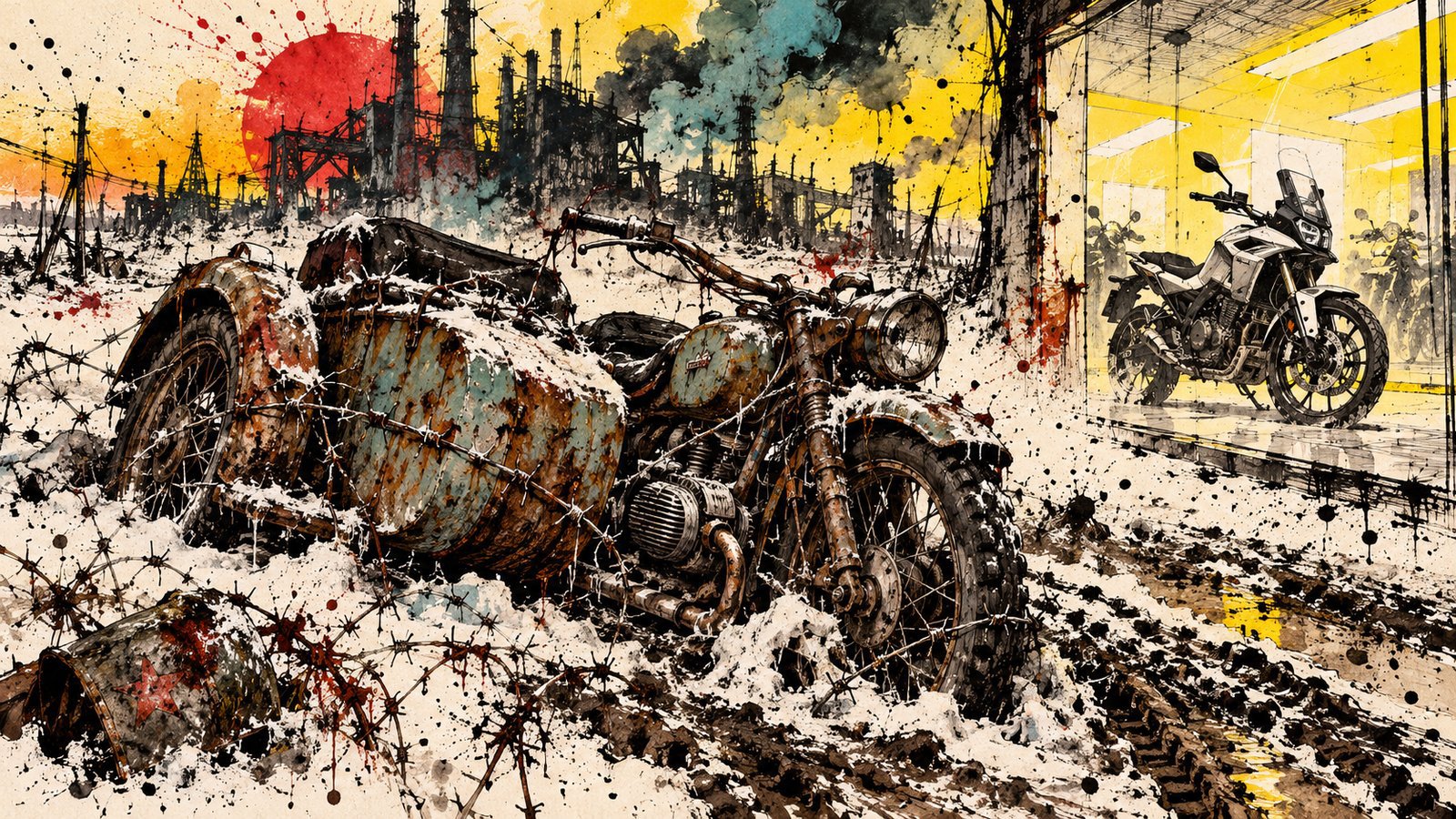
When the Soviet Union disintegrated in 1991, there was a brief, intoxicating window where it seemed possible that Russia might finally join the civilized world. People hauled down bronze statues of secret police chiefs, queued up for rock records, and held genuine hopes for open markets, free elections, and honest trade.
Ural was the physical proof that this promise could actually work.
The machine had been forged in 1941 out of sheer panic. As Hitler’s motorized divisions tore across western Russia, the Soviet military loaded the tooling and blueprints of a reverse-engineered BMW R71 onto flatcars and hauled the entire enterprise 1,200 miles east of Moscow, beyond the Ural Mountains, to the remote Siberian logging town of Irbit. That was IMZ: the Irbitskiy Mototsikletniy Zavod. The motorcycles they stamped out were heavy, agricultural, and crude, built to carry Red Army scouts and machine guns through roadless mud and subzero blizzards.
Long before anyone coined the marketing acronym “ADV” or bolted an aluminum luggage catalog onto a dual-sport, the Ural was the original adventure motorcycle. Decades before the 1980 BMW R80G/S launched the modern adventure-touring segment, and long before celebrity travelogues turned round-the-world riding into a television genre, the Ural was clawing through trackless Siberian taiga where roads were merely a rumor. It was never just a cute, vintage-styled retro novelty. The engageable two-wheel-drive sidecar setup gave it serious, tractor-like all-terrain capability: an unapologetic expedition machine that riders in the know could take on extreme backcountry adventures that would terrify your average showroom-floor BMW GS owner.
Over five decades, Irbit built more than three million of them. And when the Soviet empire collapsed and state subsidies evaporated, the factory very nearly died with it. In 1998, workers were being paid in flour and motorcycle frames.
Then came one of the great survival stories in modern manufacturing. In 2000, entrepreneur Ilya Khait and his partners bought the derelict giant and spent the next twenty years civilizing an iron dinosaur. They understood what made the bike special: the heavy, hand-welded steel frame, the sidecar tub, and the thumping, air-cooled 750cc flat-twin boxer engine with its cylinders sticking straight out into the wind. But they stripped out the garbage Soviet metallurgy. They brought in Italian Brembo disc brakes, German Herzog precision timing gears, Austrian Sachs shocks, and Japanese Keihin electronic fuel injection.
Against all economic odds, Ural became a beloved, eccentric international darling. You saw them in Seattle, Munich, and Melbourne: rugged adventure rigs hauling camping gear, vintage tool rolls, and grinning dogs in goggles. Eighty percent of the factory’s production went overseas, managed from a modest office in Redmond, Washington. Russian iron and Western components had merged into something joyous.
Then Vladimir Putin decided to drag his country straight back into the bloody gutter of imperial totalitarianism.
The moral collapse: why Ural had to choke#
To understand why Ural died, you have to be honest about the timeline.
Russia’s war against Ukraine did not begin in 2022. It began in February 2014, when Russian troops without insignia seized government buildings across Crimea, annexed the peninsula at gunpoint, and sparked a grinding, bloody proxy war in the Donbas. For eight long years, the Western world mostly looked the other way. European capitals bought cheap Russian natural gas, Washington issued tepid financial wrist-slaps, and Russian businesses, including Ural, carried on with global commerce as if nothing fundamental had changed.
It was the catastrophic surge of February 2022 that finally broke the Western illusion.
When Russian armored columns launched their full-scale blitzkrieg toward Kyiv, leveling residential neighborhoods in Mariupol, murdering civilians in the streets of Bucha, and systematically bombing power grids in freezing weather, the world could no longer look away. Putin expected Ukraine to collapse in seventy-two hours. Instead, the world witnessed an astonishing display of Ukrainian courage, dignity, and national resistance.
Ukraine’s heroism won the hearts of the free world. And in doing so, it made the decision to economically quarantine Russia not just a regulatory reaction, but an absolute moral imperative.
Let me be entirely blunt about my perspective on this: the invasion and occupation of Ukraine is an unforgivable crime, and if Ural had to suffer and die because of it, that is completely, unconditionally fine by me.
Russia, Russian businesses, and Russian institutions should suffer every single day that Russian boots remain on Ukrainian soil. You do not get to slaughter your neighbors on weekdays and sell quirky, nostalgic adventure toys to suburban riders in the West on the weekend. The economic sledgehammer swung by the democratic world was justified, necessary, and deserved.
The bitter historical irony is that the Kremlin wrapped itself in the sacred memory of the Great Patriotic War to justify butchering Ukrainians, millions of whose grandfathers fought and died in the Red Army riding Irbit-built sidecars against the Nazis. In waging this war, Moscow murdered the only mechanical artifact of that era the free world actually loved.
When the 2022 surge began, Ilya Khait spoke out immediately against the war: an act of considerable bravery for an executive with over a hundred workers in Siberia. He described the invasion with striking clarity: “It felt like our factory in Irbit had suddenly exploded.”
It had. But the physical border was only the outer perimeter. What actually garroted Ural was the invisible plumbing of international finance.
The paper garrote: how banking actually killed the bike#
The public narrative of sanctions usually imagines physical blockades: customs agents turning away cargo ships at ports. But the death of Ural was executed in fluorescent-lit bank offices in Des Moines, New York, and Almaty.
In the powersports industry, independent motorcycle dealerships rarely buy inventory with cash from their own checking accounts. They rely on “floor-plan financing”: specialized commercial revolving lines of credit. A commercial lender buys the motorcycles from the manufacturer, places them on the dealer’s showroom floor, and collects interest until a retail buyer signs the paperwork.
On March 25, 2022, exactly one month after Russian tanks surged across the border, Ural sent an emergency bulletin to its North American dealer network:
“As you already know, Wells Fargo and Northpoint cancelled their contracts and will no longer provide flooring for Urals. As much as we want to express our feelings about this, it carries no tangible value at this time…”
With a single corporate stroke, Wells Fargo Commercial Distribution Finance and Northpoint Commercial Finance shut down the credit pipeline. In their risk models, anything carrying a Russian VIN was toxic paper.
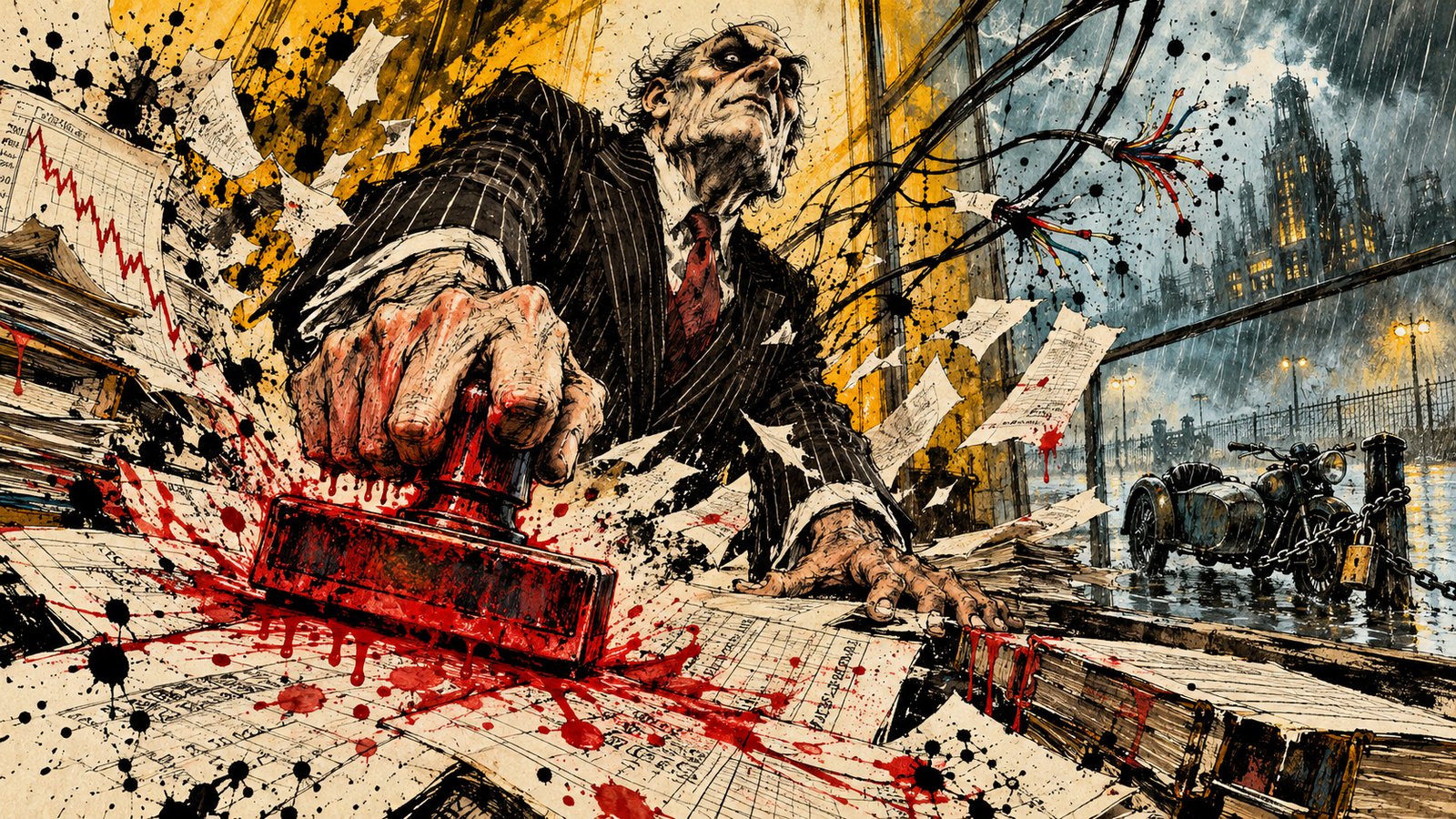
Think about what that meant for an independent motorcycle shop in Pennsylvania or Oregon. If a dealer wanted three new Urals on their floor for spring, they could no longer finance them through their normal bank facility. They had to wire sixty thousand dollars of their own operating capital out of pocket to a company operating on the fringe of a war zone. Dealership orders evaporated overnight.
Meanwhile, global banking threw up an impenetrable wall:
- The SWIFT severance: Russian financial institutions were severed from the international SWIFT messaging network. Money generated from retail sales in North America could no longer be legally or reliably transferred back to Siberia to pay metalworkers and utility bills.
- The Kazakh shell game: Desperate to keep exporting, Ural moved final vehicle assembly 370 miles southeast across the border to Petropavlovsk, Kazakhstan in the summer of 2022. The theory was simple: bare frames and engine castings would cross the border under the Eurasian Customs Union, imported European parts would meet them in Kazakhstan, and the finished bikes would ship out as Kazakh exports.
- The OFAC panic: The theory collided with the terror of US secondary sanctions. Under US Treasury enforcement, Central Asian commercial banks faced total exclusion from the US dollar clearing system if they facilitated trade for Russian-connected entities. Kazakh banks responded with intense over-compliance: demanding notarized letters of guarantee that components would never enter Russia, freezing transactions, and submitting routine wires to eight-week compliance holds in New York correspondent banks.
- Cash-in-advance parts bottlenecks: European suppliers like Brembo and Herzog either refused to deal with an entity connected to Irbit or demanded 100 percent payment upfront in cash on massive minimum order quantities.
Even before the war, Ural had been gradually pricing itself out of reach as it added premium European components. But the wartime logistics turned the math into an outright slaughterhouse. Shipping bare components across borders, routing finished crates around the Black Sea, paying inflated insurance premiums, and floating cash for upfront parts sent the retail price of a classic Gear Up soaring past $22,000, then $25,000.
In late 2025, Khait laid out the brutal financial truth: operating between two countries was unsustainable. Ural was losing money on every single motorcycle it assembled. And when fresh trade tariffs landed in early 2025, the door slammed shut for good.
The ghost town in Irbit#
If you visit Irbit today, you are looking at an industrial monument to a ruined future.
In its Soviet heyday, the factory was an entire city within a city, employing 10,000 people with its own housing blocks, schools, and cultural halls. Even during the boutique era under Khait, over a hundred veteran machinists and metalworkers kept the flame alive, stamping steel tubs and hand-assembling boxer engines.
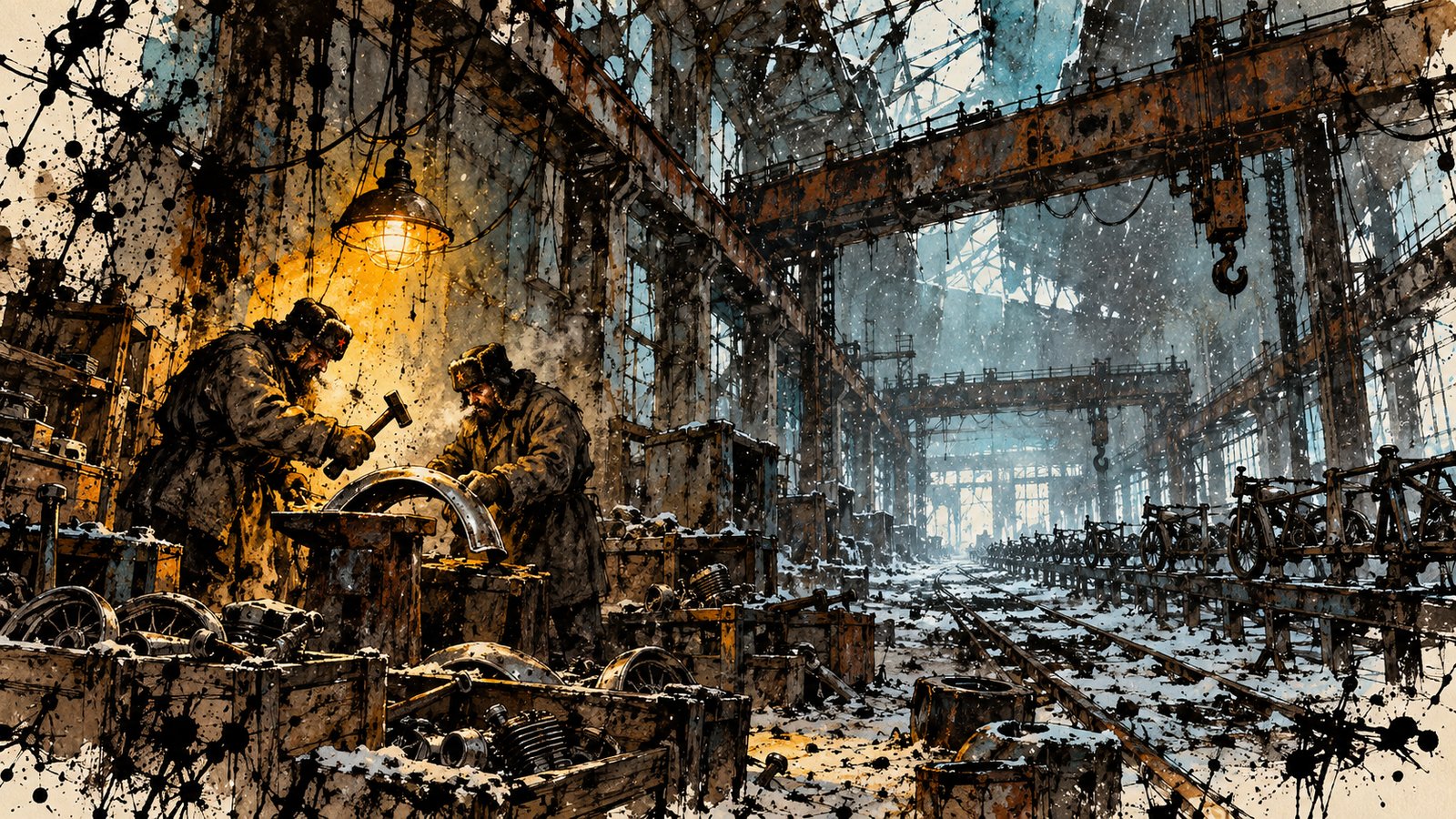
In November 2025, Ural announced an indefinite pause on the manufacturing of all classic legacy boxer-twin models for export markets. In corporate language, “indefinite pause” is the polite term for a quiet funeral.
The sprawling assembly line in Petropavl, Kazakhstan is shuttered. The historic plant in Irbit is reduced to a skeleton crew. They stamp out spare parts to keep existing rigs running, assemble a trickle of domestic units from remaining pre-war inventory, and perform contract metal-stamping for local commercial vans.
The air-cooled, pushrod, 750cc flat-twin engine that carried Russian soldiers against the Wehrmacht and eccentric overlanders through the Mojave Desert has rolled off the export line for the last time.
The Ural Neo misses the entire point#
To prevent the company name from being engraved on a tombstone, Ural had to find a life raft. What they chose, however, is a tragedy of a different sort.
Enter the Ural Neo 500.
To survive, Ural partnered with Yingang, a motorcycle manufacturer in Chongqing, China. Yingang builds the rolling platform, and Ural’s engineers contributed 127 pages of engineering revisions to adjust chassis geometry, steering trail, and sidecar mounting.
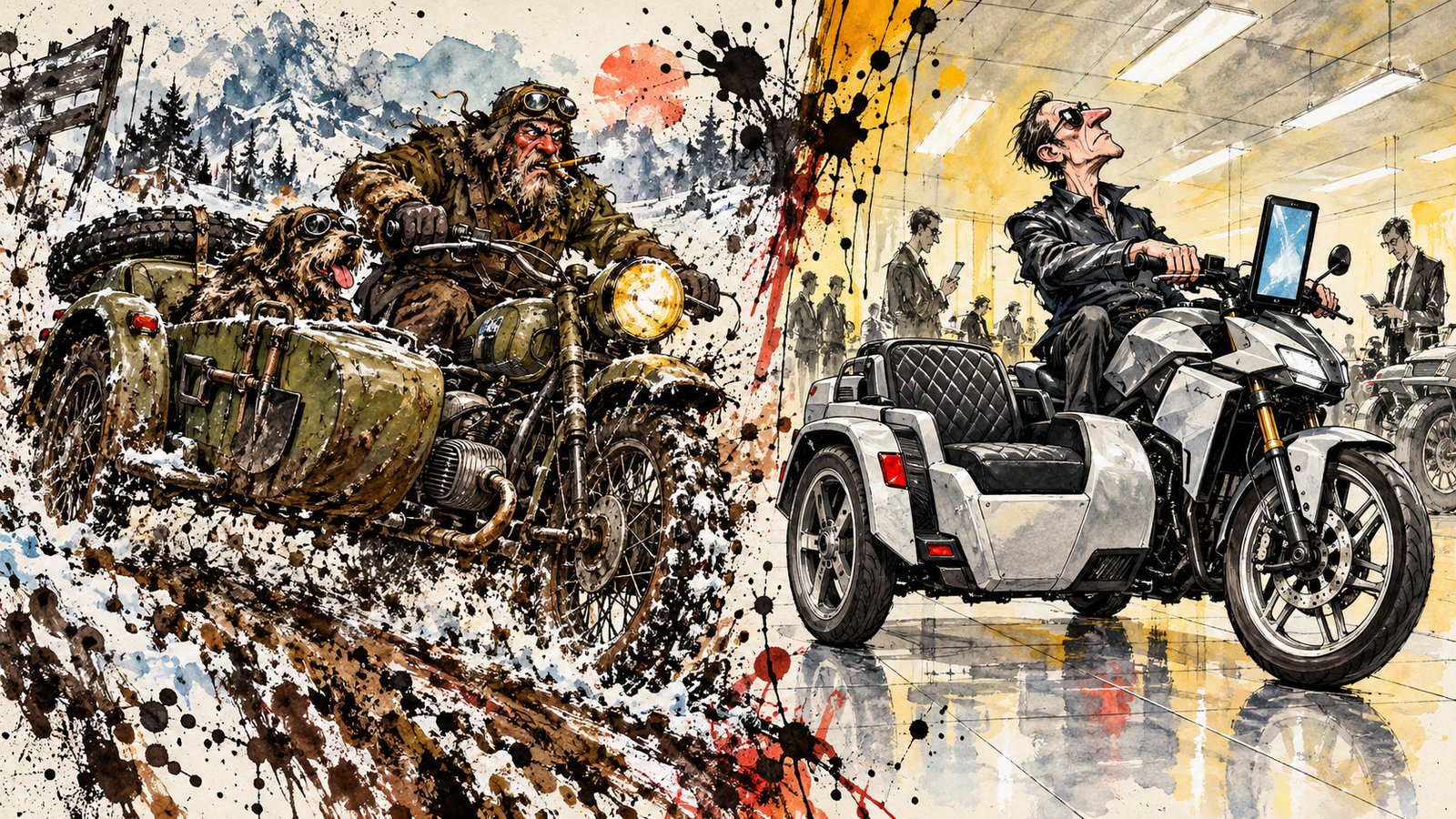
I understand why Khait did it. As he wrote to owners: “The alternative was losing Ural altogether. We’d rather see the name move forward than carved on a tombstone.”
From a pure balance-sheet perspective, China was the only place on earth with the tooling and supply chain to build a sub-$15,000 sidecar rig. But from a motorcycling perspective, it feels like Ural completely forgot its own heritage with this bike.
The Neo misses the entire point of what made Ural an icon.
What made a Ural legendary was never speed or modern consumer convenience. Attaching a sidecar to a generic, high-revving sports bike or a plastic-wrapped commuter is silly. You do not need a 150-horsepower engine to have fun in a sidecar: a powerplant in the 400cc to 650cc range is plenty.
What made Ural iconic was its authentic adventure DNA:
- Genuine two-wheel drive: The mechanical, engageable drive shaft connecting the rear motorcycle wheel to the sidecar wheel was the soul of the machine. It turned a motorcycle into a three-wheeled tractor that could crawl through snowdrifts, climb sandy ridges, and churn through muddy forest roads where four-wheel-drive trucks got stuck.
- Engine character and mechanical honesty: The low-slung, air-cooled boxer twin had a rhythmic, tractor-like pulse that you felt in your chest. It was simple, exposed, and serviceable with a wrench on the shoulder of a logging trail.
- Visual proportion and aesthetic soul: The wire-spoke wheels, the tear-drop steel tank, the sweeping fender lines, and the rugged, purposeful stance looked right next to a steel sidecar body.
The Ural Neo 500 throws every single one of those qualities into the garbage bin.
It is powered by a generic, liquid-cooled 500cc parallel-twin engine producing a polite 35 horsepower. It buzzes with the sterile vibration of a commuter scooter. It rolls on 17-inch cast alloy wheels wrapped in tubeless street tires. It has single-wheel drive: the sidecar wheel is just a passive passenger along for the ride. Bolted to the handlebars is a ridiculous, vertical iPad-style digital TFT tablet with menus and Bluetooth connectivity, paired with a beeping reverse alarm straight off a forklift.
It is not an adventure machine. It is a forgettable Chinese street bike with a chair bolted to the side. The pioneer of genuine two-wheel-drive motorcycle exploration has surrendered its identity to build a grocery-getter. You can rewrite 127 pages of chassis specs, but you cannot engineer soul into a parts-bin compromise.
Who could actually build the sidecar we want?#
If Ural is going to fade into history, the sidecar niche should not have to die with it. But who could actually fill that void and carry the adventure banner forward?
On paper, there is an alluring, almost poetic candidate: BMW.
There would be incredible historical justice if BMW were to take back from Russia that which Russia originally stole from BMW. The 1941 Ural M-72 was, after all, a stolen BMW R71. Having BMW Motorrad build a modern, factory-supported boxer-twin sidecar rig would feel like the original design was finally coming home. BMW is literally the only company in the world that could claim they were not copying Ural: they would simply be reclaiming what was already theirs, lost in the fog of a war against an enemy that no longer exists.
BMW certainly possesses the modern sensibility and marketing polish to understand the adventure segment: they practically invented the modern ADV market with the GS. Yet the moment you move past the romance, the reality of modern BMW collapses the idea.
BMW Motorrad has leaned completely into being a premium luxury lifestyle brand. Look at the real numbers: a base 2024 BMW R12 cruiser carries an MSRP of $12,345, while the roadster R12 nineT starts at $16,295. Once you add destination charges, dealer prep, and the option packages almost every dealer orders, out-the-door prices readily exceed $21,000 for the bare two-wheeler alone. The new 2026 R12 G/S starts at $17,090. If BMW were to engineer a factory sidecar frame and a mechanical two-wheel-drive system, the resulting rig would easily command $35,000 to $40,000. That is an insane amount of money for a sidecar outfit. Ural was already pricing itself out of the market at $25,000; BMW would launch it into the stratosphere.
Worse, the R12 is simply way too much motorcycle for a sidecar.
Its air/oil-cooled boxer engine displaces 1,170cc, pumping out 109 horsepower and 85 lb-ft of torque. Opening up a 109-horsepower monster with an unladen sidecar attached is terrifying, and on public roads, it is downright dangerous. Anyone who has ever flown the chair on a sidecar rig knows that sudden, aggressive torque in a right-hand bend will lift the hack and shove you toward oncoming traffic. What sidecar riders actually need is about half the displacement and half the performance: roughly 400cc to 650cc, with low-end tractor chug and predictable throttle response.
As poetic as a BMW revival would be, the BMW Motorrad of today does not have a base motorcycle that is appropriate to attach a sidecar to, nor are they ever going to get the pricing right.
What about Triumph?
You could certainly make a design case for Triumph. A Bonneville T120 or a Scrambler 900 has the classic British lines and handsome engine cases that look magnificent beside a sidecar. But for Triumph, motorcycling is primarily about refined aesthetics and polished street performance. I cannot see Triumph ever getting serious about the mechanical grease-and-iron reality of an authentic two-wheel-drive off-road rig. It simply is not who they are.
That leaves one manufacturer standing head and shoulders above the rest: Royal Enfield.
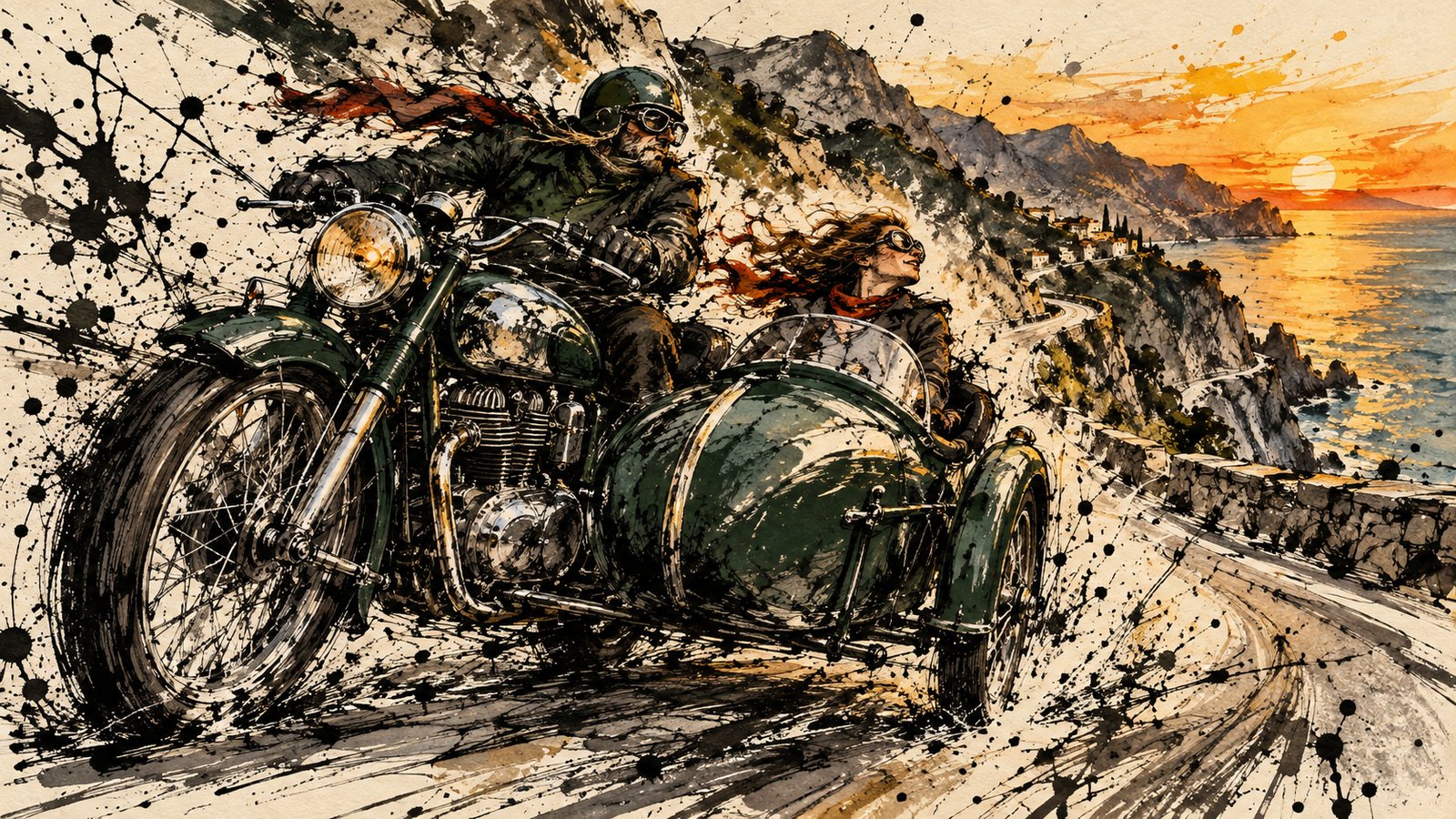
Royal Enfield would be my absolute first pick among modern motorcycle companies. They check every single box.
First, the aesthetics, displacement, and proportions are already in the sweet spot. Their 650cc twin platform (the Classic 650, the Interceptor, and the Shotgun) produces 47 horsepower: smooth, torquey, air-cooled, with mirror-polished engine cases, traditional cooling fins, teardrop tanks, and wire-spoke wheels. Even their new 450cc single-cylinder Sherpa engine in the new Himalayan offers 40 horsepower in an honest, utilitarian package. It looks right next to a sidecar because it shares the same timeless mechanical language.
Second, and most importantly: Royal Enfield has real, unassailable street cred when it comes to true adventure. When Royal Enfield builds a motorcycle, they beat the living shit out of it.
They did not slap the name “Himalayan” on their adventure bike as a focus-grouped marketing buzzword. They took the prototypes into the highest, most punishing mountain passes on the planet, across glacial rivers, through altitude sickness, and over unpaved boulder tracks in Ladakh, just to prove they could take the punishment.
If Royal Enfield decided to build a proper, factory-backed sidecar rig, you can almost guarantee how they would launch it: they would load up two-wheel-drive rigs and ride them straight through the Himalayas, far off the beaten path, climbing goat trails to prove the machine’s durability to the world. A two-wheel-drive Royal Enfield sidecar would not be a hipster accessory: it would have earned its place as a genuine adventure bike. They have the engineering grit, the manufacturing scale, the global dealer footprint, and the accessible price point to make it a reality.
I am struggling to imagine any other company on Earth that could do it.
The road ends in the rubble#
In the end, the story of Ural is an allegory for modern Russia itself.
Russia had the world’s goodwill. It had a culture rich in literature, science, and tenacious engineering. It had a unique mechanical artifact that brought joy to thousands of riders across the globe, bridging cold geopolitical divides with grinning passengers and dogs in sidecars.
Vladimir Putin threw all of it away for imperial conquest and ruined villages in the Donbas.
He traded global commerce for isolation, replaced Western partnerships with Chinese dependency, and turned his country into a pariah. The machine that outran Adolf Hitler’s armies in 1941, pioneered the true adventure motorcycle across the Siberian wilderness, and outlived sixty years of economic chaos was finally run off the road by the criminal vanity of the Kremlin.
Russia’s most famous motorcycle is now an outsourced commuter made in Chongqing. Thanks a lot, Russia. You broke your own toy.