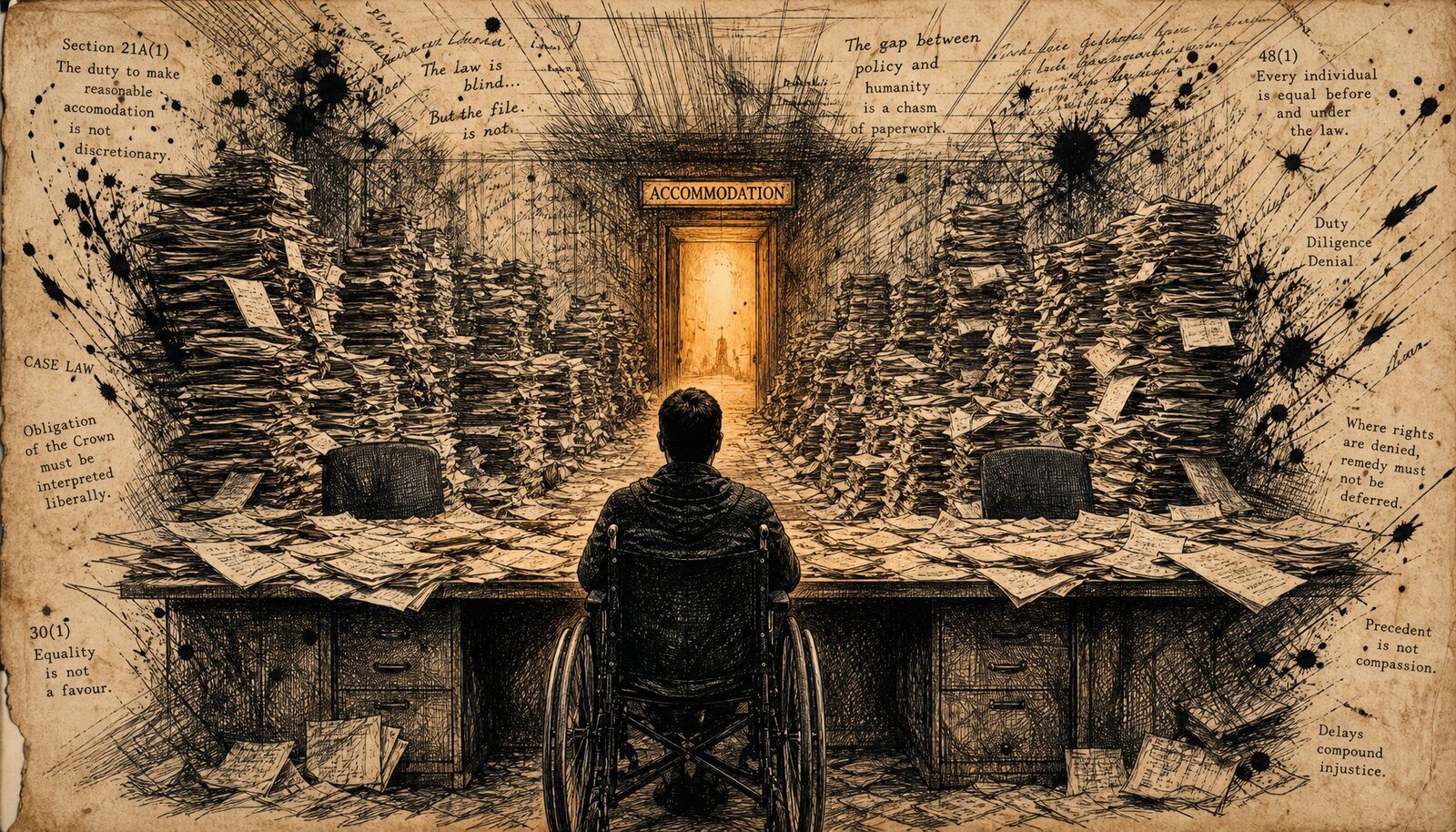
The formal email arrived late in the evening. It was marked confidential, tagged with corporate leadership competency categories, and laid out a sudden catalog of interpersonal concerns.
I had been building software systems and leading engineering teams for decades. My career has had its share of rough edges and hard lessons: I am nobody’s saint, and I have never pretended to possess an unblemished track record. But I am very successful in my field, my teams deliver results, and my performance reviews have consistently reflected that.
Yet sitting in the glow of my monitor that night, reading bullet points that recast basic neurological overwhelm as executive instability, I realized something was shifting under my feet.
I am Autistic, with co-occurring ADHD. When interpersonal friction escalates or sensory environments turn chaotic, my nervous system does what it has done my entire life: it begins to shut down. I withdraw, go quiet, and step away to self-regulate so I can return to the problem with a clear head. To a company that understood human wiring, stepping out of a heated room for ten minutes to preserve focus would look like emotional maturity. To an executive team operating on corporate autopilot, it was documented as a failure of composure.
I did what the federal government tells disabled workers to do. I initiated a formal request for reasonable accommodations under the Americans with Disabilities Act.
I was not asking for much. I was not requesting expensive specialized hardware, an altered compensation structure, or reduced expectations. I asked for four zero-cost adjustments: the flexibility to take unscheduled sensory breaks when overstimulated, the option to step back from loud mandatory evening social gatherings at company offsites, a predictable cadence of direct conversations with my manager so performance feedback arrived in person rather than as late-night emails, and the ability to communicate in writing during flare-ups of selective mutism. My physician completed the paperwork, certifying the permanent neurological realities of my condition.
What I expected was the informal, problem-solving dialogue promised by thirty-six years of federal statute.
What I ran into was an immediate corporate immune response.
Almost overnight, the organization stopped treating me as an executive solving hard technical problems. I had become an organizational pathogen: an administrative liability that needed to be contained, papered over, and neutralized.
The Myth of the Problem-Solving Table#
The Americans with Disabilities Act never intended accommodation to look like a legal deposition.
A 1989 Senate committee report, which legal scholars trace as the conceptual origin of the interactive process, described an informal, collaborative problem-solving approach centered entirely on the worker’s lived experience. Employers were told to sit down with employees first, ask what tools would help them succeed, and consult outside vocational specialists only if they needed technical advice.
Physicians are not mentioned in that legislative history. Endless diagnostic re-evaluations are not part of the blueprint.
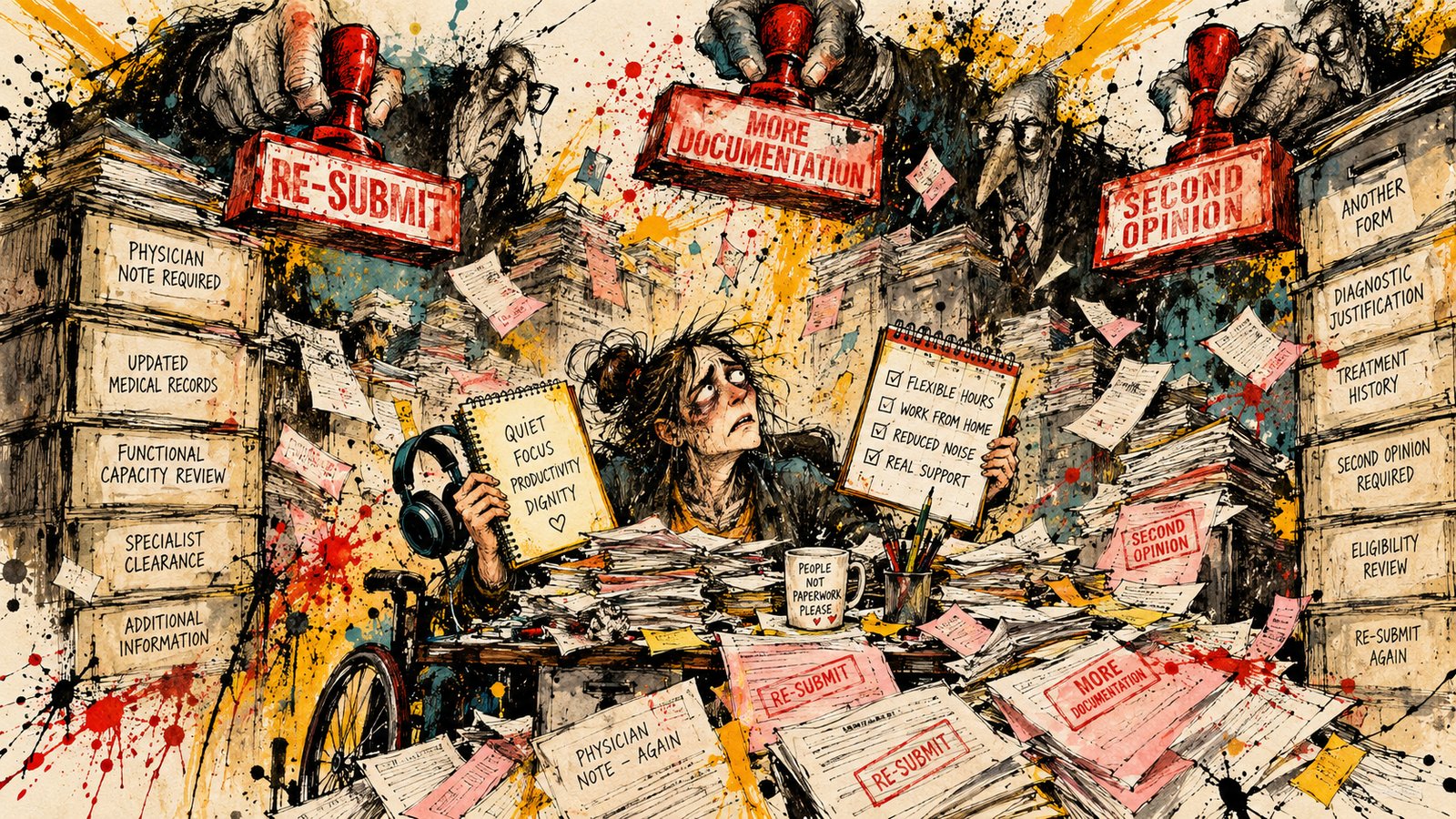
What corporate America constructed instead is an adversarial gauntlet. It treats every accommodation request as presumptively fraudulent until a licensed physician proves otherwise. Legal scholar Doron Dorfman coined a name for this cultural reflex in his 2019 article in Law & Society Review: the “disability con.” It describes an entrenched organizational paranoia that employees claiming a disability are running a scam, angling for unearned perks or an excuse to work less.
In my case, the corporate immune system mobilized along two coordinated tracks.
First came the bureaucratic moat. Weeks dragged by with no substantive movement. When human resources finally issued an “approval,” the terms were detached from physical reality. They insisted that my sensory breaks had to be scheduled in advance with my manager, as if neurological overwhelm keeps office calendar invites. When I pointed out that an Autistic shutdown is reactive and cannot be pre-booked on a Tuesday morning, they told me that modifying the terms would require submitting a fresh support ticket and returning to my physician for another round of medical verification. They even slapped a thirty-day expiration date on the approval, as though forty years of autism would evaporate by the middle of next month.
Second came the paper trail. While human resources stalled the interactive process, formal performance emails began appearing in my inbox late at night. Minor scheduling misunderstandings were escalated into broad leadership deficiencies. Incidents that had never been raised in our regular conversations were suddenly documented in Situation-Behavior-Impact format.
The strategy was unmistakable: construct a documented record of performance issues parallel to the accommodation dispute, ensuring that when the dismissal arrived, leadership could point to a tidy folder of competency critiques rather than their own failure to accommodate.
Within months, the immune response completed its work. A seasoned professional who asked for quiet space to think was packaged out the door.
I consulted a specialist disability rights attorney while the conflict was unfolding. The legal advice was sober and clear: I had documented rights, the employer’s conduct was creating actionable exposure, and if I chose to pursue formal administrative complaints and litigation, there was genuine legal relief to be had.
I chose not to litigate.
Because of my seniority and my standing in the field, I believed that an executive should not have to wield a lawsuit to solve a workplace communication problem. I wanted to believe that if I pushed hard enough, asserted my rights plainly, and remained professionally collaborative, I could make the process work as the statute intended. I wanted to demonstrate that reasonable people could reach a reasonable accommodation without burning down the house.
It did not end well for me. And the part of that decision that still haunts me has nothing to do with my own career.
By taking the quiet exit rather than forcing a public reckoning, I left the machinery intact. I set an unspoken precedent within that organization that leadership can treat civil rights protections as an administrative inconvenience, run out the clock, and suffer no institutional consequence. The next person who walks into that human resources department asking for a reasonable accommodation: an early-career engineer, a quiet analyst, someone without my savings, my resume, or my network: is going to walk straight into the same meat grinder. And they will be steamrolled.
The Paperwork Trap That Backfires in Court#
This pattern is not an isolated corporate aberration. It is standard operating procedure across corporate America, and it is precisely how well-heeled employers walk themselves straight into federal litigation.
Medical documentation has a legitimate, strictly bounded role under federal law. Its purpose is to confirm that a qualifying ADA disability exists and to identify the general functional limitations that require accommodation. That is all.
What documentation is never supposed to do is replace employer judgment. EEOC Enforcement Guidance is explicit that any medical examination required by an employer must be job-related, consistent with business necessity, and “limited to determining the existence of an ADA disability and the functional limitations that require reasonable accommodation.” Demanding that a family medicine physician design specific meeting cadences or write exact workplace workflows shifts an obligation that belongs entirely to the employer onto a doctor who has never set foot in your building.
Courts have noticed how easily this documentation demand turns into bad faith. In Reyes v. Krasdale Foods (S.D.N.Y. 2013), both parties agreed the employee had Type 1 diabetes. Yet the employer won summary judgment because the worker’s medical note simply confirmed diabetes without explaining why leaving work thirty minutes early was medically necessary to manage it. Even when a disability is undisputed, an obsession with paperwork can derail the conversation before it starts.
Even more dangerous for employers is procedural delay. In Strife v. Aldine Independent School District (5th Cir. 2025), the school district demanded additional medical evaluations addressing alternative accommodations despite already possessing five separate physician letters confirming the employee’s disability and medical need. The Fifth Circuit held that the resulting six-month delay could constitute a failure to accommodate and evidence of bad faith. That liability remained intact even though the district eventually granted the accommodation and the employee suffered no separate monetary harm during the wait.
Six months of procedural paper-shuffling. The accommodation was approved in the end. The employer is still exposed to trial.
The Myth of the Expensive Accommodation#
When executives resist accommodation requests, the whispered excuse is almost always cost: the fear that saying yes will open a floodgate of expensive demands or lower performance standards.
The data proves that fear is fantasy. The Job Accommodation Network (JAN), funded by the U.S. Department of Labor’s Office of Disability Employment Policy, has tracked accommodation expenses since 2019 across thousands of employers.
Their findings are clear: 61% of workplace accommodations cost absolutely nothing to implement. Modifying a schedule, allowing remote work, adjusting lighting, or shifting minor duties costs zero dollars. When an accommodation does require capital, 33% involve a one-time median expense of just $300 (such as noise-canceling headphones, specialized software, or ergonomic hardware). Only 6% create ongoing annual costs, with a median of $2,400 for services like sign language interpreters.
Compare those modest numbers to the alternative. EEOC settlements and federal jury verdicts routinely land between $30,000 and $300,000, before accounting for six-figure legal defense bills, mandatory consent decrees, and brand damage.
Foley & Lardner noted in early 2026 that the most consistent pattern in employer trial losses was treating the interactive process as a one-time hurdle rather than a continuous duty. Frustrated managers routinely pull the plug and terminate an employee rather than working through an ongoing accommodation need.
That abandonment is where liability lives. The accommodation rarely breaks an organization; walking away from the dialogue does.
What Real Dialogue Looks Like#
An accommodation workflow that respects EEOC guidance and sharply reduces legal risk follows five basic principles:
- Start with the employee, not the paperwork. When a worker asks for help, the first question must be: “Tell me what is getting in the way of doing your job, and what tools or adjustments would help you solve it.” The worker understands their body and their daily workflow far better than an outside physician who knows nothing about your systems.
- Request only what is necessary. If an employee’s condition is not obvious and the connection to the requested accommodation is unclear, you may request documentation. But keep the scope tight. You only need to verify that a qualifying condition exists and understand the functional limitation. You do not need complete medical histories, full diagnostic files, or an independent medical exam by default.
- Never treat the first exchange as the finish line. The interactive process is continuous. If an initial adjustment proves ineffective, reopen the conversation. If a role evolves or a health condition shifts, talk again. Treating accommodation as a box to check once during onboarding is how companies land in depositions.
- Guard your timeline. When an employee requests accommodation and management responds weeks later with a surprise performance improvement plan, judges and juries read that sequence clearly. That temporal proximity becomes prima facie evidence of retaliation. Keep accommodation dialogues and performance evaluations on separate tracks, with clear contemporaneous documentation.
- Accept employee self-advocacy. Katherine Macfarlane’s Fordham Law Review study argues persuasively for a hands-off standard modeled on religious accommodations, where an employee’s statement of belief is accepted at face value. Disability, like faith, is personal and experiential. A $300 pair of noise-canceling headphones requested by an autistic or ADHD engineer does not require three doctor visits and a notarized diagnostic form.
The Quiet Exodus#
Rutgers Law scholar Katie Eyer has demonstrated that disability remains significantly underclaimed as a civil rights status in American workplaces. Employees who genuinely need adjustments routinely avoid asking for them because they already know what follows: corporate suspicion, invasive medical questions, months of silence, and the patronizing message that their own self-knowledge is invalid.
If a seasoned executive with an established track record, substantial institutional credibility, and the resources to advocate for themselves can be ground down by this machinery, imagine what happens to everyone else. Imagine the junior developer who needs written task lists, the customer support specialist who needs sensory breaks from open-plan noise, or the hourly employee who cannot afford to miss a single shift while human resources debates whether their physician’s note is specific enough.
They do not fight. They do not hire attorneys. They quietly mask their symptoms, burn out in silence, and slip out the back door, leaving organizations to wonder why their best talent keeps walking away.
The interactive process was written to build bridges between competent workers and the jobs they were hired to do. When companies turn it into an immune response designed to purge anyone whose wiring deviates from the norm, they are not just breaking the law. They are systematically discarding the very minds that built their success.