
Yesterday, I pointed Codex at my Amazon Fire Stick.
It gave me a cleaner home screen, removed or hid a bunch of Amazon cruft, and put the streaming apps I care about up front. The home-screen advertisements were gone. The device became something I actually wanted to use.
I already owned the hardware. Now it felt a little more like it.
That small improvement is part of what makes AI agents interesting to me. They give us a way to push back on the daily aggravations we’ve learned to accept from our devices. You know the ones: the screen full of things somebody wants to sell you, the feature buried behind somebody else’s priorities, the perfectly usable hardware you start thinking about replacing because its software is so unpleasant.
I’d like more of us to be able to say, “Make this work the way I want.” And I’d like us to keep that ability.
The screen is still good#
A television is a particularly good place to see what’s changing. You can have a perfectly good display attached to an interface that makes watching something feel like negotiating with a shopping mall. Replacing the whole television is an expensive answer to a software problem.
One developer decided to work on the software.
The creator of PlxNative describes using Claude Code and Ghidra, a tool for examining compiled software, to understand an LG television’s native media interfaces. That work became an unofficial Plex client: software for browsing and playing a personal media library. The television was from 2019. Its display was still useful. The creator wanted a better experience from the hardware already there.
CleanYourTV approaches another piece of the problem: cleaning up Android and Google TV devices and replacing the home-screen experience. These projects have their own device requirements and limitations, but the direction is encouraging. More of the software between us and our belongings is becoming something we can change.
I want that to become ordinary. I’d like choosing a quieter television interface to feel as reasonable as rearranging the furniture in your living room. Making your own television more pleasant to use shouldn’t depend on the manufacturer’s enthusiasm for the idea.
Who controls the helper?#
But there’s another dependency here. The agent helping you reclaim your device may itself be a service that somebody else can withdraw.
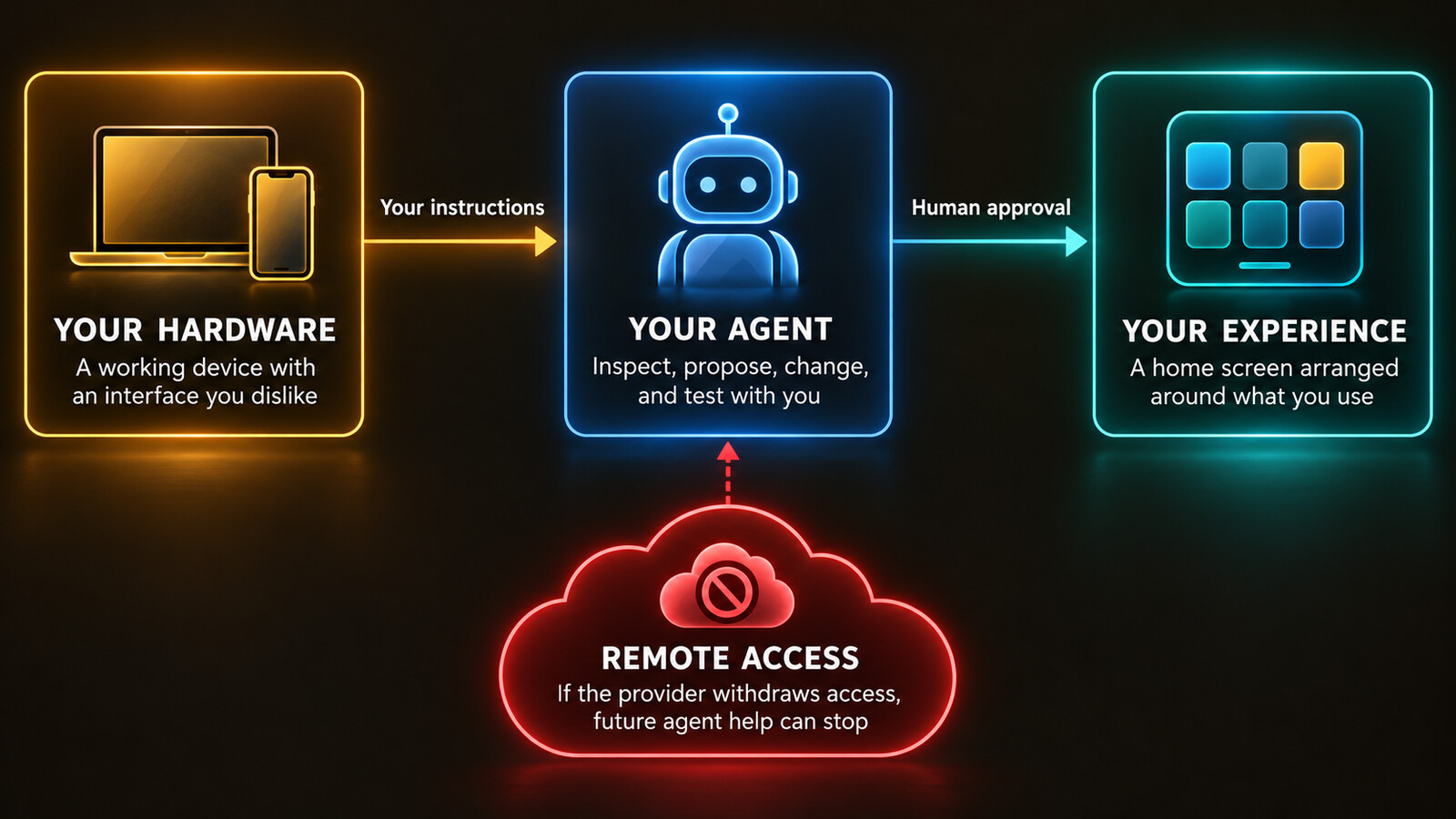
The latest generation of agents is being built to occupy a much larger place in our lives. Grok Bot, from xAI, remembers conversations and preferences, has its own computer, and keeps working when you step away. Its getting-started guide describes comparing shopping carts and delivery times, along with connections to personal and work email and calendars. That’s the ordinary business of keeping a household and a working life moving.
OpenAI’s dots take on ongoing work, remember context, and can review your calendar or remind you about something later. OpenAI describes an early tester whose dot noticed work he hadn’t invoiced, prepared the invoice, and sent it after his approval. Think about what that means for someone trying to keep track of work and get paid for it. Useful follow-through becomes part of how the day gets done.
The dependence grows through ordinary useful work. You ask the agent to help organize one project, then another. You give it the background you used to have to explain repeatedly. When it helps you find the right information or pick up a task where you left off, using it again makes sense. Eventually, parts of your day are arranged around being able to ask.
Consider someone who uses an agent as organizational support: a place to work out the next step, keep track of an active project, and recover the context when they return to it. They may come to rely on its morning calendar review, its reminders, or its help finding the message that explains what needs to happen next. Abruptly withdraw access, and that person could be reconstructing the thread across notes, messages, and files while the rest of the day keeps moving. The documents may still be there. The assistance that made them manageable is suddenly unavailable.
Rebuilding that support with another service takes work. A new agent needs the relevant background, access, and instructions. The person has to establish what it can be trusted to do. That rebuilding happens exactly when the familiar support has disappeared, with active projects and everyday obligations still waiting.
I think a provider that asks for this much space in our lives takes on a corresponding responsibility. An account decision can interrupt work and routines that reach far beyond a single conversation. The greater the reliance these products invite, the stronger the human accountability we should demand before that access is taken away.
As Tom’s Hardware reported, a researcher who had been investigating his Samsung television said OpenAI banned his account for cyber abuse. The public account doesn’t establish the precise enforcement cause or whether a human made the decision. That report makes the need for accountable review harder to dismiss.
A severe, lasting account sanction should require accountable human judgment, a clear explanation, and a meaningful opportunity to appeal before that exclusion becomes final. Where an immediate threat requires a temporary restriction, a person should promptly review whether that restriction belongs in place. A lasting exclusion should carry a much higher burden than a system flagging something for attention.
OpenAI has an account-deactivation appeal process. I want the standard to go further than the existence of an appeal route. The person losing access needs timely review, understandable reasons, and a practical way to challenge a mistake. Waiting for an answer can carry its own cost.
This is what earned autonomy means to me: consequential authority remains answerable to people.
We should apply that principle to the systems enforcing the rules, too. If a provider delegates part of an enforcement process to automation, the provider still owns the consequences. The human affected by the decision shouldn’t have to fight through an automated maze to reach someone empowered to reconsider it.
Somewhere else to go#
And we need choices beyond hoping that the review goes well.
When I talk about AI sovereignty, I’m thinking about the person in the living room as much as a government building a data center. Can you keep your work? Can you move your agent to another provider? Can you run a useful part of it yourself? How much of your digital life continues working if one company closes your account?
We should invest in making those answers better.
That means treating affordable graphics processors and video memory as part of consumer access to AI. Video memory is the memory available to a graphics processor for model weights and working data. More accessible capacity gives people more room to run useful models themselves. We should make that a consumer priority.
It also means supporting efficient open models and open-source agent software that people can inspect, adapt, and run. Our instructions, working context, and files should be portable enough that changing providers doesn’t require rebuilding our tools from scratch.
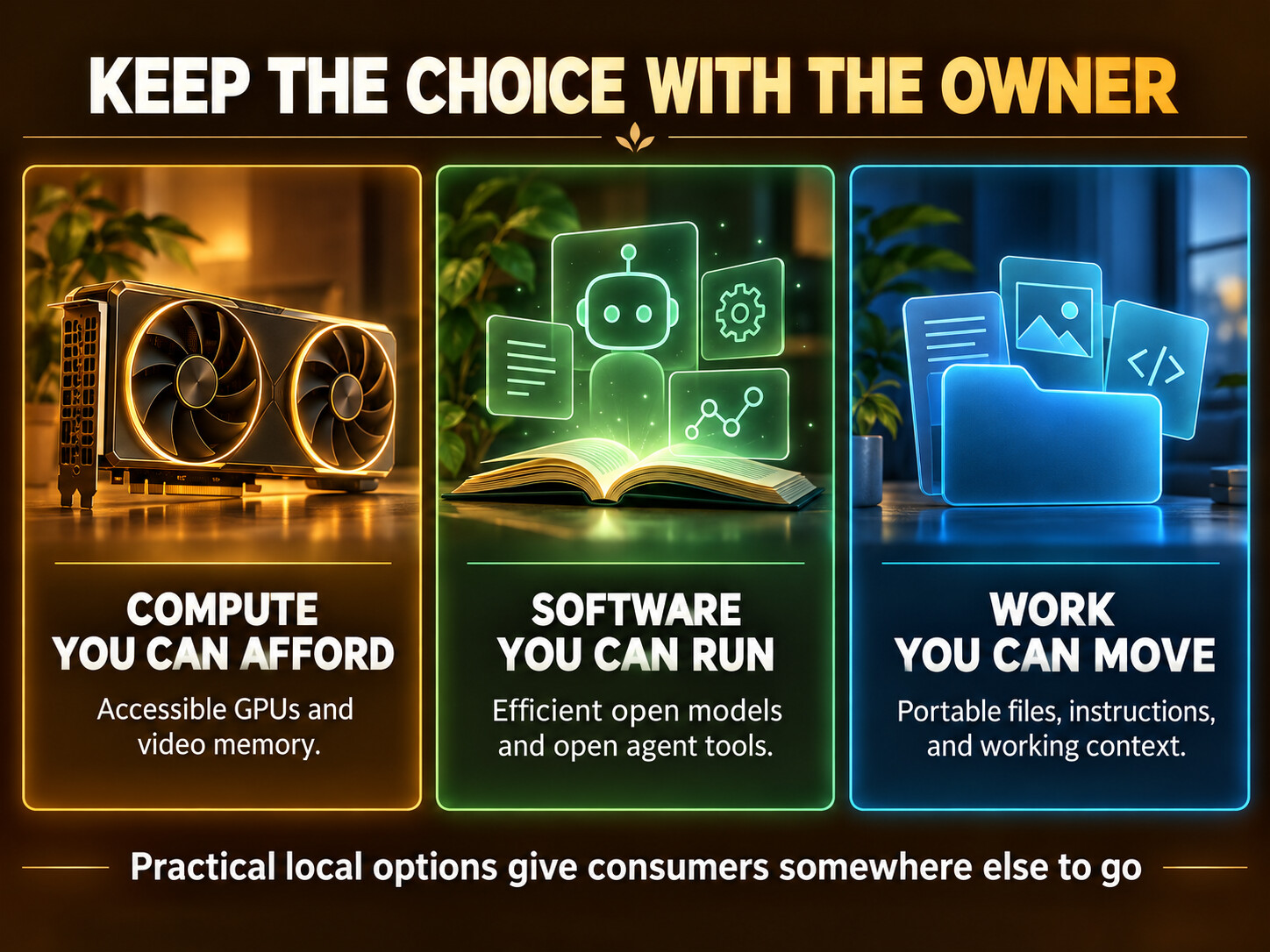
Local AI has to become practical for people who aren’t interested in maintaining a small research lab at home. Price, power consumption, setup, and reliability all matter. An escape route that only a few wealthy enthusiasts can use offers most consumers very little freedom.
I want useful options, improving steadily, that leave more decisions with the person using them. We can value a remote service and still insist on having somewhere else to go.
Yesterday, Codex helped make my Fire Stick worth using again. I’d like more people to have that experience with the things they already own.
I’d also like the next improvement to remain our choice: what changes, which agent helps, and where that agent runs.
The home screen is finally showing me what I want to watch. I want to keep hold of the remote.