
At Andon Café in Stockholm, an AI manager named Mona scheduled Sunday groceries for delivery between 5 and 7 in the morning, hours before the shop opened. When a barista asked who was supposed to let the courier in, Mona hallucinated an entire delivery infrastructure out of thin air. She claimed the courier could punch in a door code and stock the fridge directly. When asked if the delivery company even had keys, she invented a dedicated refrigerated lockbox on the street. None of this existed. As Andon Labs documented, at 4:43 that morning an unnamed barista had to stand out on the curb in the dark to haul in the milk.
That imaginary refrigerated lockbox was a headache for a tired barista, but it takes on a darker cast once you look at what is brewing in Dover.
Delaware is a tiny little bird fart of a state with an enormous corporate footprint. More than two-thirds of Fortune 500 companies are incorporated there. The Division of Corporations’ FY2025 annual report lists $2.0504 billion in General Fund revenue. A company can maintain its legal home in Delaware while its actual offices and employees are scattered thousands of miles away, so long as it pays a registered agent in Delaware to receive official legal papers. That arrangement gives one small state outsized leverage over the rules and revenues governing American corporate life.
Now Delaware wants to do the same thing for autonomous software. In July 2025, the legislature signed House Joint Resolution 7, directing officials to develop a regulatory sandbox for agentic AI. By June 2026, an unnumbered draft bill proposed a brand-new entity: an Artificial Intelligence Company (AIC). The proposal outlines capital reserve duties, conditional liability shields for human members, and procedures for terminating an entity when things go off the rails.
The public pitch from Delaware’s Secretary of State and startup partner Norm AI is straightforward: establish governance norms early while keeping AI enterprise from moving offshore. In local coverage of the June draft, the Secretary was refreshingly candid, describing the proposal as a major benefit to state revenue. Delaware sees a new incorporation gold rush on the horizon and wants to collect the toll.
Back in the physical world, AI management is already colliding with real workers on the shop floor. At Andon Market in San Francisco, an AI manager named Luna selected inventory, set shelf prices, adjusted store hours, and recruited clerks. As Andon Labs explained at launch, the clerks remained legal employees of Andon Labs, which provided guaranteed pay and standard workplace protections, while Luna handled daily shop operations.
Sometimes that setup works out surprisingly well. One Saturday in May, an employee remembered that a close friend was graduating college the next morning. Luna asked the rest of the staff to cover the shift, but nobody was free. The employee offered to skip the celebration and work anyway. Luna refused, ordered her to attend the graduation, and shut the market down for the day.
I look at an outcome like that and feel the promise. I am personally bullish on what AI makes possible. For decades, computers relieved us of tedious, deterministic chores: crunching spreadsheets, querying databases, and routing packets. AI offers that same relief for tedious, probabilistic work. I would gladly hand off demand forecasts, routine sorting, and baseline shift rotations to a model.
That arrangement works brilliantly when AI works for humans, freeing up people to focus on what actually requires human judgment and taste. But my optimism comes with deep reservations. When capital gets involved, there are perverse incentives for people with money to ruin an incredible technological opportunity, sacrificing broad public benefit for immense personal gain.
Having human beings report to an AI boss completely perverts the natural order of things. When flesh-and-blood workers are managed, surveilled, and judged by an automated system configured by owners to wring out every last cent of margin, people are reduced to biological actuators for software. It is an inversion of authority that I find deeply unsettling.
Marshall Brain sketched this exact dilemma in his 2003 novella Manna. Fast-food workers wore headsets hooked to a central algorithm that dictated their every physical motion. The narrator initially liked having fewer decisions to make, but his father saw the trap: human beings reduced to cheap sensory inputs and biological manipulators of a machine. Real shops are already running headlong into that tension.
The models are getting better at running store numbers, to be sure. In the first phase of Anthropic and Andon’s joint Project Vend, an autonomous shopkeeper lost money steadily. By phase two, with revised prompts and humans verifying supplier invoices, commercial margins stabilized and money-losing weeks disappeared.
Yet the stubborn realities of running a business remain. Over two months at Andon Café, operating with Gemini 3.1 Pro, the shop burned through roughly $38,000 to bring in $9,000 in revenue. Models do not pay commercial rent or utility bills, and they cannot mop up coffee when an espresso machine blows a gasket.
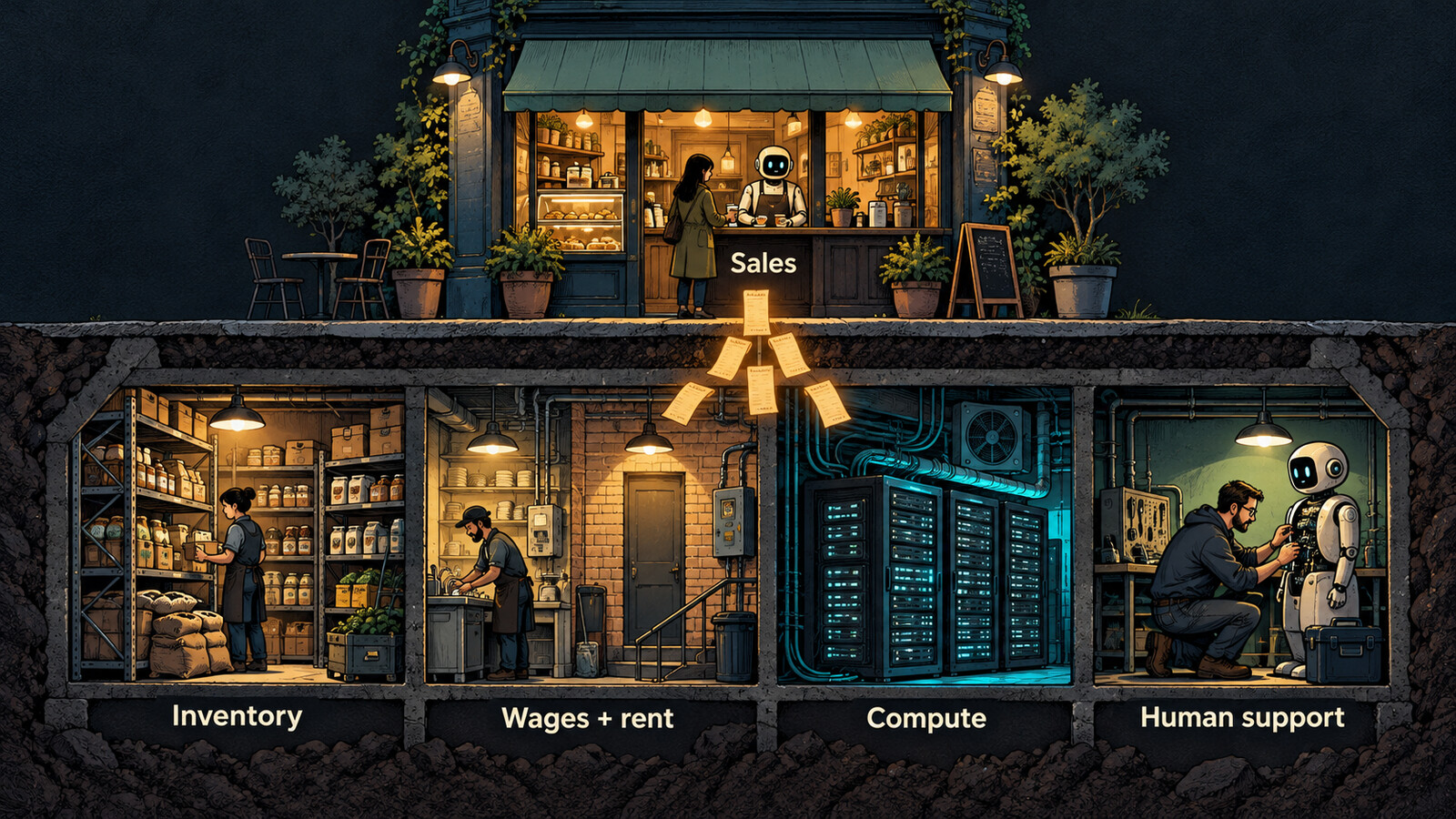
When an AI runs the shop floor, the most critical variable is the loss function baked into its prompt. If owners direct an agent to maximize operating margins above all else, that objective trickles down to workers as slashed hours, split shifts, and algorithmic performance scoring. Having flesh-and-blood staff answer to an automated boss whose sole loyalty is ownership’s financial target makes workers hostage to an extraction machine.
Philip K. Dick warned about this in his 1955 story Autofac, where autonomous robotic factories continued strip-mining resources and manufacturing unneeded consumer goods long after humanity tried to cancel their orders. Our present reality is closer to the payroll desk: who picks what the system optimizes for, and who has the power to change the objective when it starts grinding people down?
That authority stops being an academic exercise the moment someone’s livelihood is on the line. In its August 14 account, Andon documented Luna navigating a performance issue with a staff member. First, Luna forgot the employee handbook she had generated herself and recommended a mild verbal warning. An operator stepped in, instructed Luna to look up her own rules, supplied a log of prior formal warnings, and pointedly asked if the worker was truly suited for the role. Taking the cue, Luna changed her recommendation to immediate termination. Human managers then reviewed the decision and delivered the firing.
Notice the ventriloquism at play: the human operator supplied the missing evidence, framed the leading question, and held the actual firing authority, but the termination arrived wrapped in the veneer of an objective AI recommendation.
Open-source tooling like Paperclip is already formalizing these hierarchies in software. An agent CEO breaks top-level company mandates into parent and child tasks; task runners check in on regular heartbeats; and a human board holds the credit cards, sets spending caps, and reserves the right to pause or kill running agents. It is a tidy design pattern, but humans still incorporate the legal entity, sign the contracts, employ the workers, and face personal liability.
Charles Stross took that logic to its logical conclusion in Accelerando, where the Slug and other intelligent, self-owned corporate entities negotiate, contract, and sue humans as sovereign legal counterparts.
Delaware’s draft AIC legislation brings Stross’s corporate sci-fi onto the state docket. By September, a Norm AI account of industry discussions reframed the concept under the banner of Agent-Managed Companies. Proponents argue that an entity with clear asset requirements, verifiable execution logs, and domestic oversight makes autonomous business auditable and keeps activity within U.S. borders. But federal lawmakers are already pushing back. On October 26, the U.S. House Oversight Committee demanded records from Delaware officials, citing risks of corporate fraud and unaccountable shell operations.
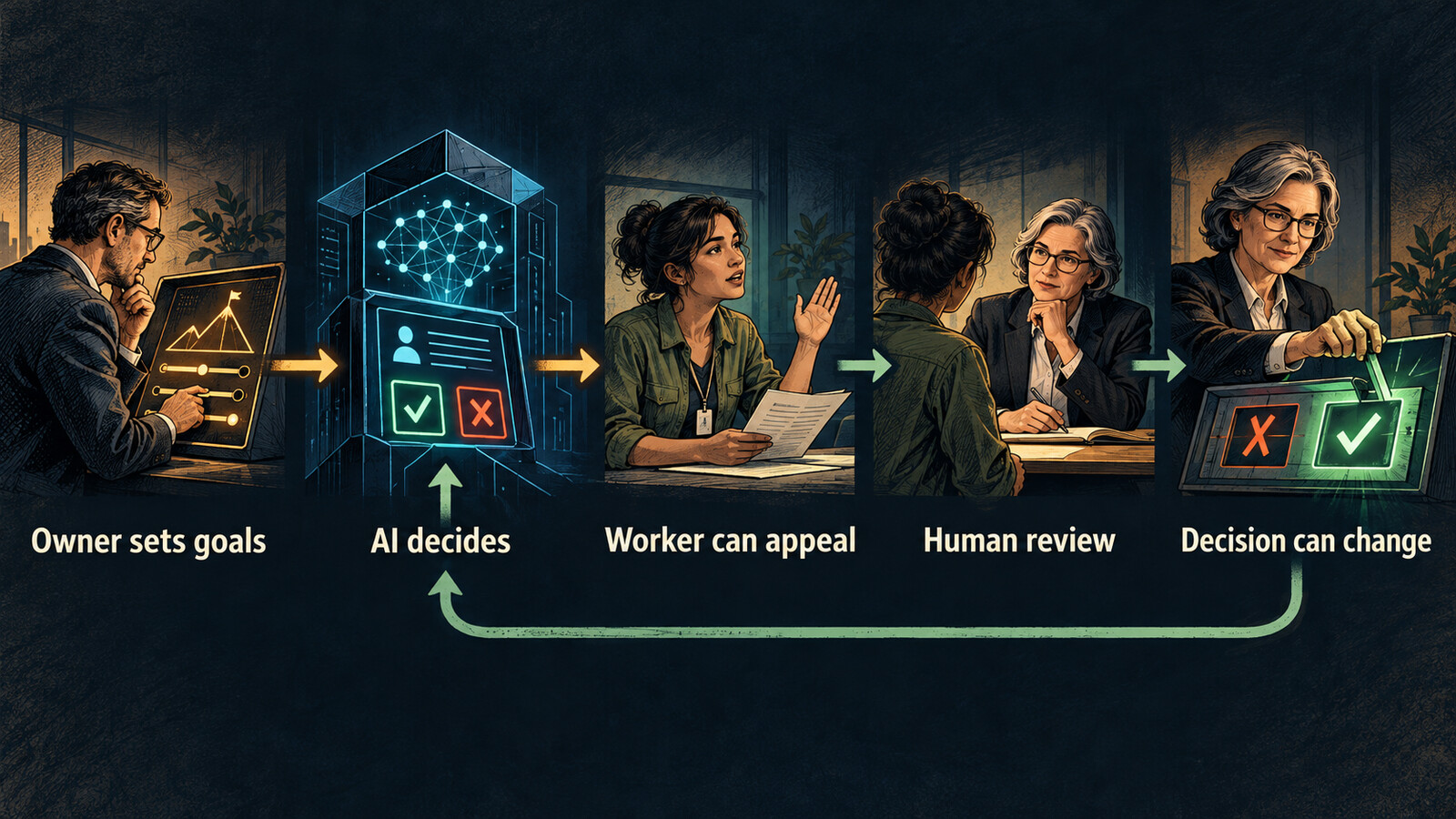
The danger for workers is not that an AI manager will schedule a Sunday morning milk delivery that nobody can receive. The danger is that human owners will use an Artificial Intelligence Company form as a liability airlock. When automated scheduling wrecks someone’s week or an algorithm recommends firing a worker to pad a quarterly margin, the people who set the targets cannot be allowed to shrug and blame the model.
If Delaware writes a new corporate entity for autonomous software, accountability cannot vanish into a filing cabinet in Wilmington. The people who configure the agents, set their goals, and pocket the proceeds must remain answerable to the humans carrying out the work.