I’ve watched the Backrooms movie about five times, and I expect I’ll watch it again. Kane Parsons’s work rewards that kind of return visit. There is too much detail to absorb in one pass, too much reality woven into the fiction, too many things that seem to be waiting just outside the frame. A background document might be a throwaway or it might be a key. A date on a form might mean nothing or everything. The videos invite obsessive attention without handing over an easy answer.
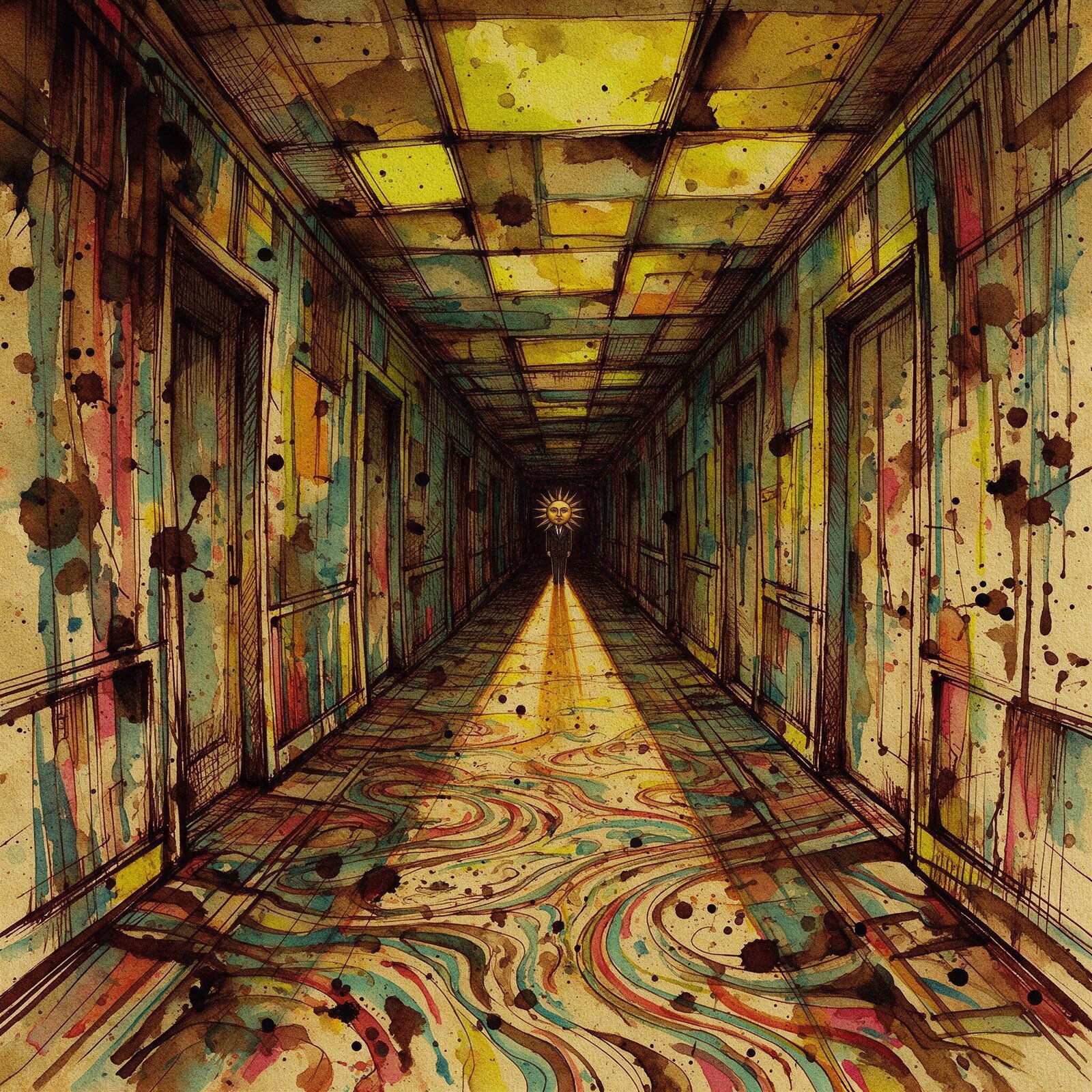
One of those details is the Sun. In the official Backrooms - Found Footage #3, repeated pictures show a radiating sun with a face. The video doesn’t give the images a name. Fans often connect them to a reportedly planned Parsons project associated with the same sun-face motif, usually called Splendor. That’s a useful name for the question we’re asking, but it isn’t a confirmed label in the video.
There’s a real piece of new music in the record, too. Apple Music lists The Kind Old Sun as a Kane Parsons single released June 15, 2026. The title and cover make a connection to the Sun easy to imagine, and the song feels like one more sun clue, even if it isn’t official canon.
And there’s a wonderful public clip. A fan account’s six-second video on X shows the sunburst pin and the prompt “TELL US ABOUT YOUR PIN.” The full source video preserves the short exchange at approximately 00:23–00:28: “The sun told me to wear it. It talks to me. That’s all I can say.” The video context identifies Parsons wearing the pin at the Backrooms movie premiere. It’s a weird, warm moment from a premiere, preserved by a fan, and I love that it exists.
Once you put that sun-face motif beside the dated episodes, a more specific question appears: do real solar events line up with Parsons’s fictional chronology? The short answer is sometimes, and in ways that are genuinely fun to think about.
The Sun is in the machinery#
Parsons’s great strength is his control of implication. A detail can be story, atmosphere, an Easter egg, a visual rhyme, or a door into another project. Those possibilities coexist, and the fun is in letting them.
The historical calendar is where the theory becomes concrete.
A date in the sky#
In Overflow, a late document carries Ivan Beck’s approval and the date 8/2/72. Around it, an instrument climbs into overload, green light floods the frame, and the sky seems to rotate or mirror itself. The impossible sky is the detail that keeps pulling me back. You watch it and wonder whether the Backrooms has its own weather, its own sky, its own Sun. You can see all of that in the official video.
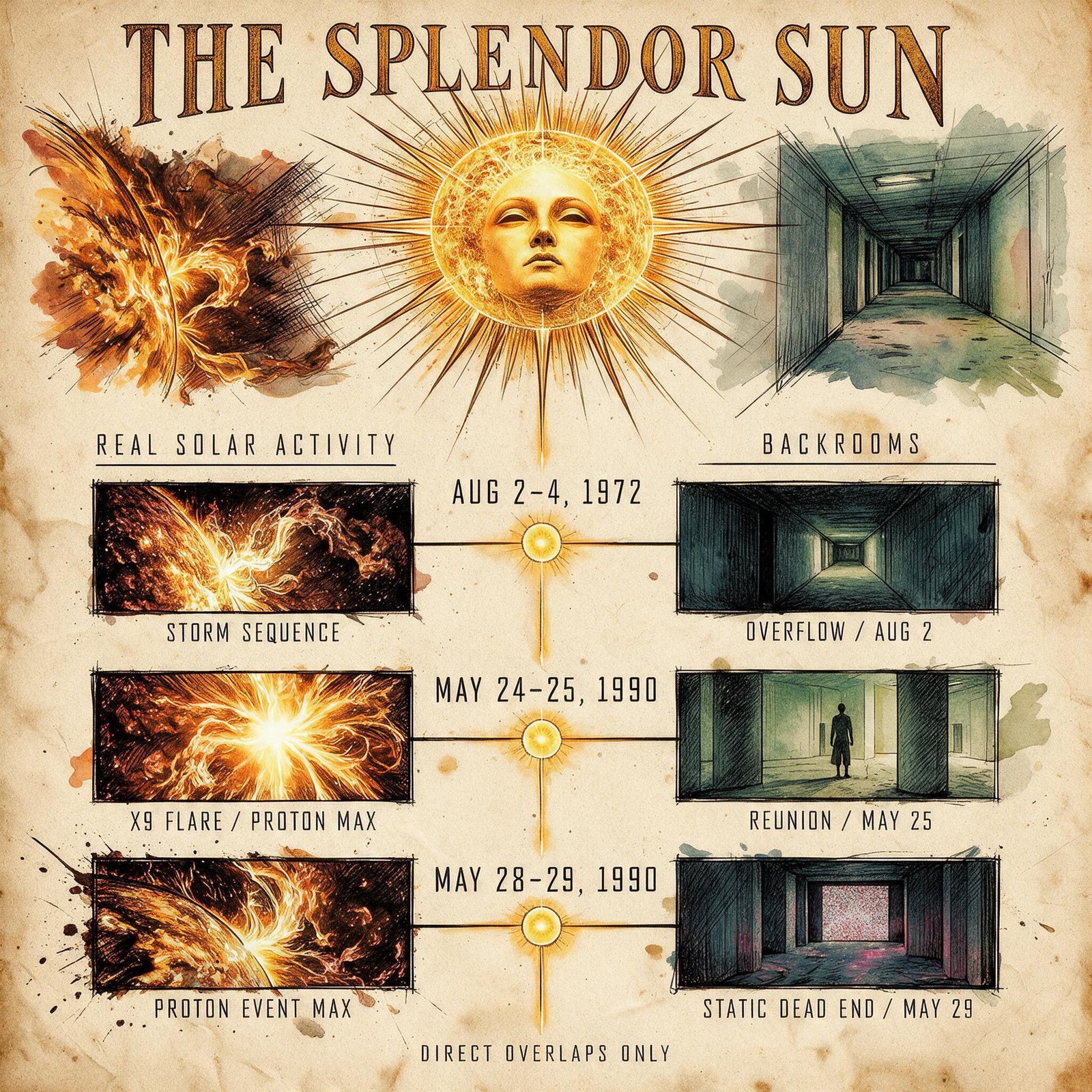
The real Sun was putting on its own extraordinary show on that same calendar date. NASA dates the beginning of the 1972 storm sequence to August 2. A peer-reviewed reconstruction fills in the next two days: several eruptions followed between August 2 and August 4, and the record-fast shock reached Earth about 14.6 hours after the August 4 eruption. The overlap is still striking. The fictional incident starts on August 2, and so does the real storm sequence. The fastest eruption came two days later, on August 4, which is worth keeping straight without taking the fun out of the coincidence.
The calendar keeps talking#
Lighting and Tile Survey is dated November 14, 1989. Its narration even says, “Today is November 14th. It is a Tuesday.” The next day, November 15, NOAA’s solar-proton archive records an X3 flare and a proton event. The episode comes first, then the sky answers overnight. That is exactly the kind of timing this story invites us to notice.
Reunion is dated May 25, 1990. NOAA’s May 24–25 event record shows a flare on May 24 setting off a proton event that reached its maximum on May 25, after beginning the previous evening. The May 25 date lands right on that peak. That’s the kind of detail that makes you sit up and keep reading.
Static Dead End gives us another May date, May 29, 1990. The same NOAA archive records a separate proton event that began May 28 and peaked on May 29. The fictional date lands on the solar peak again.
Put the four dates together and they move like a sequence. A storm begins alongside Overflow. The Sun answers the Backrooms the next day, after Lighting and Tile Survey. Reunion and Static Dead End each land during a proton maximum.
The Sun’s activity unfolds as a chain, not a single button. A flare’s light reaches Earth in minutes. Energetic particles and the shock from a coronal mass ejection can take hours. The 1972 shock reached Earth about 14.6 hours after the August 4 eruption. So a day between a Backrooms event and a solar event sits comfortably inside the lag the Sun’s physics already allows. That’s enough to make the calendar feel haunted.
The arrow might point either way#
Here’s where the speculation gets fun. If the Backrooms has its own physics, the arrow might point either way. The Sun could be disturbing the complex, or the complex could be disturbing the Sun.
The obvious direction is inward. Solar activity ripples toward Earth, and in the fiction it could ripple into the Backrooms too, appearing there as an incident or a disturbance. The August 2 overlap reads naturally this way: a real storm sequence begins, and something in the Backrooms overflows.
But the other direction is the one that tickles me. A Backrooms event ripples outward and affects the Sun, so a solar event the next day might be a consequence rather than a cause. The Lighting and Tile Survey date is November 14, and the proton event is November 15. What if the survey came first? What if whatever happened in that tiled room sent a disturbance upward, and the Sun answered?
Reunion works the same way from the other side. The episode falls on May 25, during the proton maximum that began the evening before. Did the Sun disturb the Backrooms, or did the reunion disturb the Sun? Both readings are equally fun to sit with, and the fiction doesn’t close the door on either one.
As worldbuilding, it is irresistible. Parsons builds a universe dense enough that the question feels worth asking, and the fiction is generous enough to leave the door open.
Looking toward 2027 and 2035#
The future part of the theory usually gathers around two eclipses. NASA’s eclipse catalog for 2021 through 2030 lists a total solar eclipse on August 2, 2027. That’s exactly 55 calendar years after August 2, 1972, the date on Overflow’s document and the beginning of the historical storm sequence. NASA’s 2031 through 2040 catalog lists another total eclipse on September 2, 2035.
The anniversaries give us dates to watch. An eclipse is a geometric alignment, so its calendar date is a bookmark for attention, while a flare depends on the Sun’s magnetic mood, which nobody can schedule.
Solar Cycle 26 is the more tantalizing clock. NOAA’s current Cycle Progression page expects it to begin sometime between January 2029 and December 2032, but NOAA has not issued an official forecast for its strength or peak. A 2024 peer-reviewed model places a possible maximum in 2035 and 2036. That gives us a date range to watch, not a promise.
There’s also a deeper rhythm underneath the 11-year sunspot cycle. NOAA’s Sunspots/Solar Cycle overview describes the cycle, whose magnetic polarity takes roughly 22 years to return to its starting orientation, a pattern some call the Hale cycle. If you’re the kind of fan who notices that 1972 plus 22 lands on 1994, or that the August 2027 eclipse sits inside that same long beat, the pattern starts to feel seductive. It gives the whole theory a longer rhythm to hum along with.
The fun from here is simple: watch what Parsons releases next, keep an eye on the Sun’s calendar beside it, and see whether new echoes turn up.
The pleasure of an unsettled clue#
What I love about Kane Parsons’s work is the labor visible underneath the mystery. The videos feel built rather than merely plotted. They reward attention because the world has been given enough density to withstand it. The Backrooms movie carries that same sense of care, and I respect what Parsons has put into the work since he was an adolescent.
I expect I’ll watch the movie again. And I’ll be watching for whatever Parsons does next, whether it’s Splendor, another sun pin, or something none of us have guessed yet. That’s a good place for a mystery to live: in the accumulation of clues, with room for the work to keep surprising us.