
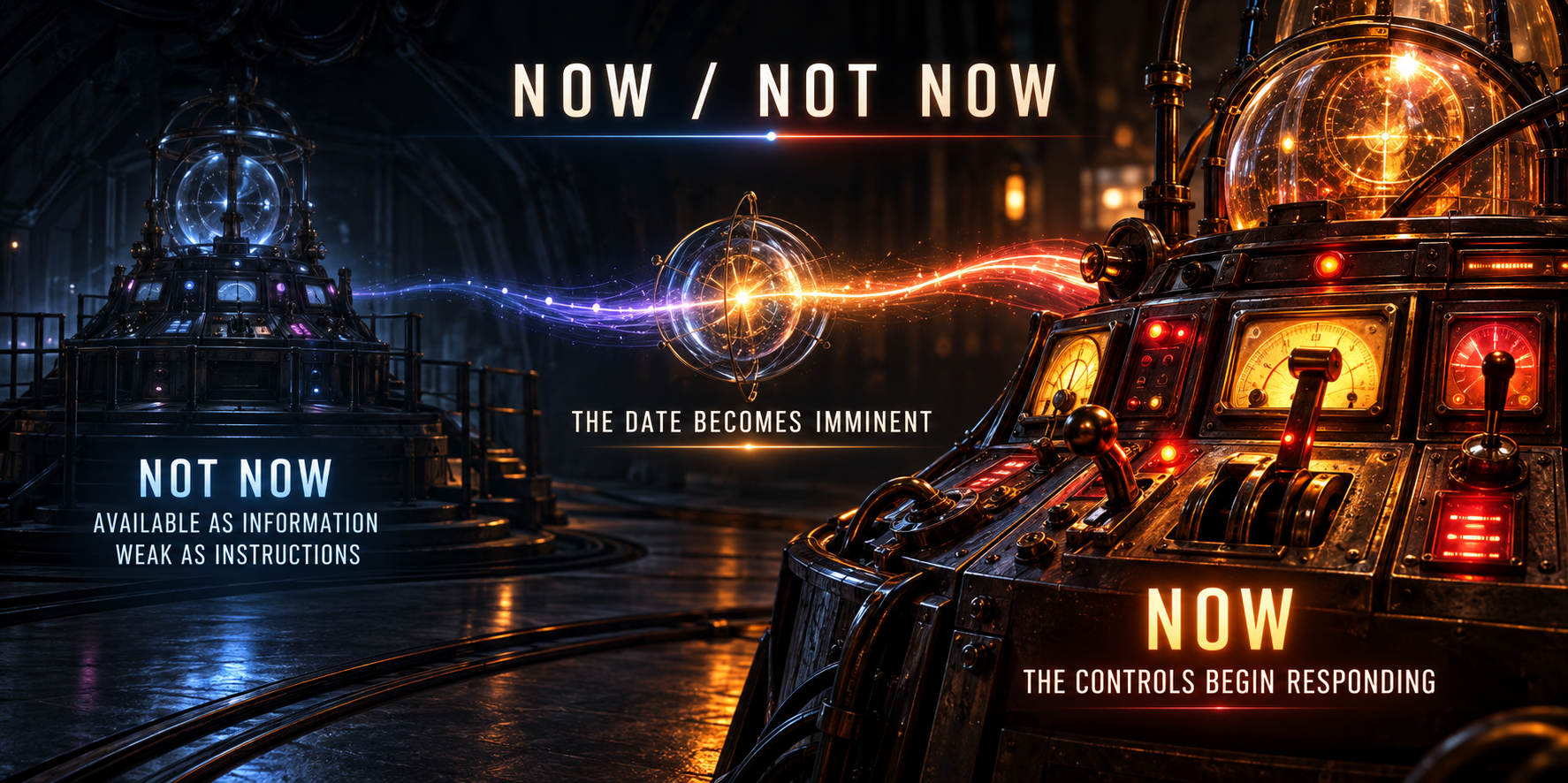
The Doctor once tried to explain time as something much less orderly than a line. In Blink, he gave us “wibbly-wobbly, timey-wimey.” My ADHD version is less cosmic and more inconvenient: nowy-not-nowy. The TARDIS is broken, and the destination dial has only two settings. Now. Not Now.
I first encountered the phrase “time horizon collapse” in a Sofia Rose Online post, where she used it for a more pedestrian ADHD problem: a later appointment can make the hours before it feel unusable. The phrase also fits a broader experience I know well: a future obligation can stay perfectly legible in my head while losing the force that would make it govern what I do in the present.
I am ADHD. Many of you are too. We know this phenomenon from experience even when we don’t have a name for it. ADHD people also have a long tradition of making self-effacing jokes about the ways it trips us up. We can laugh at the broken TARDIS because the joke is recognizable. The consequences can still be real.
A meeting next week isn’t necessarily forgotten. A bill due next month isn’t necessarily unknown. The appointment, the deadline, and the sensible plan can all be available as information while remaining strangely weak as instructions. Then the date becomes imminent, the future turns into Now, and the controls begin responding again.
I’m borrowing time horizon collapse beyond that appointment-day example, for the broader gap between knowing about the future and letting it govern the present. It is not a diagnosis, clinical model, or established research term. The older scientific lineage includes Russell Barkley’s 1997 theory of ADHD, self-regulation, and time, which described ADHD as returning control of behavior to “the temporal now.” “Time blindness” and “Now / Not Now” are useful lived-language labels too. The research separates the experience into several neighboring pieces of the machine.
When the future stops pulling#
You know the meeting is next Thursday. You can see it on the calendar. You can describe what it covers. And yet that knowledge sits there like a fact about the weather, not like something that needs action today. The future isn’t invisible. It just isn’t pulling.
NICE’s ADHD guideline focuses on practical support: environmental changes, organization, time management, remembering appointments, daily structure, and treatment options.
Researchers study the gap between a future event and a present action from a few different angles. Some ask how we perceive time passing, and whether that perception differs for ADHD people. Some ask why a later reward loses some of its pull compared with an immediate one. Some track what happens between forming an intention and actually carrying it out.
These questions are related, but they aren’t the same question. How long a minute feels is separate from why a bill gets missed, and choosing between $20 today and $50 next month is separate from making a dentist appointment. That separation is where the useful explanation begins.
What timing studies can and can’t tell us#
Does ADHD actually change how time feels?
Several large research reviews comparing ADHD and non-ADHD groups on timing tasks have found differences on average. A 2024 review by Metcalfe, McFeaters, and Voyer pooling results from many studies found a moderate average difference between ADHD and comparison groups when people were asked to estimate, reproduce, or compare time intervals.
The tasks in that literature vary. Participants might estimate an interval, reproduce it, or judge whether a time estimate feels accurate. The direction and size of differences depend on age, task, and design. A child and an adult aren’t interchangeable data points.
The child and adolescent evidence is comparatively clear on one narrow point. A review of 27 studies, with more than 1,600 ADHD participants and nearly 1,250 comparison participants, found lower timing accuracy and precision in the ADHD groups, with age and gender affecting the size of the difference.
Adult timing research is thinner and more mixed. Mette’s review of a decade of adult ADHD time-perception research described the number of studies as very scarce, with findings differing across estimation, reproduction, and time-management tasks. The adult evidence just isn’t settled yet.
If the TARDIS dial behaves differently, we still need to ask which circuit is misbehaving in which situation.
What happens while a reward waits#
Think about a reward that’s waiting in the future. You know it’s coming. You know it matters. But right now, whatever is in front of you has texture and immediacy, while that future reward is just an idea.
Researchers call this “delay discounting”: a reward loses some of its motivational pull as it moves further into the future. A 2016 review by Jackson and MacKillop found that ADHD groups discounted delayed monetary rewards more steeply than comparison groups, across 25 comparisons from 21 studies including children and adults. The average difference was moderate.
Still, the result offers a bridge between “I know this matters later” and “later isn’t exerting much force right now.” A reward that is vivid in the present can outcompete a reward that is merely understood in the future. The same logic may make a distant deadline feel more like a fact than a command, though that extension is an interpretation, not a direct measurement.
Urgency can change the balance. A deadline that was Not Now yesterday becomes Now at 4:57 p.m., and suddenly the task has texture, stakes, and a place in the control room. Researchers discuss arousal, reward, and state regulation as context-sensitive parts of ADHD. That context-sensitivity is reason to be suspicious of moral explanations that treat every delayed start as a stable character defect.
Where intentions break down#
The clearest evidence for the gap between knowing and doing comes from prospective memory, the research term for remembering to do something later.
Think about the last time you told yourself to send an important email after lunch. You remembered the intention. You knew what to write. Lunch came and went, and the email didn’t get sent. The problem wasn’t that you forgot the plan. Something between the plan and the action didn’t hold.
A structured adult study compared 45 ADHD adults who weren’t taking stimulant medication with 45 matched controls. The ADHD group showed a large difference in planning, while the difference in recalling the plan itself was negligible. The person can know what the plan is and still have built a less workable bridge toward carrying it out.
The study makes an important point: forming the plan, remembering the plan, noticing the right moment, and actually starting are separate operations. “You remembered” doesn’t logically entail “you were equipped to execute.”
A 2019 study by Altgassen, Scheres, and Edel moved closer to ordinary life. ADHD adults completed fewer of the everyday intentions they set for themselves, and the gap in prospective-memory performance helped explain the link between ADHD symptoms and procrastination. The result challenges the idea that forgetting the instruction is the only failure that matters.
The problem may occur before forgetting, after remembering, or in the handoff between intention and action.
Working memory is one contributor. Working memory is the mental workspace that holds information while you’re using it, like keeping a future instruction active while current distractions arrive. A review of 38 adult studies by Alderson and colleagues found moderate average ADHD-related differences in working memory. The timing review found that working memory was linked to the size of timing-task differences only in participants under 18.
The brain story is distributed too. A review of 55 brain-imaging studies by Cortese and colleagues found group differences spread across multiple brain regions, rather than a single broken spot. A large youth analysis of brain connectivity found small average differences spread across multiple regions.
And dopamine is involved. MacDonald and colleagues’ critical review of the dopamine hypothesis found evidence for dopamine’s involvement, with human and animal findings showing increases, decreases, and no change across different measures.
What can I do with a broken dial?#
The practical response is to stop asking the internal clock to carry the entire scheduling system.
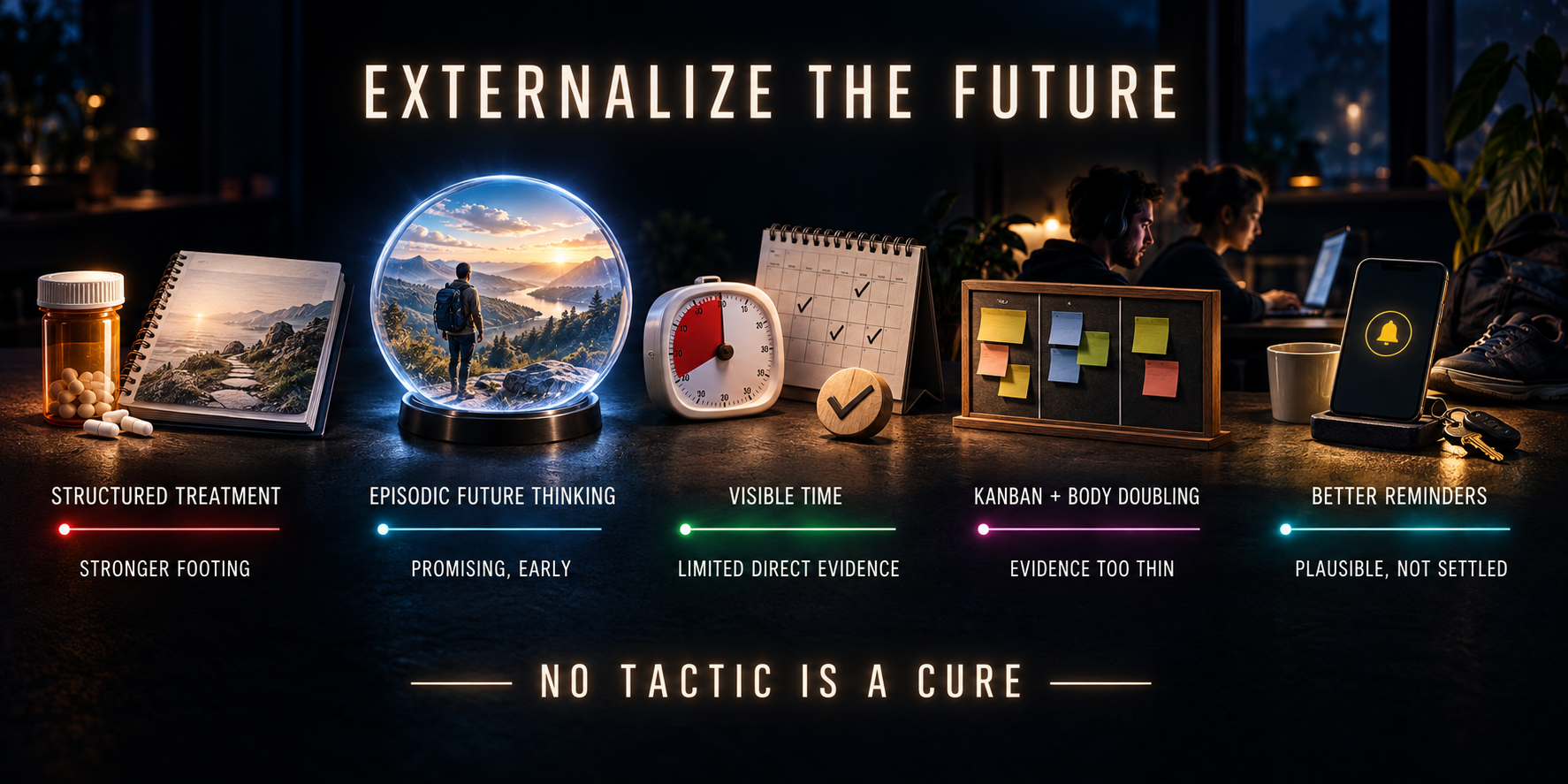
Put time where it can be seen. A visual timer may make a passing interval more concrete. A calendar with a next action can turn “prepare for the appointment” into “open the form.” A short checkpoint may make a distant commitment less abstract. These are reasonable, low-risk accommodations to test, with limited direct ADHD-specific evidence for analog timers.
Make the next action external and close. “Work on taxes” is a destination. “Find the tax folder and put it on the desk” is a door. A Kanban board can show task state, and body doubling can add social presence. Either may help a particular person, though the evidence is thin. That fits the broader argument in Accommodation Is Not the Answer: support shouldn’t be an exception you have to fight for.
Reminders need better design than “send another reminder.” In a randomized adult ADHD study, extra generic weekly SMS messages didn’t improve overall module completion or login counts, although selected modules showed differences in login speed or time spent. A reminder that arrives at the wrong distance from the action can become wallpaper. Timing, specificity, and an immediate next step are plausible improvements worth testing.
Structured treatment has stronger footing than any individual productivity trick. A 2025 review pooling 113 randomized trials and 14,887 adults found short-term core-symptom benefits for stimulants and atomoxetine on both self-report and clinician ratings. Psychological approaches showed more variation by outcome and rater. NICE recommends individualized care, including medication when appropriate and structured ADHD-focused psychological support when indicated. Treatment can reduce some of the problems that make the handoff from future intention to present action unreliable.
One newer experiment points in an interesting direction. In a 2026 randomized study of 196 adults, half in the ADHD group, Stelz, Edel, and Altgassen tested a simple idea: when you form an intention, spend a moment picturing yourself actually doing it. Researchers call this “episodic future thinking,” and it improved later intention completion compared with forming the intention the usual way. Picturing the outcome worked best. For one recent study with a brief design, that is promising enough to watch.
The idea is simple enough to try without pretending the science is finished: don’t only write down what you will do. Spend a moment making the future result concrete, or picture the first physical step. If it helps, the benefit may come from giving Not Now a little present-tense texture.
Agency without the courtroom drama#
I don’t want a name for this experience to become an alibi. If my behavior affects someone else, recognition doesn’t erase the effect. Naming the mechanism still leaves me responsible for repairing the impact and redesigning the point where the system keeps failing. It also lets us stop treating every failure as evidence of bad intent.
The ordinary planning system assumes that a future consequence will remain equally available as a motivator. For some ADHD people, that assumption is unreliable. External cues, structured support, treatment, and a more precise understanding of the failure point can reduce the number of times a task has to cross that gap unaided.
The TARDIS metaphor gives me a way to describe the odd interval when the future is intellectually present and behaviorally remote.
I’ll settle for a control panel that lets the future get my attention before it arrives screaming and starts throwing switches.