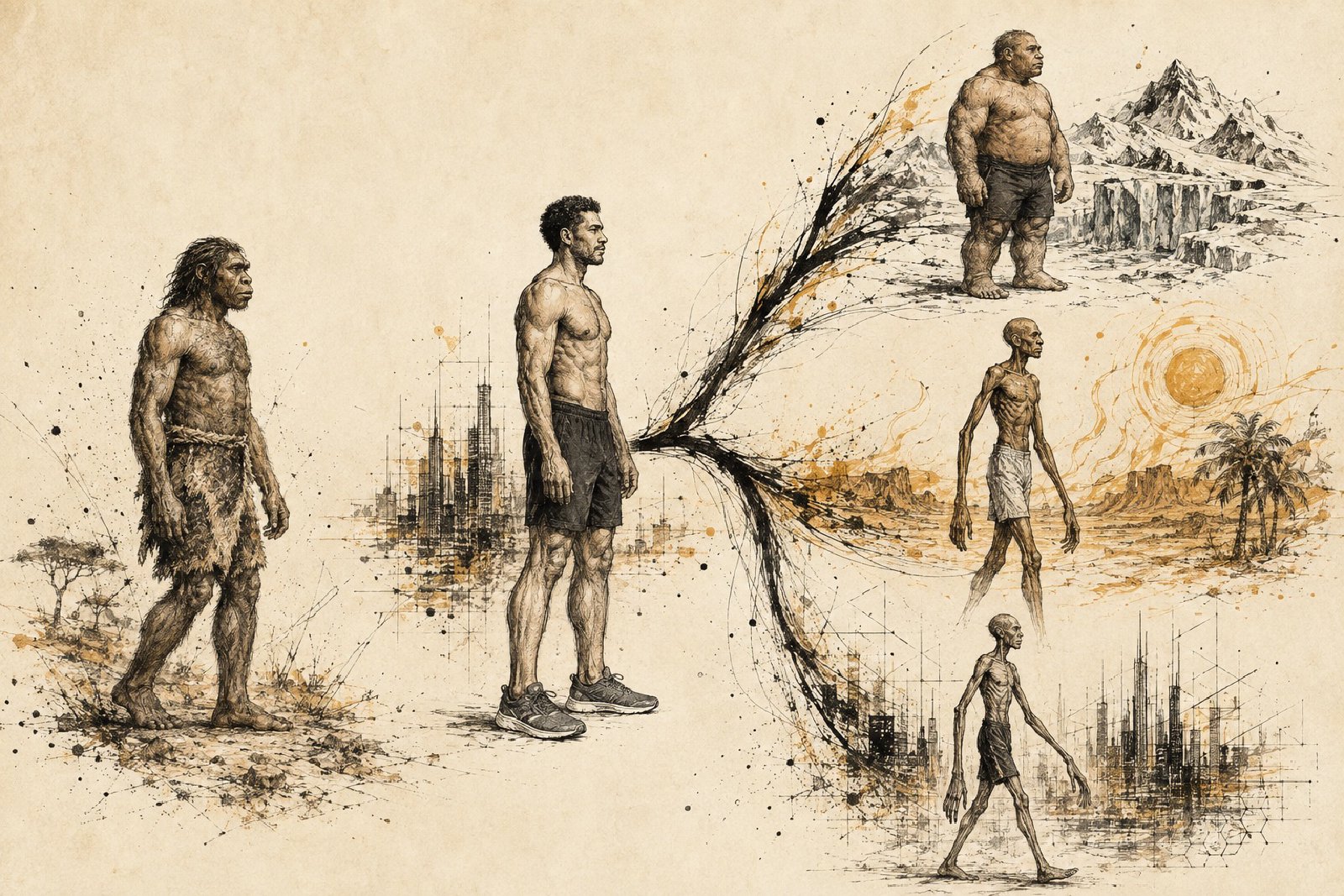
Welcome to the family album from two million years in the future.
The captions are a little strange because the family has become very strange. Here is the compact one, built like a suitcase with opinions. Here is the heat model, all limbs and ears, looking as if evolution hired a sound engineer. And here, under the fluorescent lights of a city that never quite sleeps, is the long-handed descendant whose fingers have become a permanent argument with a keyboard.
None of them is a prediction. They are suspects.
The curator has assembled them to answer an awkward question: if evolution once happened to us, what happens when we become the environmental event shaping ourselves?
We alter the climate. We build habitats. We move pathogens around the planet, then suppress them with medicine. We change who can reproduce, when, and how. Eventually, perhaps, we will edit embryos and pass some of those choices down the family tree. The old pressures are still in the room, but they are now accompanied by air conditioning, public-health departments, venture capital, zoning boards, fertility clinics, and a truly alarming amount of software.
The two-million-year horizon is a theatrical prop, not a forecast. Biology does not owe our imagination a satisfying silhouette. Still, the thought experiment gets interesting when the descendants stop being examples in a textbook and start interrupting one another.
The family album has no straight line#
The compact descendant points at the first page. “Begin with Homo erectus,” it says, as if it has been waiting all afternoon to correct the tour guide.
Fair enough. The Smithsonian Human Origins Program places Homo erectus roughly between 1.89 million and 110,000 years ago, while also noting that the category is variable and contested. Some researchers separate African Homo ergaster from Asian Homo erectus. Others use erectus more broadly. Even the label arrives with a footnote attached.
The fossils include bodies with elongated legs and relatively shorter arms, useful proportions for a terrestrial animal moving across substantial distances. A specialist review by Jeffrey Antón makes the variation difficult to mistake for a clean template.
The old family album was never a ladder. It was a box of photographs from several parties, some of them taken in bad light, with cousins arriving and leaving through doors the photographer did not notice. Populations split. Populations met again. They mixed. Some lineages disappeared. Others contributed genes without becoming a neat named species in the caption.
The emergence of Homo sapiens has the same inconvenient shape. The Jebel Irhoud fossils date to about 315,000 years ago, and the associated Nature research describes an early, geographically distributed history of Homo sapiens. Those fossils do not show one isolated population suddenly stepping onto the stage as “modern humans.” They show a deep African history in which populations varied, moved, mixed, and accumulated traits over time.
This is important for the family-album gag because descendants do not emerge from a single chute. The past gave us branching lineages and uncertain ancestry. The future gets the same mess, plus airports.
For much of the Pleistocene, weather, food, predators, parasites, terrain, and other organisms imposed costs on Homo populations. Heritable differences could affect survival or reproduction, but nobody lived inside a pure biology experiment. Fire, clothing, shelter, tools, food processing, cooperation, and care moved part of the local environment inside the group. Culture began taking turns with the weather.
The curator flips the page. The descendants stop smiling.
The species that changed the set#
Natural selection needs more than an unpleasant Tuesday. It needs heritable variation, differences in survival or reproduction, and enough time and connectivity for variant frequencies to shift in a population. A heat wave is an exposure. A heat-related death can be a fitness consequence. Neither one, alone, proves that a particular body plan is on its way.
Our species has become very good at inserting other things between exposure and consequence.
Industrial greenhouse-gas emissions change heat exposure, extreme weather, food systems, water systems, health risks, migration, and working conditions. The IPCC synthesis report supports those effects. It does not provide a design brief for the future human ear.
Cities make the album harder to caption. Dense settlements alter contact networks, pathogen transmission, noise, light, mobility, food access, and social behavior. Johnson and Munshi-South describe urban environments as evolutionary systems, which is much more useful than declaring that cities select for one obvious “urban human.” The city is not a single pressure. It is a committee meeting that keeps changing its agenda.
Medicine changes the arrangement again. A treatment can let someone survive or reproduce despite a condition that once prevented either. Public health can reduce some exposures, suppress some pathogens, and create new ecological conditions in the process. Medicine does not switch evolution off. It changes which differences affect survival and reproduction, and it changes that relationship unevenly because access is uneven.
Air conditioning can soften heat. Clothing can soften cold. Transportation can reduce the cost of distance. Screens and desk work can alter activity, sleep, diet, and energy balance. None of that means natural selection is quietly breeding a person shaped like an office chair. Obesity, diabetes, and back pain are health outcomes, not body-plan blueprints.
Cultural evolution moves faster. A tool, norm, institution, or preference can spread without changing allele frequencies. It can still change who meets whom, who has children, what work is rewarded, and which biological differences matter. Culture and genes keep leaning on each other, like two people carrying a couch through a doorway and refusing to admit that the angle is wrong.
That is the twist in the album. The environment shaping future humans may include weather, but it may also include a hospital, a building code, a vaccine schedule, a labor market, a fertility clinic, and the price of electricity.
Three descendants enter an argument#
The cold descendant gets first word.
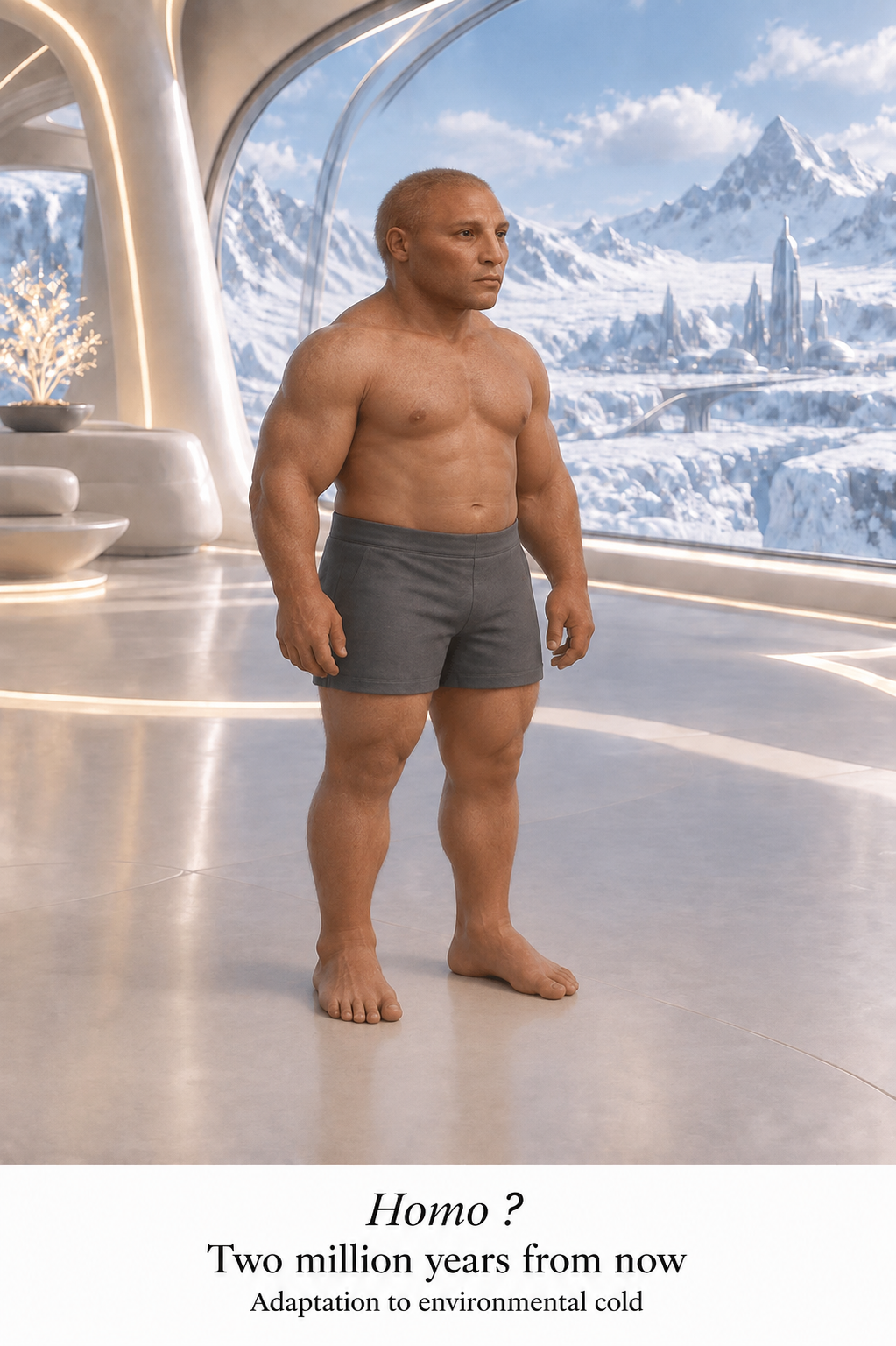
“Give me cold,” it says. “Give me generations in which technological buffering is limited, and heritable body differences affect reproduction. A more compact build could become more common.”
It has a case. Bergmann’s rule describes a broad tendency for endothermic animals in colder climates to have greater body mass or a lower surface-area-to-volume ratio. Allen’s rule concerns appendages, with warmer-climate populations tending, on average, toward relatively longer extremities and colder-climate populations toward shorter ones.
But the cold descendant is overselling the brochure. A reassessment across 263 human groups found that support for Bergmann’s rule depended on the geographic and temperature ranges sampled and on how the variables were chosen. A later critical analysis warns against turning the rule into a human just-so story. Nutrition, development, migration, clothing, buildings, and culture all arrive at the scene carrying their own evidence.
The heat descendant clears its throat. It has large ears, which makes this theatrical gesture especially effective.
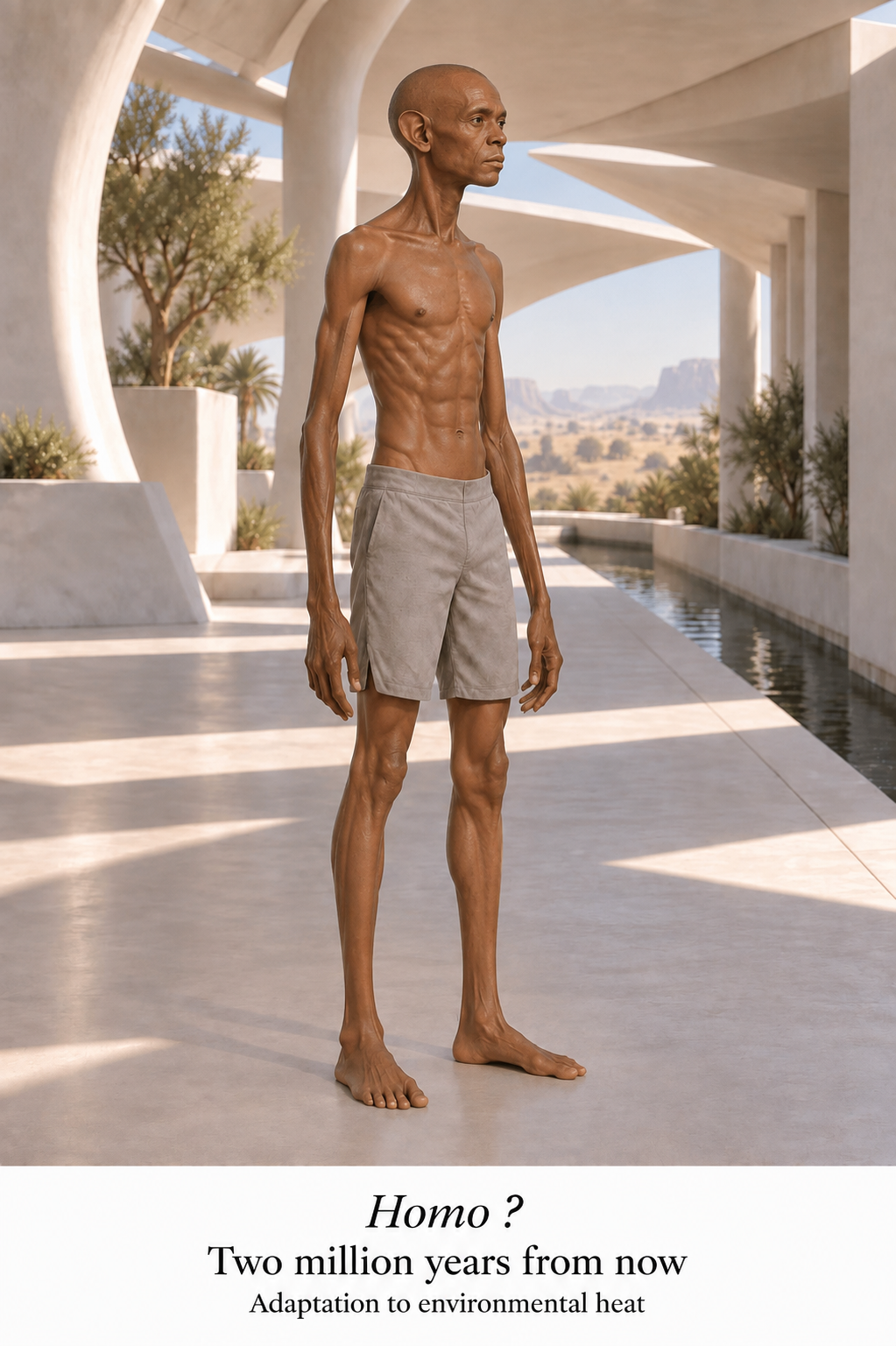
“Repeated heat stress might favor a leaner, longer-limbed body,” it says. “Maybe larger ears. Maybe better heat shedding. Assuming physiology matters more than shelters, cooling systems, migration, and policy.”
That last part is doing nearly all the work. A billion people with reliable cooling and a billion without it do not inhabit the same evolutionary environment, even when the weather map gives them the same color. Inequality can concentrate exposure. Policy can make heat a shared public problem or an individual bill. Migration can move people away from a pressure. Infrastructure can absorb it. The same climate can produce several different selection environments because institutions distribute danger.
The city descendant has been waiting for its cue.
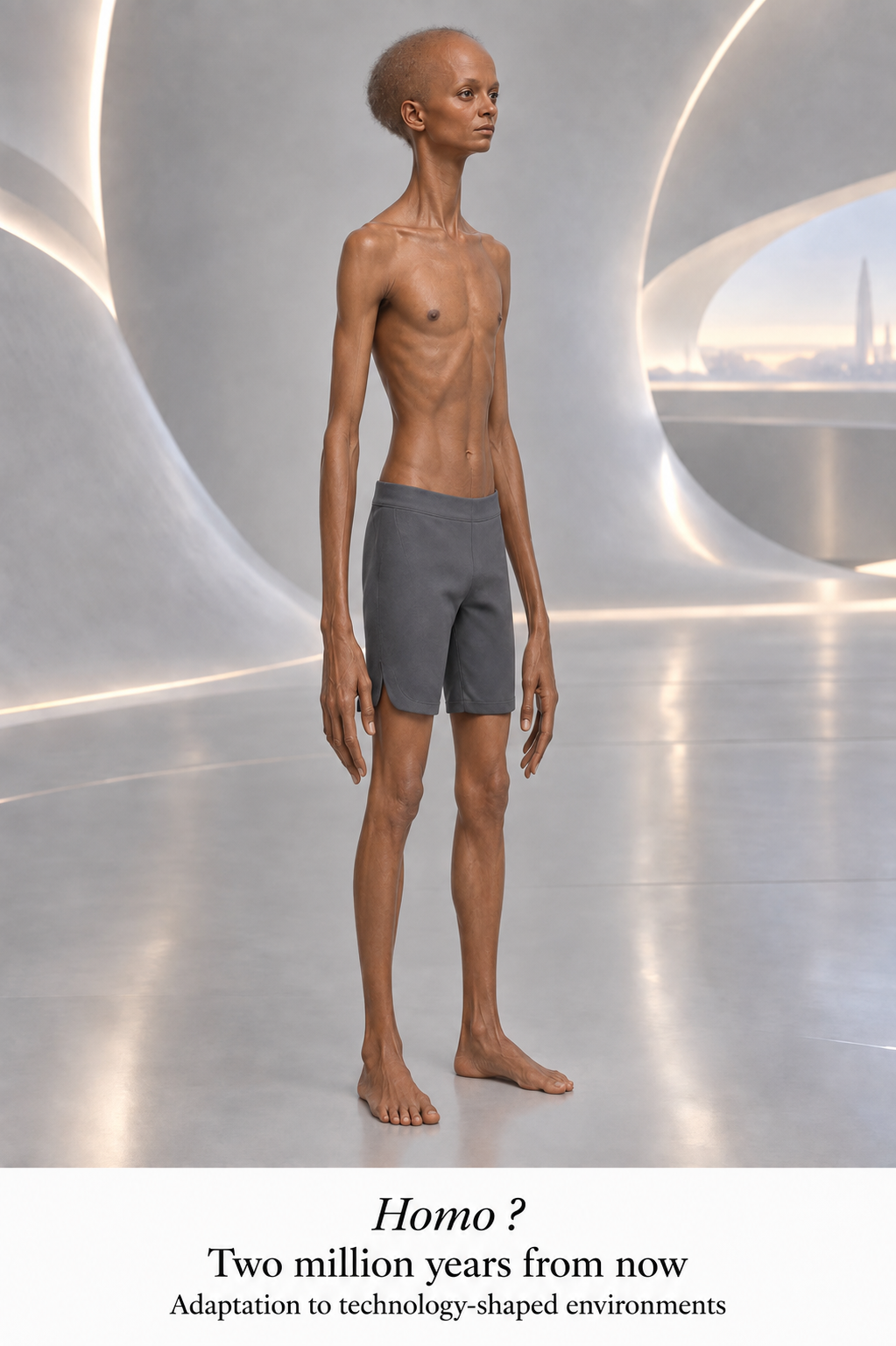
“Your climates are quaint,” it says. “My habitat is social and computational. I need fine motor control, relentless interface work, and a nervous system that can filter an information fire hose.”
The other two object that a phone can acquire a new interface in a year, while a population cannot evolve a new hand in a product cycle. The city descendant concedes the point, then quietly extends its fingers.
This is where the branch becomes useful. Long hands and small faces are not evidence. They are props. The real question is which pressures remain biological, which are handled by culture, and which are absorbed by machines before biology gets a vote.
A dense city might change pathogen exposure, sleep, mobility, social contact, and reproduction without producing a distinctive city body. It might instead produce a population whose daily life is increasingly protected, constrained, or directed by systems outside the body. The future descendant could look familiar and still live inside an entirely different evolutionary arrangement.
The reproduction desk is open#
The family album’s most consequential room may not be the climate gallery. It may be the reproduction desk, where choices become infrastructure.
Contraception, donor gametes, delayed childbearing, embryo testing, surrogacy, and IVF change the relationship between biological fertility and realized reproduction. Reviews of IVF and human evolution and IVF’s possible effects on selection describe plausible mechanisms by which assisted reproduction could circumvent some selection associated with infertility. They do not demonstrate a large, predictable change in the human gene pool.
The album curator writes five labels in the margin, then crosses out the word “technology” because it is doing too much work.
Natural selection changes variant frequencies through differences in survival or reproduction. Cultural evolution changes practices and preferences. Medicine changes who survives or can reproduce. Embryo selection chooses among existing genetic combinations. Heritable genome editing changes DNA in a lineage in a way that could pass to descendants. Somatic editing changes cells in one person and is not itself inherited.
Embryo selection is not writing a person from scratch. It is choosing among available combinations, with imperfect predictions and trade-offs. Complex traits such as intelligence, personality, and body shape involve many variants and environments. The prediction is noisy before anyone has to live with the result, which is an unpleasant feature for a product category that may eventually acquire a premium tier.
Heritable editing is different because an intentional change could become transmissible. The WHO framework on human genome editing treats somatic, germline, and heritable editing as distinct governance problems. The WHO recommendations call for oversight, registries, international coordination, and public engagement. The National Academies international commission identifies unresolved issues including off-target effects, mosaicism, developmental consequences, long-term monitoring, consent, and equity.
Now the descendants stop arguing about their ears and hands.
If contraception, assisted reproduction, embryo selection, and heritable editing become safe, effective, and widely used, they could influence human evolution intentionally. That sentence contains several enormous conditions. Access might follow wealth. Policy might restrict or encourage particular uses. Communities might make different choices. A trait favored in one environment could be irrelevant or harmful in another.
“Who gets to adapt?” asks the heat descendant.
“Who pays?” asks the cold one.
The city descendant points to the price list.
Adaptation could become something distributed by institutions and markets long before it produces visibly different populations. Some people would be protected by infrastructure, some by medicine, some by reproductive technology, and some would be left to face the raw environment. A society might call this adaptation while quietly deciding whose body counts as an acceptable risk.
That is a human problem before it is a posthuman one. A future genome clinic could offer choice, but choice is never floating in empty space. It sits inside laws, insurance systems, family pressure, cultural expectations, and the ordinary fact that some people have more room to say no than others.
The caption remains unfinished#
Two million years from now, assuming there are still humans recognizable as humans, the family album probably will not end with one official portrait. It will contain branches, vanished branches, mixed branches, and captions written by descendants who are still arguing about where the line begins.
One branch may be compact in the cold. Another may be lean in the heat. A third may have long hands for a dense technological world. None may happen. Something stranger may happen because the conditions we imagine will be interrupted by migration, disease, policy, wealth, invention, or a new way of making children.
Evolution still happens to us. We have simply started editing the room in which it happens, sometimes deliberately and often with the confidence of people rearranging furniture while the building is on fire.
The descendants in the album are not waiting for us at the end of history. They are a way to look back at the present and notice the machinery already surrounding reproduction, survival, climate, and choice.
The curator leaves the final page blank. For once, that is the scientifically responsible caption.