
I have a fascination, and sometimes an irreverence, for the way buzzwords can spread like wildfire in business. This is not a new habit. I have been making a small, happy nuisance of myself about it for years.
In 2013 I started writing for the Red Hat Developer Blog about a DevOps transformation we were running inside Red Hat IT, and somewhere in that series I went on a tear about managerspeak. My team hung a piece of paper on the wall with a Sharpie beside it, where we would write down the words that would never cross our lips. The next year, in a lightning talk at Surge 2014, I opened by ripping through the buzziest words of the moment, and then I said the thing I am proudest of from that era: “I’ve used up my buzzword quota, so now we can speak in plain English.”
That was over a decade ago. The wildfire has not gone out. It has moved on to new fuel, and the current blaze is “go to market.”
Here is the pattern I have come to recognize. A useful term starts by describing something specific. Then it gains prestige, expands into neighboring territory, becomes an organizational identity, and eventually tells you as much about the speaker as the thing they are describing.
“Go to market” has traveled that whole path. It is business language, not tech jargon, and technologists are downstream of it. We hear it in standups and roadmaps and quarterly all-hands, and we are left to decode language we never generated in the first place.
Where the term came from#
Companies have been going to market for centuries. That is not the interesting part. The interesting part is when the ordinary phrase became a hyphenated strategy, and then an acronym, and then a thing that a person can lead.
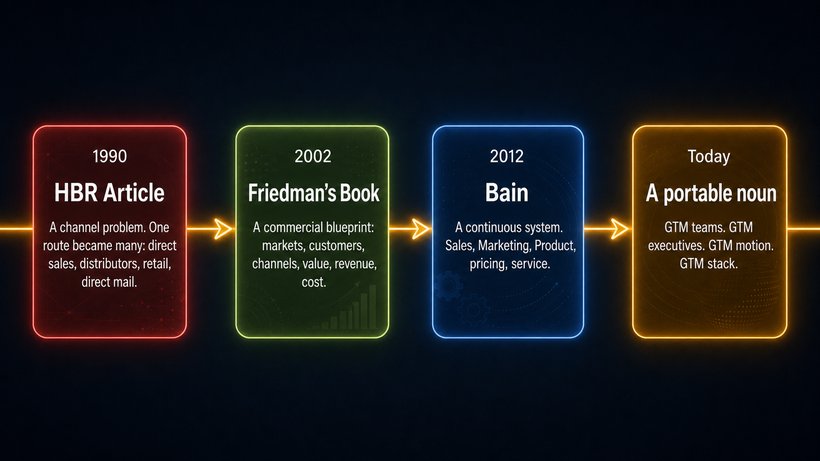
The earliest modern use I have been able to trace is a 1990 article in the Harvard Business Review called “Managing Hybrid Marketing Systems.” It is also the earliest use Roger Martin found when he went looking, though he readily admits he does not know whether it was the first. The article opens with a line that could not be more clear about how narrow the meaning was: “There was a time when most companies went to market only one way.” Direct sales. Distributors. Retail. Direct mail. The term named the genuinely new problem of coordinating several selling channels at once instead of just one.
That was the seed. A channel problem.
Then the term grew. In 2002, Lawrence Friedman published a book simply called “Go To Market Strategy,” and the channel plan became a commercial blueprint: which markets, which customers, which channels and partners, what value proposition, at what revenue and cost. By 2012, the consulting firm Bain was writing about “creating an adaptive go-to-market system,” and the word had completed its transformation. It was no longer a plan. It was machinery. The whole cross-functional apparatus that creates, converts, delivers, and expands revenue: Sales, Marketing, Product, pricing, distribution, service, post-sale support.
And then, in the last decade, the acronym went portable. Companies have GTM teams. Executives own GTM. Firms optimize their GTM motion, their GTM engine, their GTM stack. The word stopped pointing at a specific activity and became a badge you wear in the room.
How one meaning became three#
Here is the trouble, and it is the whole point. “Go to market” now covers at least three layers of commercial activity, and all three are current.
At its narrowest, it is an event: a bounded plan for launching a product or entering a market. Stripe holds this sense: GTM is smaller than a business plan, focused on getting one product to launch or taking it into one new market.
Then there is the expansive strategy. Gartner’s definition reaches across pricing, channels, the buying journey, launches, rebranding, demand generation, compensation, and the voice of the customer. It still calls GTM a plan, but that plan now touches most of the commercial organization.
And then there is the system. Bain’s 2012 formulation is explicit: GTM is the ongoing, adaptive machinery connecting Sales, Marketing, Product, pricing, distribution, service, and customer feedback. The term has moved from describing a trip to market to naming the vehicle, the road, the crew, and the navigation system.
Same acronym. Expanding scope. When the strategy professor Roger Martin wrote his critique of the term, he put his finger on why this matters. He called the piece “The Downside of Go-to-Market Strategy: Sounds Sexy, but Not Helpful.” His objection was not that the jargon is annoying. It is that the broad definition quietly swallows most of business strategy. If GTM owns the customers, the channels, the price, the brand, the advertising, and the launch, then GTM is most of “where to play” and “how to win.” And once you split the company into a Product head and a GTM head, you have dis-integrated choices that ought to be made together. The predictable failure mode is mutual blame: GTM says the product was unsellable. Product says GTM was terrible. Both are usually right.
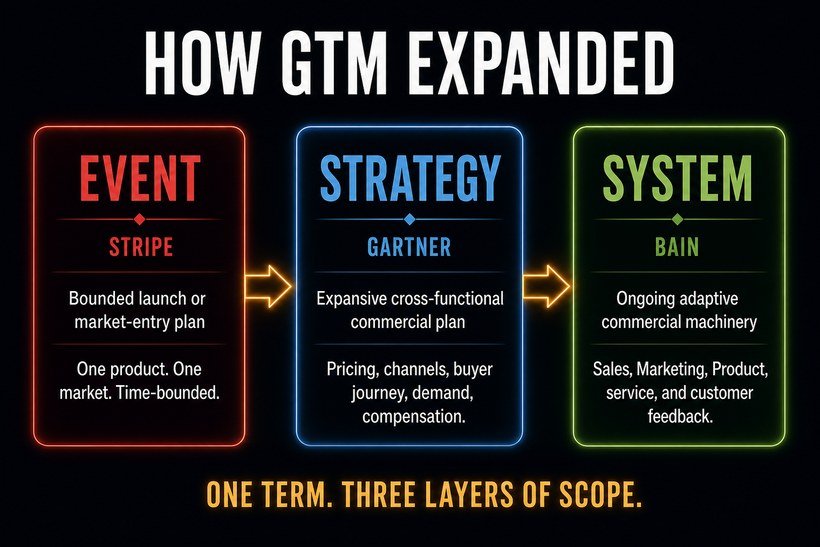
That is semantic inflation in plain English. A channel problem became a launch plan, the launch plan became a cross-functional strategy, and the strategy became an organizational system. Each expansion made the term more useful to more people. It also made the acronym less capable of telling you which layer a speaker means.
Give nonsense syntax and the posture of expertise, and people grant it depth.#
That sentence is the heart of it, and I cannot take credit for it. It is a distillation of research into why people accept impressive-sounding vagueness. In one well-known study, people were shown syntactically coherent sentences built from randomly arranged buzzwords, sentences like “Wholeness quiets infinite phenomena,” and they rated them as at least somewhat profound. The researchers were testing a general human tendency, not corporate speech specifically, so we should be careful not to overclaim. But the finding transfers. Give a statement the posture of expertise, the confident cadence, the fluent shape, and many readers will grant it depth before they stop to ask what it actually says.
Another piece of the mechanism was documented by a team of organizational researchers who ran nine studies on the question. They found that when people hold lower status, they reach for more jargon, and they do it not because it communicates better but because they are worried about how the audience will evaluate them. The jargon becomes a membership signal, not a tool for clarity, a way of saying “I belong in this room” without having to demonstrate it.
That suggests a mechanism for what we see in organizations. The leader who says “we need better GTM” is not necessarily trying to deceive anyone. They may be in an environment where confident fluency is easier to observe than good judgment, where appearing current matters, and where copying the language of respected peers is a cheap and safe career move. Nobody has to coordinate the fashion. The organization has made fluency legible and humility risky, and the buzzword is what flows through that gap.
Call it a substitute for humility if you want. I think that is fair. But point the critique at the system that rewards the mask, not at the individual wearing it.
The translation guide#
Once you accept that “go to market” means whatever the speaker needs it to mean, the demystification becomes a translation exercise. Here is the guide I keep in my head.
When a leader says “we need better GTM,” they usually mean “we built something and we are not selling enough of it.” The fix they are asking for is revenue, not a vocabulary upgrade.
When a leader says “she leads GTM,” they are naming a real function: someone owns the revenue system. But the shape of that ownership varies by company, and the phrase does not tell you which shape you are getting. Ask what it is.
When a leader says “GTM strategy,” they might mean the whole integrated commercial plan. Or they might mean marketing strategy wearing a more prestigious label. The term gets reduced in plenty of places to mean something smaller than the full function, which is exactly why the question is worth asking.
When a leader says “our GTM motion,” they are telling you something about how the company sells, and you should ask a follow-up, because a motion can be sales-led, product-led, account-based, agent-led, or none of the above, and the word does not tell you which.
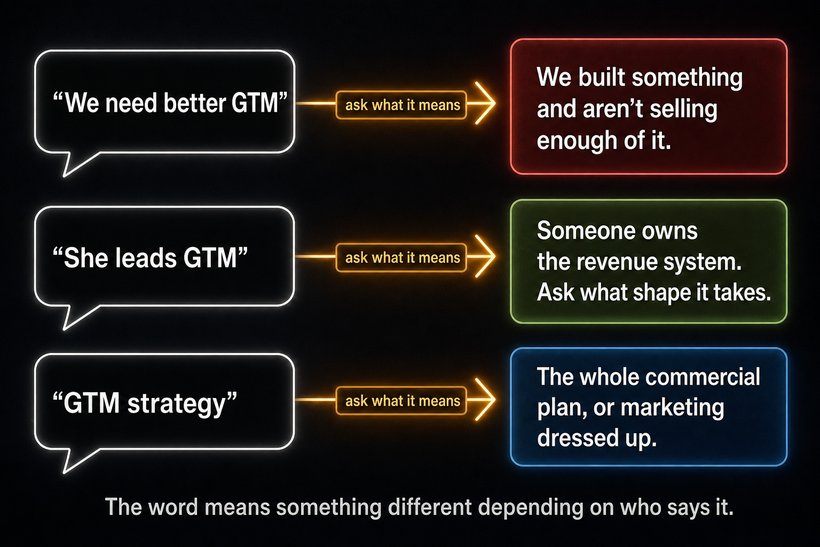
The general rule is not that the word means nothing. It is that the word means something different depending on who says it, and you cannot know which version you are getting until you ask.
But GTM is also a real job#
None of this is to say GTM is fake. Far from it. In the same week I was writing this article, real companies were hiring for real GTM leaders with real accountability, and the postings are worth reading because they show what the term means to operators who understand its full breadth.
Mutiny, an AI personalization startup, was hiring a “Head of GTM (Path to COO)” who owns the entire go-to-market function: revenue, marketing, sales, customer experience, hiring, and the company narrative. The posting notes the role “can quickly convert to COO.” It wants a generalist, a “holistic company builder” with a nose for distribution.
Harvey, the AI legal technology company, was hiring a “Head of GTM Incentive Strategy.” The role does not redefine GTM as compensation. It owns one specialized discipline inside Harvey’s broader GTM organization: incentive design across pre-sales and post-sales teams, including account executives, solutions teams, customer success, territories, quotas, and coverage models.
TaskUs was hiring a “Head of Go-to-Market” for its AI safety services unit who owns the strategy “from segmentation and value prop to pricing, quotas, and integrated campaigns,” leading a squad across enterprise sales, account management, solutions consulting, and marketing.
Same title family. Same seniority. Real, demanding work that spans far beyond any single function. Mutiny uses GTM to name the whole revenue organization. TaskUs uses it for pricing, pipeline, and a cross-functional squad. Harvey shows what happens after the label becomes an organizational container: companies start creating specialties inside it, including GTM incentives, GTM operations, GTM engineering, and GTM strategy.
That is the honest picture. GTM is a genuine senior function in 2026, and it is also an underspecified term whose precise shape you cannot know until you read the posting. Both are true, and neither makes the other less true. The word does real work for the people who run it well, and it also lets people who run it less well hide behind it.
The buzzword that came for our job titles#
GTM is business language you decode as an outsider. There is a sibling case where the business language came for your actual job title, and it is worth naming because technologists feel this one in their own skin.
“Forward deployed engineer” used to mean one very specific thing. Palantir pioneered the role, and its framing was crisp: “one customer, many capabilities.” An engineer embedded at the customer, shipping production software in the real environment, owning the technical outcome. Not advice. Not demos. Not configuration. Code, in production, at the deployment.
Then the title got prestigious, and the prestige got borrowed. Today, “forward deployed engineer” is used for people who build production systems with customers, support sales cycles, configure products, or automate the CRM. One analysis of a thousand job postings found three incompatible families of work: 60% production builders, 30% rebranded sales engineers, and 10% internal GTM or RevOps tooling roles. It also found postings up 1,165% year over year.
The litmus test is simple and worth keeping: does the person ship and own production code in the customer’s environment? If success means demos, deals, or a handoff, the underlying job is sales engineering or solutions engineering, whatever the title says. The word became a badge, and the badge stopped describing the work.
This is the same mechanism as GTM, aimed at us. We did not coin it. We inherited it. And we are the ones who have to decode whether the job posting means the original demanding role or the rebranded one.
And now watch it happen in real time#
If any of this still feels like a small matter, watch what is happening with the word “AI.”
Nobody agrees on what it means. Model, product, feature, capability, hype, all of it, depending on who is talking. And yet everyone invokes it, constantly, and with total confidence. It is the same contagion, on fast-forward, with higher stakes.
The numbers are stark. The Federal Reserve Bank of St. Louis analyzed 185,999 earnings calls and found that AI-related sentences rose more than fivefold in the year after ChatGPT launched. The SEC has warned that new technologies “create buzz from investors,” and has taken enforcement action against claims it calls “AI washing,” where companies invoke the label before the substance exists.
Why? I think the ambiguity itself is doing financial work. A precise definition of “AI” would puncture the balloon. The vagueness lets investors and executives hear whatever future they prefer in the same two letters, and there is real incentive for everyone to keep it that way. The ambiguity is what keeps the balloon inflated.
That is the pattern, stated plainly: the least-defined term wins. It wins because a flexible signal serves more speakers than a precise one does, and because asking for a definition is the fastest way to reveal that you, too, do not have one.
What the engineer does about it#
I did not write any of this to make anyone feel bad, least of all the leaders who reach for the words. I have been that leader. I got drafted into increasingly senior roles, and I had to learn the vocabulary to survive, and I found out the hard way that the vocabulary was never as precise as it pretended to be.
The practical move is not to refuse the language. That is a good way to make yourself unwelcome in rooms where decisions happen. The practical move is to treat every buzzword as a question to be decoded, not a fact to be accepted. When someone invokes GTM, ask which sense they mean: the launch plan or the whole machine. When someone says forward deployed, ask who ships the code. When someone says AI, ask what, specifically, it does. Not to be hostile. To be clear. Clarity is the whole job, and the person who asks the question is not the one who looks foolish. The person who invoked the word without knowing what they meant is, and deep down, they know it, and they will often be grateful you asked.
And if you want to keep the chain going, do what I have been doing since 2013. When the room runs low on buzzwords and everybody is tired of pretending, say the words that made this article possible: “I think we have met our buzzword quota. Can we speak in plain English now?”