
This article started with me talking to my agent over Wispr Flow. I was dictating my thoughts while it transcribed them and kept the whole conversation available as context. That’s very much what my creative flow looks like. But while I was speaking, it occurred to me that something important was happening: I wasn’t editing myself.
When you type, you filter. You form the sentence, judge it, revise it, and only the polished version survives. The filter operates so fast you barely notice it. But it’s there, and it’s ruthless. You discard thoughts before you commit one to the screen.
Voice doesn’t work that way for me. I speak, the words ship, and the transcript holds what I said. I tend to state the same thing two or three times before I move on. I circle the same idea from different angles. All of that survives, and an agent can be directed to treat the circling as signal rather than noise.
This isn’t a claim that transcription preserves everything. It drops prosody, tone, pause structure, and some of the messiness of overlapping speech. Wispr Flow also cleans up stutters and fillers. What survives is the semantic redundancy: the same thought stated two or three different ways. Emphasis is directed, not read. I tell the agent to attend to what repeats.
Voice is the one channel in my workflow where capture precedes curation. The record comes first. That record lets judgment keep working after a conversation is over.
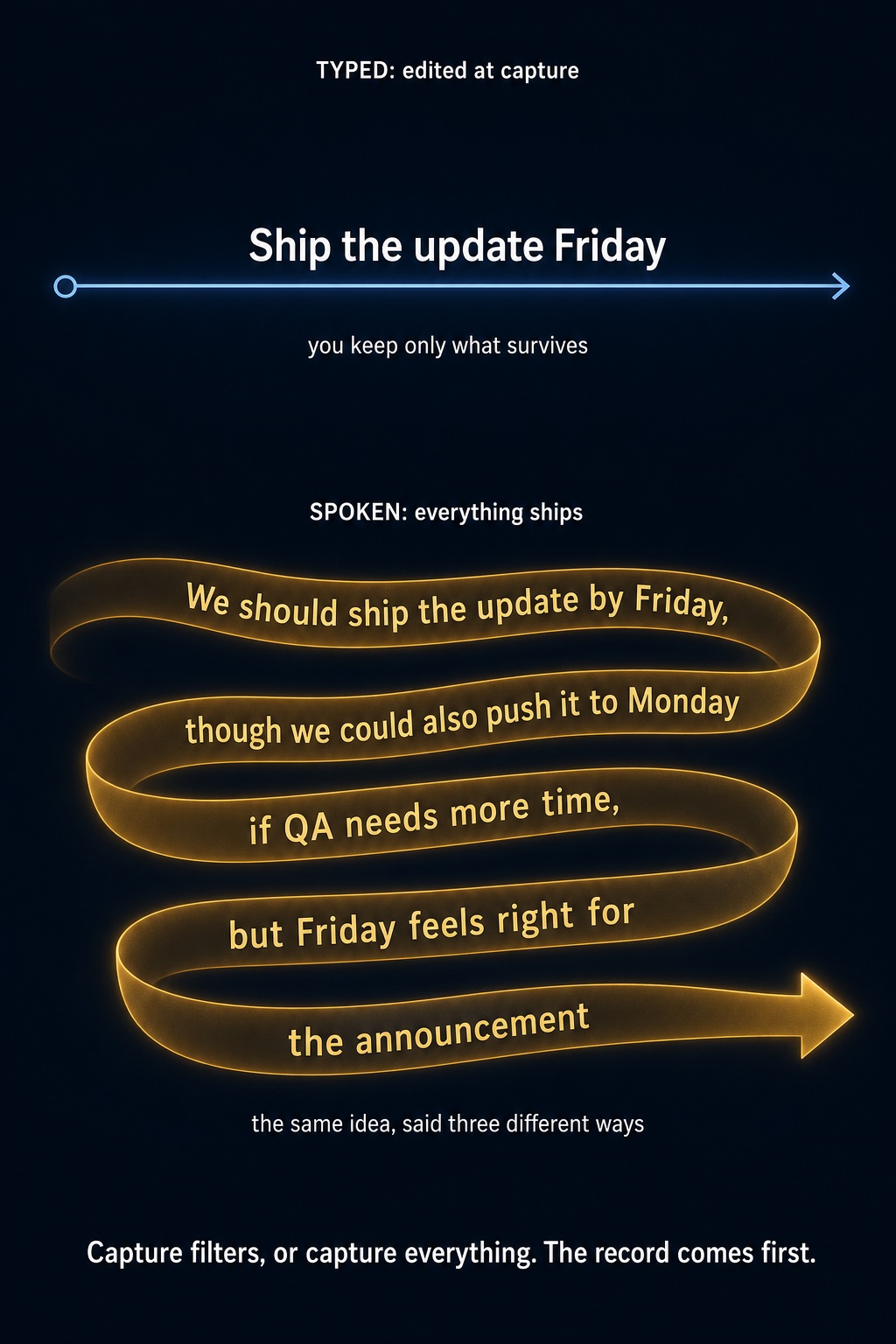
Typed notes still have a job. They’re useful when you want a decision, a summary, or a clean artifact to share. But they shouldn’t be the only record an agent receives, because the curation happened before the agent ever saw what was left out.
The Division of Labor#
There’s a simple frame for this transformation: the mechanical goes to AI, while taste and judgment stay human. It sounds like a bumper sticker until you see it working.
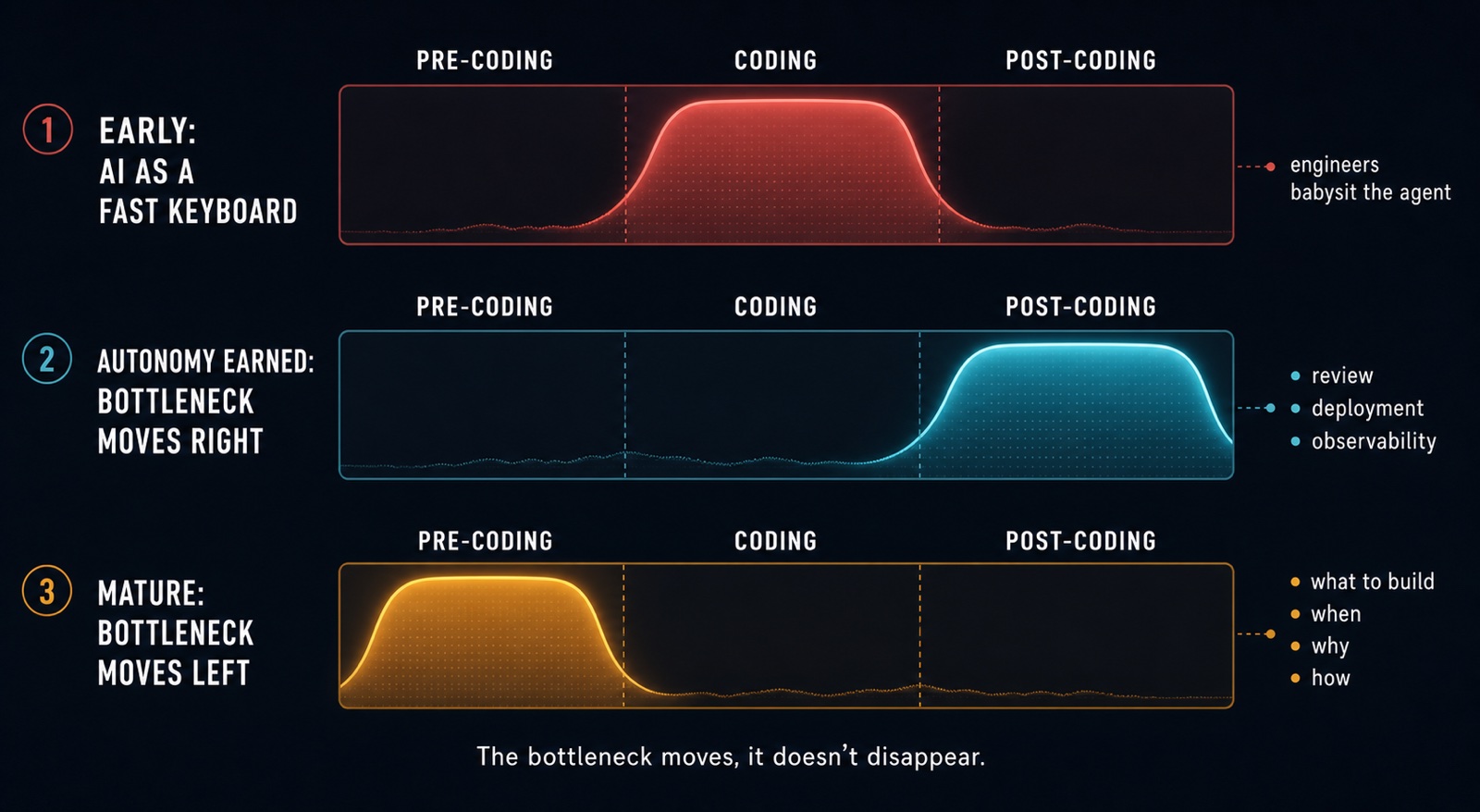
Take a software sprint. You can break it into three phases: the pre-coding work, the coding itself, and the post-coding work. Teams often feel that they don’t spend enough time on the pre-coding and post-coding sides because coding is where success gets measured: how much value did they deliver?
When teams first start using AI, they use it like a fast keyboard. They prompt an agent, watch it generate code, and hover over the screen because they don’t trust it yet. Engineers at this stage joke about how stupid the AI is. They’re not wrong to withhold trust. The agent hasn’t earned autonomy. It hasn’t been given the context it needs to make good decisions, and nobody has built enough evaluation coverage to catch its confident mistakes.
So the engineers spend their time babysitting.
Once good context goes in and reliable code comes out, the agent starts to earn autonomy. Then the bottleneck moves. It shifts right into code review, deployment, and observability. The questions change too: how do we decide when this code is safe to deploy, and how do we observe it effectively in production?
As those practices mature, the bottleneck can move again, this time to the left. It lands in the pre-coding phase. Teams spend more time on the questions that matter: what should we build, when, why, and how?
The roles start to blur, but with careful boundaries. The technical architect cares more about why and for whom. The product manager cares more about how the architecture works. Neither becomes the other. They have deeper conversations with each other.
That’s where the agent’s real value lives: facilitating more effective human-to-human collaboration. The mechanical work, including notes, recall, and first passes, gets delegated. The exploration stays human.
Half One: Your Unedited Thinking#
Wispr Flow captures my spoken words at roughly three times the speed I can type. It filters stutters and fillers automatically, so the transcript reads clean. But the semantic circling survives: the same idea restated in different ways. That’s the signal I want to keep.
Here’s what that looks like in practice. I dictated a response to a question about what happens when AI reliably carries the mechanical parts of your work. The core response ran about seven hundred words. It circled the same idea from multiple angles: trust earned through consistency, the sprint arc from babysitting to autonomy, the movement of the bottleneck, the blurring of roles between architect and product manager, and the endgame of deeper human-to-human exploration.
I directed the agent to read the full transcript and find the through-line: agentic transformation shifts where teams spend their time, from babysitting code to deep discovery. It pulled out the three phases of a sprint, the progression from fast keyboard to earned autonomy, and the careful qualification that roles converge without dissolving. Because the restatements remained in the record, I could tell it to treat them as evidence of emphasis rather than discard them as repetition.
You wouldn’t have gotten that kind of depth out of me if I were typing. You got it because I was brain dumping a stream of consciousness in response to a few simple prompts. That’s the mechanism working.
Half Two: The Record of the Room#
The other half is meetings: not your solo thinking, but conversations with other people. This is where Fireflies comes in. It captures a speaker-labeled transcript, and afterward you can search and query the record. I built an open-source agent skill for querying Fireflies in my public agent-skills repository.
Here’s what happens when I work a recorded conversation after the call. In a discussion about AI maturity, the transcript might establish that delivery has moved ahead of evaluation and assurance, while safety remains a firm boundary. The next investment should go into evaluation coverage, trust, security, and capacity rather than delivery speed. Spending is tied to outcomes. Models can change. The surrounding workflow, skills, and guardrails carry the durable value. Security review and peer review apply to changes around the agent.
But that’s not the important part. The important part is what the record leaves open. One meeting doesn’t produce the full picture. It produces a precise map of what’s missing.
The maturity stages may not yet have observable outcomes. The record may not tell us where headcount follows the moving bottleneck or how people outside the technical team will use AI safely. Those are no longer vague unknowns. They’re specific gaps.
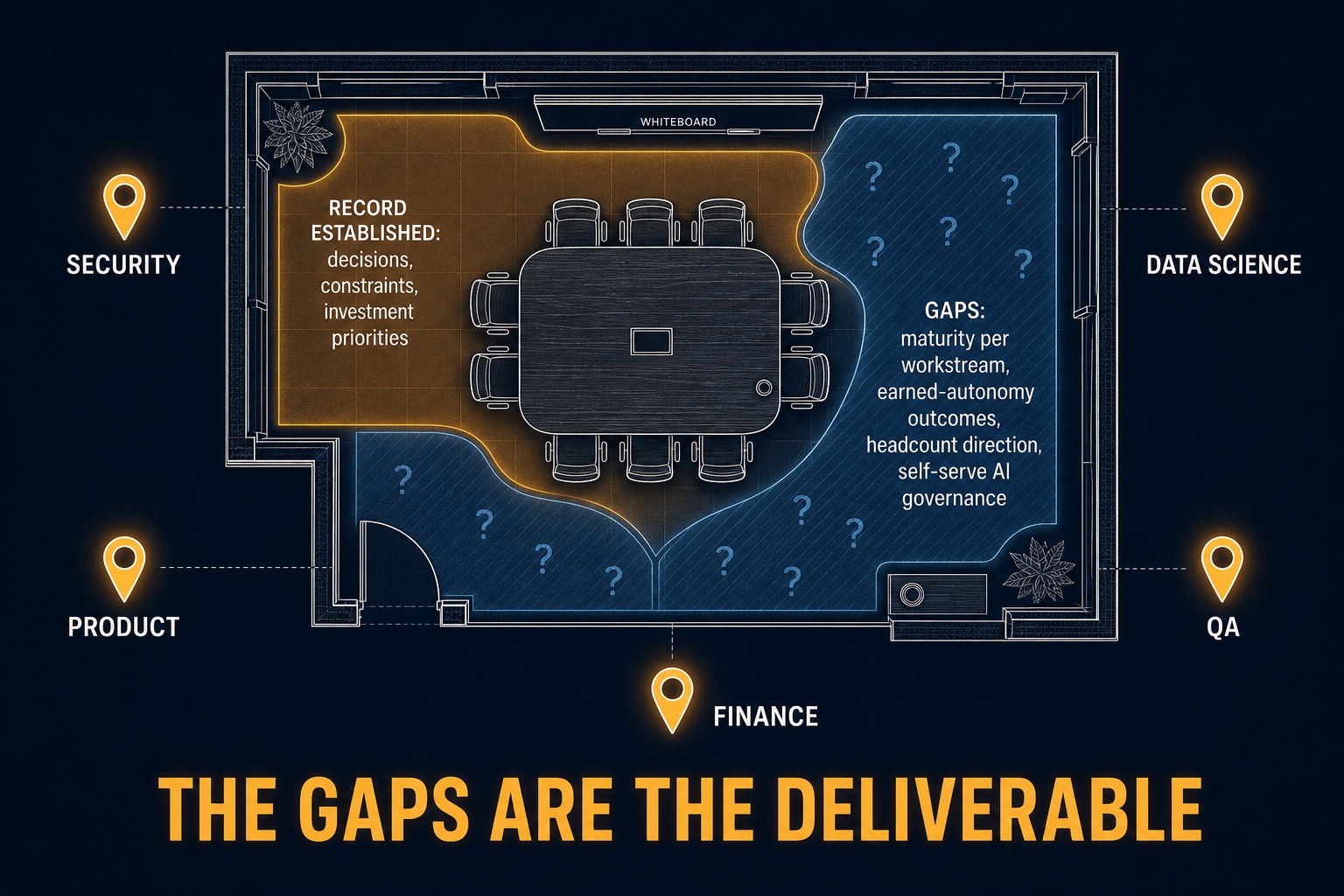
That map tells you who should be in the next conversation: people responsible for security, analytics, product, assurance, finance, and operations. It also gives you the questions: what observable outcome shows assurance has caught up? Does headcount follow the bottleneck or the org chart? Which failure mode worries you most when people make AI-informed calls? What would justify placing a deliberate limit on autonomy?
The gaps are the deliverable.
You can run the same pass on your next meeting transcript. Ask four things: what did this conversation establish, what remains unknown, who can fill each gap, and what should I ask them? That’s how a transcript becomes the next useful conversation instead of another file in storage.
The Overlap#
The source meetings referenced in this section are confidential. Everything here is a generalized composite of patterns from a sampling of conversations with leaders across organizations. No individual’s secrets are represented.
Voice is data, and voice is an interface. I talk to the agent about the transcripts it’s read. A sampling of recent conversations with technology executives surfaced six patterns that kept recurring:
- The bottleneck moves: it doesn’t disappear. When AI compresses one phase, friction relocates to another.
- Evaluation is the gating capability, not delivery speed. In this sampling, the teams farther along were investing in evaluation coverage and assurance rather than treating faster output as the goal.
- The harness beats the model. Models can be swapped. The durable advantage lives in the workflow, skills, and guardrails around the agent.
- Tech debt must speak business. Framed as engineering guilt, it gets deferred. Framed as business value, it can be sequenced.
- Trust between engineering and business is the multiplier. The strongest delivery improvements discussed in these conversations traced back to repairing that trust, not to a tool.
- Safety is earned, not granted. Agent authority increases through bounded, measured, and safe increments.
I need to be clear about what this means. Mining the transcripts can’t prove these patterns. It can only show that they recurred in the recorded conversations I sampled. My prior convictions shape the questions I ask; they aren’t evidence that the patterns recur. But because the agent can hold the whole set of transcripts, it can surface intersections I might miss. Not because its judgment is better, but because the full record is available at once.
I was in the meetings. The agent had the records from all of them. The patterns are the intersection.
Silent in the Call, Productive After#
A transcript creates an observer effect. Knowing a record exists can change how people listen and speak. In my experience, people become more mindful of destructive talk and more deliberate about making useful contributions. Even if some of that behavior is performative, knowing there’s a record can keep a conversation closer to everyone’s best behavior.
It changes how I listen too. I relax more. I feel comfortable with lively back-and-forth, interruptions, and clarifying questions. Every now and then, I might stop and say, “Hey, for the record, did we just decide X, Y, and Z are sequence three on our product backlog?” That conscious callout helps the transcript capture a shared decision. Otherwise, the transcript lets me move lightly and quickly through a conversation that would be much harder if everyone slowed down to take notes.
But there’s a quiet cost to not having the record, and you only see it in hindsight.
I worked with an organization that depended on a terrible piece of enterprise software. It was terrible for the users and for the technologists keeping it running. Nobody would champion it. Inertia and sunk cost kept it alive. We couldn’t figure out how they’d landed there in the first place. The system had been around for years, and turnover had erased the trail. There was no email, wiki entry, or chat history that explained who chose it or why. We had speculation.
By then, more recent group meetings were being transcribed, and decisions from those transcripts were being captured in email. It was easy to query the newer records and reconstruct who took part in a decision, what they contributed, and whether consensus came easily or with caution. The contrast between the pre-transcript era and the post-transcript era was stark.
We capture some of the pennies, and we leave the dollars behind. It’s tragic. It happens whenever a meeting ends without a transcript and institutional knowledge evaporates. The asymmetric cost is what you don’t see: the decisions that vanish, the reasoning that leaves with the people who held it, and the patterns that never surface because nobody has the whole record.
The record isn’t passive capture. It shapes the room, and it preserves judgment after everyone leaves. Without it, the loss compounds quietly, meeting by meeting, until one day you’re staring at a system nobody can defend and nobody can explain.
This article is the sequel to the capture pipeline I described earlier this year.