
The cheapest AI model isn’t the one with the lowest token price. It’s the one that gets acceptable work across the finish line with the fewest retries, repairs, and wasted minutes.
That sounds obvious, but it is not how most of us pick models. When a model family has a cheap tier, an expensive tier, and a middle tier, the middle feels responsible. It sounds like the sensible default.
OpenAI’s GPT-5.6 family makes this temptation easy to see. Sol is the frontier model. Terra is the middle. Luna is the inexpensive, high-volume option. A reasonable first instinct is to use Terra most of the time, move up to Sol when the work looks hard, and drop to Luna when it looks trivial.
The public evidence suggests a different default: Luna for bounded work you can check, Sol when a bad answer would create expensive downstream work, and Terra when its fast first response actually matters. That last condition matters. The middle tier still has a job, but it needs one.
Price is not the same as cost#
A cheap model can become expensive quickly. It may take three attempts to get a usable result. It may produce a plausible diagnosis that sends you down the wrong path. It may create work that a person or a stronger model has to repair.
A more expensive model can be the bargain when it gets the problem framed correctly on the first pass.
So the number worth watching is not a token price. It is the full model cost, including retries and verification, divided by the number of results that pass your normal checks without repair.
The July price update puts the stakes in plain dollars. Sol costs $5.00 per million input tokens and $30.00 per million output tokens. Terra costs $2.00 and $12.00. Luna costs $0.20 and $1.20. Terra is ten times Luna’s list price, and Sol is two and a half times Terra’s.
Token prices don’t settle the question. But they make a bad default expensive fast.
Why the middle is no longer the obvious choice#
The most useful third-party comparison comes from Artificial Analysis, which tested the family across a mix of agent work, coding, scientific reasoning, and general capability. Its conclusion is narrow, but it matters: in the reasoning settings it tested, no Terra configuration offered a better intelligence-cost trade-off than every Luna or Sol alternative.
That is not proof that Terra loses on every task. It is a reason to stop treating it as the automatic economic middle.
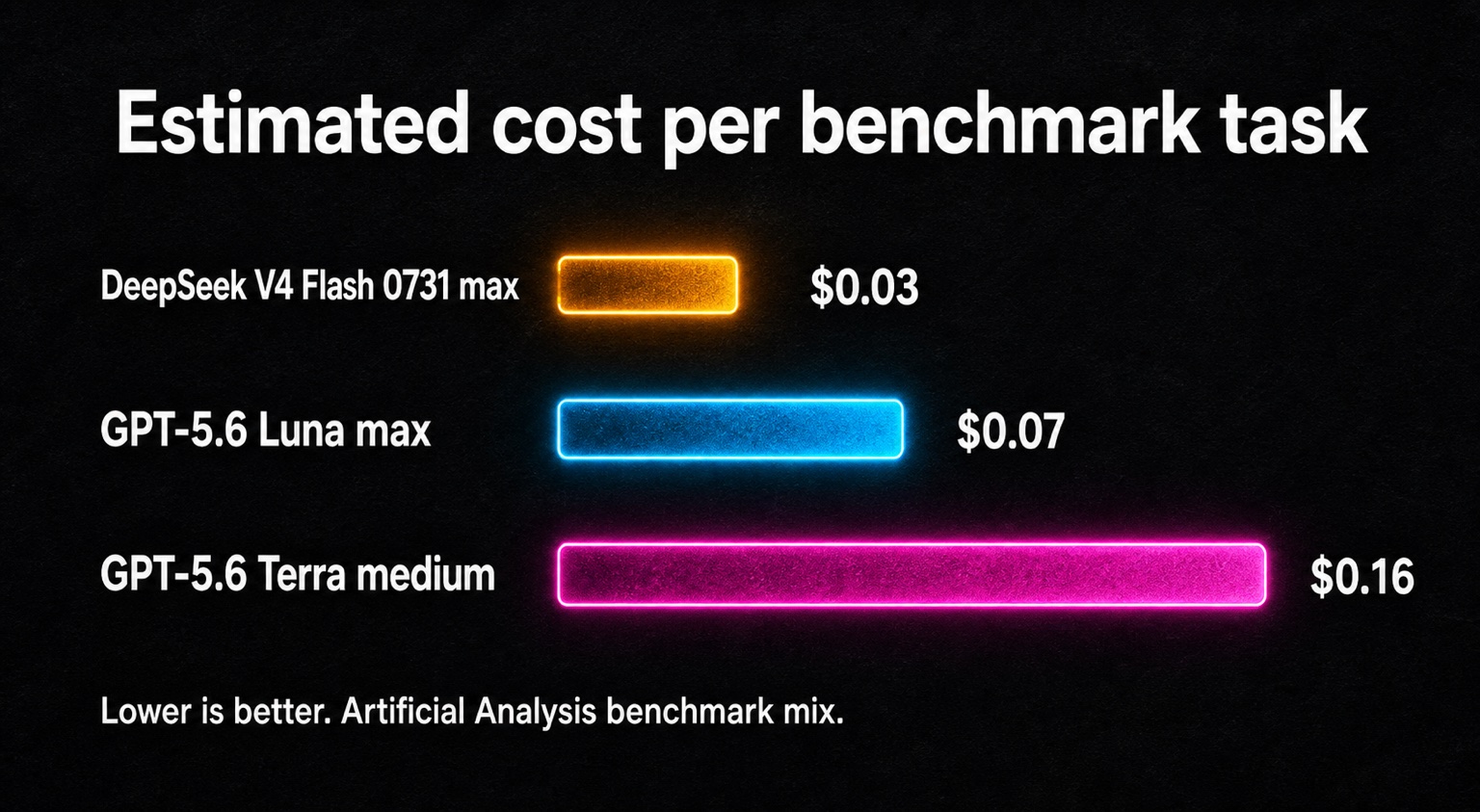
The clearest public comparison is Luna at maximum reasoning against Terra at medium reasoning. Luna-max scores 51 on Artificial Analysis’s composite Intelligence Index. Terra-medium scores 46. Artificial Analysis estimates the model cost of an average task in its benchmark mix at $0.07 for Luna-max and $0.16 for Terra-medium.
Luna-max versus Terra-medium
Composite Intelligence Index
Luna-max: 51
Terra-medium: 46
Estimated benchmark-task cost
Luna-max: $0.07
Terra-medium: $0.16
Output once generation starts
Luna-max: 175 tokens/s
Terra-medium: 99 tokens/s
Wait before the answer starts
Luna-max: 126.28 s
Terra-medium: 1.60 s
That last row is Terra’s real argument. Luna-max takes more than two minutes to begin answering. Terra-medium begins almost immediately. If you’re in a live conversation, that delay can change the experience enough to matter. If you are running a background job, it may barely matter at all.
So Terra-medium is worth considering when immediate response matters enough to outweigh Luna-max’s benchmark advantage. That is a much more useful reason than “it’s the middle model.”
Spend on Sol when the mistake would be expensive#
Sol is not an upgrade to apply everywhere. It is the model to spend on when weak reasoning would cost more than the model bill.
Think about difficult debugging, an architectural decision that will shape months of work, or a research synthesis that will steer someone else’s choice. A stronger first pass can save time, but the public benchmarks do not prove that Sol will lower the total cost of every real task. They show higher aggregate capability. You still have to test whether that capability avoids failures that are expensive in your own work.
Here’s a useful division of labor: use Sol to resolve ambiguity and form a plan. Use Luna to execute well-specified, verifiable work. And use Terra when the work is interactive enough that the wait is part of the cost.
DeepSeek V4 Flash is a test candidate, not a promotion#
A new outside option makes the comparison more interesting. DeepSeek’s July 31 API update says that V4 Flash 0731 is now in public beta. It retains the preview architecture and size, but has been re-post-trained.
DeepSeek publishes promising coding and agent benchmarks for the new version. Those are vendor results from tests run with DeepSeek’s own harness, so they are a reason to investigate, not a reason to declare it equivalent to OpenAI’s models.
The more useful external signal is Artificial Analysis’s V4 Flash and Luna comparison. V4 Flash 0731 at maximum reasoning scores 50 on the same composite Intelligence Index, one point below Luna-max’s 51. Artificial Analysis estimates $0.03 per benchmark task for DeepSeek, compared with $0.07 for Luna.
That is a serious low-cost contender for controlled, text-heavy work, particularly when it can reuse cached context. But it is also a new public beta. The comparison lists it as text-only, and an aggregate benchmark cannot tell you whether its tool behavior, reliability, output style, or governance fit your work.
Close on a chart is not interchangeable in practice.
Run the smallest test that can change your mind#
You do not need a grand model evaluation program to make a better choice. Pick five real, non-sensitive tasks: a bounded implementation with tests, a repository diagnosis, a source-grounded research brief, a short interactive request, and an ambiguous planning problem.
Run each task three times with the same prompt, tools, timeout, and acceptance criteria. Compare Sol-medium, Terra-medium, Luna-high, Luna-max, and V4 Flash 0731-max. Track the model bill, cache reads, retries, time until an answer begins, time to a verified result, and the minutes of human repair needed before you can accept it.
Then divide the full cost by the number of accepted outcomes.
That gives you a rule for choosing models that is better than a leaderboard, a price card, or a comforting middle tier. Luna may become the economic default for a lot of bounded work. Sol may be cheap insurance for the work where a bad frame creates a week of cleanup. Terra may earn its place when responsiveness is part of what the person in front of the screen needs.
For the benchmark method and its limits, Artificial Analysis publishes its Intelligence Index methodology. The Index is a third-party, English-language, text-focused composite. It is useful evidence, not a universal definition of intelligence or a substitute for testing the work you actually do.
I’m going to try Luna as my primary model in Hermes Agent, set to maximum reasoning.