
DeepSeek Harness is a coding-agent harness from DeepSeek. It’s labeled as a developer preview, and it puts DeepSeek’s models inside a serious, modular environment for working on code.
That makes it interesting. It also puts the software awfully close to a person’s source code, credentials, shell, files, and network.
I haven’t adopted it. I decided to inspect it first.
There’s an obvious geopolitical context here. DeepSeek is a Chinese AI lab, and the relationship between the United States and China gives people reasonable cause to ask harder questions about software that may touch sensitive work. But national origin isn’t evidence of wrongdoing. If a powerful agent came from a lab in San Francisco, Paris, or Raleigh, the practical trust questions would still be there: What can it read? What can it execute? Where does data go? Which boundaries are real, and which ones merely sound reassuring?
So I tried to answer those questions from the code.
What I actually inspected#
This was an early safety investigation, not a hands-on product review. I haven’t yet spent enough time using DeepSeek Harness to tell you whether it feels good during a long coding session, whether its approval flow becomes irritating, or whether its DeepSeek-specific design produces better results in real work.
What I can tell you is what the inspected software appears to do.
I pinned the review to one public source commit rather than a moving branch. I also examined the rc.6 npm package, checked a runtime boundary around project configuration, and used three independent specialist audits to look at privacy and data flow, execution and isolation, and supply-chain governance. That combination matters because a clean-looking repository doesn’t prove that the package in a registry came from the same source, and static code review doesn’t prove that a runtime boundary behaves as intended.
The investigation was deliberately narrow. It didn’t use a real DeepSeek credential, send confidential prompts, test an enterprise deployment, or examine what happens inside DeepSeek’s servers. Several risk paths came from source analysis rather than a demonstrated exploit.
That’s the boundary around everything that follows.
The reassuring part came first#
I found no evidence of malware, covert spyware, cryptomining, hidden persistence, disguised exfiltration, or a secret background service in the pinned source I reviewed.
That result matters. Political anxiety can make ordinary product behavior look sinister before anyone has read the code. DeepSeek Harness does make outbound requests, of course. It’s an agent built around remote models and search services. Those disclosed requests are part of what the product does.
The more meaningful concerns were sitting in plain sight. They are consequences of authority, configuration, and isolation choices. Powerful software can create serious risk without containing anything covert.
The local sandbox protects writes better than secrets#
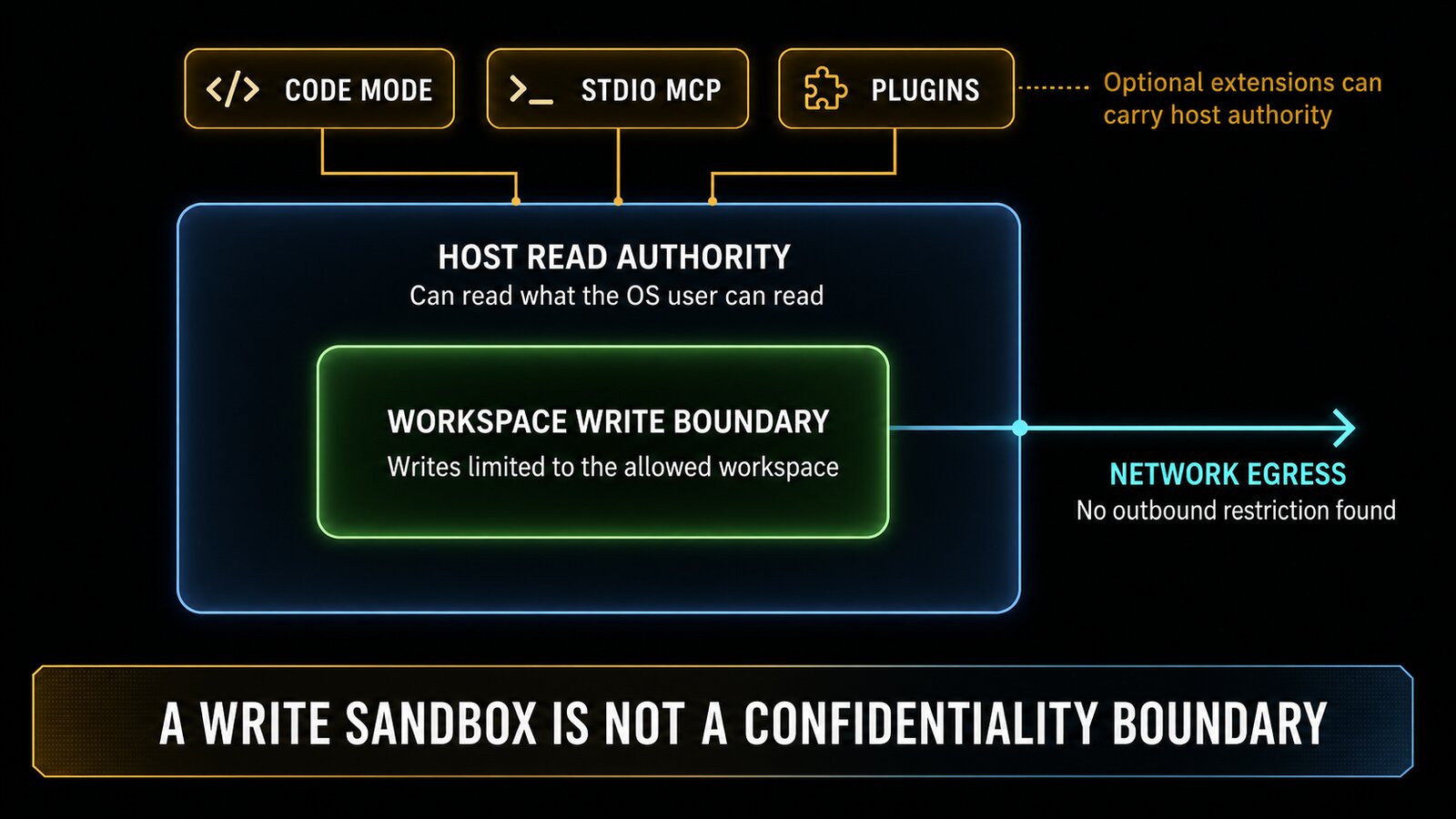
DeepSeek Harness’s default local workspace-write profile limits where commands can write. That’s useful. But the local sandbox profiles allow reads anywhere the harness operating-system user can already read, and I found no outbound network restriction in the sandbox implementation.
In ordinary language: a command may be unable to overwrite a file outside the workspace while still being able to read that file and send its contents elsewhere. Normal operating-system permissions still apply, so this isn’t a claim that every file on the machine is readable. It means workspace-write is a write boundary, not a confidentiality boundary.
In the same proud tradition as recent OpenAI and Anthropic cyber evaluations, DeepSeek Harness also leaves a road to the public internet. The comparison is unfair in one important way: OpenAI’s zero-day escape defeated intended isolation, while Anthropic’s open path led through a third-party evaluation range. DeepSeek Harness saves everyone the suspense. Its local sandbox simply places no restriction on network egress.
That distinction becomes important when the agent is working in an unfamiliar repository. Instructions hidden in source code, tool output, or fetched content can try to steer a model toward files that have nothing to do with the task. A restricted write path doesn’t solve that problem.
The safest practical assumption is that the local process has the readable authority of the account running it. If that account can see SSH keys, cloud configuration, or application tokens stored as files, the harness may be able to see them too.
Optional power changes the trust model#
DeepSeek Harness includes Code Mode, which can evaluate generated JavaScript in a Node worker. The worker runtime applies resource limits, which can help with runaway work. But a worker thread is not operating-system isolation. It shares the harness process’s identity and ambient host authority.
That creates a credible path to host compromise if adversarial generated code runs. I didn’t execute that path during this investigation, so I am not claiming an exploit was demonstrated. I am saying Code Mode should be treated as host-authority code execution, not as a secure little box inside the application.
I’d apply the same care to extensions. The stdio MCP transport launches executable components outside the managed command sandbox, and MCP tools do not require MCP-specific approval for every call. CLI plugins are installed and activated inside the harness. Dynamic host extensions can alter what the harness does, and the host runner comments say the node:vm arrangement is not containment.
These are legitimate ways to make an agent useful and extensible. They are also privileged trust decisions. Installing an MCP server or plugin deserves the same suspicion you would give any other program that can read files, call services, and act with your account’s permissions.
Telemetry is off, but ordinary requests still carry identity#
Telemetry upload is disabled in the base configuration. When telemetry is enabled, the exporter can send detailed session events, including prompts, model output, tool calls, results, errors, approvals, and feedback. That is sensitive material, even when collection is explicit.
Telemetry is separate from normal model traffic. Requests through the DeepSeek adapter include a stable pseudonymous UUID stored in the harness home. The adapter test shows that UUID traveling as a request header, including when the operator configures a custom base URL. That’s pseudonymous tracking, not a machine fingerprint, and the audit did not establish that every provider receives it.
The base bundle mounts the first-prompt title provider. After the first eligible user message, the title service schedules its automatic work, and the title implementation dispatches an additional model request. That isn’t telemetry either. It is ordinary API traffic that sends first-prompt content through an additional request.
I can’t tell you what DeepSeek retains on the server side, who can access it, or what internal controls apply. The client code can’t answer those questions.
A privacy default is still just a default#
The uncomfortable inference is that today’s telemetry default is a policy choice, not a structural privacy boundary. The telemetry configuration selects DISABLED, FULL, or FEEDBACK_ONLY. A future release could change that default without building a new telemetry system because FULL mode is already wired to capture the live session stream.
I found no evidence that DeepSeek intends to do that. Still, quietly enabling FULL mode would be a severe privacy regression. The existing instrumentation can carry prompts, answers, tool calls, results, errors, approvals, and feedback. That deserves protection against a default changing underneath the user.
The current release has a useful hard override. The CLI boot code turns any nonempty DSH_TELEMETRY_DISABLED value into a final overlay that disables the telemetry plugin, even if a profile asks for FULL mode. I wrote and tested a small fail-closed launcher that forces that override, rejects telemetry mode and collector environment settings, and refuses to run unless the executable’s version check succeeds and reports rc.6.
chmod 755 dsh-private.sh
DSH_REAL_BIN="$(command -v dsh)" ./dsh-private.sh
That wrapper is a guardrail, not a permanent proof of privacy. It relies on the executable truthfully reporting its version and the reviewed release honoring its hard-disable contract. Requiring a successful rc.6 version report makes an ordinary upgrade stop for review instead of sliding through unnoticed. An operating-system egress rule that denies the telemetry collector while allowing the model API is a stronger independent layer.
The package provenance is still fuzzy#
The source commit I audited declares rc.5, while npm publishes rc.6. The registry metadata has no gitHead or provenance attestation, and the public repository has no corresponding tag or GitHub release that cleanly ties rc.6 to the reviewed source.
That doesn’t show tampering. In my local checks, the downloaded package matched npm’s integrity value and had no lifecycle scripts. The release workflow has thoughtful mechanics: immutable installation, packing, packed-install verification, artifact handoff, narrow permissions, and an environment-gated publishing job.
But registry integrity and source provenance answer different questions. One tells me that I received the bytes npm described. The other would tell me which reviewed source produced those bytes. I could verify the first and not the second.
For a developer preview, that gap isn’t shocking. It’s still something I’d want resolved before giving a release broad access to sensitive work.
There is quite a lot to like here#
DeepSeek Harness is much more than a thin command-line wrapper around a chat endpoint. Its base bundle composes model adapters, credentials, session persistence, telemetry, approvals, sandboxing, tools, and user interfaces as replaceable components. That makes it interesting as both a product and a reference design.
The safety work isn’t empty theater, either. The bootstrap denylist prevents project .env files from redirecting model endpoints or injecting process-bootstrap variables. The web bundle defaults to loopback, and startup rejects a literal wildcard bind, while request-trust checks cover Host and Origin headers. Credential files use owner-only permissions. The intended release path is structured, even though the public provenance story is incomplete.
The result is a product with thoughtful boundaries and some consequential gaps. That is a more useful description than either panic or praise.
When I would reach for DeepSeek Harness#
DeepSeek Harness looks like a natural fit for DeepSeek-centered coding in a deliberately isolated environment. If the work is bounded to a repository, the machine or account contains no unrelated secrets, and outbound traffic is controlled, its opinionated integration may be exactly what someone wants.
It’s also compelling for anyone who wants to study a first-party harness from a model lab. There is a lot to inspect and customize here.
I’d be much more cautious about opening arbitrary third-party repositories under my normal desktop account, enabling Code Mode casually, or adding MCP servers and plugins without reviewing them. Isolation changes the experiment from “trust this software with my working life” to “let this software operate inside a boundary I chose.”
That’s a better place to begin.
Why Hermes Agent remains my daily harness#
Hermes Agent is still the harness I use day to day. My work with an agent doesn’t stay inside a coding session. It crosses research, writing, publishing, infrastructure, communication, and home automation, often with context that needs to survive the end of one conversation.
Hermes is a natural fit for that relationship because it provides persistent memory, reusable skills, messaging continuity, and execution choices. That last choice matters: the local backend runs with my user authority unless I select an isolated backend. Its CLI controls cover profiles, scheduled jobs, webhooks, and providers, making it feel more like a broad personal operating environment than a coding tool. DeepSeek is one of the providers it supports.
I wrote more about that relationship in Every Hat, One Companion.
This is a product-shape comparison, not a security ranking. Choosing a harness does not require accepting or rejecting a particular model lab.
DeepSeek Harness has a clearer win condition when the work is DeepSeek-specific, coding-centered, and contained. Hermes has the clearer win condition for the persistent, cross-domain way I work.

What I still need to learn by using it#
I intend to spend time with DeepSeek Harness in an isolated environment. Source review can tell me where authority flows, but it can’t tell me what the product feels like when the work becomes messy.
I want to see whether the approval flow stays understandable during real tasks. Which optional capabilities are required before the harness feels useful? How does the local sandbox behave when a repository contains hostile instructions? Will telemetry remain predictably disabled across profiles and upgrades? And can a future tagged release be built cleanly from the public source?
Those questions need experience, not another confident paragraph.
For now, this investigation is a head start, not a verdict. I’ll run DeepSeek Harness somewhere that cannot reach the rest of my working life, and I’ll pay attention to each piece of authority I add. What happens inside that boundary will determine how much trust it earns from me.