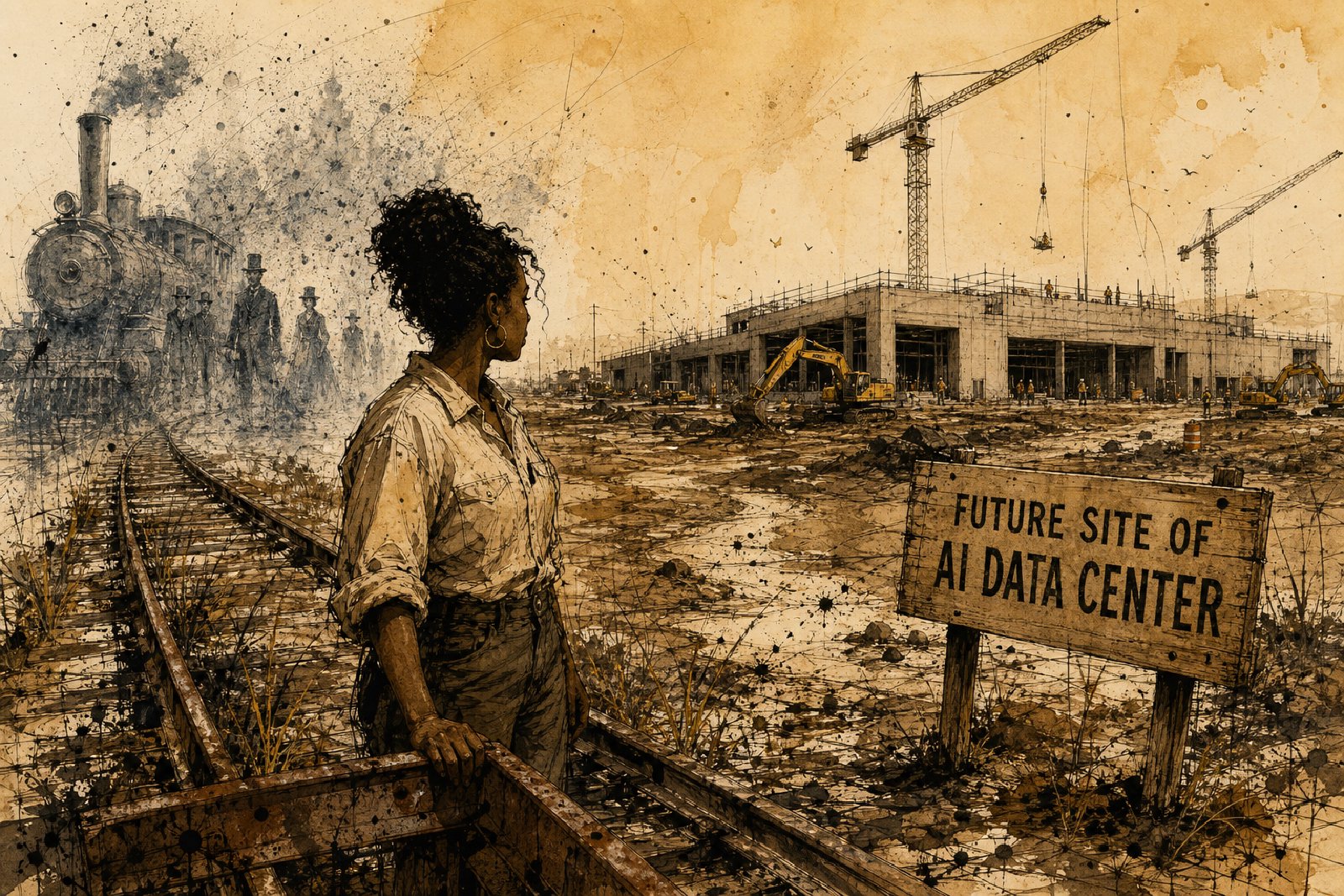
Almost every American knows where to find an abandoned railroad track near them.
Go look. There is probably one within driving distance of where you live right now. Weeds growing between the rusted rails. Ties rotting into the ground. Maybe the right of way has been paved into a walking trail. Maybe it just sits there, too much trouble to remove.
Those tracks used to keep towns alive. A railroad passing through was the difference between a settlement that grew and one that was abandoned. The interurban electric railway was the fifth-largest industry in the United States at its peak. The Indianapolis Traction Terminal alone handled 500 trains a day, moving 7 million passengers a year. The network crisscrossed the country, carried the economy, connected everything to everything else.
And then the automobile happened. Not as a replacement for trains. It was something that made the whole concept of fixed-route transportation feel like a constraint you didn’t have to accept anymore. Within 18 years of the Model T’s introduction, half of the interurban railway mileage in the country was in bankruptcy. The fifth-largest industry in America collapsed not because it ran trains badly, but because its entire sense of what business it was in (running vehicles on fixed rails between fixed stations) had no room for a machine that could go anywhere.
The rails were not just infrastructure. They were an assumption. And that assumption was invisible to the people who made their living on top of it.
The Assumption You Cannot See#
Deterministic transportation means fixed routes, fixed timetables, known outcomes. You go where the iron decides. That was the railroad industry’s water they swam in. Nobody questioned whether transportation had to work that way, because it had never worked any other way.
Deterministic computing is the same architecture. Fixed logic, known inputs producing known outputs, execution paths specified in advance by a programmer. You tell the computer what to do, and it does exactly that, every time. That assumption has been the foundation of enterprise computing for seventy years. It shaped how we design processes (inputs → predictable outputs), how we govern systems (audit every step against known rules), and how we measure value (cost of inputs vs. value of guaranteed outputs).
Probabilistic computing breaks all three. Same input, different output. The system explores paths nobody specified. It makes discoveries instead of following instructions. It produces answers nobody fully traces.
It feels like a faster version of the old thing, but it’s a different machine entirely. And most organizations are responding to it the way the railroad industry responded to the automobile: trying to bolt a probabilistic engine into a deterministic chassis and wondering why it doesn’t fit.
Three Gaps, One Root Cause#
The surveys all say the same thing. 88 percent of organizations are using AI now. But the stuff underneath the adoption numbers is thin.
Nearly half, 48 percent, shipped AI without redesigning the work it was supposed to change. They bolted a probabilistic tool onto process maps drawn for a deterministic world and called it transformation. Only 12 percent have redesigned at scale.
The governance numbers are worse. 69 percent of organizations keep AI on a very short leash: no autonomy at all, or strictly limited to low-risk reversible actions. Only 12 percent let AI run end to end with humans auditing rather than approving every step. The thing is, autonomy is expanding anyway. It happens one use case at a time, and the accountability framework meant to govern it is always a step behind. That gap is where the risk lives, invisible until something breaks.
On measurement, the gap is widest. 4 percent of organizations can report AI value at the board level. There is a structural reason for that: CFO systems were built to consume cost-based business cases. Better decisions, faster insight, new capabilities: all of these require a measurement architecture most organizations don’t have. The ones pulling ahead are moving toward something Deloitte calls Return-on-Autonomy: measuring what AI changes the enterprise is capable of, not what it costs or saves.
What looks like three separate problems are really three symptoms of the same root cause. The organization’s sensing apparatus (its metrics, processes, and resource allocation systems) was designed for a world where the right answer was incremental investment in existing business models. That apparatus is giving the wrong signal now. Not because it is broken. Because it is working exactly as designed.
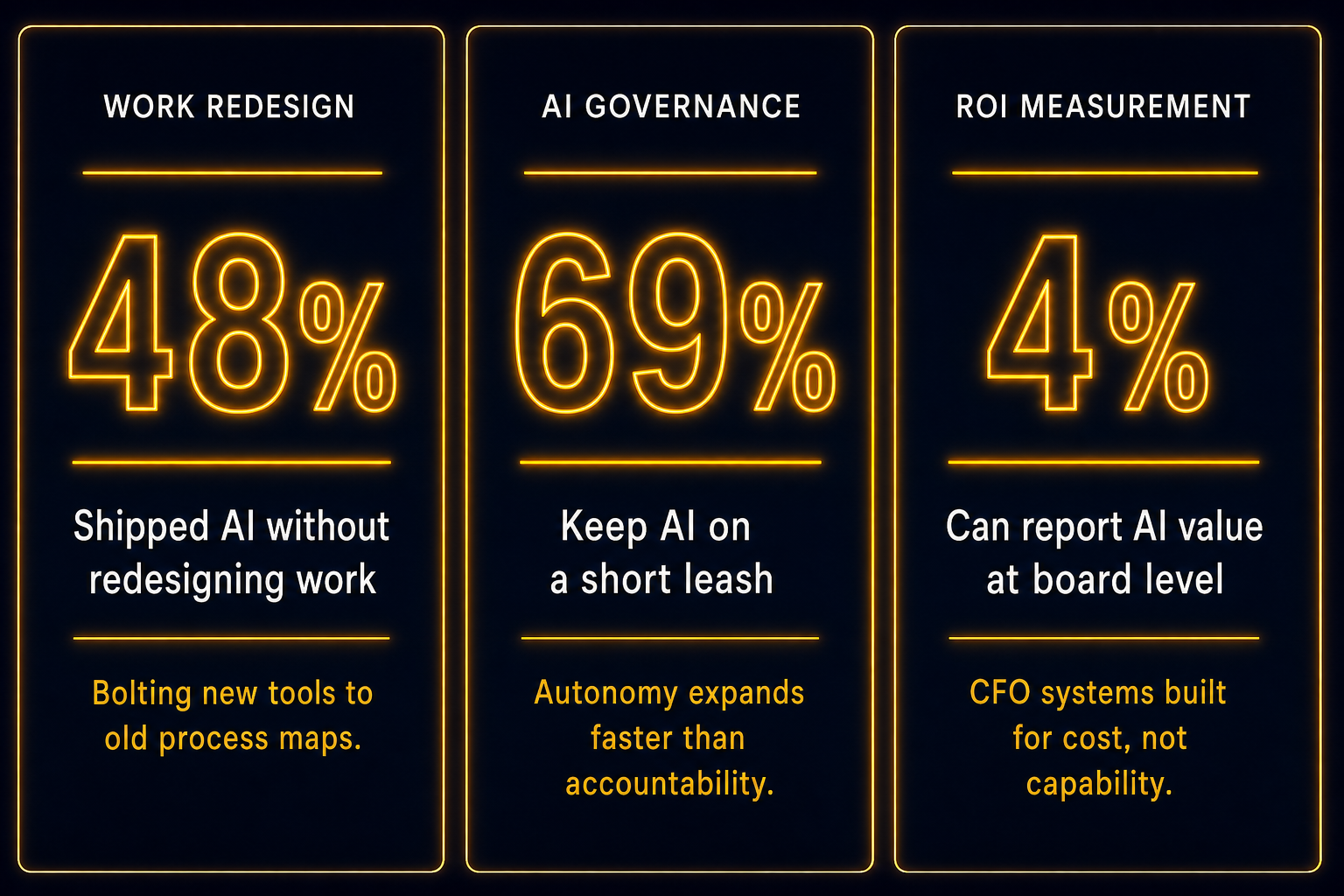
Three gaps, one root cause. Data from Deloitte’s AI Pulse Check, polling nearly 3,700 professionals.
Why Mobile Was Not a Warning#
The desktop-to-mobile transition was big. It created entire industries, destroyed others, and rewired how people interact with technology. But it was structurally different from what is happening now.
Mobile added a new computing surface (a device in your pocket) without replacing or altering the desktop paradigm. Companies could have a mobile app while continuing their desktop operations unchanged. Nokia held 49 percent market share in 2007 and collapsed because it couldn’t see the iPhone coming. Steve Ballmer laughed at the iPhone in a 2007 interview. Those failures were spectacular, but they were failures of individual companies, not of an entire paradigm. The paradigm itself, deterministic computing, screens and inputs, known outputs, stayed intact.

Steve Ballmer, 2007: “There’s no chance that the iPhone is going to get any significant market share. No chance.” The graveyard behind him tells a different story.
The shift from deterministic to probabilistic computing isn’t that kind of change. It rewrites the paradigm. It doesn’t add a new surface. It changes what a computer is. And the difference between those two things is the difference between a transition you can manage with the same organizational toolkit and one you can’t.
The Threshold#
Human organizations have a maximum perceivable rate of change. Below that threshold, gradual adaptation works. You see the shift, you adjust, you survive. The desktop-to-web transition was below the threshold for most companies. The web-to-mobile transition pushed close to the edge for some and past it for others, but the paradigm itself held.
Above the threshold, something strange happens. The organization doesn’t accelerate its response. It slows down. It defaults to what it knows. It treats a category shift as a minor adjustment because the alternative, admitting the magnitude of what is happening, is too destabilizing to process.
Clayton Christensen documented this pattern across eleven industries. Incumbent organizations are structurally incapable of nurturing disruptive innovation, not because they’re run by bad managers, but because their resource allocation processes, customer feedback loops, and ROI metrics are all calibrated for the existing business model. The mainstream organization demands high margins; disruptive technology starts lower. It serves existing customers; disruptive technology targets new ones. It requires predictable returns; disruptive innovation is inherently uncertain. Every signal the organization uses to decide what matters is designed to say no to the thing that will eventually replace it.
This is the Innovator’s Dilemma. The organization’s immune system is working exactly as it was built to work. The problem is that the threat it was built to defend against, incremental competitors making incremental improvements, is no longer the only threat in the environment.
What the 5 Percent Do Differently#
The research is not all bad news. Project NANDA, an MIT research initiative, studied 52 organizations and found that 95 percent of enterprise AI implementations deliver zero measurable return. But the 5 percent that succeed share three specific choices, and none of them involve technology selection.
They buy rather than build. External partnerships succeed at 66 percent compared to 33 percent for internal builds, because vendors bring learning infrastructure that enterprises can’t replicate internally. They start narrow where learning compounds: embedding AI in specific workflows where feedback loops are tight and improvement is visible. And they decentralize to power users who already understand what good AI interaction feels like, rather than routing everything through centralized labs.
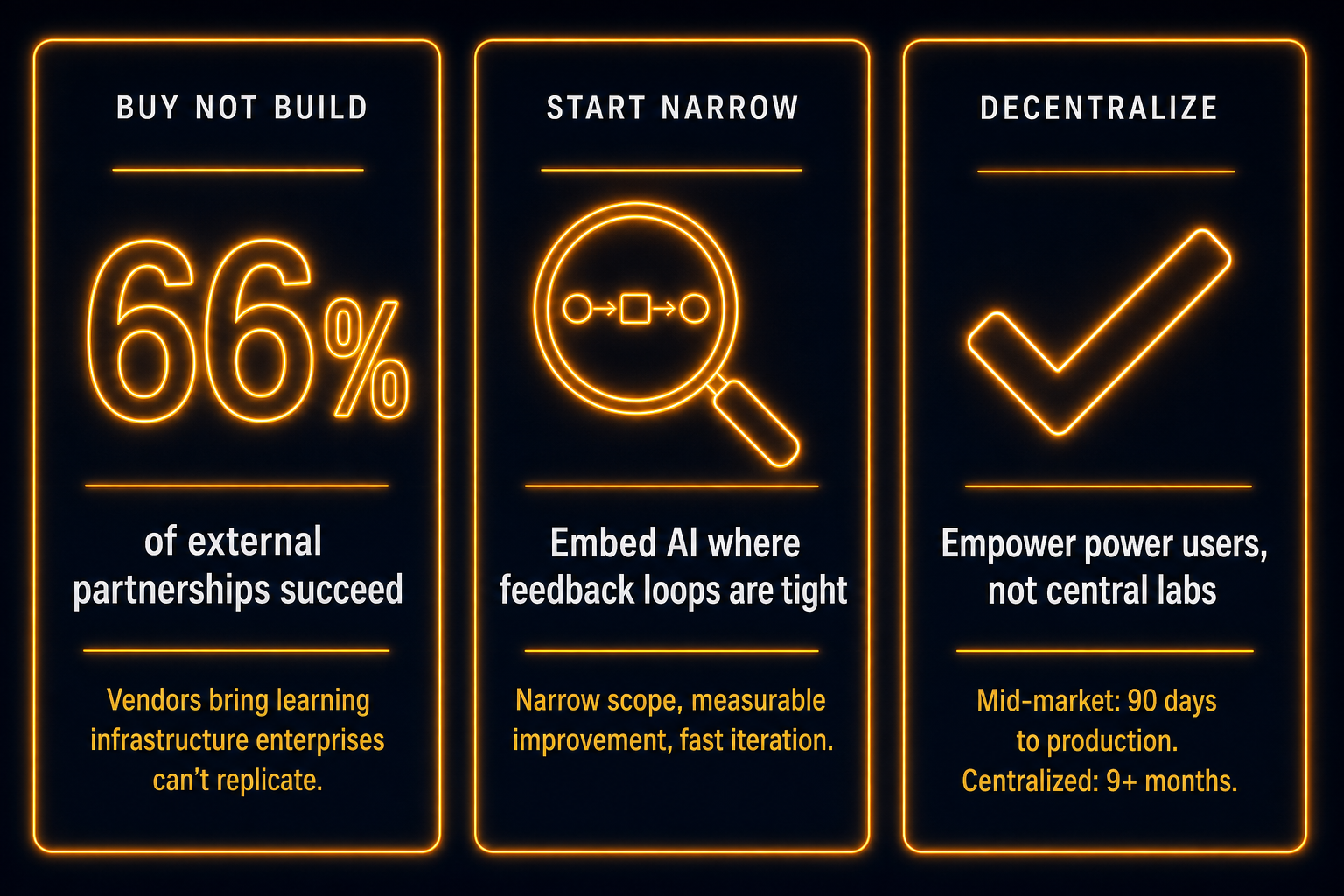
The three choices that separate the 5% from the 95%. Data from MIT Project NANDA, studying 52 organizations across industries.
Technology decisions? No. These are organizational design decisions. And they are the opposite of what most companies do.
The Tracks We Are Standing On#
The abandoned railroad tracks near you are not just relics of a bygone industry. They are a physical reminder that entire economic ecosystems can collapse because the people running them couldn’t see that their most basic assumptions had stopped being true.
The interurban railway executives were not stupid. They were running profitable, growing businesses. They had customers, revenue, and a network that was the envy of the industrial world. They were making rational decisions within their frame of reference. The frame itself was the problem.
Right now, the same thing is happening to organizations making entirely rational decisions about AI. They are deploying tools without redesigning work. They are restricting autonomy because their governance frameworks were built for deterministic systems. They are measuring ROI with cost-based scorecards that can’t capture strategic value. Every one of these decisions makes sense within the frame of deterministic computing.
Great managers keep the trains running on time. But great leaders recognize when that’s no longer the winning strategy.