
I think the United States should consider building an American Stewardship Fund: a permanent public inheritance that turns some portion of a major economic windfall into capacity for people who aren’t lucky enough to own the scarce assets behind it.
That’s the argument. The mechanism is not settled, and I’m not pretending I’ve got a complete federal policy blueprint tucked into a blog post. I’m thinking about this as a citizen. I keep looking at countries and states that reached a watershed moment, recognized that a windfall wouldn’t last forever, and chose to save some of it for people who hadn’t even been born yet.
Then I look at the technology booms America has already lived through, and I wonder whether we missed our own versions of that choice.
One recent image has stuck with me. I watched Elon Musk briefly get crowned a trillionaire, and I couldn’t make it feel like celebrity gossip. I knew the number was paper wealth and could move fast. I knew the companies behind it made real things. But I was looking at an economy where enormous AI expectations can gather around a person, while companies in the same orbit can win major public contracts, including NASA’s SpaceX lunar-lander award. What does the public get back besides the next quarterly story? That was the moment this stopped being an abstract argument for me.
The stewardship lesson#
Norway channels state petroleum revenue into a diversified national fund and generally expects the government to spend the fund’s long-run real return rather than consume the principal. This didn’t end austerity, remove politics from budgeting, or prove that a similar institution would work for technology. Norway started with something unusually clear: revenue from a publicly owned, finite natural resource.
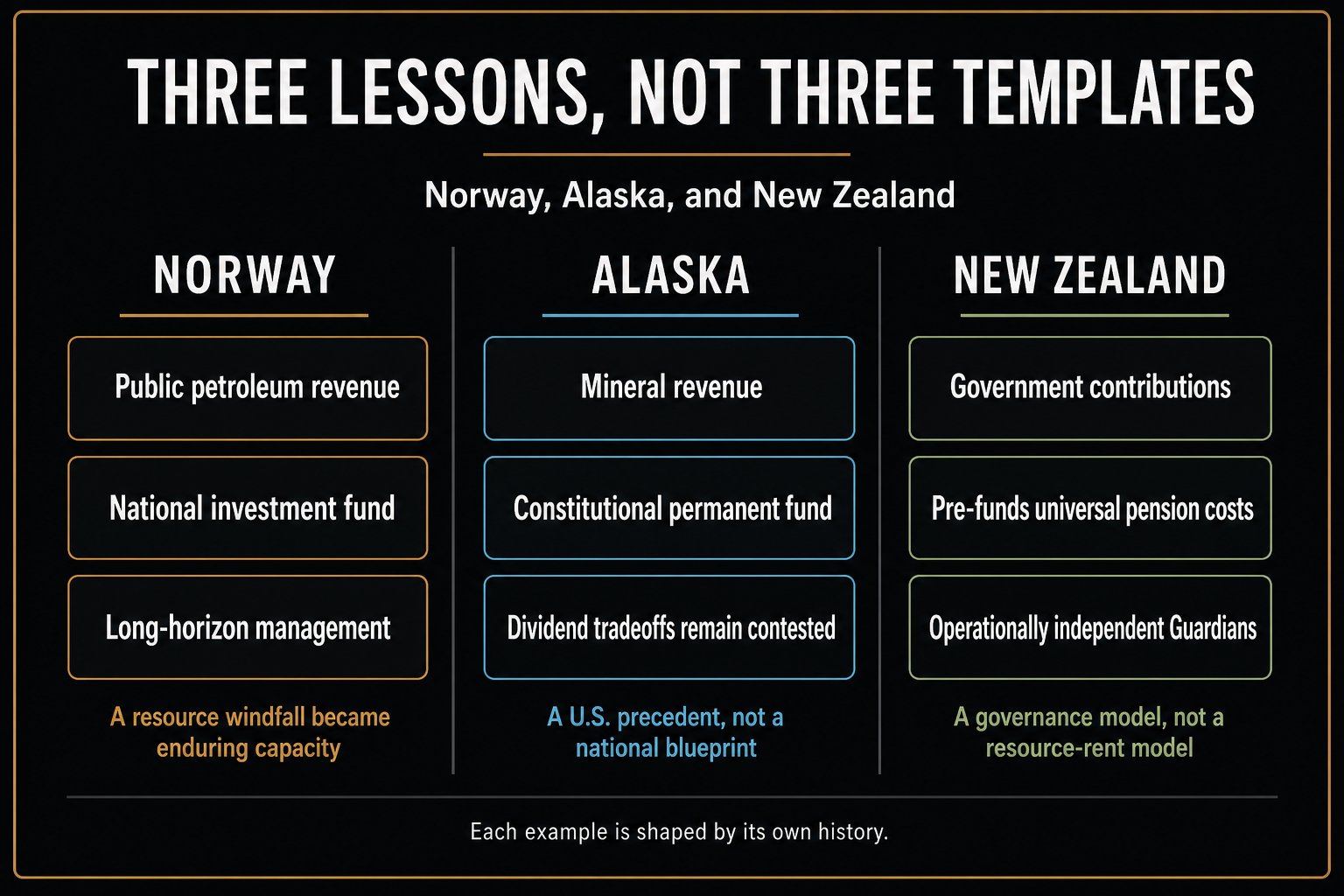
The lesson isn’t “copy Norway.” The lesson is simpler: a society can decide that a temporary public windfall should create lasting public capacity.
Alaska made a related choice in 1976, when voters amended the state constitution to put a share of mineral revenue into a permanent fund. Alaska is an American example, but it isn’t a clean national template either. Its dividend and the use of fund earnings have remained politically contested. Protected principal doesn’t protect a society from politics (nothing does).
New Zealand offers a third, quieter lesson. Its Super Fund uses government contributions and investment returns to help meet the future cost of universal superannuation. The Guardians are legally separate from the Crown and operationally independent in investment decisions, while remaining accountable to government. This isn’t a resource-windfall model, and its contributions were suspended from 2009 to 2017. But it shows that a public institution can be designed deliberately to spread an acknowledged future burden across generations.
But all three examples force the same question: what does one generation owe the generations that come after the windfall?
Did America miss this choice before?#
I’ve been thinking about two earlier American technology waves: the computer expansion of the 1970s and 1980s, and the commercial internet and e-commerce expansion of the late 1990s.
I don’t know that either moment offered a neat, identifiable stream of public revenue that Congress could have swept into a fund. That would be a counterfactual dressed up as history. The personal computer industry wasn’t a barrel of publicly owned oil, and the commercial internet wasn’t a mineral royalty.
Still, the contrast bothers me.
The United States helped create some of the foundations on which the internet economy grew. The National Science Foundation describes how government-funded networks, including NSFNET, helped enable the commercial internet. DARPA’s history traces ARPANET, packet switching, and TCP/IP development. Public money, public institutions, university researchers, standards work, education, and infrastructure all helped make the later private boom possible.
That doesn’t mean the public automatically owns every company or fortune that followed. Private people took risks, built products, organized companies, and created real value. Acknowledging the public foundation doesn’t erase any of that.
But we mostly treated the public return as a flow: taxes, jobs, growth, and whatever annual budgets could capture. The Congressional Budget Office found that late-1990s stock-market gains helped federal revenues through capital gains realizations. Useful, yes. Permanent, no. Revenue entered the ordinary political stream rather than becoming an enduring national balance sheet.
Could we have done something different? I honestly don’t know. But I think it’s a question worth carrying into the next wave.
Why AI makes the question harder to ignore#
AI may create broad productivity gains, new businesses, better services, and higher wages. It may also reward people who already own the things that are hardest to reproduce: compute infrastructure, energy capacity, data, intellectual property, and equity in the companies assembling them.
That second outcome isn’t guaranteed. An IMF working paper models AI as potentially increasing wealth inequality through higher returns to capital, but it also identifies wage and productivity effects that could push in other directions. This is a plausible risk, not destiny.
The starting point matters, though. Federal Reserve data show how strongly household wealth is shaped by ownership of corporate equity and real estate. If the largest gains from AI accrue through ownership, people who already hold substantial assets are positioned to collect more of them.
Here’s where I stop thinking about balance sheets and start thinking about people. If you teach the children who become researchers, maintain the electrical grid, fund universities through taxes, care for the people doing the work, build roads and networks, or contribute your own work to the economy, what durable claim do you have on the prosperity your society helped make possible?
A job is one answer. Cheaper services might be another. Annual tax revenue is part of the answer, too. But none of those necessarily gives an ordinary person a lasting stake in the wealth being created.
Ownership does.
A dividend is not the whole inheritance#
There’s an obvious reply to all of this: if a public fund belongs to the public, distribute it. I understand the instinct. A dividend makes ownership visible, and a little more money is genuinely useful to people who need it.
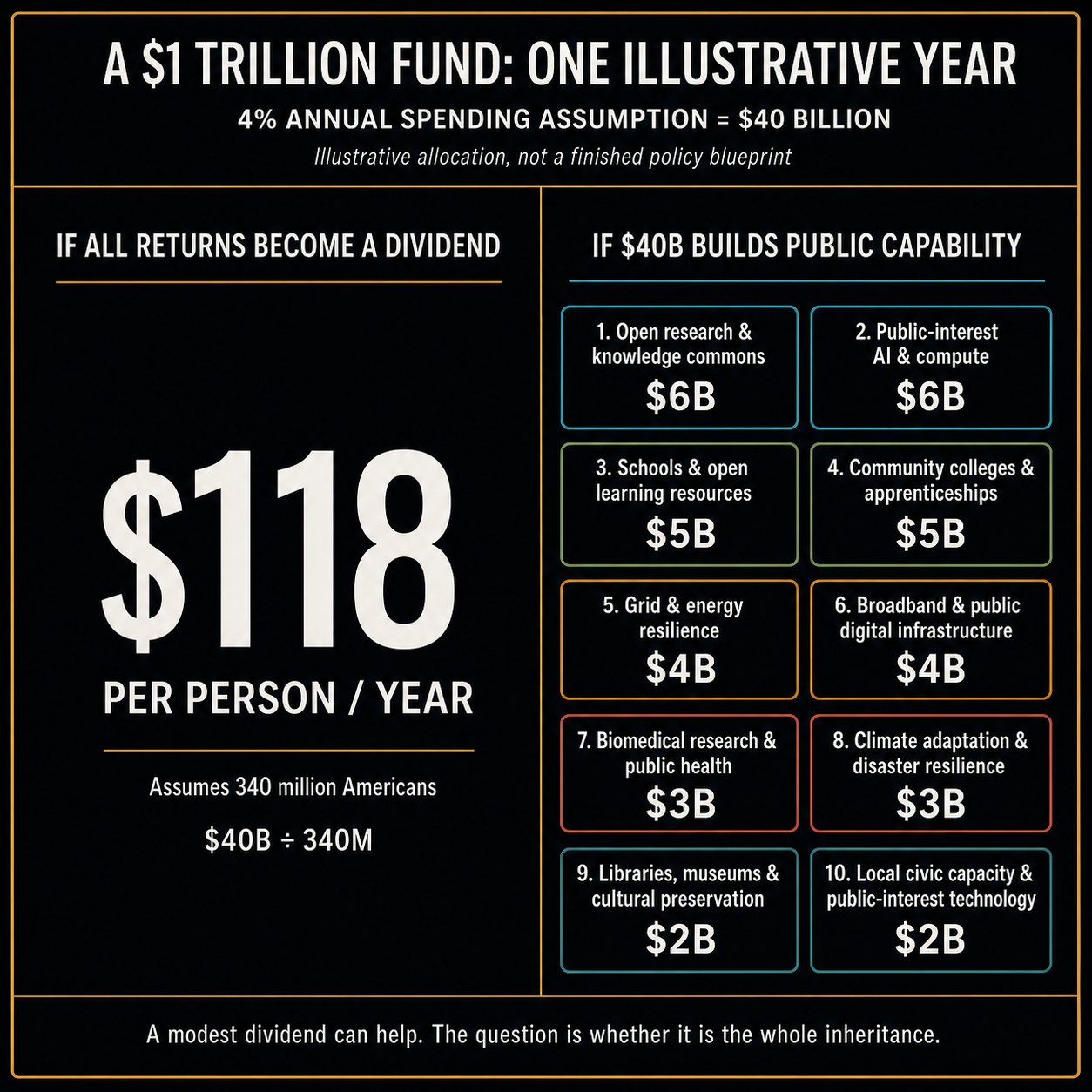
But the math changes the argument. Using the Census population clock’s roughly 340 million Americans as a planning denominator, dividing a $1 trillion fund’s principal once would be about $2,941 per person. That is real money. It is also a one-time liquidation of the inheritance.
If the principal stays intact and the fund distributes only an assumed 3% to 6% annual return, the annual amount is about $88 to $176 per person. That isn’t nothing. But it is not enough, by itself, to change a family’s economic position or build the open research, education, infrastructure, and shared technical capacity that future people will need.
| Illustrative annual investment | Amount |
|---|---|
| Open research and knowledge commons | $6 billion |
| Public-interest AI and compute | $6 billion |
| Schools and open learning resources | $5 billion |
| Community colleges and apprenticeships | $5 billion |
| Grid and energy resilience | $4 billion |
| Broadband and public digital infrastructure | $4 billion |
| Biomedical research and public health | $3 billion |
| Climate adaptation and disaster resilience | $3 billion |
| Libraries, museums, and cultural preservation | $2 billion |
| Local civic capacity and public-interest technology | $2 billion |
Those categories are not my settled list of ten winners. They are a thought experiment about scale: the same annual return could underwrite visible, durable pieces of a public inheritance. Choosing the actual mix would need democratic legitimacy, real cost estimates, and far more expertise than I have.
So I’m not arguing against a dividend. I’m arguing against mistaking a dividend for the whole stewardship agenda. We’d still have to decide how much of the return should reach people directly, how much should preserve and grow the principal, and how much should create durable public capability. Those are hard choices. Pretending that an annual check in this range settles the question isn’t.
A fund, not a finished formula#
By “American Stewardship Fund,” I mean a durable public institution that holds productive assets or preserves public returns across generations. I don’t yet know how it should be capitalized. A dedicated revenue stream, negotiated returns from certain public investments, royalties or warrants where contracts and law support them, and a legislated tax-and-capitalization rule all deserve serious scrutiny. Each carries risks involving incentives, administrative complexity, political capture, and constitutional authority.
I’m not choosing among them here. That work needs people who know far more about federal finance, law, governance, and industrial policy than I do.
But I do think a serious design needs a few basic commitments:
- Preserve principal where possible, rather than creating another account that disappears into the next budget fight.
- Make governance transparent enough that the public can see what it owns, who manages it, and who benefits.
- Keep it democratically accountable without turning every investment decision into a partisan favor.
- Produce public capability, not merely a nicer number on a federal balance sheet.
That last point could include more than money. Federal public-access policy already recognizes that publicly funded research should produce public access to publications and data, subject to privacy, security, intellectual property, and other real limits. A stewardship agenda could treat knowledge, research infrastructure, education, and shared technical capacity as parts of the inheritance, too.
Again, that isn’t a claim that everything touched by public money belongs to everyone. It’s a claim that public investment should leave something durable in public hands.
The choice is still ours#
Maybe the computer and internet booms were never clean opportunities for an American fund. Maybe any attempt to build one then would have failed. I can’t prove a missed counterfactual, and I don’t want to pretend I can.
But AI gives us a chance to ask the question before the economic structure fully hardens around us: if this technology produces extraordinary abundance, who gets a durable claim on it?
We can leave the answer entirely to existing patterns of asset ownership. We can collect some taxes, spend them through annual budgets, and call that enough. Or we can explore whether a portion of this moment should become a public inheritance that compounds over decades.
Norway and Alaska don’t tell us how to do that. They tell us that stewardship is a choice.
America can still make one.