
A city can put a remarkable amount of information online and still make it hard to use.
You can find Raleigh police records, fire statistics, old incident summaries, inspection histories, and a public active-incident map. But each service has its own vocabulary, its own search form, and its own idea of what the result means. A resident arrives with a normal question. The city replies with a database.
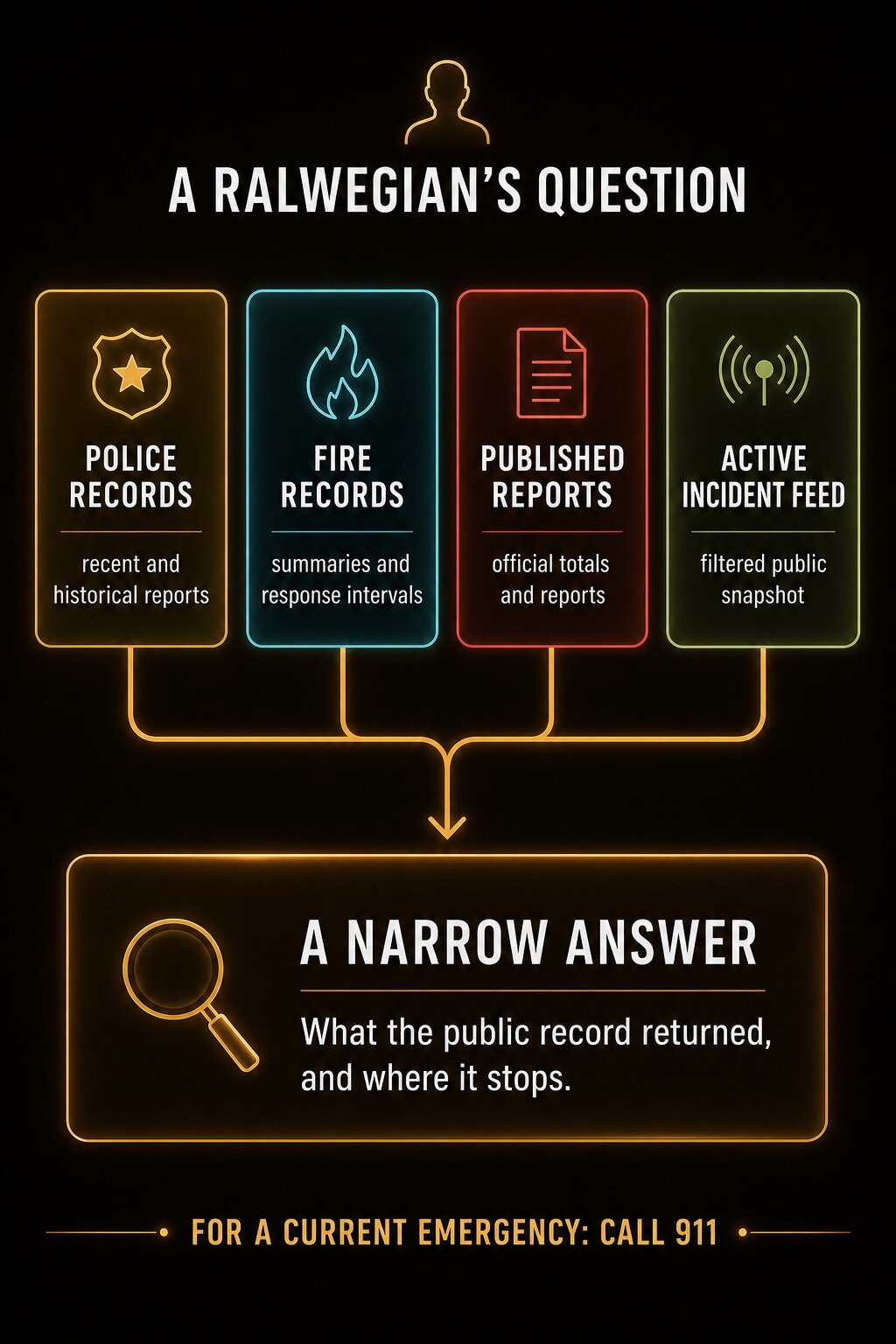
That gap is where an AI can be genuinely useful. But public-safety data is where it has to know when to stop. It is not a police scanner, an emergency dispatcher, or a machine that turns a block-level incident row into a story about a person.
I introduced the Raleigh Agent Skill as a way for Ralwegians to begin with the question they actually have. Version 2 gave it more doors into the city’s digital maze. The new public-safety work takes that idea into places where a good answer needs a little more restraint.
I captured these examples late on July 26, 2026. They’re snapshots, not promises about what a public feed will say tomorrow.
First, what happened nearby?#
A person moving into a neighborhood might ask:
“What public police reports of burglaries were recorded in Raleigh this week?”
The concierge can take that question to the Raleigh Police Department’s public crime-data service and bring back this:
| Description | District | Block address | Location |
|---|---|---|---|
| Burglary, commercial or non-residential | Southwest | 200 Block Dixie Trl | Block-level |
| Burglary, residential | Northwest | 5900 Block Timber Creek Ln | Block-level |
| Burglary, residential | Southeast | 500 Block Chapanoke Rd | Block-level |
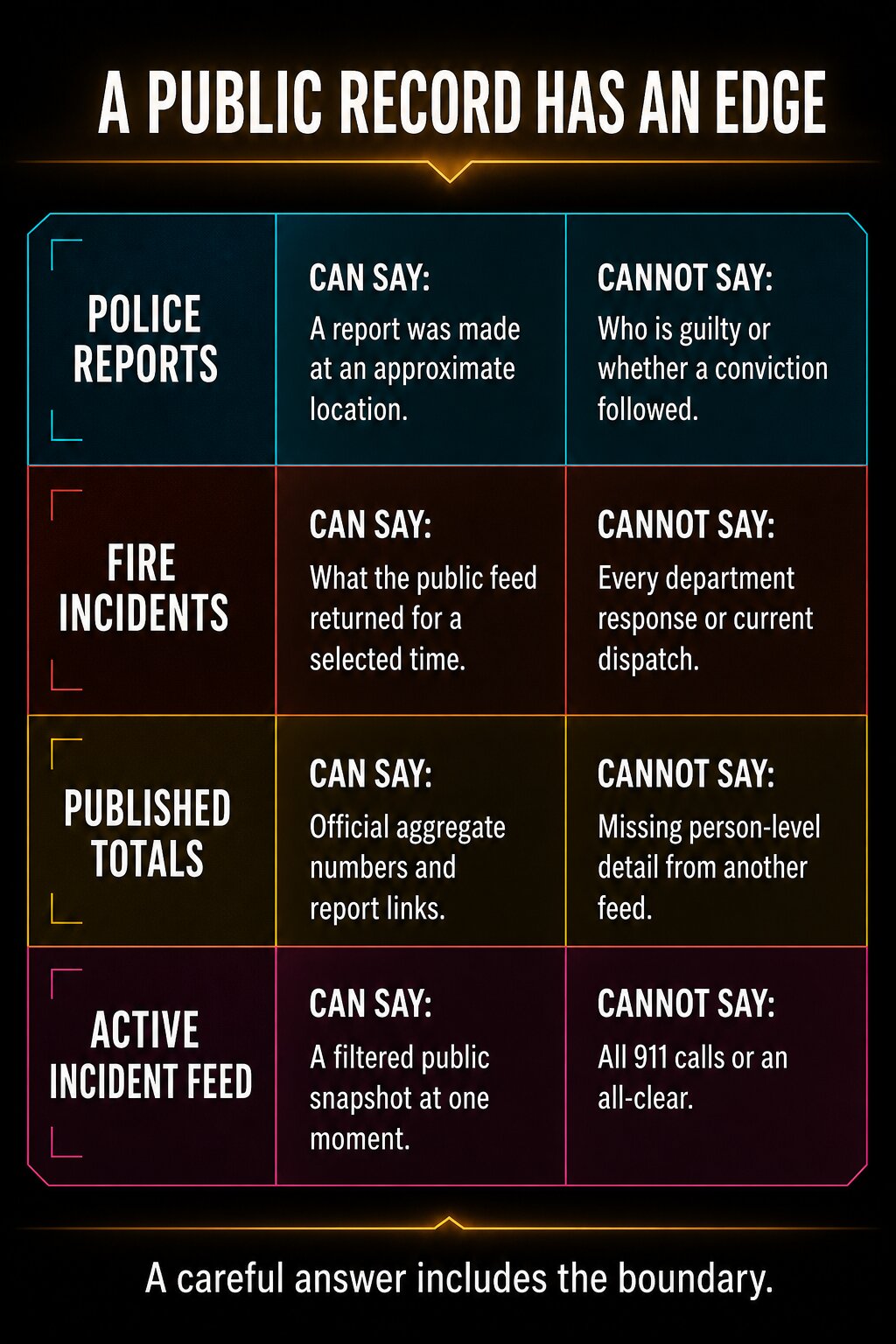
That’s context. Not a conviction, an arrest record, or a disposition. The locations are block-level, and the city may randomize or redact them. Leave the row there.
Why should you have to know that the city keeps several public police views, each with a different name? You don’t. Someone who wants the rolling 90-day CrimeMapper view of Downtown might ask:
“What has the public Downtown feed shown over the last week?”
| Description | District | Block address |
|---|---|---|
| All Other, All Other Offenses | Downtown | 1100 Block Garner Rd |
| Liquor-Alcohol Law Violations | Downtown | 300 Block W North St |
| Assault, Simple | Downtown | Fayetteville St and Prospect Ave |
And a morning-after question has a different route:
“What did the previous-day public police feed return?”
| Description | District | Block address |
|---|---|---|
| Robbery, From Person | Downtown | 400 Block Montague Ln |
| Assault, Simple | Northeast | 4600 Block Millbrook Green Dr |
| Drug Violation, Misdemeanor | Northwest | 8100 Block Glenwood Ave |
But it still can’t promise completeness. That feed can lag. “No records returned” is not the same as “nothing happened.”
Older records have a different shape again. Ask for older larceny reports, and the concierge can return them without treating redacted locations as a puzzle to solve:
| Description | District | Block address | Location |
|---|---|---|---|
| Larceny, All Others ($1000+) | Northeast | Not published | Redacted |
| Larceny, All Others ($200-$1000) | Southeast | Not published | Redacted |
| Larceny, From Coin Op Machines (-$50) | Northwest | Not published | Redacted |
The blank address is part of the answer. The concierge should leave it blank.
Sometimes a resident does not want incident rows at all. They want the official document the city published. This is a different request:
“Where can I find Raleigh’s official 2025 crime reports?”
| Year | Period | Document |
|---|---|---|
| 2025 | Annual | Annual Crime Data |
| 2025 | Q1 | Q1 stats |
| 2025 | Q2 | Q2 stats |
| 2025 | Q3 | Q3 stats |
| 2025 | Q4 | Q4 stats |
The result links to the city’s annual and quarterly documents. It doesn’t add up a different public feed and pretend the result is official.
Fire records answer a different question#
Fire data carries another kind of temptation: seeing a few records and assuming that they describe every department response. They do not.
A resident could ask:
“What has the public Raleigh Fire feed recorded over the past week?”
The current public source returned:
| Incident | Group | Type | Station | Platoon | Dispatched |
|---|---|---|---|---|---|
| 26-031545 | No Emergency | Malfunctioning Alarm | 25 | C | 2026-07-20 01:18Z |
| 26-031549 | Public Service | Person In Distress | 11 | C | 2026-07-20 02:13Z |
| 26-031552 | No Emergency | Accidental Alarm | 7 | C | 2026-07-20 03:20Z |
The Raleigh Fire Department’s public incident layer has dispatch, arrival, clearance, station, and classification fields. It excludes EMS-related categories for privacy, though, so it is not a complete record of every RFD response. It is never a reason to delay calling 911.
Same public fields. Narrower question:
“For the records you found, how long was it from dispatch to arrival?”
Arrival intervals
| Incident | Group | Dispatch to arrive | Status |
|---|---|---|---|
| 26-031545 | No Emergency | 388 seconds | OK |
| 26-031549 | Public Service | 396 seconds | OK |
| 26-031552 | No Emergency | 524 seconds | OK |
Clearance intervals
| Incident | Arrive to clear | Dispatch to clear |
|---|---|---|
| 26-031545 | 1403 seconds | 1791 seconds |
| 26-031549 | 378 seconds | 774 seconds |
| 26-031552 | 856 seconds | 1380 seconds |
Those are labeled durations for three records, not a citywide response-time verdict. That distinction sounds fussy until it prevents somebody from taking a few rows as a promise about their own emergency.
A property question travels through another public system. A Ralwegian considering an address can ask:
“What fire-protection information does the public Wake County record associate with 222 West Hargett Street?”
Address: 222 W Hargett St, Raleigh, NC 27601
Match score: 100
| Rank | Station | Source-provided distance | ISO |
|---|---|---|---|
| 1 | S01 | 425.46481411180866 | 1 |
| 2 | S03 | 3951.830682378678 | 1 |
| 3 | S05 | 7684.449341372562 | 1 |
Nearest hydrant distance: 176.43157513831414
The Wake County public fire-protection record supplies those rankings and distances. The source doesn’t publish distance units, so the concierge doesn’t guess. And it doesn’t suggest which apparatus would respond to a real emergency. That’s dispatch’s job.
Published totals are not incident rows#
A person trying to understand the department at a larger scale might ask:
“What statistics has Raleigh Fire published for 2026?”
The Raleigh Fire Department’s statistics page returned these source-published counts:
| Category | Published value |
|---|---|
| Fire | 401 |
| Hazardous Situation | 526 |
| Medical | 7,882 |
| Public Service | 2,116 |
| Rescue | 128 |
| No Emergency | 2,883 |
| Law Enforcement Support | 48 |
That answer keeps an important wall intact. The public incident feed excludes some EMS-related records. The city-published medical total is an aggregate number, not a set of incident rows waiting to be reconstructed.
The skill also finds the documents behind the numbers:
“Show me Raleigh’s public fire-statistics report for the first quarter of 2025.”
| Year | Period | Document |
|---|---|---|
| 2025 | Q1 | Fire statistics from the previous quarter |
The returned link points to the city’s published report. Again, the concierge doesn’t pretend it has numbers the document index hasn’t parsed.
A report summary is not a safety certificate#
Two more public services are useful, but only for narrow questions.
“What did the structured public fire summary show for July 24?”
| Incident | Date | Type |
|---|---|---|
| 26-032170 | 2026-07-24 00:16Z | Gas Leak / Gas Odor |
| 26-032185 | 2026-07-24 02:56Z | Elevator / Escalator Rescue |
| 26-032187 | 2026-07-24 03:43Z | Electrical Power Line Down / Arching / Malfunction |
That’s an abridged excerpt from the city’s rolling structured feed, not a claim that it has every record for that day. If you need help with a current gas odor, electrical hazard, or fire, call 911. Don’t search a public site.
The city also refers residents to its public Fire Report System. An installed concierge can search a specific business or address when someone asks:
“Does the public record list fire inspections for Raleigh Swim School?”
| Inspection | Completed | Business | Address |
|---|---|---|---|
| RFD-2025-0006213 | 05/19/2025 | Raleigh Swim School | 1012 Oberlin Rd, Raleigh, NC, 27605 |
| RFD-2026-0007014 | 05/27/2026 | Raleigh Swim School | 1012 Oberlin Rd, Raleigh, NC, 27605 |
| RFD-2025-0009659 | 08/18/2025 | Raleigh Swim School | 1012 Oberlin Rd, Raleigh, NC, 27605 |
The city publicly refers residents to the RFD Report System, and its report site served the lookup over HTTP when I checked. The command requires --acknowledge-insecure-rfd for each lookup. And those inspection entries aren’t a safety certificate: they show only the entries returned by that search, not what happened beyond them.
What is active right now?#
The last new doorway is the most delicate one. Somebody might ask:
“What is the public active-incident map showing for Raleigh Police right now?”
On the evening I checked, the Raleigh-Wake Emergency Communications Center public map returned:
| Agency | Problem | Address | Timestamp |
|---|---|---|---|
| Raleigh Police Department | MVC - Damage | 601 E Six Forks Rd | 2026-07-26 18:12:04.000 |
| Raleigh Police Department | Road Hazard | Bernard St / Brewer St | 2026-07-26 19:15:23.000 |
| Raleigh Police Department | MVC - Roadway Blocked | 928 Rock Quarry Rd | 2026-07-26 19:52:59.000 |
The map itself says its data is informational only. The skill goes further: it tells you this is a filtered public snapshot, says when it retrieved the records, and doesn’t pretend it represents every 911 call or the city’s authoritative emergency status.
That matters when the result is empty, too. A fire-filtered request in the same capture returned no active incidents. The right response is not, “Raleigh is clear.” It is, “No active incidents were returned by this filtered public feed at this moment.”
That is a better concierge. It knows that a blank page sometimes means a blank page.
The digital city should start with a question#
This is not a story about putting more surveillance in an AI chat window. Raleigh already publishes these records across separate services. The gap is that each one asks a resident to understand its own rules before asking a normal question.
The order matters. You ask about a move, a property, a historical pattern, a city report, or a public record. The concierge finds the right door, brings back the smallest answer that fits, and tells you where the evidence stops.
For Ralwegians, that’s a useful thing to install. For anyone facing an emergency, the answer is shorter: call 911.