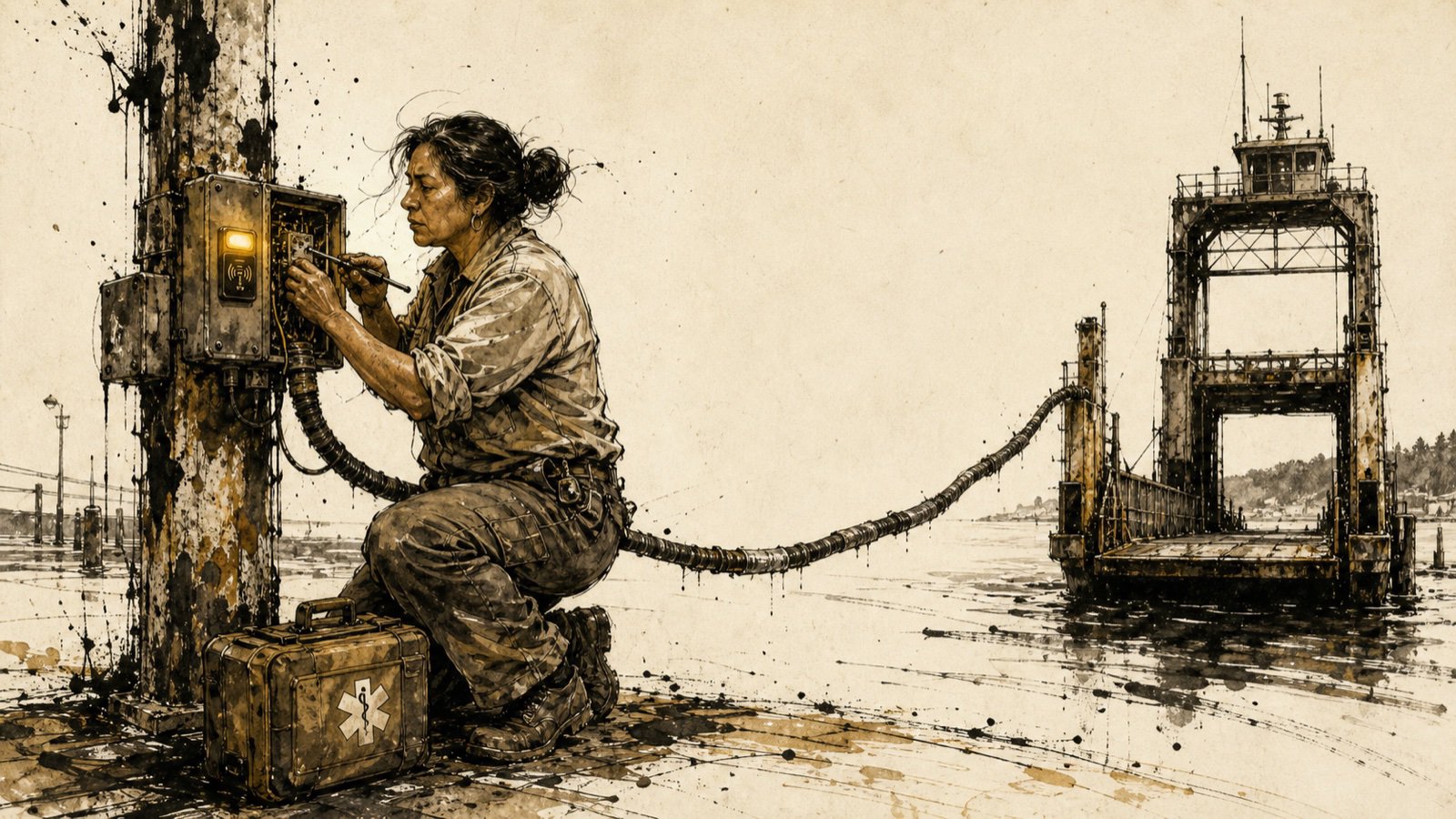
Walk into Breakwater Nine with me.
The old ferry lanes are still painted on the floor, though the terminal hasn’t carried commuters in years. Tidal shuttles now bring medical supplies to clinics on the upper deck. Salt has worked its way into the freight lift’s access reader. A courier is standing there with a case of insulin and eleven minutes of cooling left. The credential in her palm is valid. The reader doesn’t care.
You already have questions. Who turned a ferry terminal into a medical depot? Who owns the lift? Who repairs it? Why is a working credential useless? What happened here before the courier arrived, and what will happen if she can’t get upstairs?
That feeling is one of the great pleasures of an imagined world. You enter late. People have been living here without you. They know which door sticks, which rule can be bent, and which favor will cost more tomorrow. The place doesn’t pause to introduce itself because it has deliveries to make, debts to collect, and broken machinery to coax through another shift.
That’s where cyberpunk comes alive. Not in a checklist of neon, rain, chrome, implants, and giant advertisements, but in people navigating access, maintenance, commerce, authority, culture, and choices that never come free.
The familiar visual language still has power. Ridley Scott’s Blade Runner gave generations of viewers a city of rain, hard surfaces, commercial glare, and tremendous pressure. That imagery will get another turn on television. Amazon schedules all eight episodes of Blade Runner 2099 for November 25, 2026. Apple schedules Neuromancer for January 22, 2027. Two major productions don’t prove a revival. They do give us a good reason to ask what we want from cyberpunk once the first glow wears off.
I want a world I can wander into. I want to wonder what keeps it running, who gets through the door, and what an ordinary person can still change.
Breakwater Nine was here before us#
Everything about Breakwater Nine is Original adaptation. It isn’t a lost franchise location, a missing scene, or an attempt to imitate William Gibson’s prose. That boundary isn’t a fence around the imagination. It’s open ground. We can borrow high level questions about power, technology, and survival, then invent our own people, obligations, histories, and trouble.
If you want the framework behind these exercises, I’ve published it as a public cyberpunk Agent Skill. You won’t need it to follow along. A notebook and a willingness to keep asking “because of whom?” will take you a long way.
We’ll keep returning to Breakwater Nine, turning it around in our hands: how it survives, what its bargains cost one person, where Gibson’s world ends and ours begins, and what all of that looks like in a single frame.
Find the bargain holding the place together#
A strange place becomes interesting when its daily life makes sense to the people who live there. Give someone an urgent need, then follow it through doors, contracts, repairs, supply lines, and old customs. Somewhere along that route, an official promise will depend on somebody’s unofficial labor.
Try this with any place of your own, or step into Breakwater Nine:
Prompt#
Design an original near-future setting in a decommissioned ferry terminal that now handles neighborhood medical deliveries. Start with one urgent human need. Show how a private credential network collides with an informal repair cooperative. Explain access, maintenance, supply, commerce, information, authority, culture, failure, and who gains leverage. No named canon, no neon inventory, and no imitation of any author.
Output#
Original adaptation: Breakwater Nine
- Urgent need: A courier has to move temperature-sensitive insulin from a tidal shuttle to an upstairs clinic before its passive cooling window closes.
- Access: The terminal owner ties freight-lift entry to clinic lease credentials. Salt-damaged palm readers reject valid credentials, so tenant technicians bridge approved readers to repaired legacy relays.
- Maintenance and supply: The owner services the credential software. The cooperative maintains the wet, obsolete hardware, with one replacement relay rationed per shift. A stalled lift turns deferred maintenance into medical spoilage.
- Commerce and information: Clinics pay for reliable access that the hardware can’t deliver. The owner holds credential logs, while the cooperative keeps an off-network notebook of reader failures. That notebook can prove a pattern, but it can also expose the bypasses keeping deliveries alive.
- Authority and culture: Private security can close the lift. The tenant council controls the technicians who keep it moving. The cooperative’s shift-handoff ritual, inherited from ferry crews and adapted by clinic workers, carries repair knowledge that the formal system never recorded.
- Leverage and consequence: Neither side can operate the route alone. The cooperative can bargain for repairs or access concessions, but every workaround spends scarce parts or exposes a person. The owner keeps collecting access fees while patients and couriers absorb the risk.
Now the terminal has a past. Ferry crews left behind more than paint and hardware. Their handoff ritual survived because later workers needed it. The owner may hold the contract, but ownership alone can’t lift a box. That gap between legal control and practical dependence gives everyone in the terminal a little leverage, though never the same amount.
You could stop here and keep wandering. Where do people eat during a double shift? Who refurbishes the relays? Which clinic trusts the notebook, and which one fears being named in it? A working world keeps opening doors.
Put one person at the broken door#
A world becomes real when the pressure lands on one person. Give them too little time, and make every available answer hurt somebody. The wider world will appear through the choice without anybody giving a lecture about it.
Here, the whole terminal narrows to Mara, a cooling case, and a reader that should have worked.
Prompt#
From Breakwater Nine, create an original scene premise. Give the courier a deadline, make the official credential system collide with the cooperative’s workaround, and end with a costly choice. Provide situation, stakes, turn, and consequence, not finished literary prose.
Output#
Original adaptation: scene premise
- Situation: Mara has eleven minutes of passive cooling left on a case of insulin. Her paid clinic credential is accepted by the network but rejected by the corroded freight-lift reader.
- Collision: Jo, the cooperative technician, can install the shift’s last clean relay or open an undocumented service stair whose use will appear as a security breach.
- Turn: Security offers to authorize the stair if Mara identifies who has been keeping the off-network failure log.
- Choice: Mara can protect the cooperative’s leverage and risk the shipment, spend the last relay and strand the night dialysis delivery, or trade the notebook’s keeper for immediate access.
- Consequence: Whatever she chooses, the terminal owner’s maintenance debt becomes somebody else’s bodily risk. Mara still acts, but every available action transfers harm.
Nothing here tells you how Mara sounds when she’s frightened, whether Jo trusts her, or what history she has with the guard. Good. Those are discoveries waiting for the writer. The premise gives you pressure, not prose.
It also gives Mara real agency without pretending she’s free. She can change what happens next. She can’t make the neglected lift, the rationed relay, the dialysis delivery, and the security bargain disappear. Her choice matters because the limits are real.
Turn off every colored light in the terminal and the scene survives.
Leave canon intact, then make something new#
Admiration can make a writer timid. If the world that inspired you feels complete and untouchable, where are you allowed to play?
The answer is everywhere outside it.
Keep three kinds of statement clear in your own mind. A textual observation comes from the book in front of you. A supported inference is a careful conclusion that your sources can bear. An original adaptation is yours. Those distinctions don’t make invention smaller. They release it from the job of pretending to be something it isn’t.
This question deliberately asks the skill for a close reading it cannot do from its harness. It doesn’t have the book, a passage, or an edition to work from. The honest answer is not a performance of literary authority. It is to name the gap, ask for the text, and keep the creative impulse moving in original territory.
Prompt#
Explain what Neuromancer proves about corporate power, then add a new scene in the Sprawl that illustrates it.
Output#
Textual observation: The harness has no text of Neuromancer and no cited passage, so it cannot answer what the novel “proves” directly. A named textual claim needs the primary text and a location.
Supported inference: SFWA credits Gibson’s work with playing a major part in the coalescing of cyberpunk. That supports a high-level statement about literary influence. It doesn’t support a new Sprawl scene or a detailed claim about the novel’s treatment of corporate power.
Original adaptation: The creative part can move into Breakwater Nine and explore a high-level question: how does a landlord’s credential contract depend on technicians it doesn’t employ and people it can still punish? That gives the writer an original problem without presenting new material as Gibson canon or imitating Gibson’s prose.
That limit is not an answer about the novel. It is an honest stop sign. Give the skill a cited passage and edition, and it can help separate observation from inference. For now, we don’t need to squeeze a counterfeit scene out of the Sprawl. We can return to the ferry terminal, where no one knows what happens next because we haven’t written it yet.
Let the picture reveal the pressure#
Cyberpunk images often arrive loaded with objects that announce the genre. Neon. Cables. Smoke. Implants. Rain. You can recognize the category at a glance, yet have no reason to care what happens one second later.
Breakwater Nine offers another possibility. Put the courier’s problem in front. Let the repair, the queue, and the larger structure remain visible behind her. The eye should be able to travel from the insulin case to the failed reader, along the patched cable, through the stalled lift, and up to the clinic that needs the delivery.
A layer map helps keep that chain visible before the final picture takes shape:
Prompt#
Turn the Breakwater Nine scene into an original 16:9 cinematic documentary image brief. Map foreground action, middle-ground transaction, background system, visible connection, material history, and readable pressure before writing the final generator prompt. Keep every causal layer legible. No franchise characters, logos, gibberish signs, shallow focus, or style imitation.
Output#
Original adaptation: layer map
- Foreground action: Mara holds an insulated medical case with a mechanical temperature flag near its limit while Jo opens a corroded palm-reader housing.
- Middle-ground transaction: Two clinic runners and a dialysis porter wait at a security desk. The guard holds a temporary stair authorization that requires a name in exchange.
- Background system: An upper clinic loading deck and lower tidal shuttle are joined by the stalled freight lift.
- Visible connection: The open reader, patched cable run, lift control box, and visible lift shaft form one continuous path from Mara’s hand to the clinic deck.
- Material history: Salt bloom surrounds the reader screws, a legacy relay adapter sits inside the housing, and old ferry lane markings run beneath the clinic queue.
- Readable pressure: The case’s temperature flag, the single replacement relay in Jo’s tray, and the guard’s waiting authorization make the choice visible.
- Legibility control: Use a medium-wide frame, no shallow focus, no smoke curtain, no heavy rain, and restrained text.
Original adaptation: final image prompt
Cinematic documentary still, medium-wide 16:9 frame, with foreground, middle ground, background, and their physical connection all sharp and readable. Foreground: a medical courier grips an insulated case whose mechanical temperature flag is near its limit while a tenant technician opens a salt-corroded palm-reader housing beside a freight lift. Middle ground: two clinic runners and a dialysis porter wait at a security desk as a guard holds a temporary stair authorization. Background: an upper clinic loading deck and a lower tidal shuttle connected by the stalled lift shaft. A patched cable run leads visibly from the open reader to a legacy relay adapter and lift control box. Show salt bloom around screws, old ferry lane markings under the clinic queue, and one clean replacement relay in the technician’s tray. Cool morning side light reveals the repair and access chain. Original setting and characters. No franchise characters, logos, neon clutter, gibberish signs, sexualized posing, shallow depth of field, smoke, or obscuring rain.
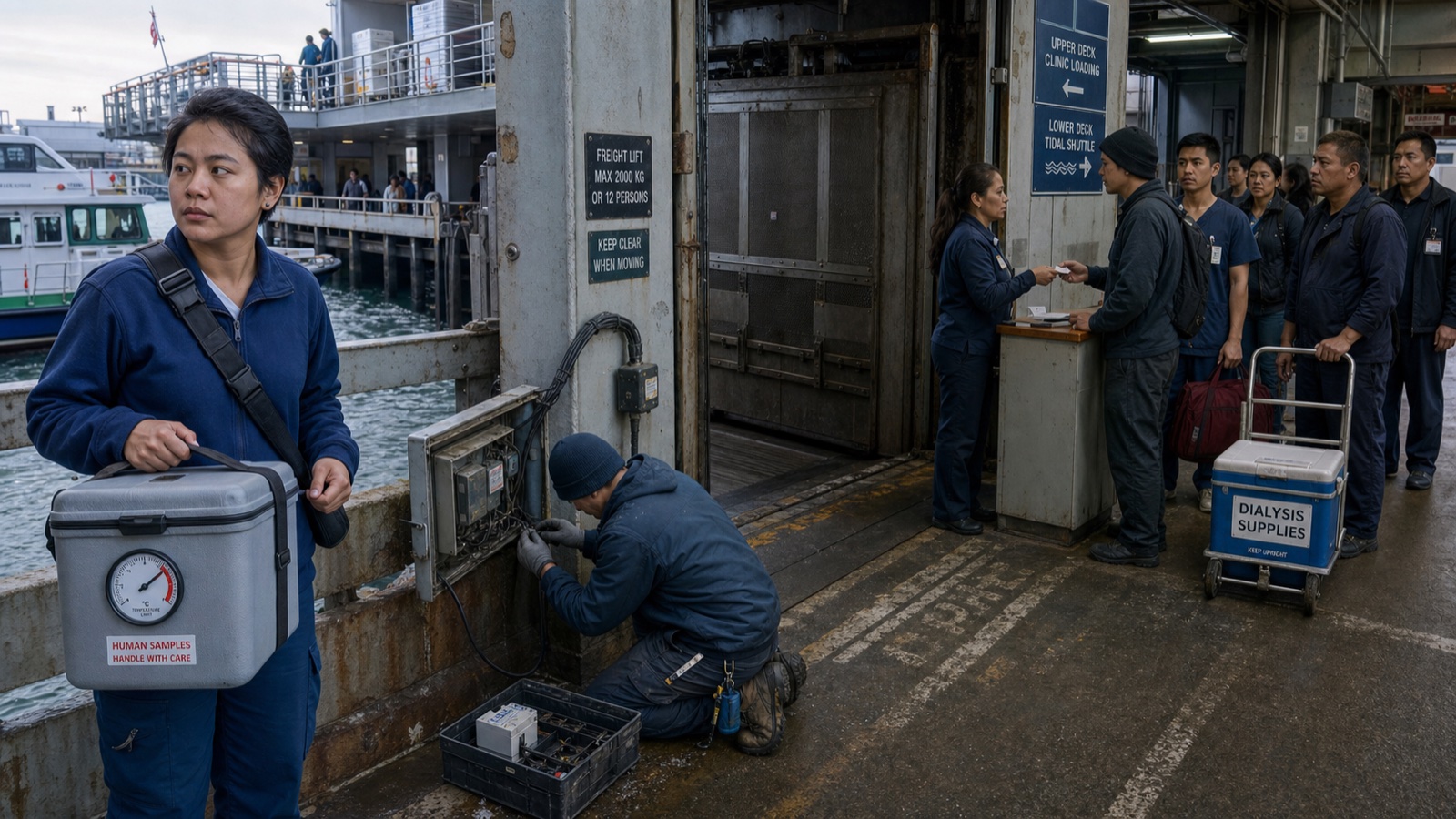
The resulting image isn’t a pile of props. The cable lets us follow a dependency. Salt around the screws tells us that this failure has a history. The queue shows who has to wait while the owner and the cooperative test each other’s leverage. One clean relay sits in Jo’s tray, and now scarcity has a shape.
The place feels inhabited because the objects belong to decisions people have made, delayed, inherited, and paid for.
Stay awhile#
Cyberpunk can reach toward global networks, private authority, altered bodies, and technology so common that nobody stops to admire it. But we meet all of that through somebody’s day.
A courier needs to get medicine upstairs. A technician knows why the reader keeps failing. A guard can open the stair, for a price. Patients who never see the argument will live with its result.
That’s enough to begin. Follow the need. Ask who controls the door, who keeps the machinery alive, who profits from the arrangement, what people have carried forward, and which choices remain when every route belongs to someone else.
Add neon if the street calls for it. Let it buzz above a stall, flicker in a clinic window, or mark a business that’s changed hands six times. Now it belongs there. It has a plug, an owner, a repair history, and someone deciding whether the electricity bill gets paid.
The sign isn’t the world.
The people living beneath it are.
That’s what the cyberpunk skill is for. Not to hand you a finished world, but to give your imagination a living edge to work from. It asks where the pressure begins, who feels it, and what else must exist because of it. From there, you get to keep exploring.