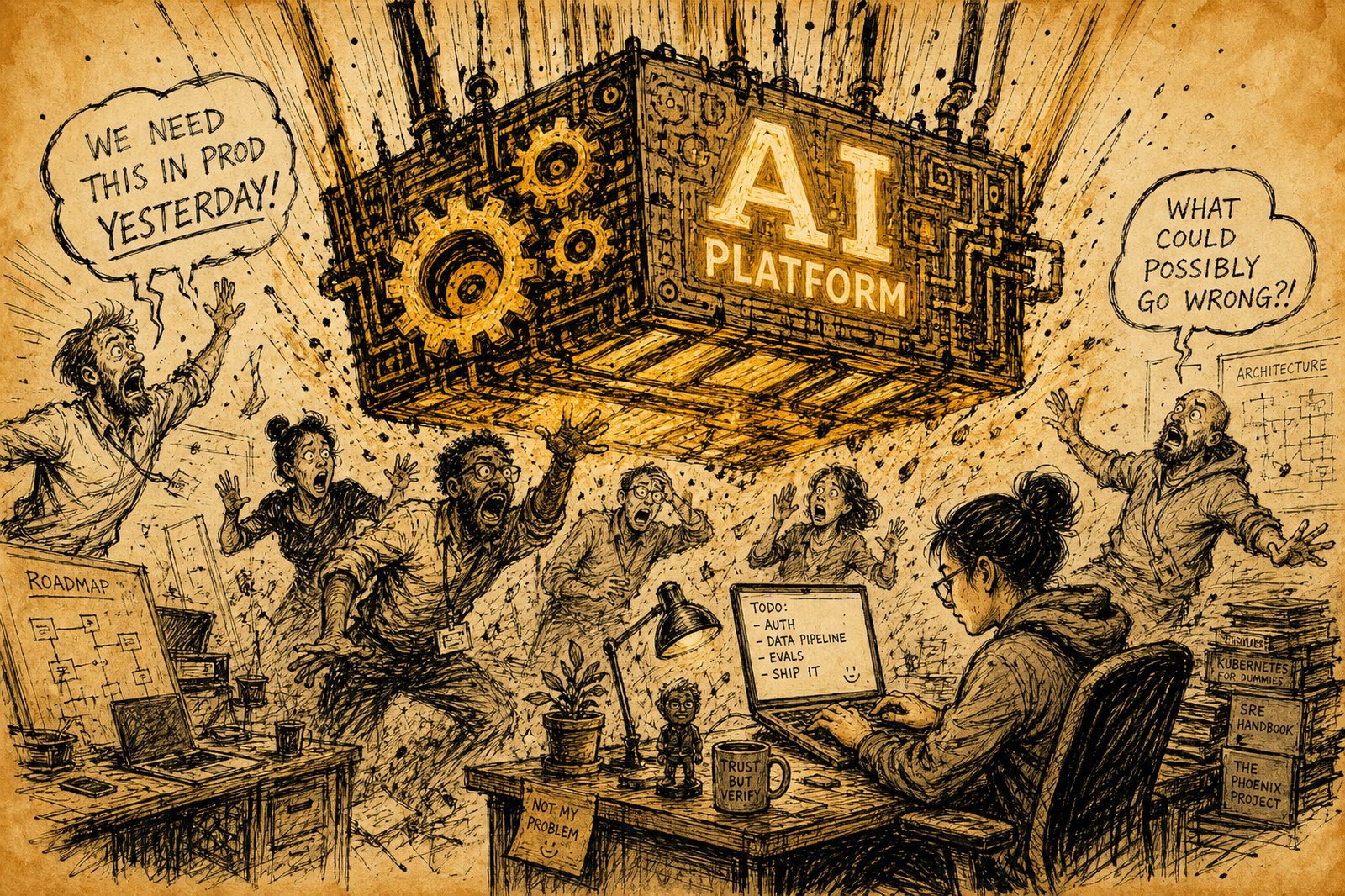
Right now, somewhere a CEO is yeeting a six figure AI platform at a team and praying something sticks. That was the opening image Shannon Ryan left us with at this month’s AgileRTP meetup, and it only got sharper from there.
Shannon is VP of Marketing and a technology strategist at Veritas Automata, a firm that works with teams adopting AI in highly regulated industries: life sciences, pharma, manufacturing, and supply chain. She spends most of her time inside real teams, watching them try to adopt AI tools without breaking what already works. And what she’s seeing is a pattern that has nothing to do with the technology.
Her talk was called “Beyond the Tech Stack: Why Your AI Tools Won’t Save a Broken Team.” The subtitle was the real thesis.
The Core Thesis#
AI doesn’t fix broken teams. It amplifies them.
Healthy teams get dramatically better with AI. Dysfunctional teams get better at creating confusion faster.
Shannon walked us through what this looks like on both sides. When a team has trust and safety, clear ownership, honest feedback loops, and a culture of experimentation, AI accelerates all of it. The team surfaces what isn’t working fast, corrects the output, and builds on what’s useful. The tool becomes a force multiplier for a system that was already producing.
When a team is broken (siloed communication, unclear ownership, low trust, anti-experimentation culture), AI makes every single one of those problems worse. Siloed communication becomes parallel hallucination: each team ships AI-generated certainty, nobody coordinates, and two people show up to the same meeting with different answers from the same tool. Unclear ownership becomes “the AI said so” as the new authority. Low trust becomes surveillance theater, where every AI feature gets weaponized into a metric. Anti-experimentation culture becomes pilot purgatory: “we tried AI and it didn’t work” after one rushed pilot with no support.
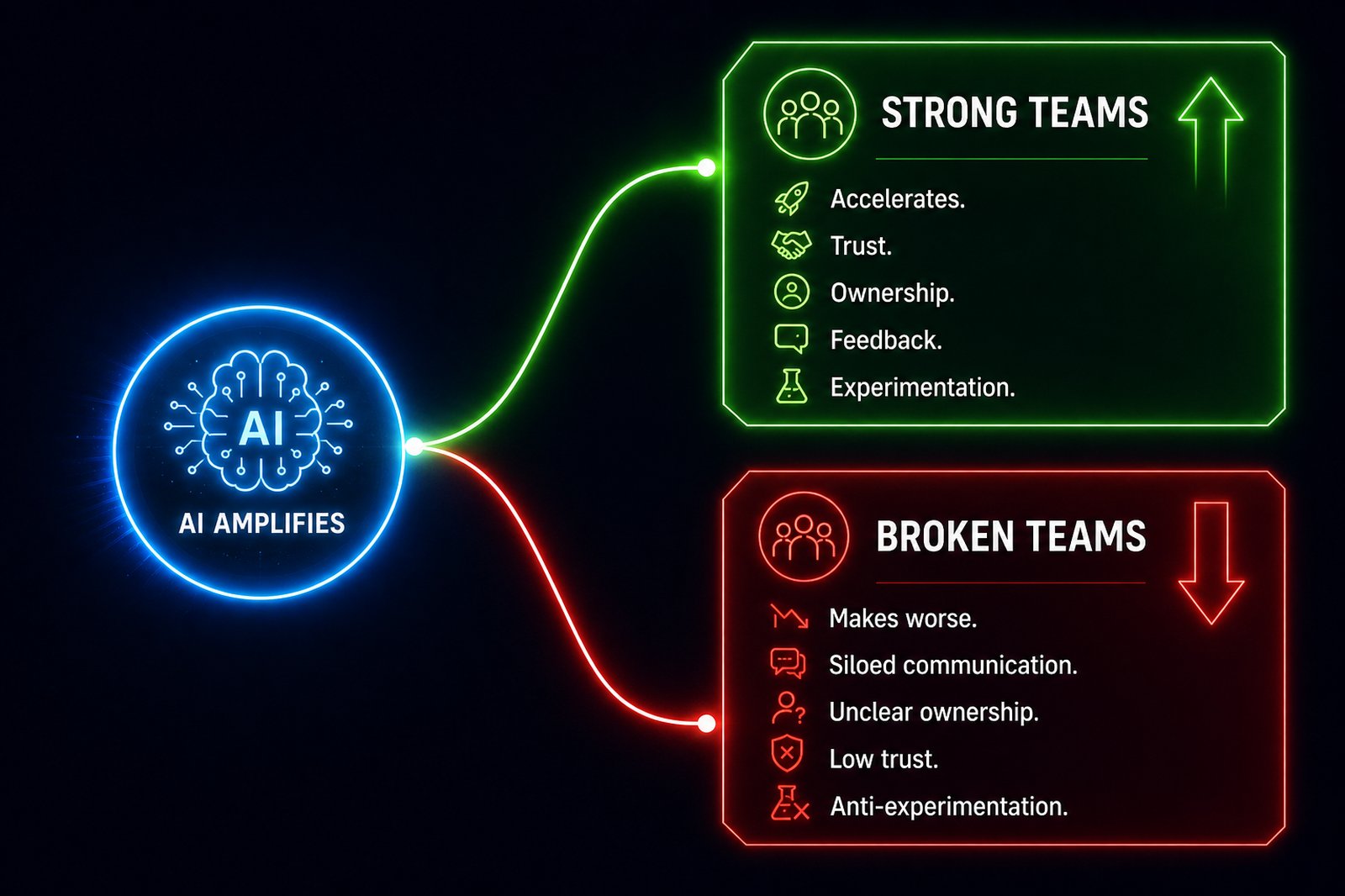
AI doesn’t fix broken teams. It amplifies whatever is already there in both directions.
The Three Patterns Right Now#
Shannon identified three things happening across tech teams right now that are creating what she called a “shadow in tech.”
The first is top-down AI mandates. Leadership buys a platform after a great vendor demo, the team gets a Slack message saying adoption is the new KPI, and nobody asked the team what problem they were trying to solve. Someone in the chat called it “top down mandates from C-suite leaders who can’t spell GPT,” which got a laugh of recognition. Shannon agreed with the sentiment. The tool was the answer before anyone had named the actual question.
The second is layoffs framed as AI strategy. Headcount gets rebranded as “AI transformation,” the survivors inherit the work and the tools, and the trauma sits in the roadmap. People are told “you are the AI team now” with no direction, no training, and no time to figure it out. Shannon called this the shadow in tech. The veterans are tired. The newer folks are scared. Both responses are legitimate.
The third is tool sprawl with no judgment. Copilots, agents, MCP servers, custom GPTs: bought and stacked without anyone asking the team what they actually need. It’s the quietest of the three because it’s often invisible until the credit card bill shows up.
The Agile Manifesto Is Now a Load-Bearing Wall#
Shannon pulled us back to the Agile Manifesto from 2001, specifically “individuals and interactions over processes and tools.” She pointed out that in 2001, this was a nice principle. Today it’s a load-bearing wall, because tools are now powerful enough to remove the human entirely.
The decision of where humans stay in the loop is the most important design decision your team is going to make this year.
Nobody argued with that one.
Five Things for Leaders#
Shannon gave us two sets of actionable guidance. The first was for leaders buying tools:
- Ask the team what’s actually slowing them down. The team is closer to the truth because they live in it.
- Check if the tool addresses that. What you’re seeing in a vendor demo might not match what your team needs.
- Run small experiments. One squad, two weeks, a real problem. Decide based on what you learn, not the sales presentation.
- Measure customer outcomes, not license adoption. Copilot license usage tells you nothing. Customer time to value tells you everything.
- Incentivize people for surfacing what’s broken. If your AI rollout depends on nobody telling you it isn’t working, you have a culture problem, not a tooling problem.
Five Things for Practitioners#
The second set was for the engineers, PMs, and individual contributors in the room. Things you can do without waiting for permission:
- Treat the AI as a junior teammate. You still own the outcome. The AI is a contributor, not the author.
- Build feedback loops. When the AI is wrong, someone fixes it, and the team sees the fix. No silent failures.
- Make experiments visible. If only one person learned it, the team didn’t learn it.
- Pair on hard problems before delegating to the AI. Skipping the human step is how you get parallel hallucination.
- Talk to your customers. AI can’t replace that signal. Stay with the humans you serve.
The Listening Method#
The part of the talk I keep coming back to was Shannon’s approach when a team calls her in after a bad rollout. She goes directly to the team, not the leadership. The first week is pure listening. No proposals, no recommendations, no selling. Just questions.
The golden question: “What are you doing right now that isn’t in the official process?”
In every dysfunctional rollout she’s seen, the team has invented workarounds. Someone is using their personal laptop to generate code, emailing it to themselves, then putting it into the company’s approved AI tool. The workarounds tell you what the tool actually needs to do.
That’s the gap between what leadership thinks the tool does and what the team actually needs. The listening step is where you find it. Skip it, and you’re just installing the next mandate on top of the resentment.
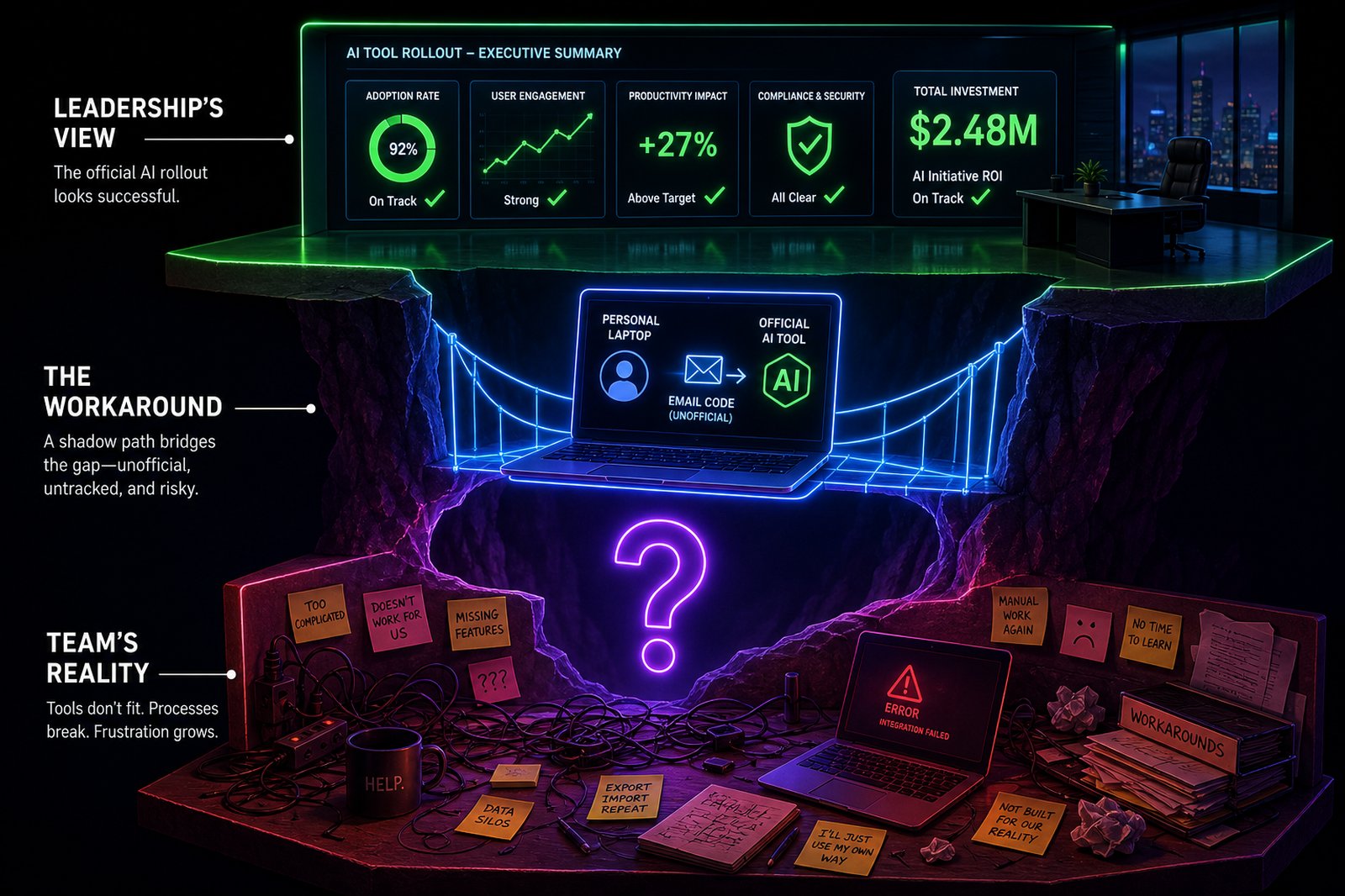
The workarounds tell you what the tool actually needs to do. That’s where the listening starts.
On Careers and the Future#
Shannon closed with a different take. The story everyone’s telling right now is that AI is taking jobs and the future is bleak. She called that clickbait. What she’s actually seeing in the field is different.
Soft skills are now hard skills. The ability to run a good meeting, ask good questions, hold a conversation. That stuff is going up in value, not down. She predicted content development will become one of the highest-paid roles in the next decade, as human-generated content becomes scarce against an ocean of AI-generated material. And sales, for anyone with good communication skills and a willingness to build relationships, is wide open right now.
She ended with a line worth repeating: “Tool proficiency depreciates. Human judgment appreciates.”
Shannon’s slides are available on the event page message board. She’ll be back in the Triangle the second week of August, and Catherine offered to organize a lunch at Page Road Grill. I’d recommend going.