
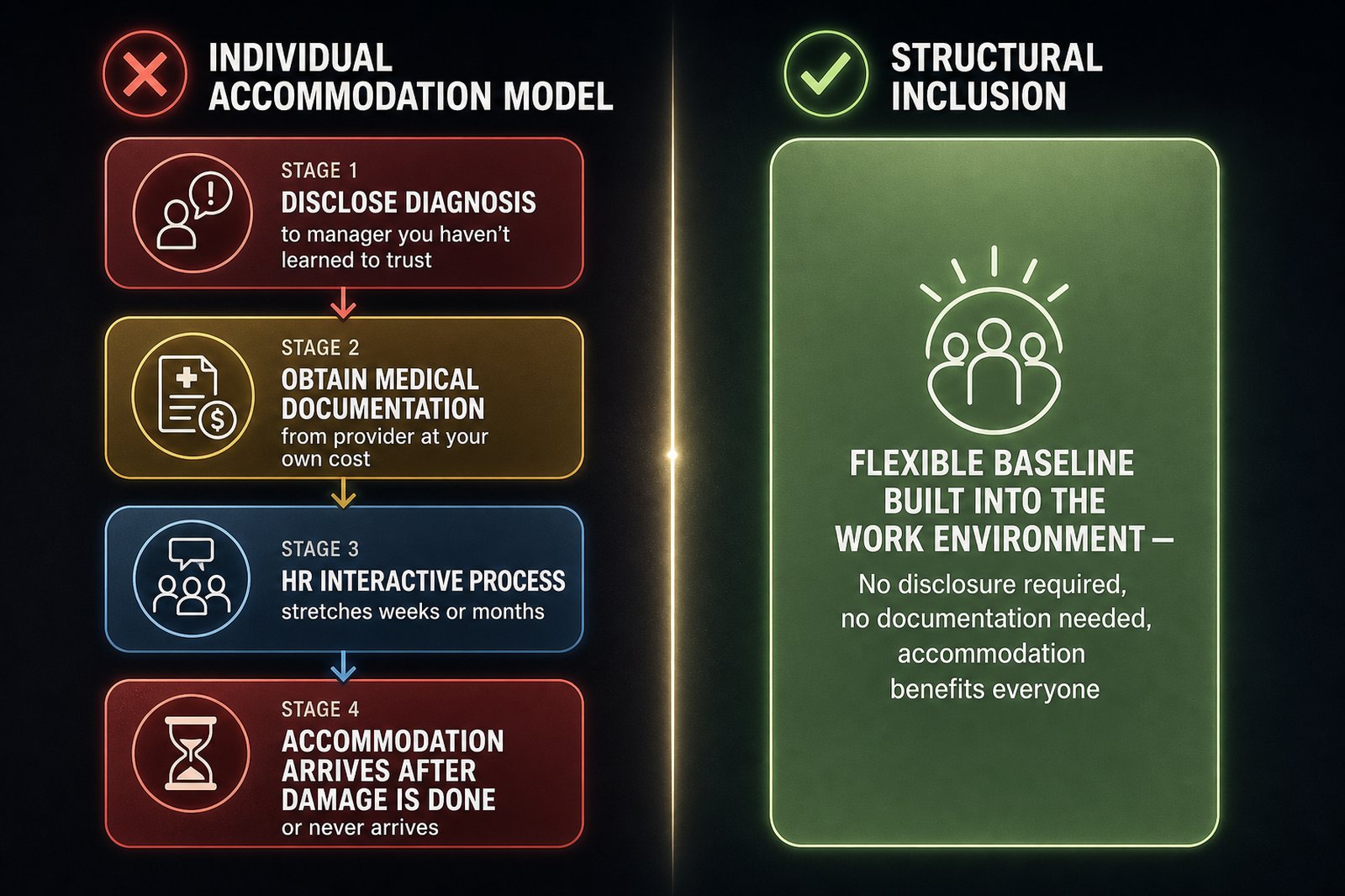
If you are neurodivergent and work in a typical office, you have probably had this experience. You know what you need to do your best work. Maybe it is a quiet space, or written instructions instead of verbal ones, or a schedule that does not require you to switch contexts six times before lunch. You know these things would help. But asking for them means disclosing your diagnosis to a manager you have not learned to trust yet, submitting documentation from a doctor, and entering a process that can take weeks or months. And even then, there is no guarantee.
A lot of us decide it is not worth it. We keep pushing through the mismatch and hope nobody notices.
A paper published this year helps explain why that experience is so common, and it has nothing to do with whether the people running organizations are well-intentioned. The problem is structural.
What the Research Actually Found#
Researchers at King’s College London and the University of Sheffield looked at 277 undergraduate students with diagnosed ADHD, autism, or dyslexia. They wanted to know what actually predicts academic performance. Is it the neurodivergence itself, or something else?
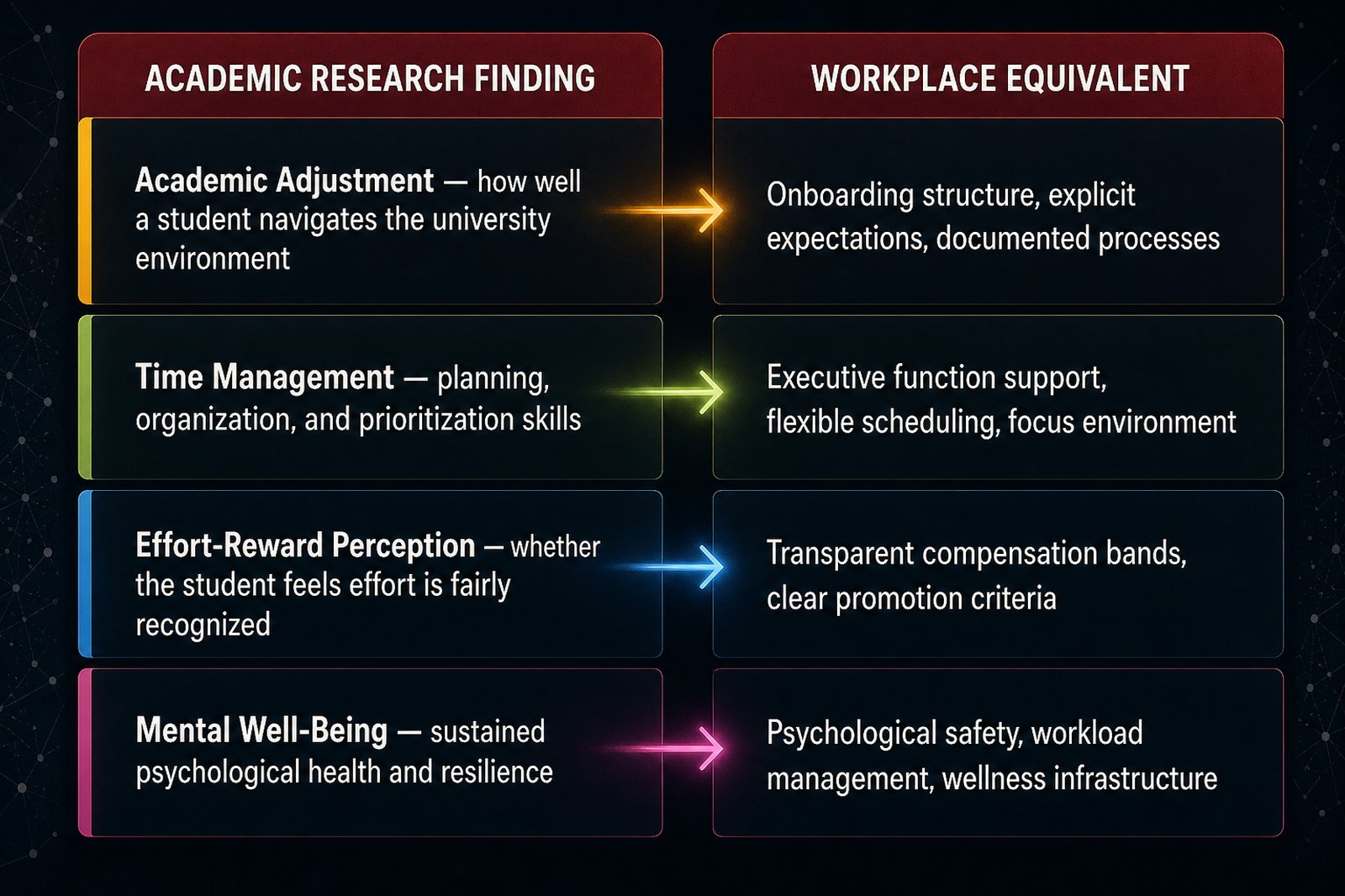
The answer surprised them. When they ran the numbers, the ADHD and dyslexia traits had no direct predictive power at all. What predicted how well a student performed was something called academic adjustment: how well they navigated the university environment, managed their time, felt their effort was fairly rewarded, and maintained their well-being. The environment mattered more than the neurology.
The lead author put it this way: neurodivergence is not a direct determinant of academic performance. It shapes outcomes indirectly, through its impact on adjustment, skills, motivation, and psychological experience. All of those things are modifiable. You cannot change someone’s neurology, but you can change how well the environment supports them.
This is the kind of finding that seems obvious once you hear it, but it has not been obvious to the systems we have built.
What This Looks Like at Work#
Think about what the workplace analogue of academic adjustment would be. Onboarding that does not assume everyone absorbs information the same way. Performance reviews that measure output instead of how busy someone looks. Compensation that is transparent enough that you can tell whether your effort is being fairly recognized. Managers who know that sending a written brief before a meeting is not a special favor. It is good management.
The existing evidence says these things work. A major review of workplace neurodiversity research found that accommodations typically cost less than twelve hundred dollars per person, less than the cost of recruiting a replacement. JPMorgan reports that participants in its neurodiversity hiring program complete tasks faster and are significantly more productive than the rest of their workforce. Ernst & Young says its neurodivergent employees excel at innovation and learn to automate processes faster than their peers.
The business case is not in dispute. What is in dispute is whether we keep treating accommodations as individual exceptions or start treating them as design requirements.
The Broken Model#
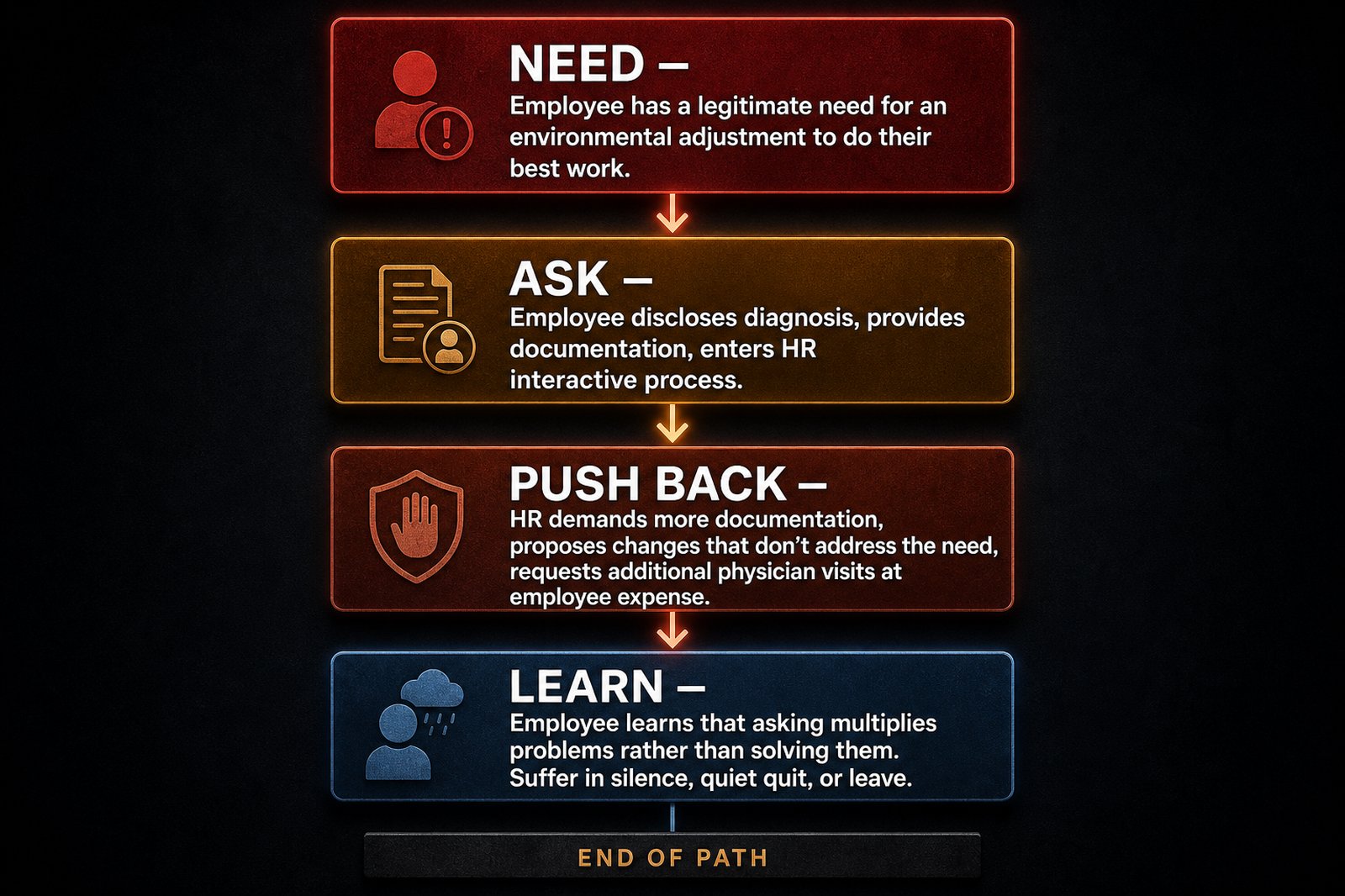
Right now, the system works like this. An employee needs a change to do their job effectively. They must disclose their diagnosis and hope the manager reacts well. They must get documentation from a medical provider. They must enter an interactive process with HR that can stretch for weeks. And if any step fails, they decide whether to escalate, knowing that escalation carries its own risks.
The research on how this actually plays out is sobering. One comprehensive review found that accommodations are typically provided as a compliance activity per individual, with few organizations looking at universal design. Access to accommodations depends on individual disclosure, which usually happens after a conflict or an episode of poor performance. By the time the accommodation arrives, the employee has already been flagged as a problem.
And many people never disclose at all. They know the risks. The same traits that make someone a great founder in a startup environment comfort with uncertainty, unconventional thinking, deep focus are the traits that get flagged as culture risks in a corporate hiring process.
I have seen this pattern play out firsthand. At one employer, I asked for four adjustments. Nothing expensive. Nothing unusual. The kind of changes that would have made work easier for anyone, diagnosed or not. The response was not a conversation about how to make it work. It was an immune response. The organization treated me like an infection it needed to contain.
The original difficulties did not go away. They got compounded by a new layer: Human Resources applying broken process pressure to accept adjustments that did not address my medical needs. Every attempt to negotiate was met with demands to go back to my physician, at my own cost, for documentation that was not even relevant to what I was asking for.
This is what the system incentivizes. You learn that asking for help multiplies your problems instead of solving them. So you stop asking. You suffer through the environment that was not built for you, or you quiet quit, or you leave. The accommodation model does not merely fail to help. It actively punishes the act of asking.
The alternative to this cycle is not harder individual advocacy. It is a different approach to how work environments are designed in the first place.
The Alternative#
The alternative is not to eliminate accommodations. It is to make the underlying environment work better so fewer individual exceptions are needed.
This is not a radical idea. It is the same principle as a curb cut. The ramp at the corner helps wheelchair users, sure. It also helps people pushing strollers, travelers with rolling luggage, delivery workers on hand trucks, and anyone having a bad day. You do not need to prove you are disabled enough to use it. It is there.
In practice, this looks like:
Onboarding that does not assume everyone picks up unwritten rules by osmosis. Written expectations, documented processes, and explicit feedback reduce the cognitive load of adjusting to a new organization for everyone, and they are essential for people who cannot read between the lines.
Performance evaluation that measures what you produce, not how you produce it. If someone does their best work at a different time of day or in a different configuration than the default, a good system captures that. A system that rewards the jump-in-and-iterate pattern and penalizes the think-first pattern is selecting for one cognitive style.
Flexibility as the baseline rather than the exception. Remote work, written communication channels, meeting agendas sent in advance, noise cancelling headphones available to anyone who wants them. These are not accommodations. They are good operational practice.
Why This Matters Now#
The legal landscape is shifting underneath this conversation. The ADA Amendments Act broadened the definition of disability. Courts are increasingly recognizing that conditions like ADHD and autism qualify for protection. The regulatory floor is rising.
But a regulatory floor is not a design goal. A system where every accommodation requires an employee to assert their legal rights before getting a chair that does not hurt them, or a schedule that matches their cognitive rhythm, or a communication channel that does not require decoding implicit social signals: that system is compliant but not inclusive. And the evidence increasingly suggests it is not even effective at producing the outcomes organizations want.
I have been on both sides of this. I have been the employee who disclosed and received accommodations that arrived after the damage was done. I have been the manager who had to go to bat for my own employee with HR, advocating for simple changes that HR itself was blocking with process demands. And I have built tools for the environment I needed, not because I wanted to be difficult, but because the default was designed for a brain that works differently from mine.
The research is catching up to what a lot of us already knew from experience. The environment predicts outcomes. The neurology does not. And the organizations that treat accommodation as an individual compliance problem are missing the lever that actually moves the needle.
The model is backward. The evidence is here. The question is whether we are willing to redesign the environment instead of continuing to demand that individuals prove they deserve to have it redesigned for them.
Sources#
- Chen et al. (2026): Investigating the Relationship Between Study-Related Factors and Neurodivergent Traits. Neurodiversity, 4.
- Doyle, N. (2020): Neurodiversity at Work: A Biopsychosocial Model. British Medical Bulletin, 135(1).
- Beyond Individual Accommodations: Rethinking Workplace Inclusion. Corporate Compliance Insights.
- Helping Neurodivergent Employees Succeed. MIT Sloan Management Review.
- Neurodiversity as a Competitive Advantage. Harvard Business Review, 2017.
- Tomczak & Kulikowski (2023): Occupational Burnout Among Employees With Autism. Current Psychology.