
I had an AI agent extract and analyze all 464 articles from the Y Combinator Library last weekend. Every piece of startup advice the world’s most influential accelerator has published: 123 categories, from Becoming a Founder to Fundraising to Artificial Intelligence.
The word “flywheel” appears exactly once.
But the flywheel mechanics are everywhere, hiding in plain sight. YC partners describe them in precise operational detail across dozens of articles. They clearly see the pattern. And nobody in the entire corpus names it. Because naming it would force an admission Y Combinator cannot afford to make: the nano-unicorn business model does not need their venture capital model at all.
The Flywheel They Describe But Will Not Name#
Four articles, read together, reveal the same compounding loop.
The AI-native playbook tells founders that AI should be “the operating system the company runs on.” Every process, every decision, every customer interaction should flow through an intelligent layer that is constantly learning. They call this a “closed loop.”
The token-maxxing article describes how Garry Tan shipped hundreds of thousands of lines of code as YC’s CEO by building a thin harness around fat skills, where every output feeds back as structured evaluation data. He calls evals “the true crown jewels.”
The prompting article shows Parahelp’s six-page system prompt: the literal constitution of their AI workforce, enforced by evaluation suites that catch regressions before they reach customers. Their founder told YC directly: prompts are not the moat. The evals are the moat.
The vertical AI agents article describes forward-deployed engineers sitting with customers, building demos in days, closing seven-figure deals, and feeding everything they learn back into the agent. Every customer integration generates workflow data that makes the next integration cheaper.
These are not separate observations. They are descriptions of a single compounding loop. Customer interaction produces structured evaluation data, which improves agent capability, which deepens customer trust, which expands integration, which generates richer eval data. The cycle accelerates.
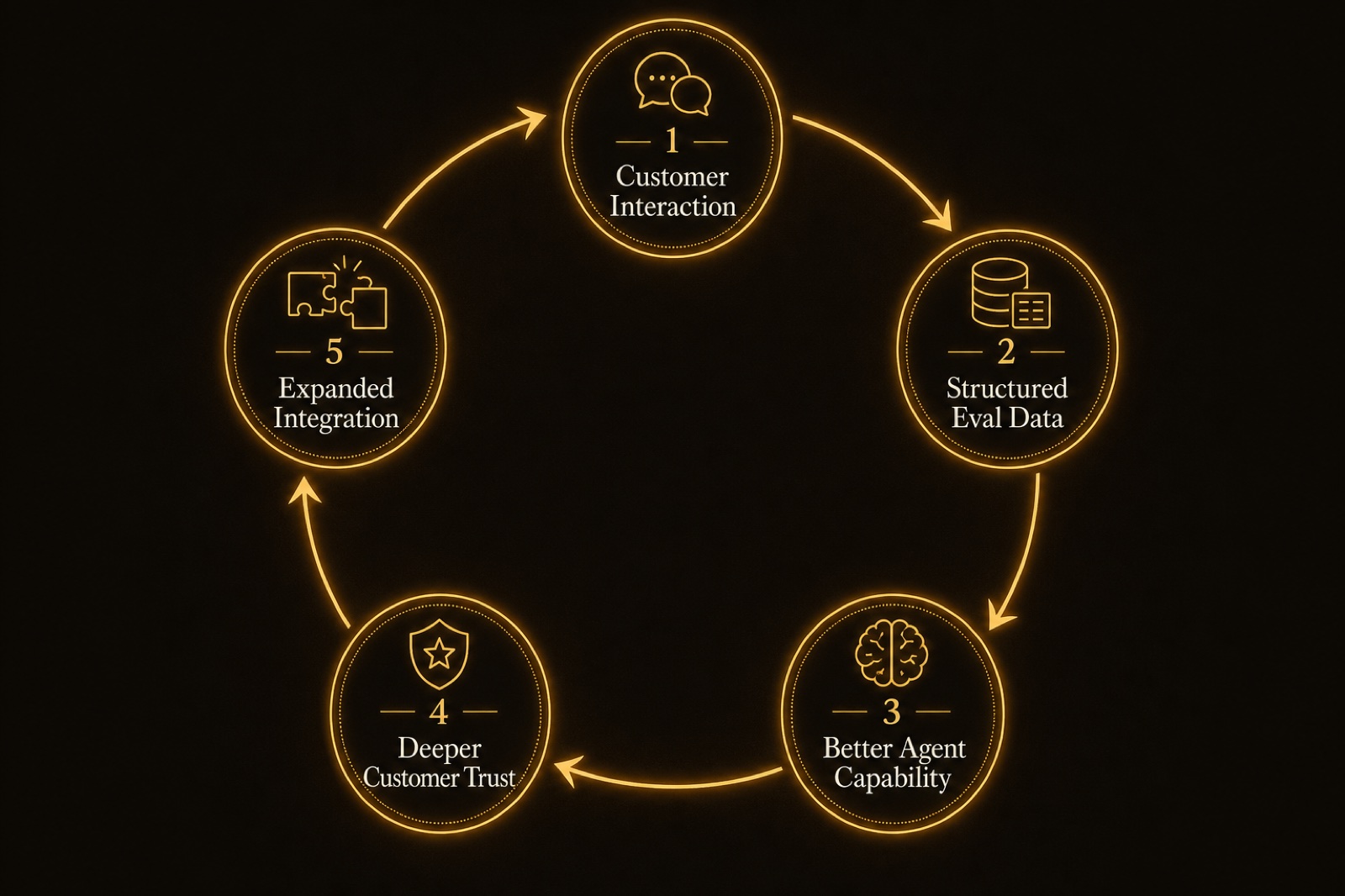
What replaces capital as the lubricant? Integration depth. Eval density. Trust velocity. Every customer touchpoint deliberately designed to produce structured signal replaces a dollar that would have been spent acquiring that signal through growth capital.
The flywheel works without money. That is the part YC cannot say.
Why YC Cannot Name This#
YC’s entire apparatus is built on a flywheel that runs on capital: batch cadence, demo-day timing, VC return models, growth velocity. But the flywheel their best advice describes works better without that pressure. It rewards the founder who sits with 10 customers for a month rather than the founder who acquires 1,000 in a quarter. It values judgment density over growth velocity. It requires deep, deliberate integration rather than rapid market capture.
These are not compatible optimization targets. You optimize for one or the other. YC optimizes for the latter because their fund economics demand it. But their own partners, in their own words, have described a mechanism that makes their model unnecessary.
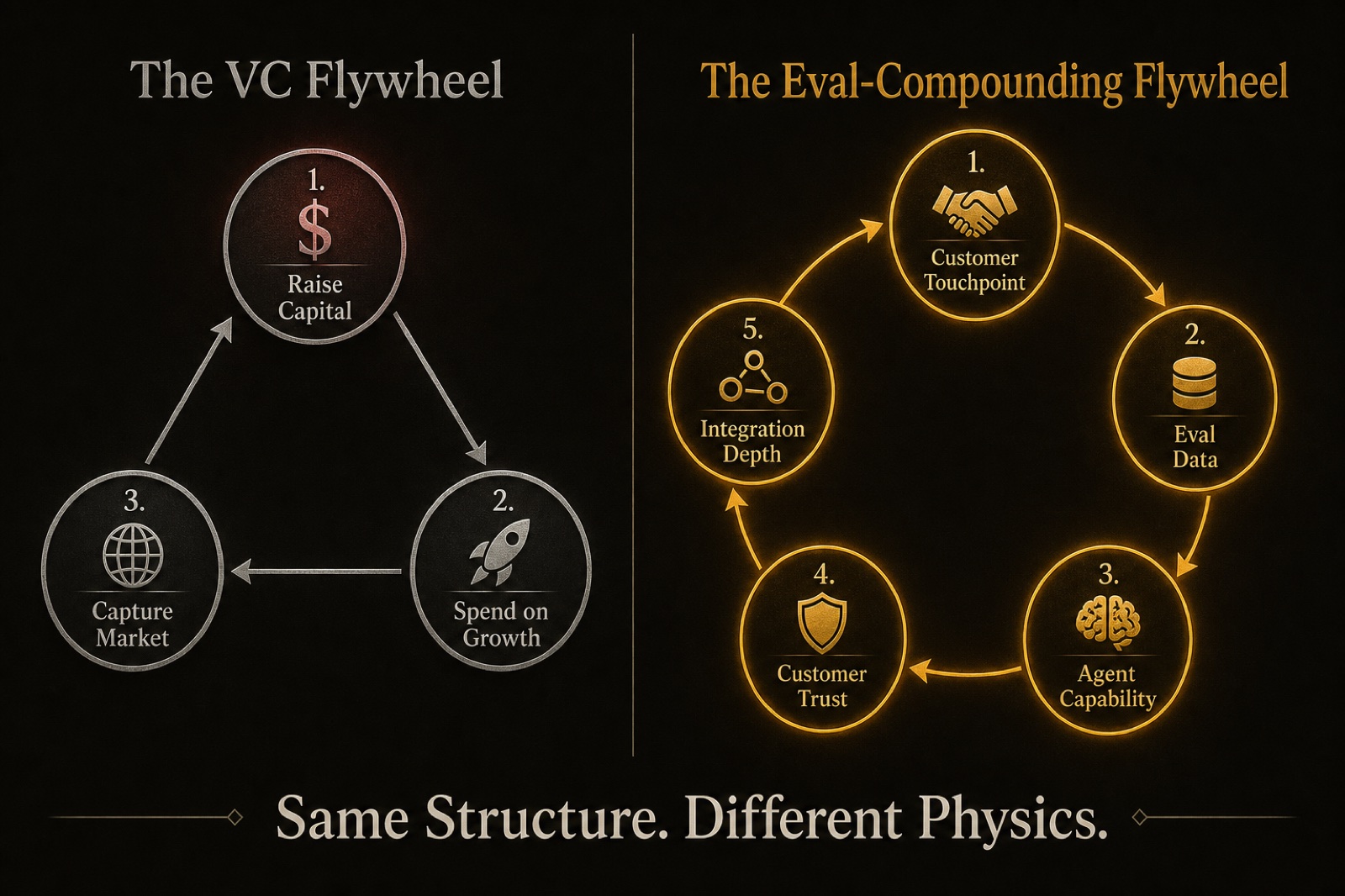
The nano-unicorn does not need YC’s venture capital. It needs an eval schema that generalizes across a vertical. It needs customer touchpoints designed to produce structured signal. It needs the discipline to stay in Phase 1, maximizing value per token, until unit economics are proven. None of these require outside funding. None of these benefit from demo-day pressure. None of these are accelerated by board meetings.
The analysis I ran surfaced this pattern across seven different analytical frames applied independently to the corpus. Not one coordinated with another. They described the same mechanism using different vocabularies: “eval quality serving as a force multiplier on agent output,” “judgment compounding: not capital, not code, not headcount,” “token-velocity flywheel.” Same thing. Different words. Total convergence on the premise that capital is not the active ingredient.
The Phase Trap#
The most dangerous pattern in the corpus: nearly every article describes flywheel mechanics that assume existing revenue, existing eval corpus, and existing customer base. Founders consume this advice when they have none of those things.
“Maximize value per token” is Phase 1. Every new customer interaction must produce maximum learning per dollar of inference. The goal is to build an eval schema that generalizes. “Maximize total tokens” (the Garry Tan model of spending $500 a day on inference because every dollar produces more value than it costs) is Phase 3. It requires proven unit economics.
Every successful example in the corpus started with Phase 1 and transitioned only after the eval schema held across multiple customers. Garry Tan’s token-maxxing began after he had working products. The Manus team launched after they had their chain-of-thought injection technique working. Parahelp scaled after their eval suite was battle-tested.
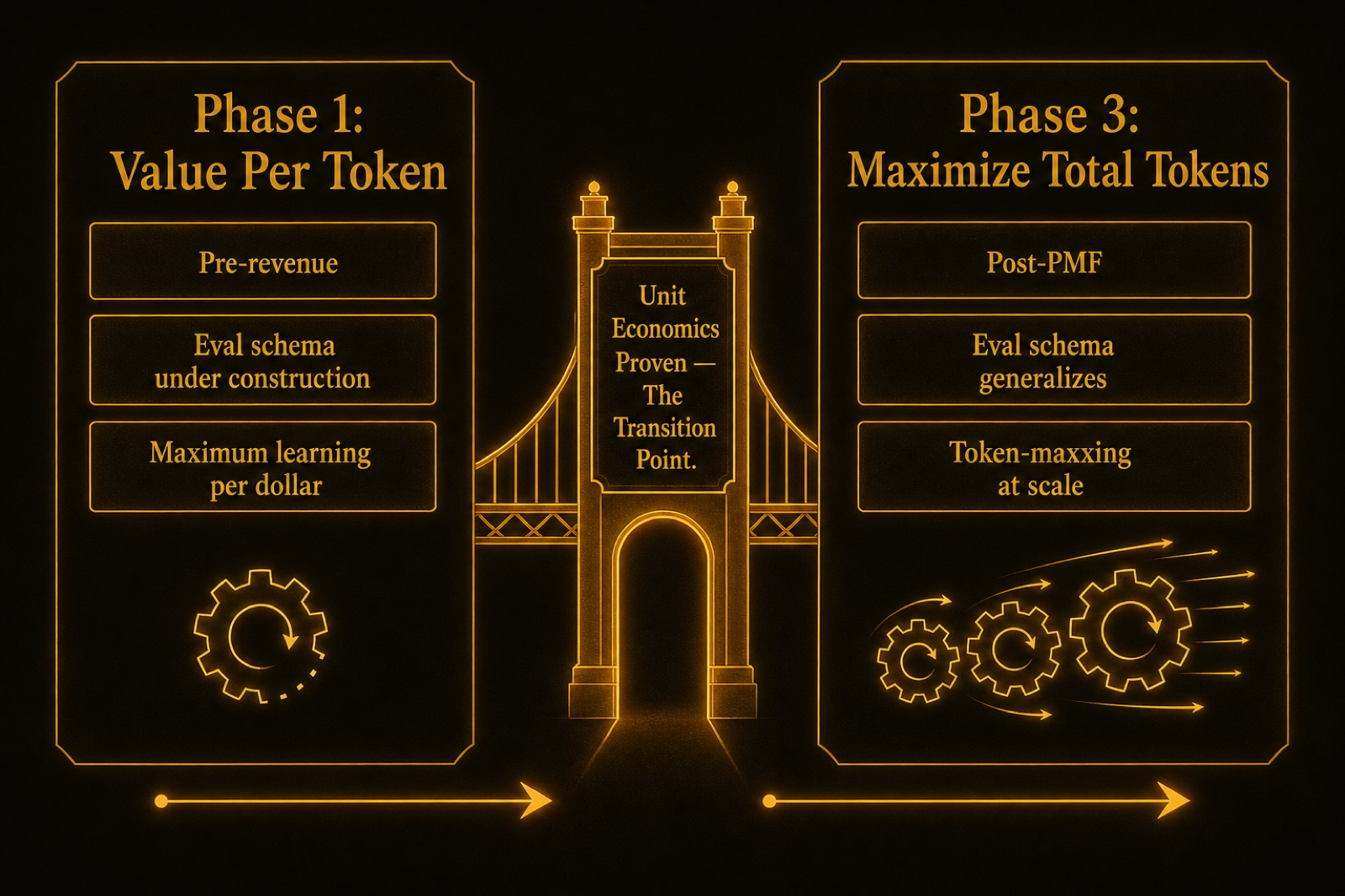
The advice YC gives is Phase 3 advice. The founders consuming it are in Phase 1. For YC companies, capital bridges the gap. For a nano-unicorn, there is no bridge. The path is Phase 1 discipline or death.
The Advice That Assumes Capital You Do Not Have#
Garry Tan’s “run an uncomfortably high API bill” is brilliant at VC scale. For a founder spending $5,000 a month on inference with zero revenue, it is fatal. The same flywheel structure operates in both contexts, but the transfer function differs by an order of magnitude.
The forward-deployed engineering model sounds perfect: sit with every customer, build demos, close seven-figure deals. It works brilliantly for three customers and becomes a scaling trap at thirty. Every customer gets a bespoke integration. The company becomes a services firm with software margins. The AI-native company is actually a consultancy that happens to use AI.
The “95 percent of our code is AI-generated” statistic from YC’s own batch survey is more warning than celebration. It produces systems where no human has read the full stack and debugging is functionally impossible when something breaks. For a company with two engineers, a single critical failure is existential.
These are not YC’s fault. Their advice is correct for the companies they fund. The problem is that founders who cannot or will not raise venture capital read this advice and apply it to a different economic model. Same playbook, different resources, catastrophic results.
The Eval Schema Is the Product#
The most actionable insight from the analysis: the eval schema is the first product. Not the agent. The agent is secondary.
A company serving 50 dental practices at $2,000 a month cannot build custom eval infrastructure per practice. If the definition of “correct” does not generalize across dental practices, the company has a consulting engagement, not a product. The agent is the delivery mechanism. The eval schema is the intellectual property.
So what does an eval schema actually look like? It is a structured artifact that defines what “correct” means for a specific vertical. Parahelp’s is a six-page document defining exactly when a customer support agent should approve or reject a tool call, how to structure output, what format to use, and examples of correct responses for common scenarios. Garry Tan’s evals are test suites that catch regressions: known inputs with expected outputs, edge cases, things that used to fail and must never fail again. An eval schema typically contains correctness criteria for the domain, a bank of test cases with expected results, regression tests for known failure modes, output format specifications so agents communicate consistently, and scoring rubrics for partial correctness. It is, functionally, the constitution of your AI workforce. Every agent action is judged against it. Every new customer teaches it something. Every edge case expands it. And it compounds: once an eval exists, no agent ever makes that mistake again.
A single eval is deceptively simple. Here is a real one, for a customer support agent handling refund requests:
| Eval | Refund Policy Adherence | |
|---|---|---|
| Input | "I'm not happy with my purchase. Can I get my money back?" | |
| Must include | Refund policy terms | PASS |
| A request for the order number | PASS | |
| Must NOT include | A promise to issue a refund before reviewing the order | FAIL |
| Verdict: PASS if all conditions are met. FAIL if any condition is violated. This eval: FAIL | ||
That is it. Five conditions. And once it exists, your agent never again promises a refund it cannot authorize, never forgets to ask for the order number, never skips the policy. The eval is the thing you learned from the first customer who complained. Now it protects every customer interaction forever. A mature eval schema is just hundreds of these, each encoding one lesson your company learned the hard way.
This reframes the entire go-to-market question as a knowledge problem. Does the ontology of correctness generalize across the vertical? If yes, the flywheel compounds. If no, every customer is a bespoke integration and the company caps at the number of forward-deployed engineers it can afford. The first validation is not “does the agent work?” It is “does the eval schema hold across the first five customers?”
The nano-unicorn that gets this right does not need to raise money. It needs five customers who will let it learn what correct means in their world. The eval schema that emerges from those five customers is the asset. Everything else (the agent, the interface, the integrations) is implementation detail.
What Comes Next#
The nano-unicorn era is real. The compression ceiling where AI enables two or three people to do the work of fifty is a phase, not a destination. Companies that cross a certain revenue threshold invariably need to hire. But the phase itself is viable, and the path through it does not require venture capital.
The eval-compounding flywheel is not a theory. It is an operational pattern described in detail across YC’s own corpus, hiding in plain sight because naming it would force an uncomfortable conversation about who the accelerator model actually serves. The nano-unicorn founder who sees the pattern, builds the eval schema first, and stays in Phase 1 until the schema generalizes has everything they need.
YC’s capital, their demo days, their growth pressure: none of it is required. Their best advice, read carefully, describes a mechanism that works better without them.