
If you read Paul Graham’s essays the way I do, as a neurodivergent person looking for clues about how the world actually works, a pattern emerges that I don’t think he intended.
Graham has spent two decades codifying what makes a successful founder. The traits he identifies show up again and again across his essays: comfort with uncertainty, unconventional problem-solving, an almost obsessive depth of focus, the ability to operate without external validation, and above all, relentless resourcefulness.
These are not random startup skills. They are textbook descriptions of Autistic and ADHD cognition. The same traits that Paul Graham celebrates as founder signals are the traits that corporate hiring processes flag as “not a culture fit.”
I don’t think this is a coincidence. I think the startup ecosystem is performing an inadvertent neurodivergent talent identification function, and it has been doing it for decades without recognizing what it’s actually measuring.
The Five Traits Paul Graham Keeps Finding#
YC’s founder selection process, described across hundreds of essays, blog posts, and partner talks, returns to the same psychological profile. Let me walk through what Graham actually wrote and what it actually describes.
1. Comfort With Uncertainty#
Graham’s essay Before the Startup argues that one of the hardest lessons for founders is that startups are counterintuitive and nothing prepares you for them. There is no training program. There is no credential that predicts success. You operate without knowing whether any of it will work.
This is a description of the baseline Autistic and ADHD experience in a neurotypical world. Neurodivergent people navigate environments designed for someone else’s sensory and social expectations, making constant decisions about disclosure and accommodation with no guarantee of acceptance. The uncertainty tolerance that startup founding demands is not a skill we need to develop. It is a survival adaptation we already have.
Graham observes that half the founders he talks to cannot honestly assess their default status: whether their company is on track to succeed or fail based on current trajectory. The honest ones are rare. But neurodivergent people who have spent their lives operating without reliable external feedback about their performance have already built that muscle. We have been doing uncertainty our whole lives.
2. Unconventional Problem-Solving#
YC’s framework explicitly rewards founders who approach problems from non-obvious angles. Graham’s essay The 18 Mistakes That Kill Startups dedicates significant space to the danger of derivative ideas: founders who build what sounds reasonable rather than what their own experience tells them is missing.
Autistic pattern-recognition, ADHD lateral connectivity, and the ability to hold multiple contradictory frames simultaneously are all forms of unconventional problem-solving that conventional education and employment systematically train out of people. The neurodivergent brain is wired to see what others miss: it processes information through a different lens. That same lens, in a corporate context, reads as “difficult to manage.”
3. Intense Domain Focus#
Graham’s description of the ideal founder includes an inability to stop thinking about a problem. In How to Get Startup Ideas, he describes the kind of deep, sustained attention that produces genuine insight rather than surface-level understanding. The best founders, he argues, are not people who can think about many things. They are people who cannot stop thinking about one thing.
This maps directly onto the Autistic experience of special interests and the ADHD experience of hyperfocus, states of deep engagement where the outside world recedes and the problem space becomes the totality of conscious experience. The neurodivergent capacity for monotropic attention is precisely the cognitive architecture that supports the kind of consuming commitment that breakthrough products require. And it is the same cognitive architecture that gets labeled “too intense” in performance reviews.
4. Operating Without External Validation#
Perhaps the most striking overlap is the requirement that founders build something they themselves need, not something that will impress investors or earn status. Graham is explicit about this. Graham has argued repeatedly that founders who start for money or coolness are less likely to succeed than those who build because they cannot not build. The best founders are building because they cannot not build.
Neurodivergent individuals, who have often experienced a lifetime of negative or absent external validation in educational and professional settings, have already developed the internal motivational frameworks that startup founding demands. When you have gone through school being told your processing style is wrong, your communication style is wrong, your way of being in the world is wrong, you learn to trust your own assessment of what matters rather than waiting for someone else to validate it. That is not a bug. It is founder training.
5. Relentless Resourcefulness#
The trait Graham returns to most often is relentless resourcefulness: the combination of refusing to give up while constantly changing tactics. Be Relentlessly Resourceful is the essay that names it directly: the quality Graham emphasizes more than any other is neither intelligence nor domain expertise but the ability to find a way through any obstacle without giving up.
The neurodivergent experience of navigating a world not designed for one’s cognitive style requires exactly this trait. Every Autistic adult who has developed a social scripting system to navigate professional contexts, every ADHD adult who has built a compensatory organizational architecture to keep their work on track, every dyslexic entrepreneur who has hired to their weaknesses has demonstrated relentless resourcefulness in the domain of their own survival. The people who Graham calls relentlessly resourceful are often people who have been relentlessly resourceful their whole lives, not because they wanted to be but because the world demanded it of them.
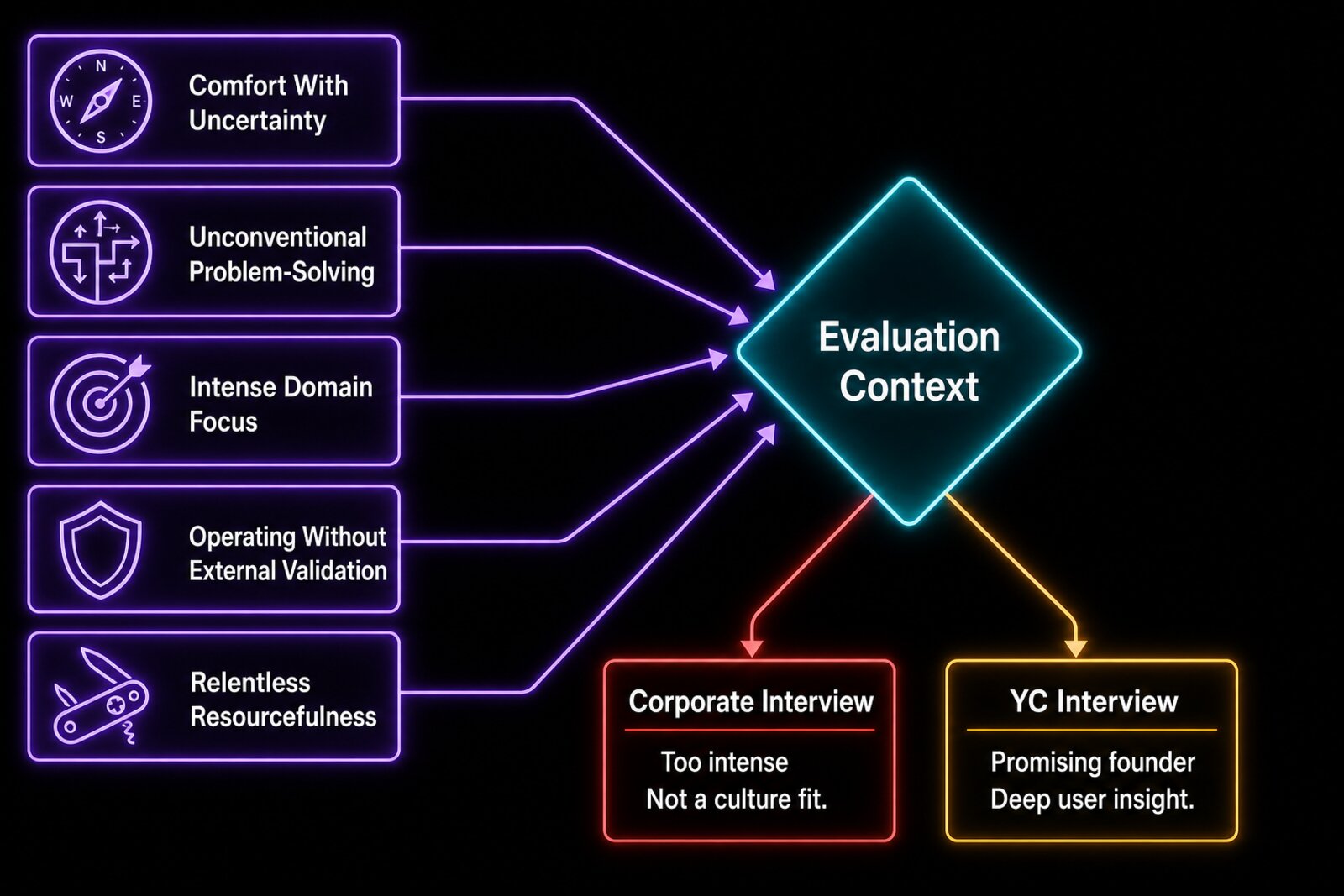
The Implicit Filter#
YC’s selection process operates on an implicit theory of founder quality. Partners look for founders who are relentlessly resourceful, who have deep insight into a real problem, and who will not quit. These attributes are assessed through behavioral signals: how the founder talks about their users, how they respond to tough questions, how they characterize their own obstacles.
Those same behavioral signals that read as “promising founder” in a YC interview read as “difficult employee” in a corporate interview. A neurodivergent founder who walks into a YC interview and answers questions about user needs with the kind of detailed, hyper-specific knowledge that comes from a special interest is evaluated positively. Yet the same person in a corporate interview answering behavioral questions with the same directness and specificity is evaluated as “not a culture fit.” Neurodivergent communication patterns (directness, discomfort with small talk, preference for substance over rapport, intensity of focus) are consistently evaluated negatively in traditional hiring contexts. As I wrote in my own leadership philosophy: “Hiring for interview performance and hiring for job performance are different selection problems that most organizations never separate.”
The Structural Consequence#
If this analysis is correct, Y Combinator is performing an inadvertent neurodivergent talent identification function. The startup ecosystem provides a parallel career path for individuals whose cognitive style is devalued in the primary labor market.
This is a familiar economic pattern: when the mainstream job market systematically excludes a group of capable people, alternative paths emerge to capture that talent. The secondary market (startups) benefits from a talent pool that the primary market (corporate employment) has not only failed to access but has actively trained to undervalue itself.
Graham himself observes that the binding constraint on startup creation is not capital or markets but the supply of relentlessly resourceful people. This essay extends that argument: the supply is larger than the startup world realizes, because many of these people are in traditional employment, being systematically filtered out of corporate advancement by the same traits that would make them exceptional founders.
What Changes If You See the Pattern#
For startup investors and accelerators, the implication is practical: the founder pool is artificially constrained by the same biases that exclude neurodivergent individuals from corporate advancement. Explicit neurodiversity-aware founder identification could expand the pool of relentlessly resourceful people, the binding constraint on startup creation.
For neurodivergent people in traditional employment, the implication is personal: the traits that have been pathologized in your career may be your strongest assets in a different context. The relentless resourcefulness you developed to navigate a world not built for you is the same resourcefulness that YC identifies as the single most predictive founder quality. You have been training for this your whole life. You did not know what the exam was.
For corporate employers, the implication is structural: the traits you filter out in hiring (directness, intensity, non-standard communication, unwillingness to perform social rituals) are the same traits that predict success in high-uncertainty, high-autonomy environments. Your hiring process may be systematically excluding the people most capable of building your next product or founding your next internal venture.
The Frame That Flips#
Paul Graham spent twenty years describing a cognitive profile without ever giving it that name in his essays. HR departments spend every day filtering against the same profile without knowing what they are losing. Those two systems, operating independently, produce a coherent result: the startup ecosystem functions as an inadvertent neurodiversity employment program.
The economic value generated by this mechanism, the companies founded by neurodivergent individuals who could not or would not navigate corporate careers, represents a hidden subsidy from the startup ecosystem to the broader economy. People who were told they were too intense, too direct, too focused, too difficult to manage were not broken employees. They were founders who had not yet found their context.
Paul Graham noticed what they had in common. HR departments noticed what made them different. Both were right. The question is which framing you choose.