
The productivity industry wants you to believe there is a best system.
There is a note-taking methodology that will fix your knowledge work, a second brain framework that will tame the chaos, a set of categories that will make everything fit. Find the right one and the torrent of information becomes manageable. It is a compelling promise, and it is wrong in a specific and instructive way.
There is no best system. There never was. Every methodology that has ever worked was an assembly of deeper principles, built for a specific information environment with specific constraints. Those constraints change faster than any methodology can outlive them, and when the constraints shift, the methodology that was saving you becomes the thing holding you back.
The Constraint Problem#
Every knowledge management methodology that has ever existed was built to solve a specific information-environment problem. The problem changed, and the methodology followed. This is not a bug. It is the entire history of how humans have managed knowledge, visible in sharp relief across four technology eras.
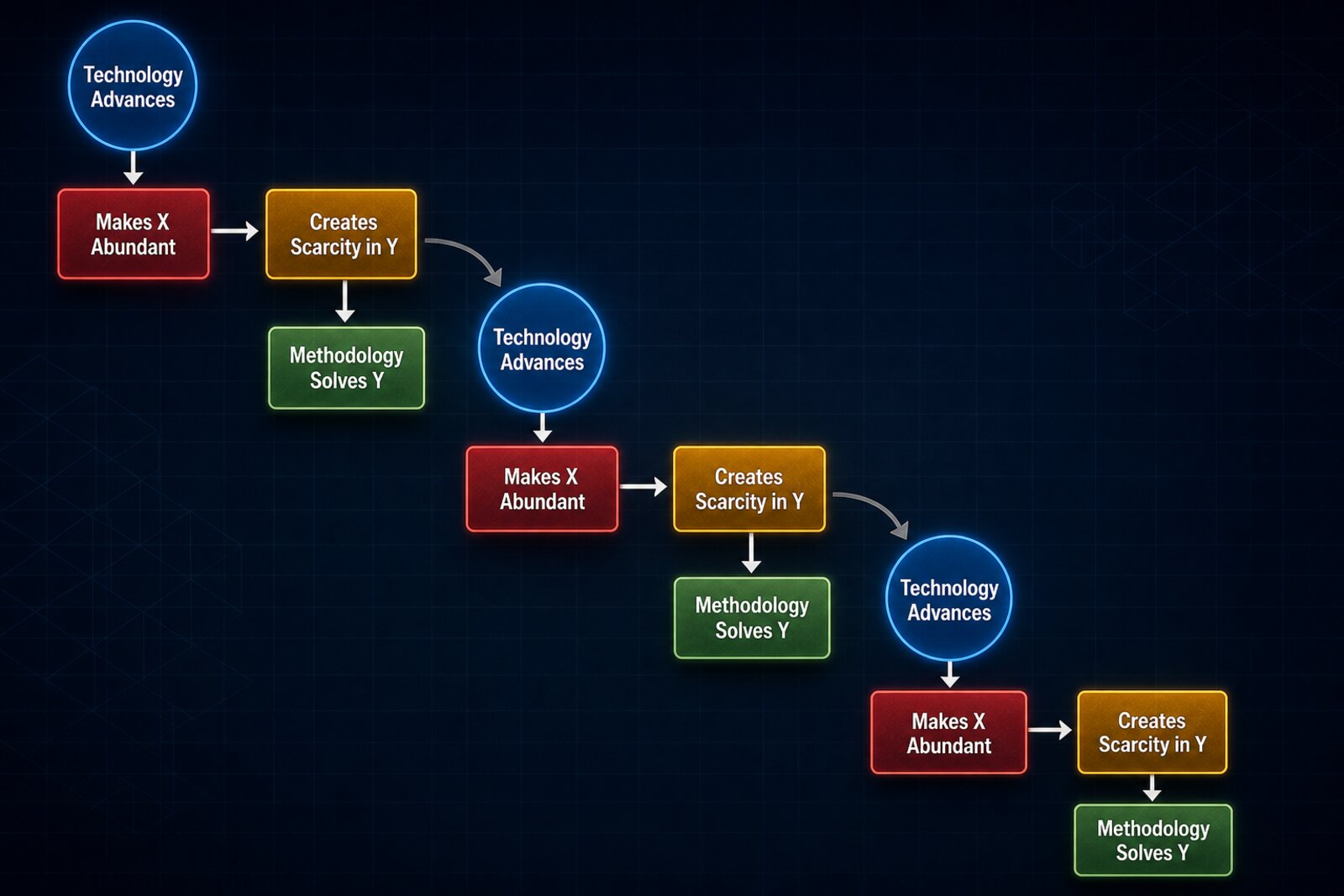
Technology solves one scarcity by creating abundance, which inverts the bottleneck to a new dimension. The methodology that follows is always a response to the scarcity no one saw coming.
Manuscript: Scarcity#
Before Gutenberg, a single Bible cost a year of a monk’s labor. Books were hand-copied treasures. A 10th-century scribe described the work as something that “dim[s] your eyes, makes your back ache, and knits your chest and belly together.”
In this world, the KM problem was simple: you preserved what you could. The commonplace book, the florilegium (a “gathering of flowers”: excerpts from scripture and the Church Fathers), was a survival tool. Every fragment was precious because the source could disappear. Seneca had already articulated the bee metaphor around 60 AD: read widely, digest, transform fragments into your own words. But the practical reality was that most knowledge workers never had more than a handful of books in their possession at any time.
The constraint was scarcity. The methodology was preservation.
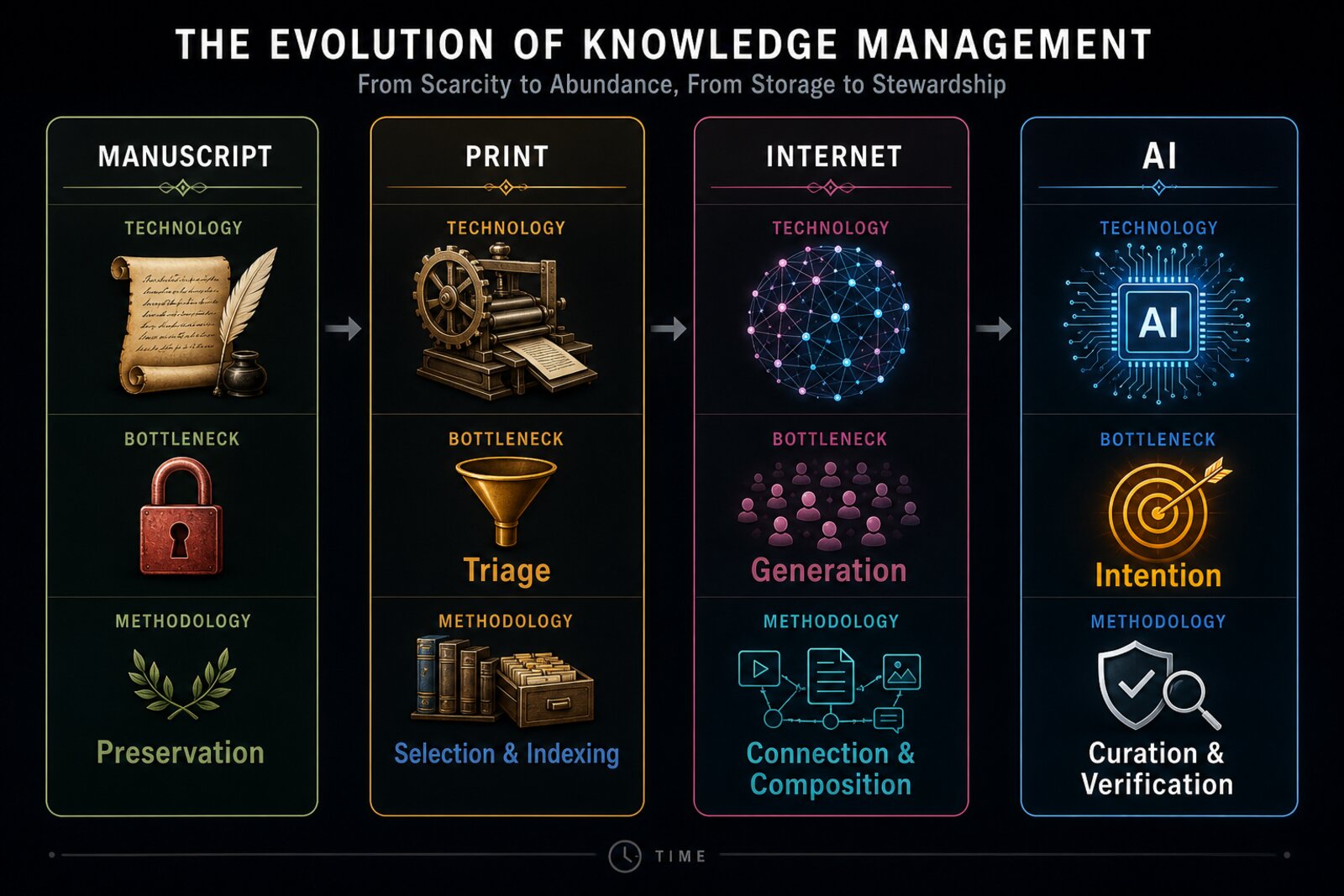
Each era's technology creates a new bottleneck, and methodology follows. The pattern repeats, but the constraint is never the same twice.
Print: Abundance#
Gutenberg’s press crashed the cost of a book by a factor of roughly 340. By the year 1500, European printers had produced more than twenty million books. Printing presses operated in 282 cities. The doubling time of book production accelerated from once per century to once per generation.
The 16th century produced the first explicit discussions of information overload. Conrad Gesner, in 1545, attempted to catalog every known book ever printed: a triage response to the simple fact that one could no longer read everything. By the late 1600s, Adrien Baillet worried that “the multitude of books which grows every day in a prodigious fashion will make the following centuries fall into a state as barbarous as that of the centuries that followed the fall of the Roman Empire.”
The commonplace book, which had been a preservation tool, transformed into a triage method. Now the skill was not finding text to copy but deciding what to copy, and organizing it so you could find it later.
Erasmus published De Copia in 1512, teaching students to collect excerpts under hierarchical topic headings. He famously demonstrated 195 variations on “your letter delighted me greatly” to show that abundance of expression was a skill you could cultivate. The bee metaphor became operational: read, select, transform.
John Locke, in 1685, solved the indexing problem that came with scale. His expandable letter-and-vowel index let you add new topics to a commonplace book without pre-allocating pages. It was the first systematic solution to the problem every note-taker eventually hits: “I don’t know what I’ll find, so I don’t know how much space to leave.”
The constraint shifted from scarcity to triage. The methodology followed.
Internet: Infinitude#
The World Wide Web turned abundance into something new: infinitude. Not just more than you could read in a lifetime: more than you could read in ten thousand lifetimes. And unlike a library, it came with aggressive attention-sucking infrastructure built in.
Luhmann started his Zettelkasten in 1952, decades before the web, but his system’s architecture anticipated the problem the internet would create. His innovation was not the index card. German academics had been using Zettelkasten for generations. What Luhmann did was make his system generative rather than archival. He called it a “communication partner”: a system that would surprise him by returning connections he had made and forgotten, generating ideas he would not have had on his own. His 90,000 cards produced 70 books, and he attributed the entire output to the system, not to himself.
Sönke Ahrens published How to Take Smart Notes in 2017, and it became the breakout book that made the Zettelkasten teachable. Three note types: fleeting, literature, permanent. A clear pipeline from input to insight. Grounded in cognitive science so the method was understandable, not mystical. His key insight was that “writing is not the outcome of thinking. Writing is the medium in which thinking takes place.” This reframes note-taking from a storage activity to a thinking activity: the precise shift Luhmann had made with his communication partner, but now accessible to anyone.
Tiago Forte’s Building a Second Brain followed in 2022, solving a different facet of the same problem. Even if you process notes into understanding, how do you organize them across a lifetime of projects, areas, and interests? Forte’s PARA system (Projects, Areas, Resources, Archives) organizes by actionability, not by subject. His insight was that people carry forward the school habit of organizing by subject, but adults do not have finals. They have outcomes. PARA flips the axis from “what is this about?” to “what is this for?”
Each of these systems is a valid assembly of principles. Each solved a real problem. And each is a specific answer to a specific question that someone else’s life asked.
AI: Intention#
The AI era has done something strange to knowledge management. It has made the marginal cost of capture effectively zero. Whisper transcribes any conversation. NotebookLM summarizes any document. LLMs can extract, tag, and link your highlights across thousands of sources in seconds.
This inverts the bottleneck again. The hard part is no longer capture, or even retrieval. The hard part is deciding what matters. It is the metacognitive load of verification, the discipline of knowing what belongs in your system and what is just noise.
There is a paradox here: automating the cognitive work of note-taking (the reformulation, the wrestling with ambiguity) bypasses the very process that produces understanding. A perfectly organized digital knowledge base can coexist with weak internal knowledge. The system looks complete but the thinking never happened.
The constraint becomes curation and intention. And no off-the-shelf methodology can solve that for you, because intention is the part of knowledge work that is most personal.
The Recurring Principles#
Across these four eras, from Seneca to Luhmann to Forte to your own vault, the same structural principles recur. They are not opinions. They are discoveries about how knowledge works at an operational level.
Atomicity. One idea per note. Seneca described the bee who “separates the flowers that lead to honey.” Luhmann wrote one idea per index card. Every atom in the vault passes the recombination test: move it to a molecule about a different topic and it still contributes novel value. This is not a stylistic preference. It is an engineering constraint. Atomic units can be rearranged, recombined, and connected in ways that compound.
Writing as thinking. From Erasmus to Franklin’s imitate-reconstruct-compare method to Feynman’s technique to Luhmann’s communication partner. Writing is not the record of understanding; it is the mechanism that produces it. The notebooks are not where you keep what you know. The notebooks are where you find out what you think.
Connection over classification. Luhmann explicitly rejected organizing cards by topic. He let the Folgezettel (follow-up note numbering) create an evolutionary sequence of thinking, and cross-references created the network. Forte organizes by actionability, not subject. Every connective system indexes from use, not from category. Classification is a box. Connection is a map.
Organize by use, not origin. Bacon’s “some books to be tasted, others to be swallowed, few to be chewed and digested” is a triage by use, not source quality. Forte’s PARA files “where you will use it, not where it came from.” The molecular notes convention is filed by topic, but the topic is a use-domain, not a source category. The question is always “what will this do for me?” not “where did I get it?”
These are the bricks. Every system is an assembly of them.
The Worked Example#
My own system uses what I call molecular notes. Atoms are single claims that survive the recombination test. Molecules compose multiple atoms into a claim that no single atom makes. Alloys synthesize multiple molecules into something structurally load-bearing: a thesis, an argument, an article.
This hierarchy is not original to me. It derives from the Zettelkasten tradition, the Molecular Notes method popularized by Wanderloots, and years of experimenting with what sticks. What is original is what I assembled it for.
I am AuDHD. I am a polymath. My brain does not learn like a person preparing for a single career. My reward function fires on the moment when two disparate fields touch: when cosmology reveals something about leadership, or cartography suggests a new way to organize a codebase. The atom-molecule-alloy pipeline is designed for that moment. Atoms are the raw materials, accumulated across many domains. Molecules are the first-order syntheses within each domain. Alloys are where the cross-domain connections live.
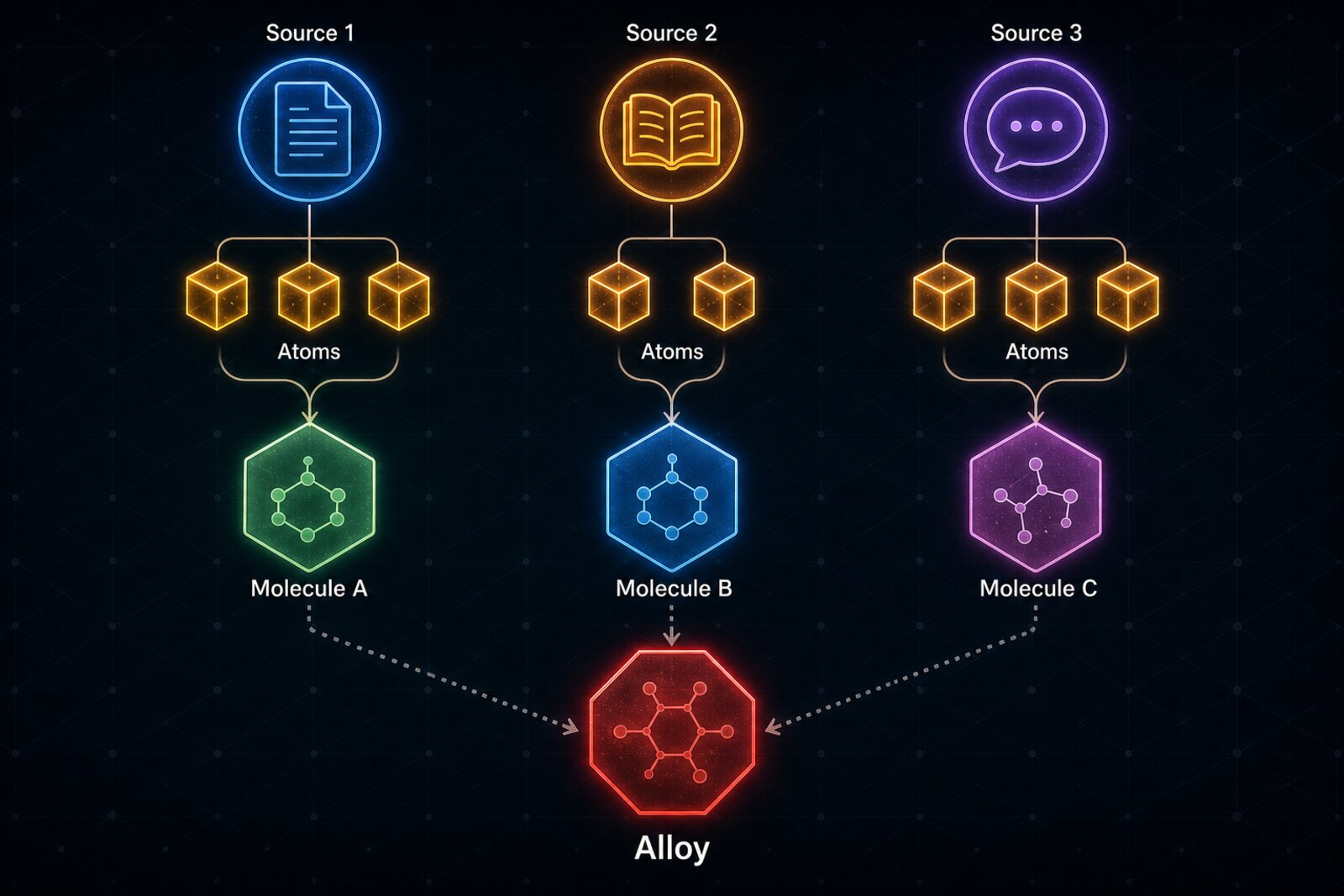
Each source yields its own atoms and molecules. The alloy is where sources meet: atoms and molecules never cross source boundaries until the final synthesis.
The vault alloy that connects molecular notes to Mark Burgess’s Semantic Spacetime framework was not planned. It emerged from molecules about two unrelated topics that happened to sit near each other and started resonating. That is the behavior the system was built to produce.
Why You Have to Build Your Own#
This is the part that the productivity industry does not want to acknowledge. When you buy someone else’s methodology, you are buying their assembly of the bricks. That assembly solved their problem. It fit their brain, their constraints, and their ambitions.
Tiago Forte built PARA for a consultant who produces deliverables for clients. Luhmann built his Zettelkasten for a sociologist who needed to produce 70 books from a single career. They built well. But neither of them was building for a person whose brain lights up when cognitive science and cartography collide.
A methodology that organizes by actionability (PARA) is genuinely useful. So is a methodology that organizes by connection (Zettelkasten). So is a methodology that organizes by composition (molecular notes). None of them is the methodology, because there is no such thing. There is only the methodology that fits the person using it.
The bricks are what recur. The bricks are what travel across centuries. The bricks are what Seneca, Erasmus, Locke, Luhmann, and Forte all independently discovered. Everything above the bricks is context-specific assembly.
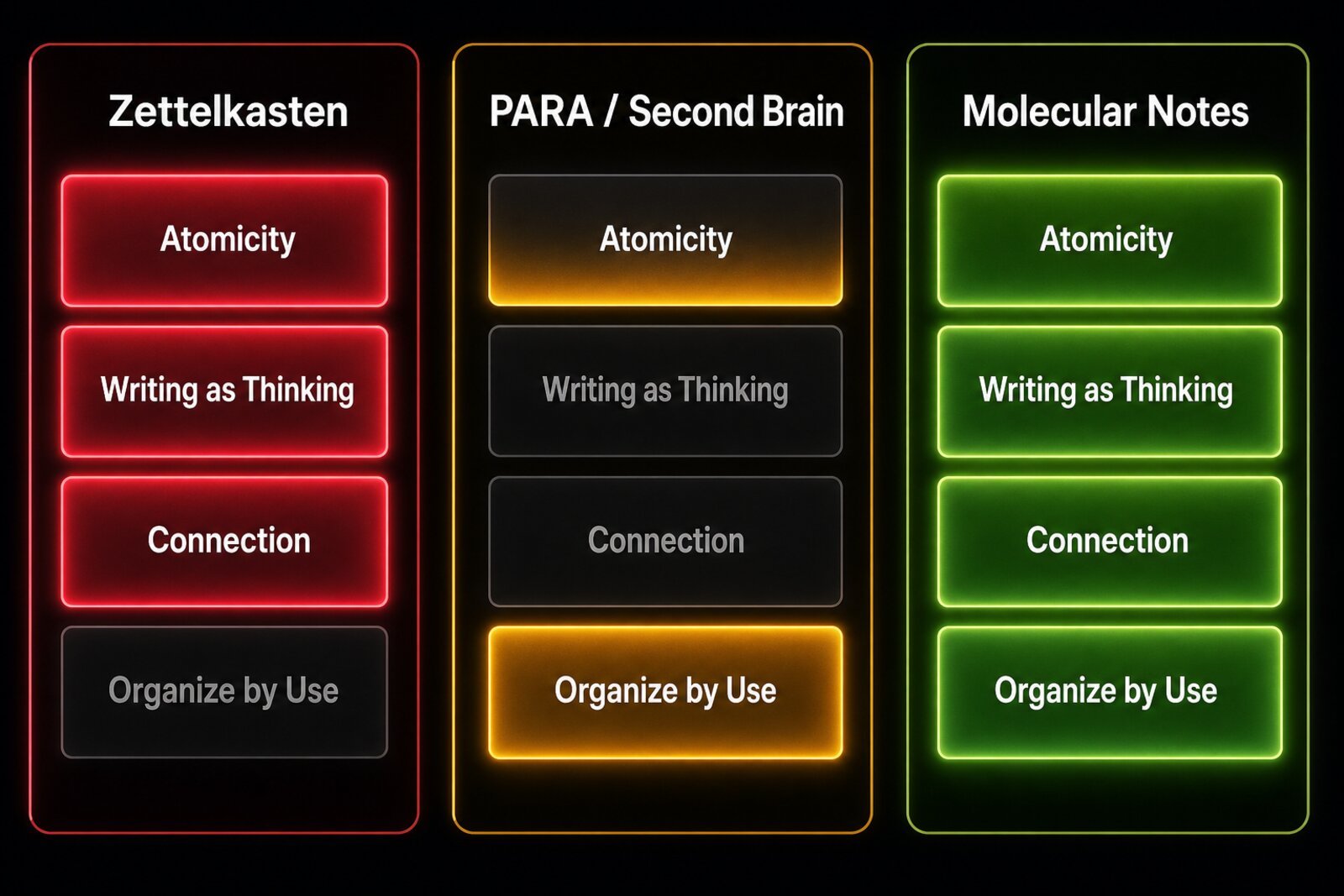
The same four principles, assembled differently. Zettelkasten emphasizes connection and writing. PARA emphasizes actionability. Molecular Notes uses all four: a polymath brain needs all the leverage it can get.
What This Means for You#
If you are reading this because you are looking for the right PKM system, let me save you some time. You will not find it. What you will find is a set of principles that you can assemble into something that works for your brain, your constraints, and your ambitions.
Start with atomicity. Write one idea per note, in your own words. Connect it to something you already have. Organize it by where you will use it, not where it came from. Do that for a few months and see what your system tells you about what it needs.
The methodology is not the product. You are the product. The methodology is what you build from the bricks you found useful.
And the bricks have been waiting for you for a very long time.