
The Architecture of Focus#
Your calendar is a design document. You probably never read it that way.
Most companies run on a schedule built for managers: back-to-back meetings, hour-long or half-hour increments. It works great for coordination and decision-making. It is actively hostile to the kind of work most organizations say they need most (sustained creative and technical output) because that work requires a completely different relationship to time.
The Cognitive Cost of Fragmentation#
Programming, writing, designing, and composing all share a hidden cognitive property: they require loading a complex mental model into working memory before any productive work can happen. A developer needs one to two hours of uninterrupted reading and analysis to reconstruct how a program fits together. Paul Graham described this years ago in his essay on maker and manager schedules, noting that a programmer forced to work in hour increments must restart that state-loading process every single time.
Michael Seibel put it in terms his non-technical co-founder could understand: imagine being interrupted in the middle of solving a ridiculously complicated word problem. The visible activity, typing, looks resume-able. The invisible activity, maintaining a complete mental model of the problem space, is not.
The research backs this up. Gloria Mark’s UCI study found that the average knowledge worker spends only 47 seconds on a screen before switching, and it takes over 25 minutes to fully return to the original task after an interruption. Flow research established that entering a state of deep focus requires 15 to 20 minutes of uninterrupted attention. Any interruption before that threshold resets the clock. The math is brutal: a full workday of hour-long fragments produces approximately zero minutes of deep work.
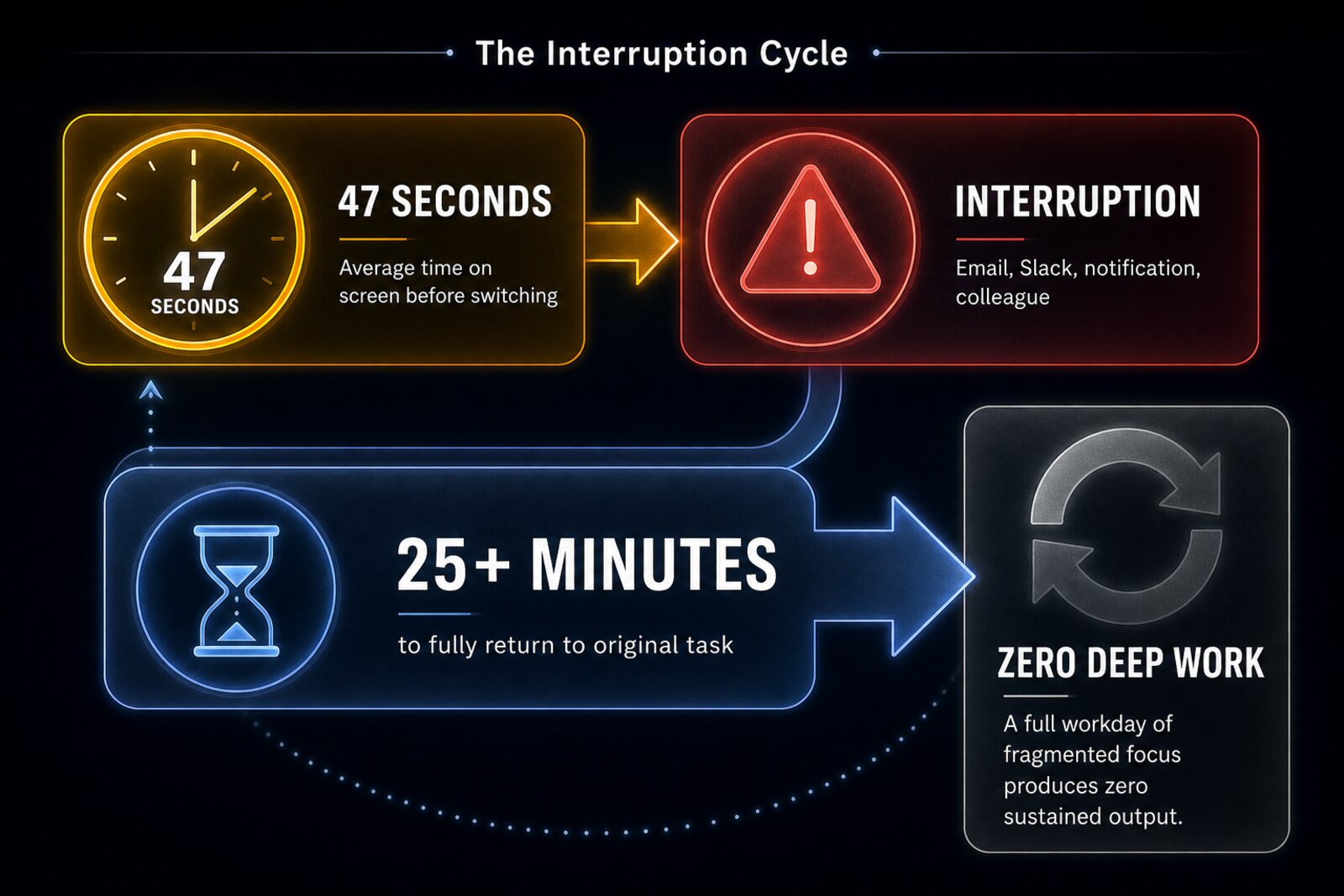
This is not a personal failing. It is a structural design problem. The default schedule is a manager schedule: it evolved for people whose work is communication, decision-making, and coordination. It works great for that purpose. But it was never designed for the people who actually build the things the company sells.
The Timeless Pattern#
What is striking is not that this problem exists. It is that the solution has been discovered independently across centuries and domains, and every time it gets forgotten.
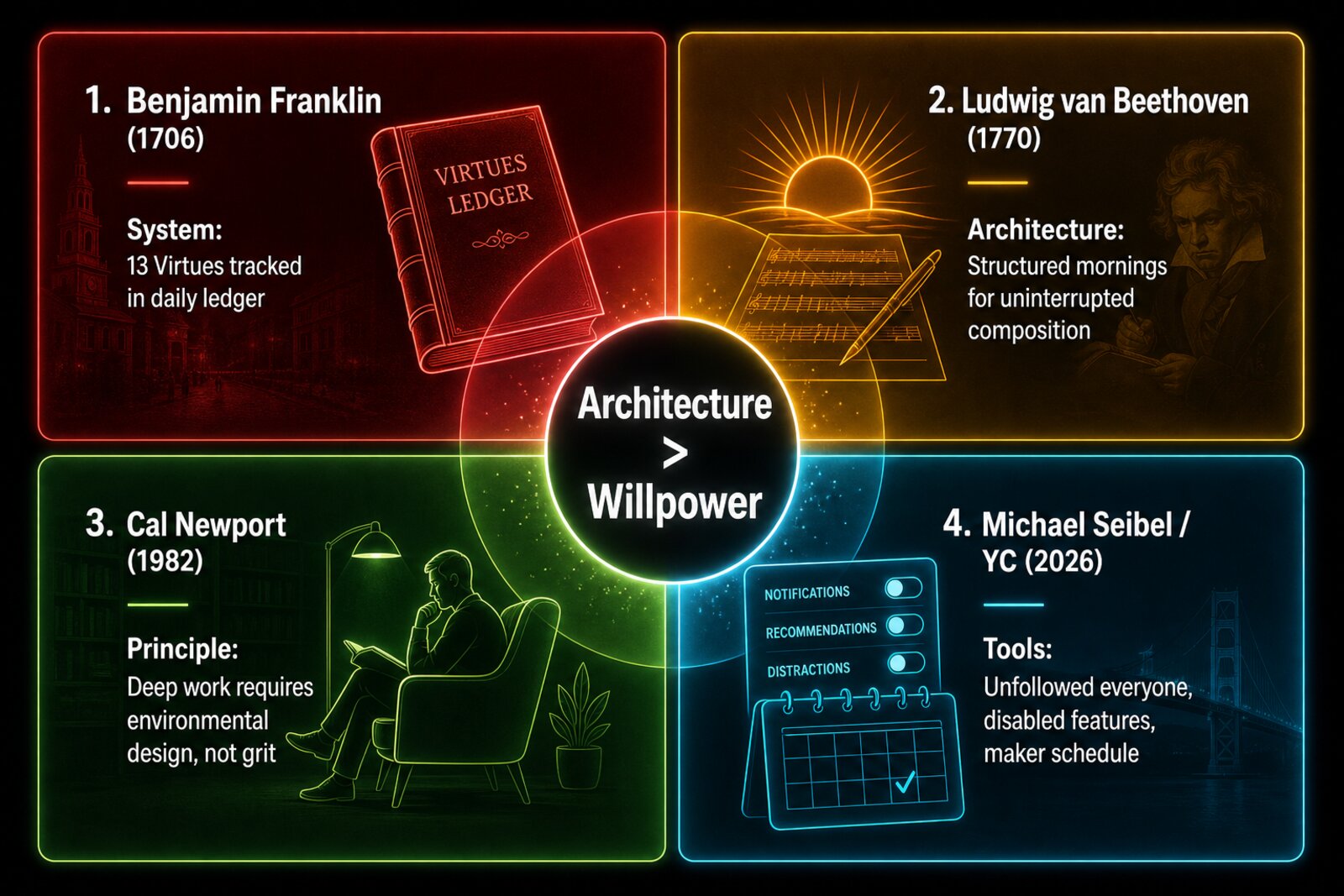
Benjamin Franklin did not become one of the most productive thinkers in history through willpower. He built a system: his 13 Virtues, tracked in a daily ledger, that made disciplined behavior the structural default rather than a daily choice. Ludwig van Beethoven structured his mornings for uninterrupted composition and accepted nothing less. Cal Newport codified the same principle for the modern knowledge worker: deep work requires environmental design, not motivational grit.
The pattern across all of them is architectural, not personal. They did not try harder. They designed their environment so that the right behavior was the path of least resistance and the wrong behavior was difficult or impossible.
The startup world, with no knowledge of Franklin or Beethoven, independently rediscovered the same principle and gave it operational language. Dalton Caldwell and Michael Seibel’s YC office hours video on the maker schedule is not novel in its insight. It is notable because it translates a timeless pattern into a vocabulary that founders and engineers can use to demand structural protection from their organizations.
The Strategic Math of Focus#
Here is where the startup framing adds something the historical examples only imply. A non-hedging team of equal competence always beats a team that splits its focus.
This is from the same YC conversation. Seibel asks: “How much better do you have to be than that team if you are splitting your resources two ways, three ways, four ways?” The question applies to startups, but it applies just as well to organizations. A company that fragments its best people across too many projects, too many meetings, too many initiatives is not being strategic. It is being out-competed by a team that does less but does it with full attention.
This is not a moral claim about commitment. It is a mathematical claim about resource allocation. Attention is a finite resource. Every meeting that interrupts a maker is a tax on their output. Every slack notification that fragments their day is a percentage point shaved off their cognitive capacity. The cost is invisible because it shows up not as a line item on a budget but as work that never quite gets done, insights that never quite emerge, and products that ship late or not at all.
Most companies measure maker productivity in tickets closed or lines of code. They do not measure the cognitive cost of the context switches those tickets require. And they certainly do not put maker productivity losses on the same spreadsheet as manager coordination gains. The full cost surface is never visible to any single decision-maker.
What YC Got Right#
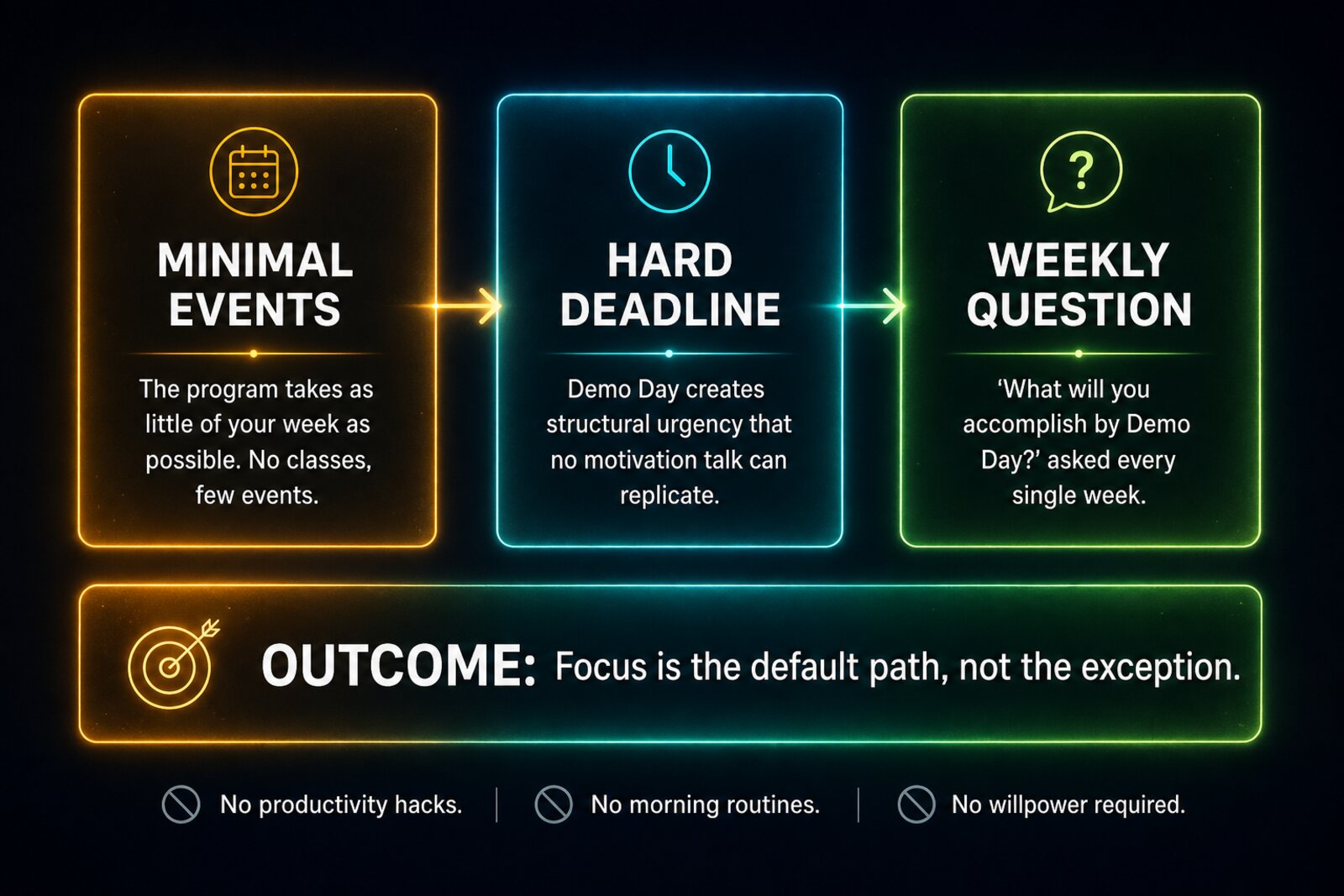
YC’s program design is instructive precisely because it is not clever. There are no productivity hacks, no time management systems, no mandatory morning routines. There are three things:
- Minimal events. The program takes as little of the founder’s week as possible.
- A hard deadline. Demo Day creates structural urgency that no motivational talk can replicate.
- A single repeated question: “What will you accomplish by Demo Day?” asked every week.
That is the entire productivity system. It works because it does not ask founders to try harder. It asks them to show up to a structure that makes focus the default.
Michael Seibel describes having a Twitter problem and solving it not through willpower but by unfollowing everyone, installing a browser extension that disabled most of Twitter’s features, removing the app from his phone, and turning off all notifications. His framing is honest: “Sometimes willpower is not enough. This is an addictive thing, I need an intervention.”
That is the maker schedule principle in microcosm. Do not fight your environment. Redesign it.
The companies that figure this out will not be the ones with the best productivity tools or the most disciplined people. They will be the ones that stop asking their makers to operate in a system designed for their managers. They will be the ones that treat the schedule not as a neutral background but as what it is: the single most consequential design decision they make about how work gets done.