You’re right to be scared.
Every day there’s another headline. Another company citing AI in a layoff announcement. Another prediction that your profession is six months from obsolescence. You’re watching the news and thinking: this time it’s different.
It is different. But not in the way you think.
Let me show you what I mean.
I grew up around adults who were building the future with their bare hands.
My uncle was a ham radio operator. In his shack, he built computers and robots from kits and scavenged parts. I spent long nights and weekends with him, watching him solder, debug, and bring things to life. I didn’t understand half of what he was doing. But I understood that something important was happening in that room.
Then there was the groundskeeper at my summer camp. He was a retired NASA engineer, and he had built his own computer from what can only be described as found parts. I learned to program LOGO on that thing before I was old enough to start kindergarten.
I didn’t know it at the time, but I was watching a revolution from the front row.
I’ve watched that same revolution repeat three more times since then. The internet. The mobile boom. The cloud. Each time, the same pattern: a new technology emerges, everyone panics, and then the world quietly adapts and moves on. Each time, the people who said “this time it’s different” were right about the change and wrong about the catastrophe.
I built my own BBS once. The Big Bang Burger Barn. Multi-line, thriving community, the kind of place people called home online before “online” meant what it does now. Then AOL started mailing out CD-ROMs in an endless torrent. Their marketing worked. People left. BBSs went away almost overnight. It wasn’t that my community failed. It was that someone with a bigger budget figured out how to make the next thing five clicks easier.
That was my first lesson in the pattern: you can build something real, watch it thrive, and still lose it to the next wave. Not because you did anything wrong. Because the wave doesn’t care.
I’ve been watching this pattern repeat for almost fifty years. I know how it goes.
The cycle always looks the same. A new technology emerges and everyone says “this changes everything.” Then the panic sets in: “this will destroy all jobs.” Slowly, the technology gets absorbed into the background of ordinary life. The panic fades. People get on with their work. The world ends up somewhere we didn’t predict, doing things we didn’t plan.
We did this with personal computers in the 1980s. The internet in the 1990s followed the same arc. We did it with Y2K (remember spending $300 billion preparing for a disaster that never arrived, and the preparation itself created an IT employment boom). Outsourcing in the early 2000s ran the same play (“your job is going to Bangalore,” except it mostly didn’t).
Every generation believes its panic is unique. “This time it’s different because the pace of change is unprecedented.” That exact sentence has been said about every technology since the Luddites.
Carl Benedikt Frey’s “The Technology Trap” documents this pattern across 250 years of industrial history. The headline: enabling technologies eventually create more jobs than they destroy, but with a lag. The transition costs are concentrated. The benefits are diffuse. That asymmetry is what makes it feel like the end of the world while it’s happening. It’s also what makes the “this time is different” argument feel true each time. It always feels different when you’re inside the transition.
But here’s the thing about the current moment that actually is different.
The fear is rational. AI development is real, it’s fast, and it will change things. What’s not rational is the explanation for who’s losing jobs and why.
Since Challenger, Gray & Christmas began tracking AI as a specific reason for job cuts in 2023, the total number of AI-cited layoffs is 107,094. That sounds like a lot until you learn it’s 3.7 percent of all layoff plans in that period. The top reasons remain cost-cutting, restructuring, and market conditions. AI is a rounding error.
Seventy percent of S&P 500 management teams mention AI on earnings calls. More than half link it to productivity and efficiency. “Only a small share could quantify concrete impact”. Almost none pointed to a clear earnings effect.
The Kansas City Federal Reserve found that AI adoption explains little of the shift in aggregate productivity. Daron Acemoglu estimates GenAI adds roughly 0.1 percentage points per year to productivity. The Yale Budget Lab reports that the broader labor market has not experienced a discernible disruption since ChatGPT’s release 33 months ago.
Federal Reserve Governor Michael Barr put it plainly: most businesses are still in the “experimentation or piloting phase”. Some have abandoned trials entirely.
Companies are laying people off citing AI’s potential, not its performance. A Harvard Business Review analysis of the phenomenon put it plainly: executives are reducing headcount in anticipation of what AI might be able to do, not because it’s already replaced anyone. It’s a bet on the future, dressed up as a report on the present.
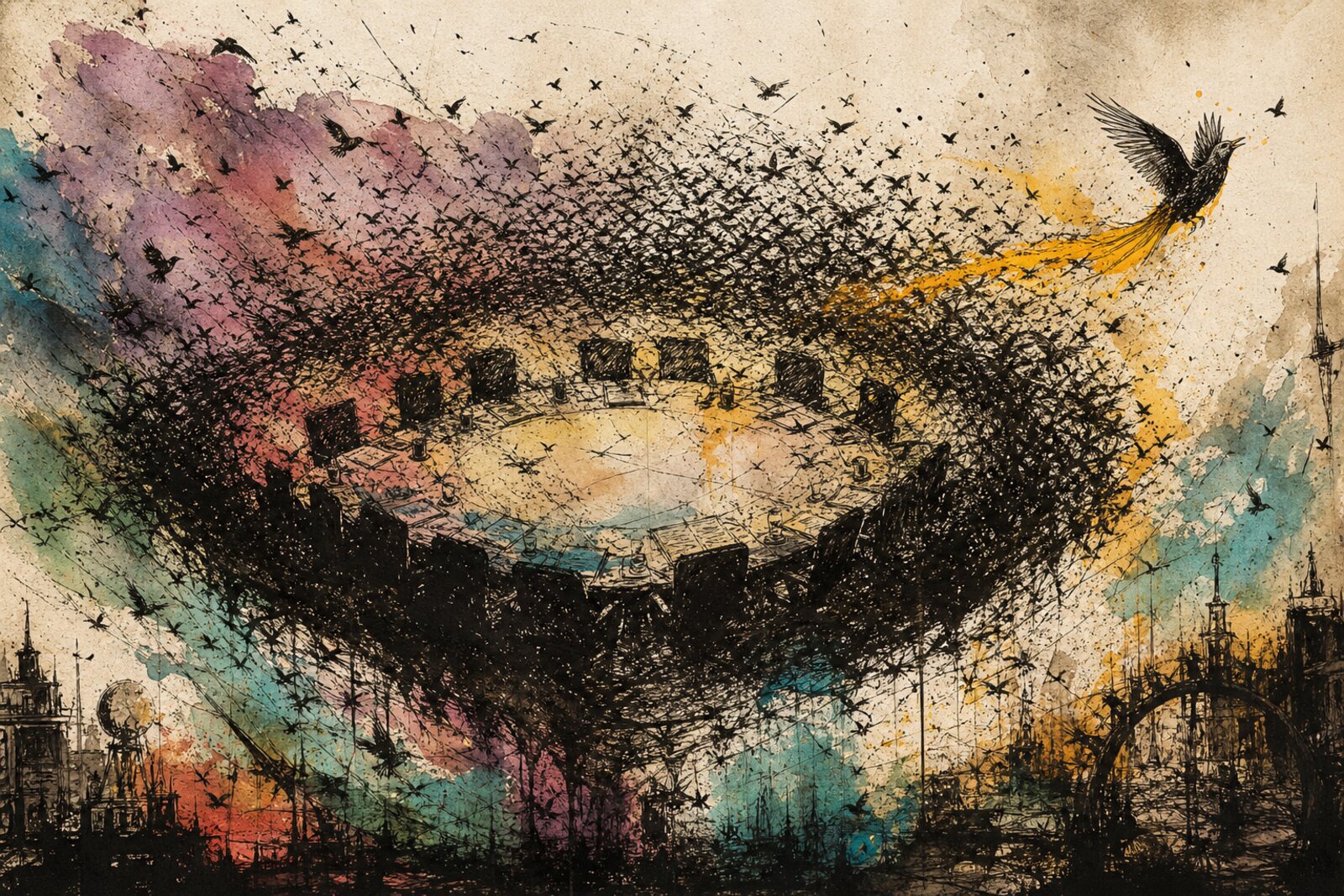
Which brings me to the murmuration.
Imagine a flock of starlings at dusk. Thousands of birds, moving as one, twisting into a single dark ribbon against the orange sky. It looks like choreography. It looks like leadership. It’s neither.
Nobody in that flock is making an informed decision about where to go. Each bird is watching the seven starlings around it and adjusting. The flock isn’t navigating. It’s reacting. And it looks exactly like strategy to someone watching from the outside.
A CEO reads that a competitor laid off 10 percent of staff and cited AI. She doesn’t know whether that competitor actually deployed anything. She doesn’t know what results they got. She doesn’t have a clear picture of what AI will do to her own industry. But she knows the seven companies around her are moving. So she moves too.
Paul DiMaggio and Walter Powell called this mimetic isomorphism. When goals are ambiguous and outcomes are uncertain, organizations imitate each other. It’s not malice. It’s not even stupidity. It’s what happens when intelligent people face a situation they don’t understand and need to look like they have a plan.
The COVID-era hiring spree makes the pattern even clearer. Big tech’s 2023 layoffs undid just 10 percent of pandemic-era hiring. The Wall Street Journal confirmed early this year that companies are still slashing jobs to reverse the pandemic hiring boom. AI is the excuse, not the cause.
Here’s what I want you to take away. Not comfort. A tool.
Next time you see a layoff announcement citing AI, ask three questions:
Did they deploy anything? If the announcement says “we’re restructuring to focus on AI” but the company hasn’t shipped a single AI product or integrated a single AI tool into a workflow, they’re explaining, not planning.
Can they quantify it? If the CEO mentions AI on the earnings call but can’t say what it’s producing, the AI mention is theater. The market rewards the mention, not the result. You can see through the performance.
Is this the murmuration? Check what the company’s competitors are doing. If three of them announced similar restructures in the same quarter, you’re watching herd behavior, not strategy.
These questions won’t save your job. But they’ll let you see the pattern while it’s happening, which is better than being caught in it blind.
I’ve watched this movie a few times now. I watched it from my uncle’s ham shack, watching him build computers before they were things you could buy in a store. The mid-90s showed me the same thing when everyone said the internet would destroy retail. I watched it in 1999 when we spent billions preparing for a computer apocalypse that never came. The early 2000s outsourcing panic followed the same arc (“your job is going to Bangalore,” except it mostly didn’t).
I’m still here. The people who adapted are still here. The jobs that didn’t exist when I was learning LOGO on a NASA engineer’s found-parts computer are now the backbone of the economy.
AI will change things. It will eliminate some roles and create others we can’t name yet. The transition will be uncomfortable for people caught in it, and that discomfort is real and deserves to be taken seriously.
But the idea that AI is an extinction-level event for human employment? That’s not a prediction. That’s a murmuration. It’s a flock of leaders who don’t know what they’re doing, following the seven birds around them, mistaking motion for direction.
The real risk isn’t artificial intelligence. It’s natural ignorance. And natural ignorance has been with us the whole time. It’s not new. It’s not accelerating. It’s just got a new name to hide behind.
We’re going to be fine. Not because nothing will change, and not because leadership will suddenly get smarter. But because I’ve watched this same panic unfold before, and every time, the world ends up somewhere we didn’t expect, doing something we didn’t plan.
And we figure it out.
Every time.