
Maximize Work Not Done: The Overlooked Agile Principle Behind Nano Unicorn Success#
Business leaders have exactly one tool for operational expenditure, and it’s a hammer. When the pressure to cut costs comes down, the reflex is the same every time: headcount reduction. A layoff round. A hiring freeze. A restructuring that moves the same work onto fewer shoulders.
Nobody thinks to cancel the lease on the half-empty building. Nobody thinks to purge the data they will never query. And it almost never occurs to them that the single most expensive decision an organization makes is the decision to start something, not the decision to continue it.
A different tool exists. It has been sitting in plain sight since 2001. It doesn’t require layoffs, restructuring, or a hiring freeze. It requires something harder: the discipline to stop doing things.
The Principle That Could Not Be Measured#
The Agile Manifesto’s tenth principle reads like a joke today: “Simplicity: the art of maximizing the amount of work not done is essential.” Seventeen developers wrote that at a ski resort in 2001, exhausted by heavyweight process. Within a few years, the industry had turned it into a punchline.
Agile-in-name-only culture inverted the principle entirely. Velocity measured work done. Sprint commitments measured scope added. Retrospectives measured what went wrong with the work that got started, not whether the work should have been started at all.
Goodhart’s Law (the principle that when a measure becomes a target, it ceases to be a useful measure) applied directly. When velocity became the target, teams maximized what was counted (story points completed, features shipped) at the expense of what was not: value delivered, outcomes achieved, work wisely omitted.
Martin Fowler called it “faux-agile”. John Cutler named it the “feature factory”: organizations where the main success metric was features delivered rather than results achieved through the feature. Dave Thomas, one of the original signatories, declared “Agile is dead” in 2015.
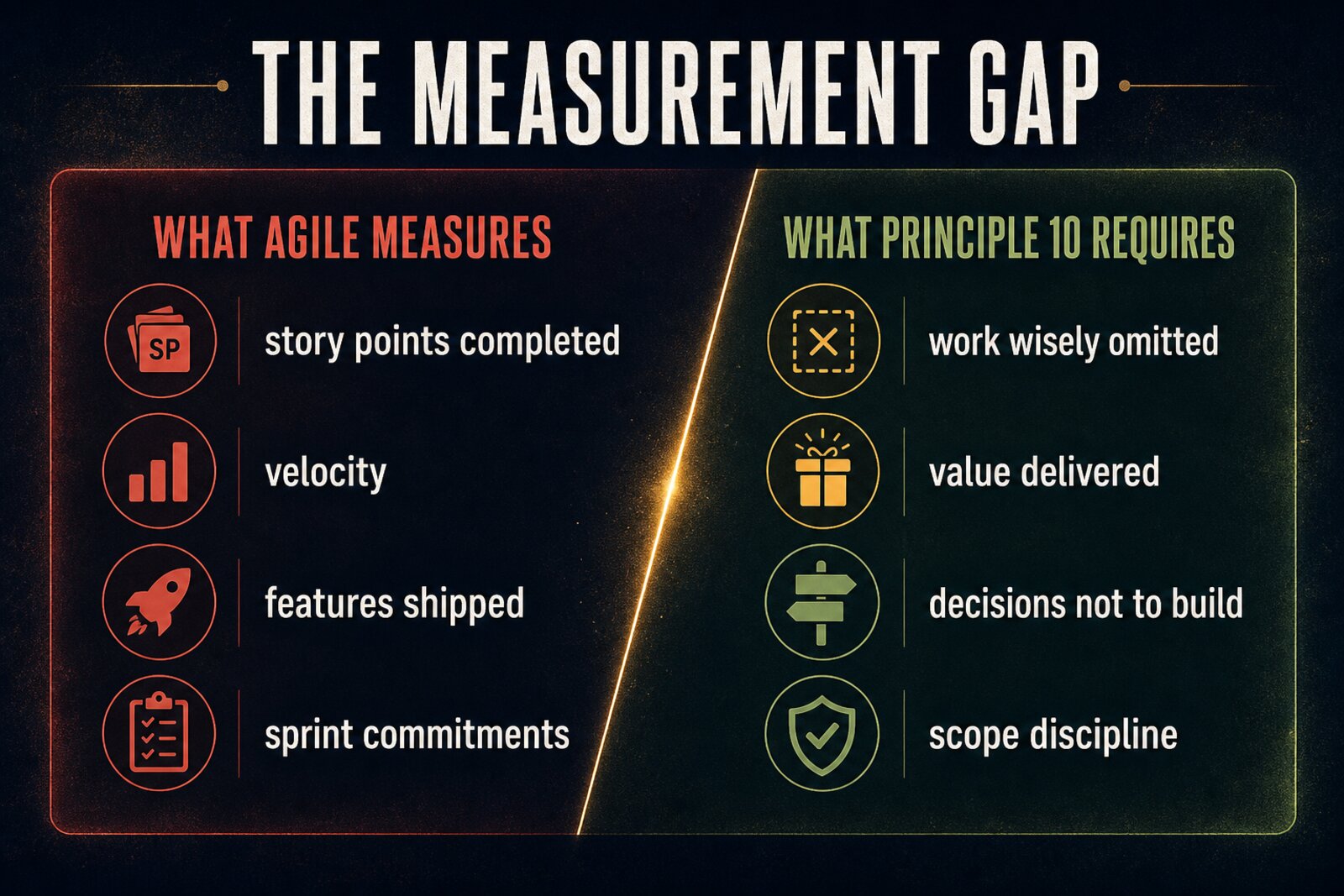
The measurement gap: Agile gave us the principle but its metrics rewarded the opposite.
You can’t sprint-point omission. You can’t roadmap a decision not to build. So the organizations that practiced real scope discipline looked less productive than the ones that just built everything in sight.
This is the gap the nano unicorn rediscovered. A nano unicorn (a company that achieves billion-dollar valuation with a fraction of the traditional headcount by generating extreme revenue per employee) proves the principle by necessity, not by process.
The Necessity of Constraint#
Nano unicorns did not find the 10th principle in the Agile Manifesto. They found it because they had to. When you’re one person, you can’t maintain multi-page sites, e-commerce, CMS features, and a mobile app simultaneously. Carrd’s founder AJ chose one-page sites because the scope was manageable for one person. When users asked for multi-page support, he invented sections (virtual pages within a single page) that solved the need while preserving the one-page identity. He freely refers users to Webflow when their needs outgrow Carrd.
Gamma reached $100 million in annual revenue with roughly 50 people. That is $2 million in revenue per employee, against a traditional software company benchmark of $200,000 to $500,000. Linear reached a $1.25 billion valuation with approximately 100 people. Danny Postma crossed six figures solo with Headshot Pro, no co-founder, no engineering hire.
These are not anomalies. The Bessemer Venture Partners Supernova program tracks AI startups hitting $40 million in revenue by year one and $125 million by year two, with more than $1 million in revenue per employee. Private market multiples for high-growth AI businesses run at 20-30x annual revenue. At 20x, a company needs $50 million in revenue to reach a billion-dollar valuation. At the Bessemer pace, that threshold is crossed in year two.
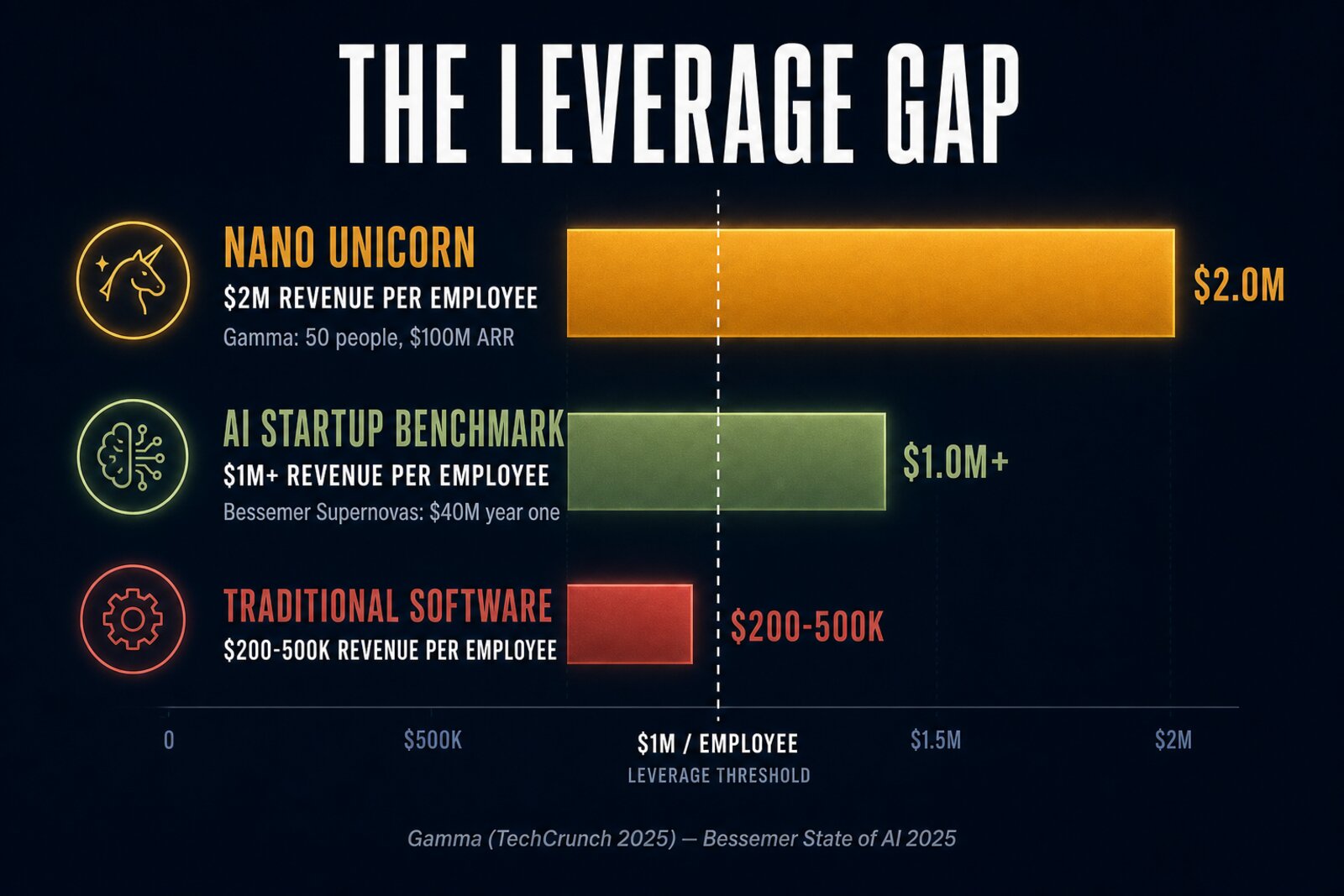
The leverage gap: Gamma generates 4-10x more revenue per employee than traditional software companies.
The math problem is gone. The organizational problem remains.
The Pre-AI Proof: Basecamp#
Before there were nano unicorns, there was Basecamp. Thirty four employees (as of 2021). Twenty seven years in business. Zero venture capital. Highly profitable. The pre-AI control case for everything the nano unicorn pattern claims.
Jason Fried and David Heinemeier Hansson built a company around saying no. No to CRM features. No to docs. No to spreadsheets. No to being everything to everyone. Their book It Doesn’t Have to Be Crazy at Work is a 200-page expansion of Agile Principle 10 applied to company operations. Their approach to new products: enter categories that have “rolled downhill, gathering complexity as they go,” competitors locked in a loop of mutual destruction through perpetual feature addition, and offer something deliberately constrained.
In December 2025, they launched Fizzy, an issue tracker that explicitly calls out Trello (“put on 40 pounds of cruft”), Jira (“started charging by the migraine”), and Asana (“tried to become everything to everyone”).
37signals also brought their cloud infrastructure back in-house, a move that was simultaneously a cost optimization and a scope constraint. When you own the hardware, you think harder about what runs on it. The OpEx containment is built into the architecture, not managed through budgets.
Basecamp proves the pattern works without AI. The nano unicorns prove it works at AI-amplified scale. The combination is the point.
An honest footnote: Basecamp is not a perfect company. Their 2021 decision to ban political discussions on internal forums triggered a wave of departures that cost them roughly a third of their workforce, including senior leadership. The coverage was brutal and deserved. But the structural lesson there reinforces the thesis rather than undermining it. When a company operates at nano-unicorn scale (thirty four people serving millions of users), every decision that alienates your team is catastrophic because there is no redundancy. A larger organization can absorb 20 departures across a 500-person engineering division. A lean company that loses a third of its people has lost its institutional memory, its social cohesion, and months of operational momentum. The discipline that makes nano unicorns efficient also makes them fragile. That is not an argument against the model. It is an argument for being careful about what you spend your limited human capital on.
Scope discipline applies to culture too.
What the Numbers Actually Say#
The OpEx math here is brutal and boringly concrete.
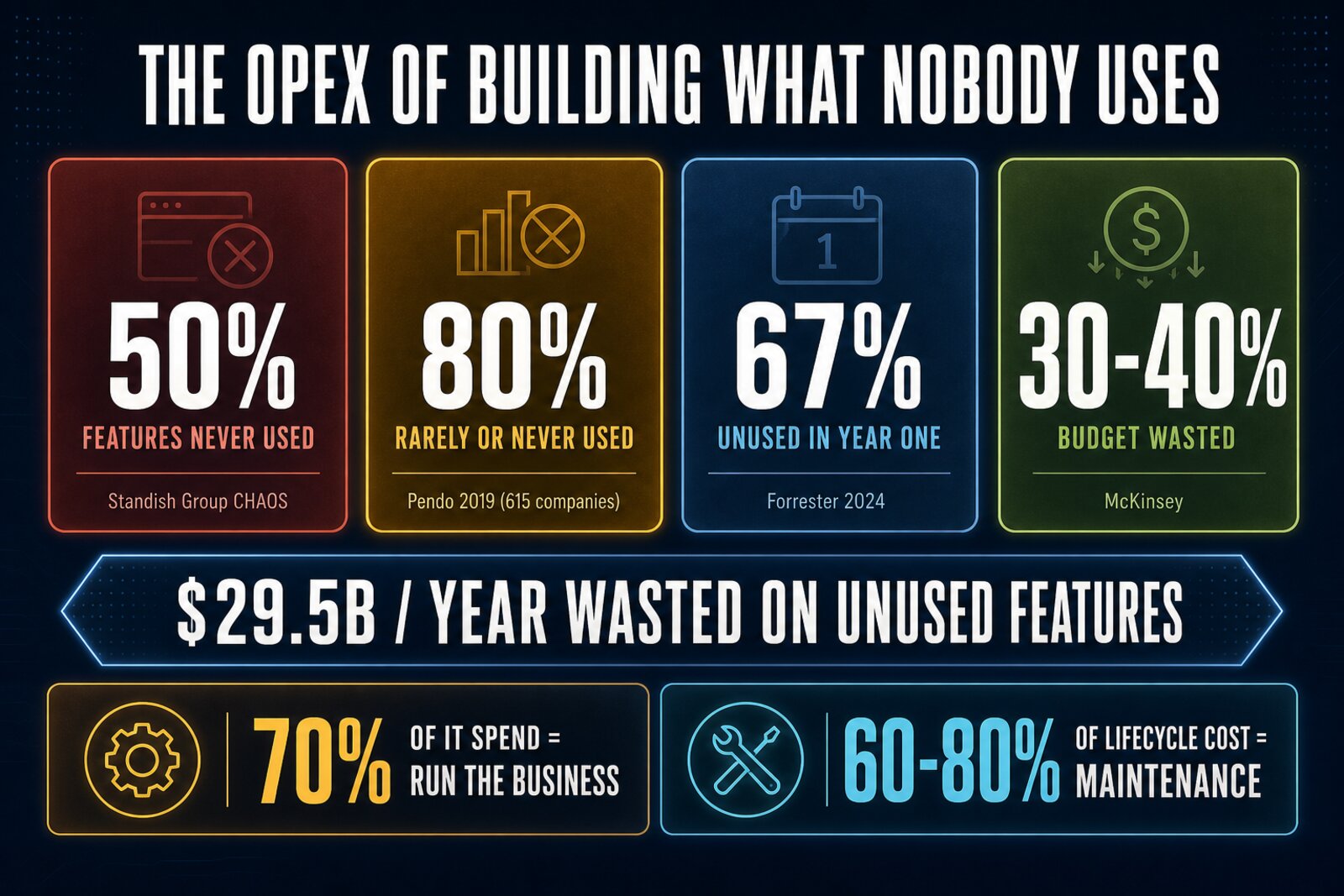
Four independent sources converge on the same picture: most of what we build never delivers value, and we pay for it forever.
The Standish Group’s CHAOS research has consistently found that 50 percent of software features are hardly ever or never used. Pendo’s 2019 study of 615 companies put the figure at 80 percent, estimating $29.5 billion per year in wasted research and development spend across publicly traded software companies alone. For a company with $50 million in revenue, that’s $8.4 million wasted on features customers rarely use. Forrester’s 2024 data shows 67 percent of enterprise software features go unused in the first year. McKinsey reports that 30 to 40 percent of software budget is spent on unused features and redundant tools.
The maintenance burden is worse. Lientz and Swanson’s landmark 1980 study of 487 organizations established that maintenance accounts for 60 to 80 percent of total software lifecycle cost. Gartner’s IT Key Metrics Data confirms that 70 percent of enterprise IT spending goes to “run the business” (operations and maintenance) versus 30 percent to “change the business” (new capabilities). McKinsey’s 2023 technical debt analysis found that technical debt accounts for 20 to 40 percent of IT balance sheet value, and organizations with high technical debt spend 40 percent more on maintenance while delivering new features 25 to 50 percent slower.
The most expensive feature an organization builds is the one nobody uses. It still has to be maintained, monitored, documented, and supported for its entire lifetime.
OpEx Without Layoffs#
Business leaders reach for layoffs because layoffs are the only OpEx tool they have internalized. But the nano unicorn pattern reveals a different path, and it doesn’t require firing anyone.
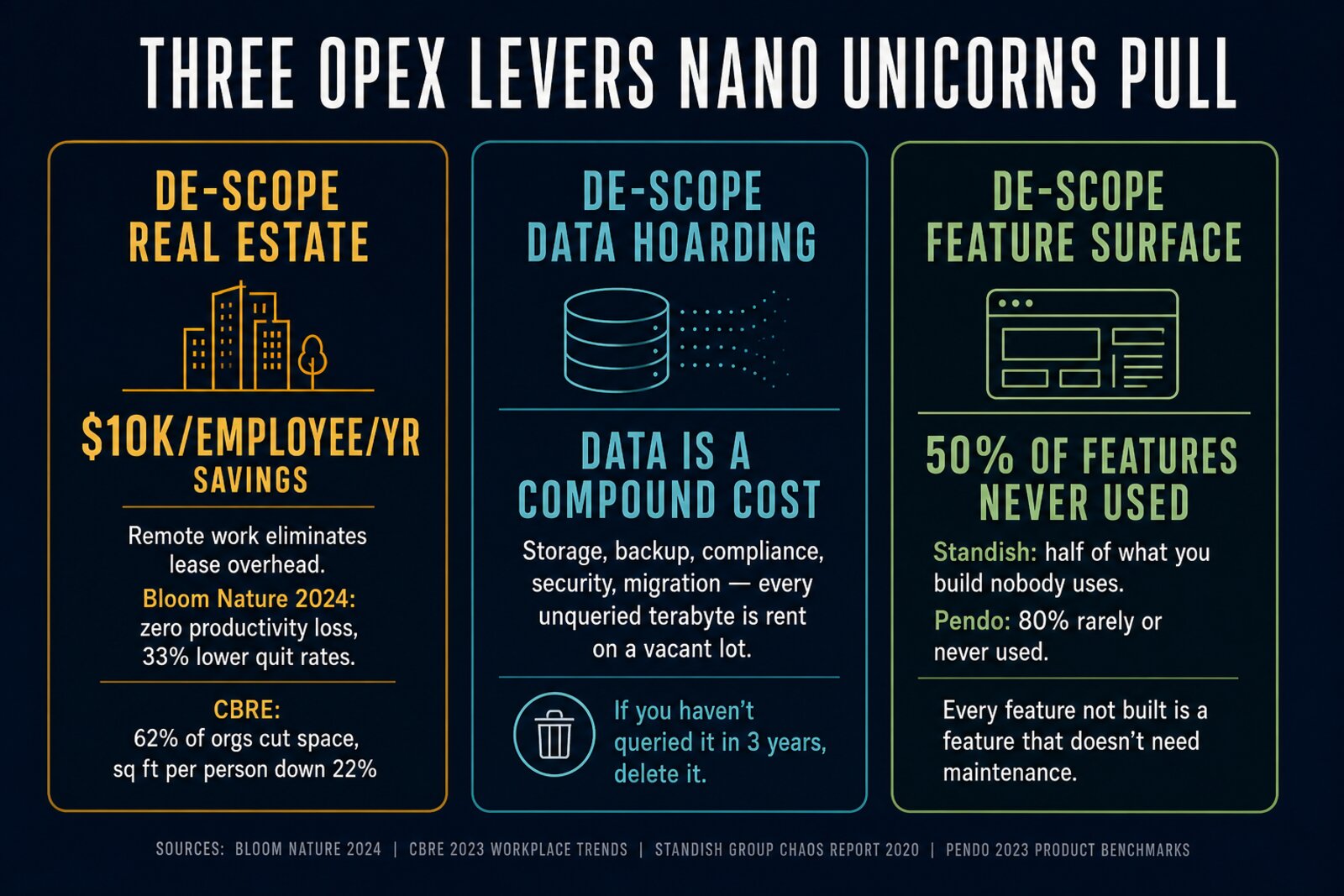
Three OpEx levers that don't require a layoff cycle. Real estate, data, and features: each one bleeds money silently.
De-scope the real estate portfolio. The assumption that knowledge workers need to be in an office to be productive is not just expensive. It is empirically wrong. A 2024 randomized controlled trial of 1,612 employees at Trip.com found that hybrid workers showed zero difference in productivity or promotion rates compared to full-office workers, while quit rates fell by 33 percent. The estimated savings from reduced attrition alone ran into the millions of dollars. A separate 2025 study of 54 S&P 500 firms found that return-to-office mandates caused a 13 to 14 percent increase in abnormal turnover, and the leavers were disproportionately high-skilled employees, mid-level managers, and women.
Global Workplace Analytics estimates average real estate savings of $10,000 per employee per year with full-time remote work. CBRE reports that 62 percent of organizations have already reduced office space since January 2020, with average square footage per person falling 22 percent in 2023 alone. The executive who insists on a full return to the office is not defending productivity. They are defending a feeling: the “miracle of the crowded office,” as one CEO famously put it, that costs their organization millions in real estate, millions more in preventable turnover, and has no measurable productivity benefit.
De-scope the data hoarding. Organizations store everything because storage is cheap and deleting is scary. But data isn’t a static cost. It’s a compound cost: storage, backup, compliance, security monitoring, discovery requests, migration overhead. Every terabyte you do not store is a terabyte you do not have to secure, audit, or migrate. Pendo’s data on unused features applies to data too: if you have not queried it in three years, you are paying rent on a vacant lot.
De-scope the feature surface. This is the hardest one because it requires product leadership to say no. But the numbers are clear: half of what you build is never used. Every feature not built is a feature that doesn’t need support documentation, doesn’t generate edge-case bugs, doesn’t slow down the next deployment, doesn’t add to the onboarding cognitive load for new team members.
The YC framework that emerged in 2026, “burn tokens, not headcount”, is the first measurement system that rewards omission. Token efficiency is a metric that naturally incentivizes doing less. When your primary productivity measure is compute cost rather than human utilization, not-doing becomes directly measurable in the same unit as doing. You can see the avoided cost in your token burn rate.
Adapt or Die#
The companies that figure out how to cap OpEx through scope discipline will have a cost advantage that headcount-optimizers simply can’t match.
The nano unicorn is not a novelty. It is a signal. The signal says: extreme leverage is possible, and it comes from what you choose not to do, not from doing the same things faster.
The Agile Manifesto said it first in 2001. It took twenty five years for the measurement system to catch up. The companies that act on it now won’t just be leaner. They will be structurally impossible to compete with on cost.