I should be upfront: I am not a biologist or a neuromorphic computing researcher. I’m an engineer who fell down a rabbit hole reading comparative cognition papers and realized something didn’t add up. What follows is what I found, and why I think there’s an unexplored opportunity here that deserves far more attention than it’s getting.
This is the first of a three-part series. Part two explores how Portia’s depth perception system has already been computationally modeled and explicitly proposed as the blueprint for a sensor cheaper than LIDAR. Part three asks why it hasn’t been built.
Imagine you are a spider. Not a web spinner. You hunt, and the thing you hunt is other spiders, many larger and more dangerous than you. You approach their webs knowing that one wrong vibration will bring them rushing out to kill you, and that your only advantage is that you are smarter than they are.
Your target is across the garden. Between you and it, a gap in the foliage where birds can see you. The direct route is the most dangerous. So instead, you climb down your stem, cross the ground under a leaf, scale a different plant, traverse a branch, and approach from above and behind. The whole detour takes over an hour. For most of it, you cannot see your prey. It is not there to guide you. It is there in your mind, a mental map you maintain and update as you move, a plan you execute without visual feedback.
This is not a story about human cognition. It is about Portia, a genus of jumping spider, and what it does with fewer than 100,000 neurons.
The Scale Drop#
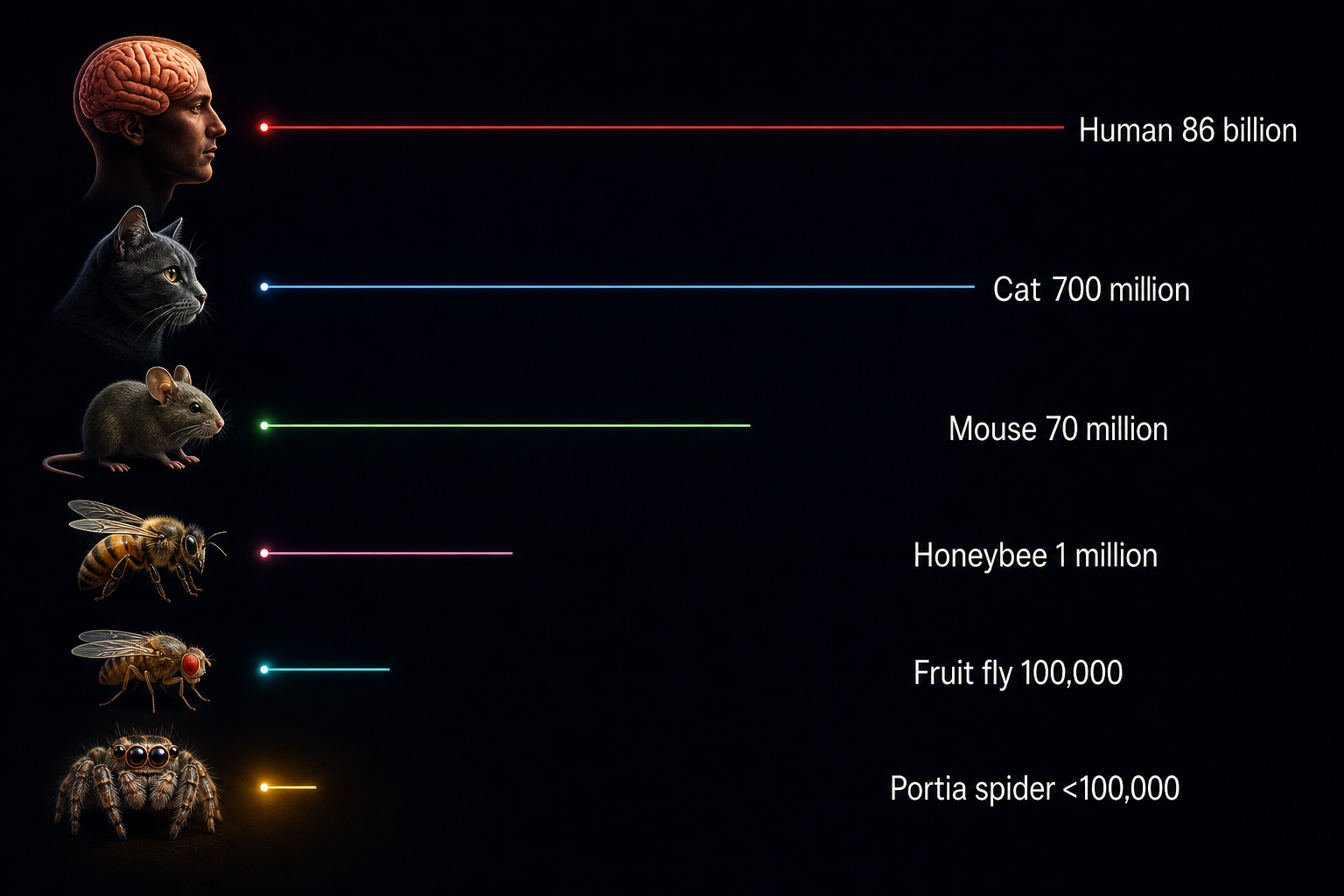
Let me give you the numbers that broke my brain when I first encountered them.
- A Portia spider has fewer than 100,000 neurons, roughly the same neural budget as a fruit fly
- A honeybee has about 1 million
- A mouse has about 70 million
- A cat has about 700 million
- You have about 86 billion
A fruit fly’s cognitive life is mostly about finding rotting fruit and avoiding being swatted. Portia plans hour-long hunting routes, learns by trial and error, recognizes individual conspecifics, and performs mental rotation of visual objects in working memory, a capability previously associated with large-brained vertebrates.
The spider that jumps when you move too close outperforms the predictions of neuroscience with every stalk. If cognitive capability scaled linearly with neuron count, Portia would be roughly 860,000 times less intelligent than a human. But it plans routes that would challenge a mammalian predator. Something is wrong with our model of what intelligence costs.
This is not a niche curiosity for arachnologists. It is an existence proof that lands at the intersection of neuroscience, artificial intelligence, and the philosophy of mind, and it has been sitting, largely unnoticed, in the literature on comparative cognition for decades.
What Portia Can Do#
Detour Planning#
The opening scene was not hypothetical. It comes from a series of experiments by Tarsitano and Jackson (1997, Animal Behaviour) that would be remarkable for any non-human animal, let alone one with a pinhead brain.
In the lab, Portia spiders were placed on a platform with prey visible on another platform, reachable only by descending, crossing the ground, and climbing an alternate route. The spider went out of visual contact with its prey for the entire detour. It selected the correct route on its first attempt, at rates no random search pattern could explain.
When multiple routes were available, Portia chose the one leading to an optimal attack angle, even when that meant walking past an incorrect but physically simpler option. This is not stimulus-response. It is evaluation and comparison of alternatives, maintained over time, executed without ongoing sensory confirmation. In vertebrates, this behavior consumes millions of neurons. Portia does it with a fraction of the hardware.
Trial-and-Error Learning#
Every Portia species enters the world with instinctive hunting tactics, a toolkit inherited from millions of years of evolution. When those tactics fail against unfamiliar prey, they improvise, a behavior documented by Wilcox and Jackson in Jumping Spider Tricksters (MIT Press, 2002).
In lab experiments, researchers gave Portia artificial prey with arbitrary but consistent behavior patterns, situations evolution never prepared it for. Portia treated its instinctive tactics as starting points, not fixed programs. When the standard approach failed, it tried alternatives. When it found something that worked, it remembered. On subsequent encounters, it went straight to the effective tactic, skipping trial entirely.
Different prey demand different tactics. Against spitting spiders that immobilize from a distance, Portia approaches from the rear. Against web-builders carrying eggs, it attacks head-on, exploiting reduced maternal aggression. Against other jumping spiders with excellent vision, Portia tucks its legs and rolls, mimicking leaf detritus caught in the web.
Object Permanence and Spatial Memory#
Object permanence, knowing that things continue to exist when out of sight, is a developmental milestone in human infants. Piaget placed it at 8-12 months. For a long time it was considered a marker of sophisticated cognition.
Portia demonstrates it every time it hunts. A spider that navigates a circuitous route out of visual contact for an hour must maintain a mental representation of its prey’s existence and location. And it goes further: Portia navigates complex 3D environments, down a stem and across the ground and up a different plant, to reach specific prey on specific leaves, suggesting not just object permanence but a spatial memory of the entire layout.
Working Memory and Mental Rotation#
In 2014, Cross and Jackson published a study in Animal Cognition that should be far more famous than it is. They demonstrated that Portia africana can mentally rotate visual objects held in working memory.
The design was elegant. Portia identifies prey by visual features like morphology and color. The researchers presented visual stimuli, introduced delays or transformations, and measured whether the spiders still recognized the target. They did. The spiders were actively manipulating mental representations, a cognitive operation previously associated primarily with larger-brained vertebrates.
The results were statistically robust, replicated, and controlled for alternative explanations. The paper argues that Portia uses specialized working memory for prey identification. It is domain-specific, not domain-general, which is arguably more impressive: evolution found a way to implement mental rotation in under 100,000 neurons by being ruthlessly selective about where the budget went.
Self-Recognition#
Portia spiders can recognize themselves.
That sounds stronger than it is, so let me be precise. Portia labiata females discriminate between their own draglines (the silk trails they leave) and those of other Portia labiata females, a finding from Clark and Jackson’s work on individual recognition (1994, 1995). This is not species recognition. It is individual discrimination. They tell themselves apart from others of the same species.
They also distinguish familiar from unfamiliar individuals, which requires memory of specific others over time. This is a prerequisite for social behavior, and it helps explain why Portia africana has been observed sharing prey and living together in ways that would be impossible without individual recognition.
How you get self-recognition out of 100,000 neurons is an open question. That you do is a fact.
Aggressive Mimicry#
If I had to pick one Portia capability that sounds like science fiction, this is it.
Portia species that hunt web-building spiders advance onto the web and vibrate the silk with their legs and pedipalps, producing patterns that mimic trapped insects or, in some cases, the courtship signals of their prey. The web’s owner, reading vibrations through its legs, interprets them as a meal or a mate and moves toward the source. Portia attacks when the target is in range.
This is not a fixed signal. Portia adjusts its pattern based on the response. If the web-builder moves toward it, Portia continues or intensifies. If the target responds belligerently (some species recognize the deception), Portia backs off and retries later. The same individual may produce different patterns for different target species, persisting for up to three days.
Read the vibrations. Match the pattern against a learned repertoire. Process the feedback. Adjust the output. All through legs reading silk threads, in real time, in a brain with fewer nerve cells than a single grain of rice.
The Unanswered Question#
Here is the thing about all of this: we have almost no idea how it works.
The first successful neural recordings from a jumping spider brain were achieved in 2014, by Menda, Shamble, Nitzany, Golden, and Hoy at Cornell, using tungsten electrodes small enough to puncture the exoskeleton without losing the spider’s hydraulic pressure. They identified a visual processing region called the arcuate body and found neurons that fire selectively in response to flies. It was a landmark achievement.
But that is where the trail goes cold. There is no connectome for any salticid brain. The wiring from the retina to the arcuate body has not been traced. The neural circuits behind mental rotation, detour planning, and aggressive mimicry are entirely unknown. We know what Portia can do. We do not know how its neurons do it.
And that is precisely what makes the next part of this story so provocative.
The Turn#
Because one part of Portia’s toolkit, its depth perception system, has been studied at the optical level in enough detail that researchers built a physically accurate computer model of its principal eye, applied a standard computer vision algorithm to the simulated retinal images, and recovered depth estimates with median error of 9.7%. The same paper, published by Müller et al. in Biomimetics (2017), proposed building a depth sensor based on the spider’s optical principles: a single uncorrected thick lens, two photosensor arrays at different focal depths, zero moving parts. The authors conclude that such a sensor would be “cheaper and more robust than the expensive and fragile corrected lens systems commonly used for depth-from-defocus.”
That was nine years ago. Nothing has been built.
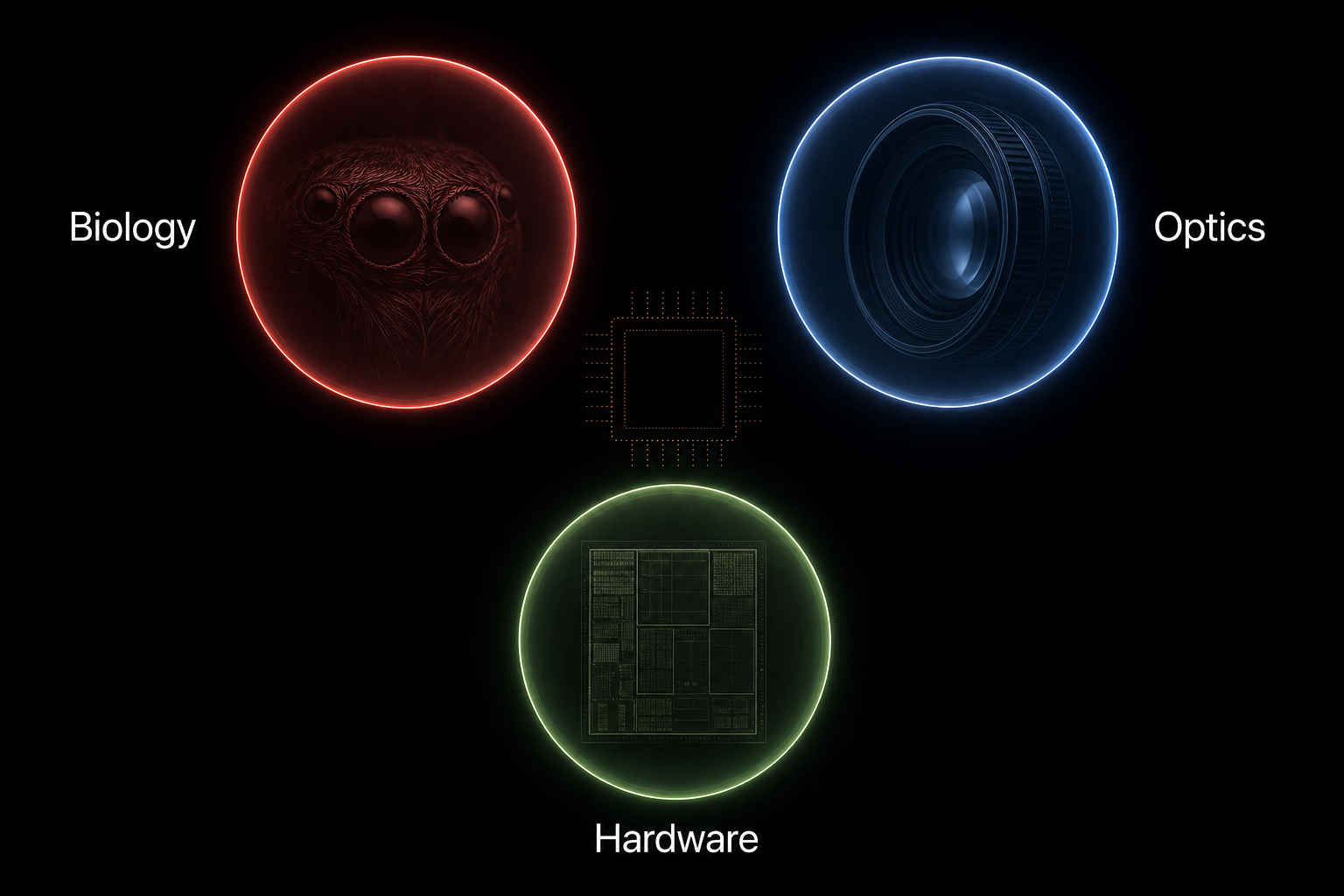
Not because the physics is wrong. Not because the math doesn’t check out. Not because the primitives don’t exist in a fab. The reason nothing has been built is that the people who understand the biology, the people who understand the hardware, and the people who understand the optics do not work together. They attend different conferences. They publish in different journals. They answer to different funders.
A sensor that could cost pennies and consume microwatts. A sensor that works like the one in the face of an animal most people find creepy. It sits unmade, in plain sight, on the page of a 2017 paper that nobody in the neuromorphic hardware community has ever read.
Which brings us to part two.
References#
- Tarsitano, M.S. & Jackson, R.R. (1997). Detour route discrimination by Portia. Animal Behaviour. https://doi.org/10.1006/anbe.1997.0505
- Cross, F.R. & Jackson, R.R. (2014). Specialised use of working memory by Portia africana. Animal Cognition, 17(2), 435-444. https://doi.org/10.1007/s10071-013-0676-2
- Clark, R.J. & Jackson, R.R. (1994, 1995). Dragline discrimination and self-recognition in Portia. Ethology Ecology and Evolution.
- Wilcox, S. & Jackson, R.R. (2002). Jumping Spider Tricksters. In The Cognitive Animal (MIT Press). https://mitpress.mit.edu/9780262537865/
- Jackson, R.R. & Blest, A.D. (1982). The biology of Portia fimbriata. Bulletin of the British Arachnological Society.
- Menda, G. et al. (2014). Visual perception in the brain of a jumping spider. Current Biology, 24(21), 2580-2585. https://doi.org/10.1016/j.cub.2014.09.029
- Müller, A.N. et al. (2017). Depth Estimation from a Single Camera Image Using a Spider-Eye-Inspired Depth-from-Defocus Sensor. Biomimetics, 2(1), 3. https://doi.org/10.3390/biomimetics2010003
- Nagata, T. et al. (2012). Depth Perception from Image Defocus in a Jumping Spider. Science, 335, 469-471. https://doi.org/10.1126/science.1211667
- Wikipedia: Portia (spider). https://en.wikipedia.org/wiki/Portia_(spider)