The Unfinished Fish#
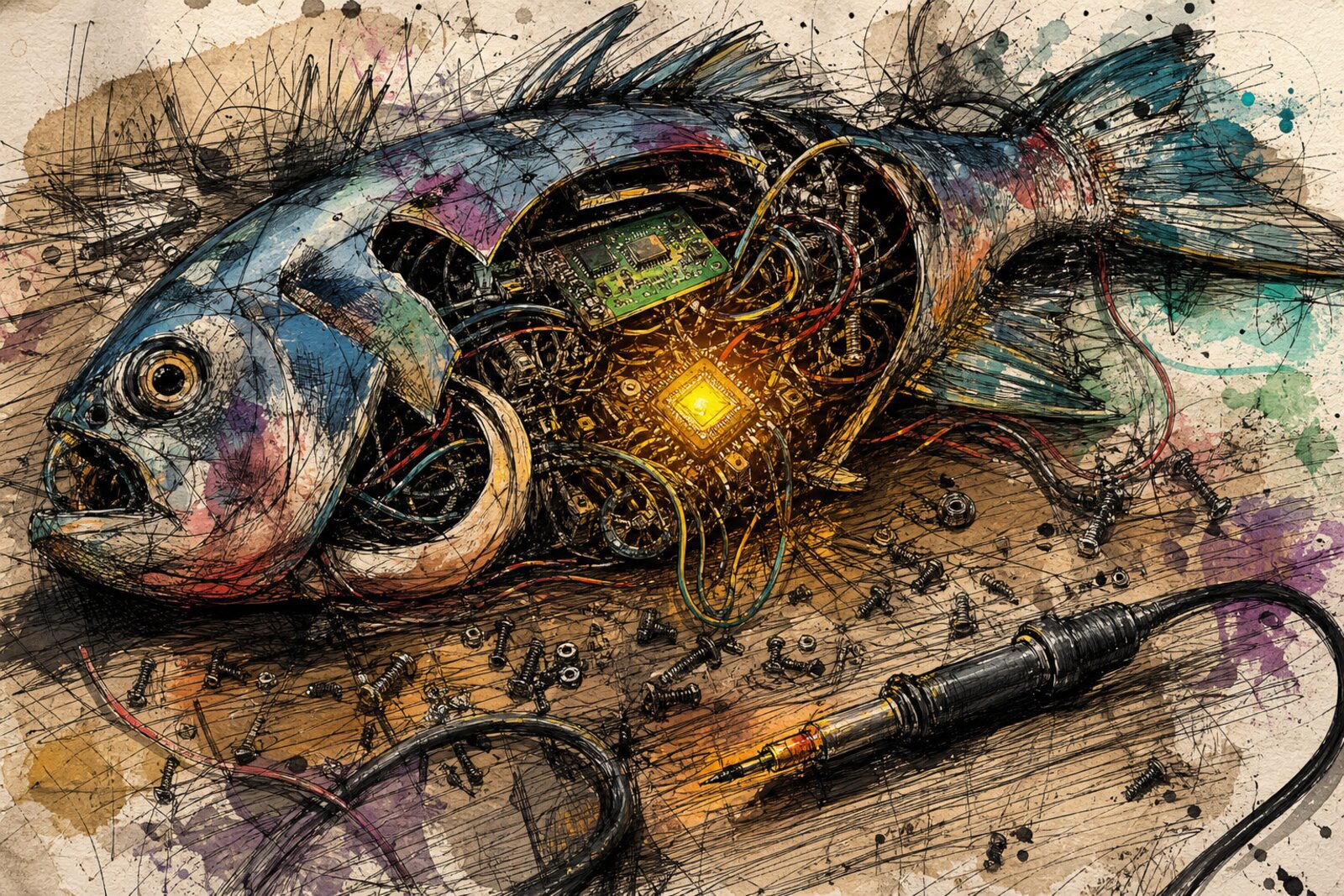
There’s a Big Mouth Billy Bass on my workbench with its back off.
You know the fish. Everyone knows the fish. You know it as a punchline. A plastic largemouth bass on a wooden plaque that twists its head and lip-syncs “Don’t Worry, Be Happy” when you walk past. Gas stations sold them. Office workers tortured each other with them. They appeared in The Simpsons and The Sopranos and WALL-E and then, somehow, refused to die.
Twenty-five years later, mine is in pieces.
The six screws are in a dish. The back panel is off, revealing the battery box and the rear speaker. The main board is out, propped against a spool of solder. I’ve traced every wire, noted every component, photographed every connector. The teardown is complete.
And I have no idea what I’m going to build.
You’d think this would be the easy part. The teardown is the hard work: the probing, the measuring, the reverse-engineering. After that, you pick a direction and build. But I’ve learned that the moment before you commit is where all the possibilities live, and once you commit, they die. So I’m sitting in that moment for a while.
What the teardown revealed is a machine of surprising honesty. The PCB is simple: a single blue board with a TC1185 LDO dropping the 6V battery rail to a regulated logic supply, a D882/D772 discrete BJT H-bridge driving the body motor, and a 16-pin SOIC that is, for all I know, the most boring microcontroller Gemmy could source in 1999. There’s a piezo buzzer for the tinny voice phrases and an 8Ω dynamic speaker in the tail that the original designers barely used. The mouth motor is a simple DC job that opens against a spring: power on, mouth opens; power off, spring closes it. No servo, no feedback, no pretense.
It’s the hardware equivalent of a shrug. And that’s what makes it perfect.
The fish was designed to do exactly one thing: sit on a wall until something triggers it, then flop and sing for thirty seconds. Its intelligence is measured in milliseconds of audio ROM. But the architecture, the LDO rail, the accessible motor leads, the forgiving power budget, invites intervention. Every component is right there, doing a job it was never meant to do at a scale the original engineers couldn’t have imagined.
There’s a word for that. Platform.
The menu of possible futures is absurdly long.
I could make it a Bluetooth speaker that dances to any audio, like the el-poisson-billy project did with an ESP32 and some MIDI mapping. I could build the full offline AI stack, VOSK for speech-to-text, a quantized LLM for responses, Piper for TTS, all running on a Raspberry Pi 5 small enough to hide in the plaque. Or I could chase the cloud path with an API key and give the fish a personality that changes weekly.
Each of these is a different essay. A different relationship with the object. A different claim about what this piece of PVC and copper is for.
And then there’s the sensor.
I’ve been reading about microwave presence detection: the kind that uses Doppler radar to know whether a room is occupied, not just whether something walked past three seconds ago. The stock Billy Bass has a light-dependent resistor that triggers when you cast a shadow on it. The difference between “I detect motion” and “I know you’re here” is the difference between a tripwire and a companion.
Microwave presence sensing changes the relationship. The fish doesn’t just react to triggers anymore. It knows when you’re in the room. It can tell the difference between you walking through and you sitting down to stay. That’s a kind of awareness the original designers never imagined, built on top of a sensor that costs less than a cup of coffee.
I don’t know what that looks like as a finished project yet. But I know it’s the direction I want to explore.
I could finish this piece by telling you what I built. That’s how these stories usually go: the teardown, the build, the reveal, the lesson learned. But I don’t have a build to show you. I have a dissected fish on a bench, a Raspberry Pi sitting next to it in its box, and a microwave sensor still in its anti-static bag.
And I’m realizing that’s a valid place to be.
The finished project is a closed door. It’s this thing, doing this thing, and all the other things it could have been fade into the background. The unfinished project is a container for possibility. Every possible Billy Bass I could build is still alive in this moment, coexisting in the space between the TC1185 and the spring-return mouth.
Some projects you finish because they need to exist in the world. Others you complete because the learning is in the doing. And some you leave unfinished because what you’re actually building isn’t a thing. It’s a decision you’re not ready to make yet.
I’ll let you know what I decide. Or maybe I won’t. Maybe the next piece is about the fish that knows when you’re in the room, or maybe it’s about why some projects are more interesting before they’re finished.
If the suspense makes you sad, well. Don’t worry.
Be happy.