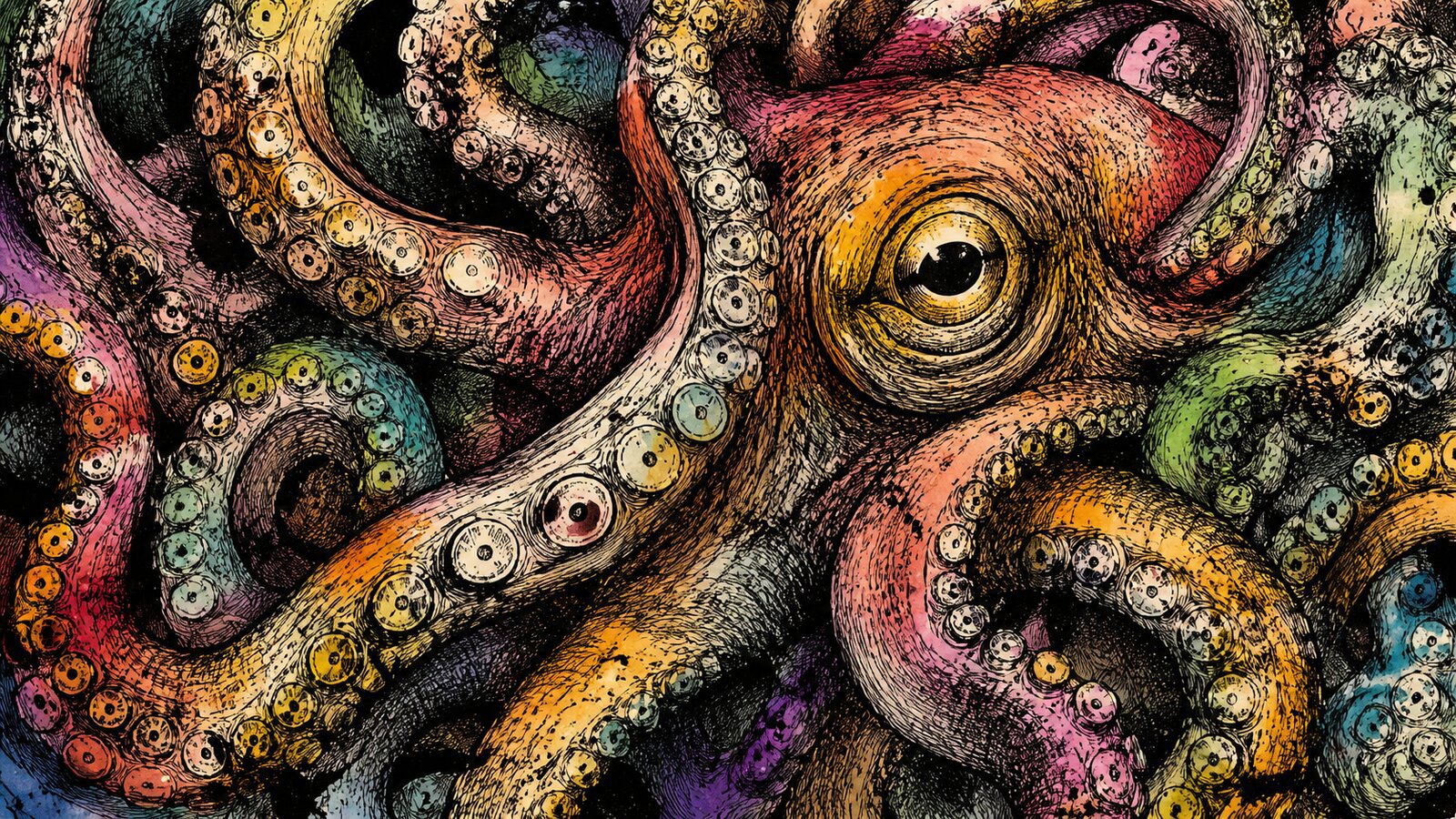
Or: Why Your Brain and an Octopus’s Brain Disagree About What “Yes” Means
I have a confession that surprises no one who knows me: I am thoroughly, disproportionately, semi-irrationally in love with the octopus. The consultancy I named Groktopus is partly a tip of the hat to that obsession. The name does double duty. It gestures at the octopus’s distributed cognitive architecture, where each of the eight arms is half-neural and half-sensor, with surprising autonomy of its own. And it gestures at the kind of grokking-from-everywhere posture I want to bring to my work. But mostly, I just think they are the coolest creatures alive.
Here’s the thing about octopuses: they aren’t just smart animals. They’re smart animals that arrived at “smart” by a route nobody else has ever taken. And just last December, a research group at the MRC Laboratory of Molecular Biology in Cambridge and KU Leuven in Belgium published a paper that pushed me from “fan” to “fully converted evangelist.” It turns out the octopus brain isn’t just doing the same job as ours with slightly different parts. It’s doing the job with what looks, on close inspection, like inverted chemistry.
Let me back up and explain why that should make your jaw drop.
Six Reasons They’re Already Aliens#
Before we get to the new science, you need to feel in your bones how strange these animals already are.
- An adult Octopus vulgaris has roughly 500 million neurons. Only about 150 million of them live in the brain itself; the other 350 million are spread out across the eight arms, which means each arm is a kind of semi-autonomous mini-brain. It’s also why a severed octopus arm keeps reacting to stimuli for a surprisingly long time. The arm, in a real sense, is still doing its own thing.
- They taste with their skin. The suckers contain chemoreceptors, so an octopus reaching into a crevice is licking the rock with thousands of tiny tongues at once.
- Their blood is copper-based and runs blue. They have three hearts.
- They are functionally colorblind, yet their camouflage is the most sophisticated in the animal kingdom. Recent evidence suggests photoreceptor-like proteins in their skin may help with this, which means their skin may, in some sense, see color even though their eyes can’t.
- They open childproof pill bottles. They solve mazes. They recognize individual human handlers, treating different people differently based on how those people have treated them in the past. There’s footage of an octopus named Inky who escaped New Zealand’s National Aquarium overnight in 2016 by climbing out of his tank, slithering across the floor, and squeezing into a drainpipe that led back to the sea.
- They evolved all of this on a separate evolutionary track from ours, going back roughly 600 million years.
Two of those bullets deserve a closer look, because they hint at how strange the underlying design really is.
The first is the wiring. The octopus nervous system, by vertebrate standards, looks chaotic. There’s no clean hierarchy the way you’d find in a mammal. Most of the processing happens out in the arms, not in the central brain, and the connections between brain and arms are remarkably loose. By every textbook intuition we have about how brains “should” be organized, this shouldn’t work very well. It works extraordinarily well. The octopus seems to have figured out how to build a high-functioning, problem-solving nervous system out of what looks, by our standards, like spaghetti.
The second is the body. Octopuses have no skeleton. Not even a small one. To get strength and precision out of pure muscle, they evolved something called a muscular hydrostat: by contracting muscles in opposing directions at the same time, the animal can stiffen part of an arm into a temporary “joint” wherever it wants one. Your tongue is the closest version of this you carry around in your own body. Now imagine your tongue could open jars, hunt crabs, and unscrew bottle caps. They had to rewrite the rules of how you turn muscle into useful work, because the rules we use depend on having something rigid to pull against, and they don’t have that.
So before we even get to the brain chemistry, the octopus is already an animal that has solved a lot of the same problems we solve, by methods we don’t use.
The Eye That Shouldn’t Exist#
When biologists talk about convergent evolution, the example everyone reaches for is bats and birds. Both fly. They evolved flight independently. Cool. But honestly, bats and birds are both vertebrates. They share a pretty recent common ancestor by evolutionary standards. They were always going to be working with similar raw materials, and similar raw materials tend to produce similar solutions.
Octopuses and humans are not that.
Our most recent common ancestor was something like a tiny, simple worm crawling around on the seafloor about 600 million years ago. It had almost no nervous system to speak of. Everything we have, eyes included, was built up from there. Everything the octopus has, including its eyes, was built up from there on a completely separate track. We’re not cousins. We’re not even distant cousins. We’re two different evolutionary experiments that happened to start from the same humble worm.
And yet, somehow, both lineages independently invented the camera-style eye. Lens, iris, retina, the whole package. Hold up a cross-section of an octopus eye next to a cross-section of a human eye and you would have trouble telling them apart at a glance. (Octopuses arguably did it slightly better. Their retinas don’t have our weird “blind spot” wiring quirk, where the optic nerve has to punch through the retina to get out.) This is one of the most extreme cases of convergent evolution we have. Two animals, separated by hundreds of millions of years and by an entire branch of the tree of life, looked at the problem of “how do I see things” and arrived at virtually the same answer.
So the obvious next question is: do they also process the visual data the same way? Same camera, same image-processing software?
Hard no. And that’s where this gets really interesting.
What the New Research Found#
The paper I keep mentioning is Courtney et al., 2025, out of Cambridge and KU Leuven. It’s a preprint on bioRxiv, which means it hasn’t gone through formal peer review yet, but the methods are rigorous and the findings hold up across multiple experimental approaches.
What did they actually do? In plain English, two things.
First, they made a chemistry map of the octopus visual system. They tagged the genes responsible for making different neurotransmitters and traced where each one shows up. This gave them a color-coded atlas of who is dopaminergic, who is cholinergic, who is glutamatergic, and so on, across the entire visual processing layer.
Second, they took the octopus’s actual ion-channel proteins, popped them into frog egg cells (which is a standard, weirdly elegant biology trick), and ran electricity through them. This let them ask directly: when you hit this specific channel with dopamine, does the cell turn on or turn off? Frog eggs are wonderful for this because they let you isolate one ion channel at a time, in a clean environment, and watch what it does.
Then, to close the loop, they took fresh slices of octopus brain, kept the tissue alive, and watched in real time using a fluorescent calcium indicator. When they sprayed dopamine onto the slice, they could literally see which neurons lit up.
What they found was the plot twist.
The Three Inversions#
In your brain, there’s a well-understood division of labor between neurotransmitters. Some are “fast” signals that flip neurons on or off in milliseconds. Glutamate is the main fast on-switch. GABA is the main fast off-switch. Other transmitters, like dopamine, are “slow” signals that modulate mood, motivation, attention, and reward over the course of seconds or minutes. They tune the volume on whole brain regions, rather than flipping individual switches. Acetylcholine sits in between; in your muscles and in some parts of your brain, it acts as a fast on-switch.
In the octopus visual system, that division of labor is, frankly, scrambled.
Inversion one: dopamine is the gas pedal, not the dimmer switch. In the octopus optic lobe, dopamine isn’t a slow modulator. It’s the primary fast excitatory signal, doing the job that glutamate does in your brain. The Courtney team found a brand new ion channel, which they called DopC1, that opens the moment dopamine touches it. Eighty-three percent of the neurons in one of the deeper visual layers fire in direct, fast response to dopamine. This is a kind of dopamine signaling we didn’t previously know existed.
Inversion two: acetylcholine is the brake, not the accelerator. In your body, acetylcholine flips muscle cells on. In the octopus visual system, the dominant acetylcholine receptor is a chloride channel called AChRB1. When acetylcholine hits it, the cell shuts down. Same chemical, opposite effect. And here’s where it gets stranger: structurally, AChRB1 is a close cousin of the receptors in your own muscles. It looks like one of yours from the outside. But a few amino acids in the pore region of the channel have flipped its ion selectivity from “let positive ions in” to “let negative ions in,” which is enough to invert what the channel does to the cell.
Inversion three: their amacrine cells are wired backwards. In your retina, there’s a class of cell called an amacrine cell, which sits between the photoreceptors and the deeper visual neurons and provides lateral inhibition. Amacrine cells receive excitatory inputs from neighboring cells and emit inhibitory outputs. That’s their job; that’s the textbook. The octopus has cells in the same position in the circuit, doing the same architectural job. But these cells receive inhibitory inputs (via that AChRB1 channel) and emit excitatory outputs (via the new dopamine channel). Both ends of the cell have been flipped. They’re doing the same job in the same place, but with opposite signs.
Put it all together, and you have an animal that built a camera-style eye that looks almost identical to ours, then attached it to image-processing wiring that runs the opposite chemistry.
Why This Should Make Every Tech Person’s Hair Stand Up#
If you’re reading this and you’re a biologist, this is interesting. If you’re reading this and you’re a tech person, this is screaming.
Here’s the thing. Almost everything we “know” about how visual computation works in brains comes from studying vertebrates. Mice. Cats. Macaques. The reason is practical; those are the animals we have models for, those are the brains we can put electrodes in, those are the genomes we have decoded. So when researchers, including AI researchers building “brain-inspired” architectures, draw insights from “how the brain processes vision,” what they’re really drawing insights from is: how the vertebrate brain processes vision.
Courtney and her colleagues have just shown that the octopus solved the same problem (process light, recognize prey, decide what to do) using a completely different molecular toolkit. Same task, different software. The octopus is an existence proof that vertebrate visual computation isn’t the only way to do visual computation. It’s one way among at least two.
Which means the design space for brain-inspired AI architectures is bigger than we’ve been treating it as. Maybe a lot bigger. The next time someone confidently asserts that some specific neural mechanism is “how brains compute vision,” it’s worth remembering that there’s a 500-million-neuron animal sitting in a tank somewhere doing the same job by reversing the polarity on most of those mechanisms.
The brain isn’t a thing. The brain is a category. We’ve been studying one branch of that category, calling it “the brain,” and assuming everything else in the category works roughly the same way.
It doesn’t.
Back to Groktopus#
This is part of why I named the consultancy Groktopus. It’s a love letter to the animal, sure. But there’s a real argument hiding inside the portmanteau.
“Grok” is Robert Heinlein’s word, from Stranger in a Strange Land. To grok something is to understand it so completely that it becomes part of you. Not to know about it. Not to have a model of it. To know it from the inside, with your whole self. Heinlein had to invent the word because he was reaching for a kind of total embodied understanding that ordinary human cognition doesn’t really do. We’re mostly abstraction machines. We build symbolic models of the world and then operate on the models.
The octopus doesn’t do that. Or it does much less of it.
The octopus tastes, sees, decides, and remembers through every inch of its body. Each arm has its own neural mass and its own substantial autonomy. Its skin contains chemoreceptors and probably photoreceptors. Its memory of an object is partly the memory of having grasped that object with a particular sucker on a particular arm, while tasting and seeing it through the skin nearby. There’s no clean separation between “the part of the animal that knows things” and “the part of the animal that does things.” It is the same tissue. It knows because it touches; it touches because it knows.
If any animal on this planet is evolved to grok, in Heinlein’s original sense of total embodied knowing, it’s the octopus. Not the human. We stand at a slight remove from the world, manipulating symbols of it. The octopus is in direct, distributed, full-body contact with reality at every moment of its life.
That’s the posture I want to bring to my work. Grok, don’t model. Touch the actual problem with as much of yourself as you can, rather than building a clever abstraction of it from a comfortable distance.
So here’s to the octopus. Inverted, distributed, boneless, blue-blooded, problem-solving, escape-artist alien. Cousin to a worm. Same eye as us, opposite mind. The animal that knows with all of itself.
I named my company after them for a reason.