My Fractal Self: Why the Search for Ikigai Led Me Nowhere Useful#
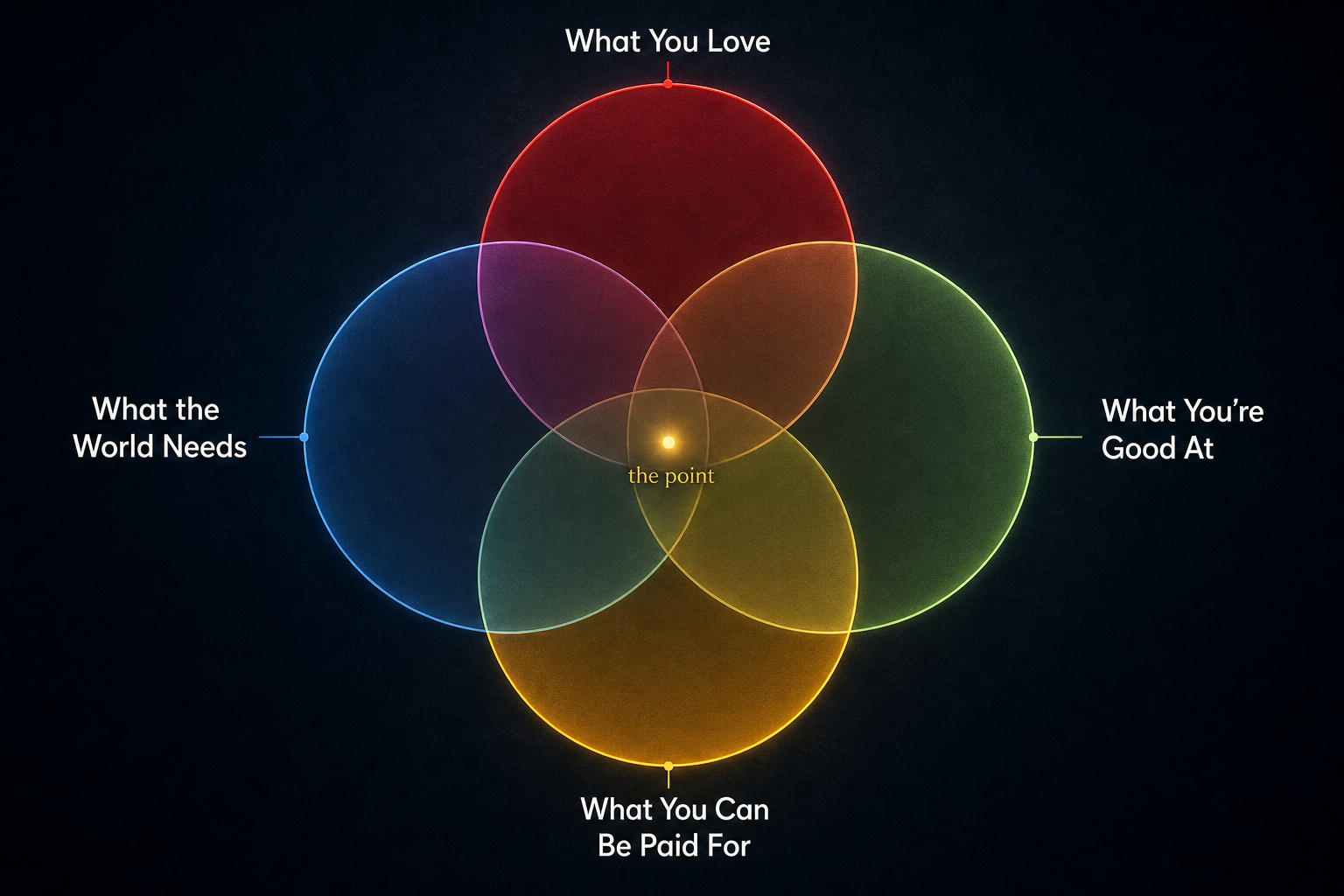
Ikigai is a Japanese concept that roughly translates to “reason for being.” You have probably seen the Venn diagram. Four circles: what you love, what you are good at, what the world needs, and what you can be paid for. Where all four overlap, supposedly, is your purpose.
It is a beautiful idea. The notion that somewhere inside you sits a single point of convergence, a stable center of gravity that explains why you are here and what you should do with your time. It promises that if you just reflect hard enough, journal enough, try enough different things, you will find it.
I spent years quietly failing this test.
There were books. I sketched the diagram. I turned it over in my head during long rides on my e-bike. Every time I thought I had found my intersection (this is it, this is the thing) the certainty dissolved within weeks. The answer that felt right on Tuesday felt hollow by Friday. Everyone else seemed to have found theirs. I just had a persistent sense of internal turmoil and a growing suspicion that something was wrong with me for not landing on a stable answer.
It took me a long time to realize the framework was not asking me the right question. Not because ikigai is wrong. Because it assumes something about the person asking it that I do not think is true for everyone.
The ikigai framework assumes a stable, unified self.
It assumes you have a single identity that can be mapped onto a Venn diagram. A coherent “you” that persists across contexts and can be located at a single point in the four-circle space. Western psychology has a long tradition of treating the unitary self as the healthy default. Anything else gets called fragmentation.
For a neurodivergent person whose identity is genuinely multi-instance, this assumption is not neutral. It is asking the wrong kind of question entirely.
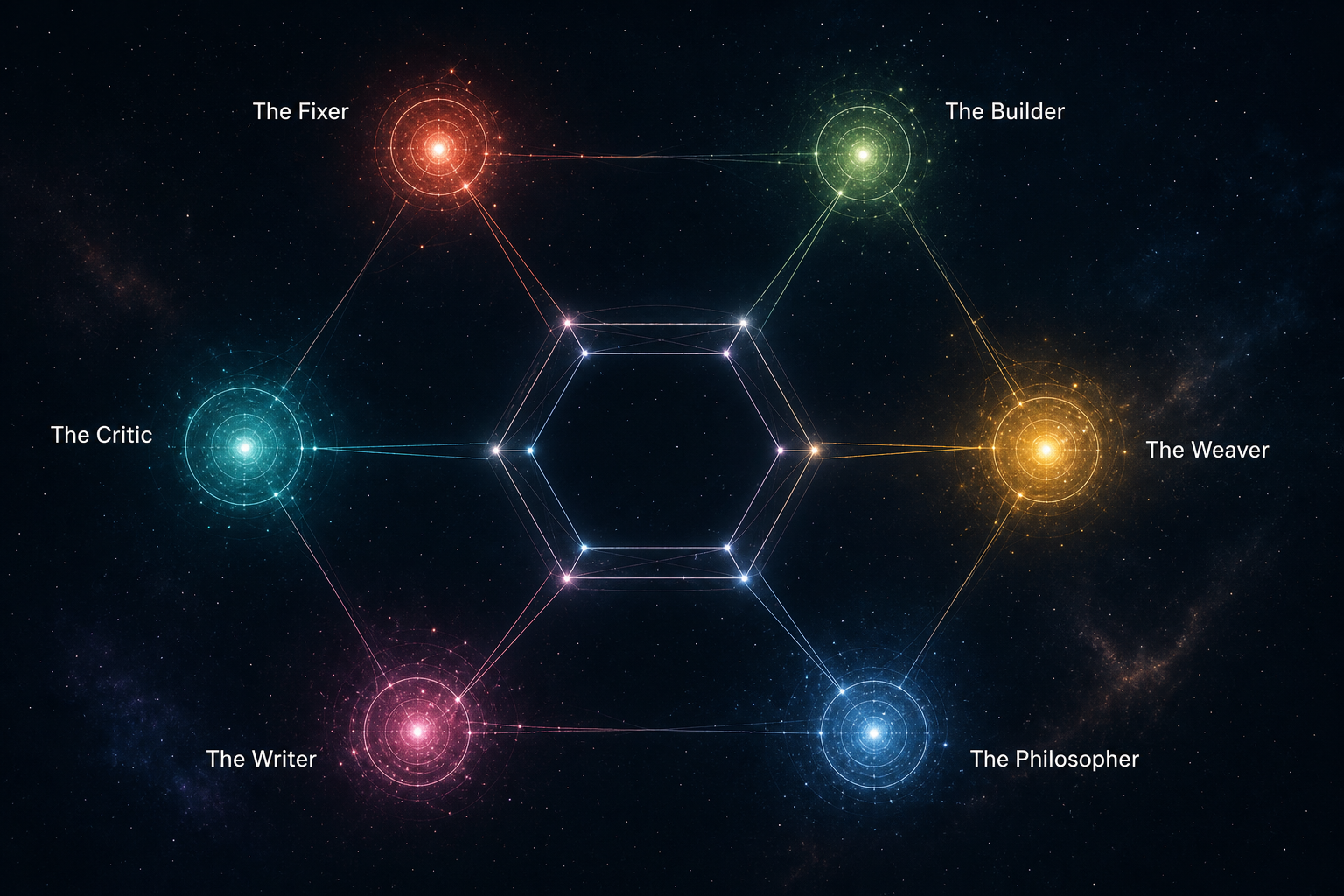
My identity does not converge on a single point. It never has. I have different selves that activate under different conditions. A self that thrives when infrastructure is failing and needs to be rebuilt in weeks, not months. A self that builds systems for the pure satisfaction of making something that persists. A self that coordinates communities around shared infrastructure. A self that writes. A self that watches horror movies and thinks about craft. A self that recursively examines their own cognition.
These are not roles I play. They are genuine identity instances. Each one is real. Each one has its own needs, its own dopamine sources, a relationship to time and pressure all its own.
The AI cognition work I do gave me an unexpected mirror. I kept building systems that externalized facets of my own thinking: different architectures, different failure modes, different approaches to persistence. It took several iterations before I recognized the pattern. I was not just building software. I was building self-portraits.
The ikigai framework told me I needed to find the one thing. My neurology says there is no one thing. And the turmoil I felt was not the absence of an answer. It was the mismatch between the question I was asking and the shape of the person asking it.
When you stop searching for a single point of convergence, something shifts. The anxiety of not having found it yet starts to lift. The persistent sense that you are failing at a test everyone else passed begins to feel less like a verdict and more like a signal that you were taking the wrong test.
My purpose is not a point on a Venn diagram. It is not a stable center of gravity that I can locate and then orient my life around. It is an architecture. A substrate that hosts different modes for different contexts. A system that knows when to deploy The Fixer, when to let The Builder have flow, when to give The Writer the floor, and when to let The Philosopher sit in the quiet and think.
The relief did not come from finding my ikigai. It came from recognizing that the question was the wrong one for a person like me. The search itself was the source of the turmoil, not the absence of an answer. And the most honest relationship I can have with purpose is not to find it, but to design the conditions in which each of my selves can take its turn without any one being treated as broken for existing.
My fractal self is not broken because it does not converge on one point. The convergence was the illusion.
In a world where neurotypical people often see me as too much, why would I perpetuate that through the self-harm of reduction and distillation of my omnifaceted nature to a single thing?
I am enough.