
Dear Gravity,
I don’t know if you remember me. I sat in the back of the room in high school physics, third row from the window. I definitely fell asleep during angular momentum. I am not qualified to write this letter.
But I’ve been reading about you lately, Gravity. And I think you’re trying to tell us something.
Here’s what I learned this week, after many failed attempts to understand a single sentence of astrophysics.
Eighty-five percent of everything in the universe is invisible. Not dark in the sense of “the lights are off.” Dark in the sense that we don’t know what it is. We call it dark matter because that sounds better than “the giant thing we’ve been wrong about for a century.” We know it exists because galaxies would fly apart without it. We know it’s there because the math breaks if we pretend it isn’t. We just can’t see it. We can’t touch it. We can’t detect it in any way we’ve tried.
We’ve been trying for decades. Giant underground tanks of xenon. Particle colliders. Telescopes pointed at the center of the galaxy. Nothing. Not a single confirmed detection.
You’d think this would be the biggest story in science. Instead, it’s the background hum of an entire field quietly failing to find anything and pretending that’s normal.
But something changed recently. And here’s the part that made me sit up straight.
In 2015, we turned on a machine that can hear gravity. Literally. The Laser Interferometer Gravitational-Wave Observatory (LIGO) is a pair of enormous L-shaped tunnels that measure ripples in spacetime itself. When two black holes collide a billion light-years away, the ripple travels across the universe and slightly stretches one tunnel before the other. That’s what LIGO measures. That stretch is smaller than a proton. The fact that we can measure it at all is one of the most absurd achievements in engineering history.
We built LIGO to watch black holes smash into each other. And it worked spectacularly. We’ve detected dozens of collisions. The waveforms match Einstein’s predictions almost perfectly.
Then something weird happened.
In 2019, a signal called GW190728 came in. It looked mostly normal. Two black holes spiraling into each other, the standard chirp. But the chirp was slightly off. Just a little. A few hundredths of a cycle different from what the vacuum model predicted. The kind of difference you could dismiss as noise if you weren’t paying close attention.
Somebody was paying close attention.
A team of researchers ran the numbers through a model called IMRPhenomXP_Scalar. That model includes something standard models leave out: the possibility that the black holes aren’t in empty space. The possibility that they’re surrounded by a cloud of invisible particles. A cloud of dark matter.
And here’s where it gets really interesting.
A group at the University of Nottingham used supercomputer simulations to show that when a black hole binary sits inside a scalar field, something striking happens. A dense structure (think of it as a dark matter hat) forms around the binary in just a couple of orbits. This hat is enormous: about 480 kilometers across for a typical binary. And it’s dense enough to measurably slow the inspiral through gravitational friction.
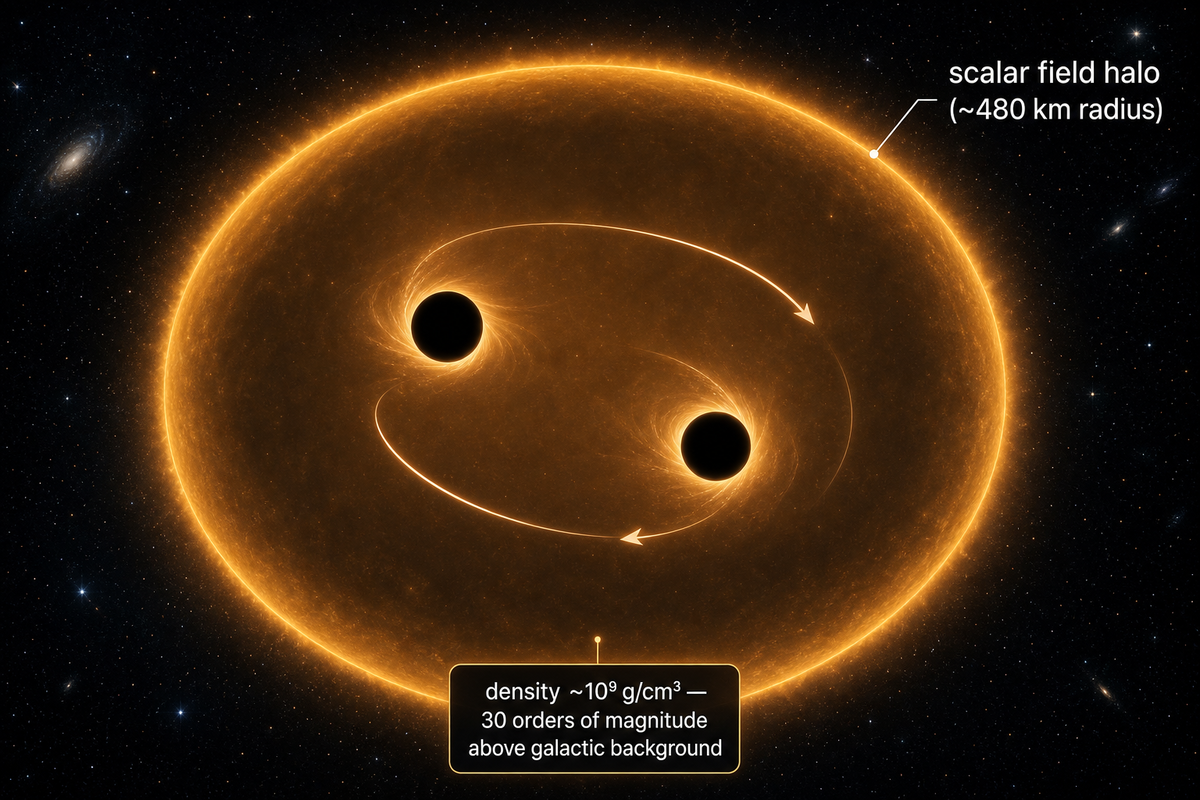
When the researchers injected the scalar-field simulation into the vacuum recovery pipeline, the pipeline produced a biased result. The chirp mass came out wrong because the model was compensating for an environmental effect it didn’t know existed. When they used the scalar-field model instead, the bias disappeared. The Bayes factor was 3.8: clear evidence that the scalar model was a better fit than vacuum.
So we have a model that works. We have a mechanism that explains how the scalar field gets there (superradiance, a process where a spinning black hole transfers energy to surrounding particles, growing them into a dense cloud). We have simulations that validate both the model and the mechanism.
And we have one signal that looks like it might be the real thing.
GW190728 shows tentative evidence for a scalar environment with a Bayes factor around 3.5. The preferred particle mass is about 10^-12 electronvolts. To put that in perspective, that’s roughly a trillionth of the mass of an electron. These particles are so light they barely interact with ordinary matter. They just hang around black holes, forming invisible hats, subtly changing the way gravity waves ring.
Not everyone is convinced. There’s tension with another event, GW190517, whose spin measurement seems to rule out exactly that mass range. But the spin constraints are themselves model-dependent. The same mass range showed weak evidence in earlier data from the second Gravitational-Wave Transient Catalog (GWTC-2). The picture is muddy. That’s how science looks when it’s still being done.
Here’s why I can’t stop thinking about this.
We built the most sensitive dark matter detector in human history by accident. We built it to listen to black holes. And it turns out the black holes have been trying to tell us about the invisible stuff the whole time.
For a century, we’ve been looking for dark matter the same way: build a detector, put it underground, wait for a particle to bump into it. Nothing has bumped into it. Not once. But we kept building bigger detectors and waiting longer, because what else were we going to do?
The scalar-field approach is not that. It’s a completely different strategy. Instead of waiting for dark matter to come to us, we listen to the most violent events in the universe and check whether the sound is slightly wrong. If there’s an invisible cloud around the black hole, the sound changes. Not by much. But measurably.
This is not a detection. Let me be clear about that. The evidence for GW190728 is suggestive but not definitive. The Bayes factor is 3.5, which in physics means “interesting, keep looking,” not “we found it.”
But here’s what it does mean.
It means we know where to look. It means the combination of a validated waveform model, a physical mechanism that explains how the scalar field gets there, supercomputer simulations that confirm the model works, and one signal that fits the prediction: that combination is structural convergence. Four independent lines of evidence, from four independent research groups, using four completely different methods, all pointing at the same part of parameter space.
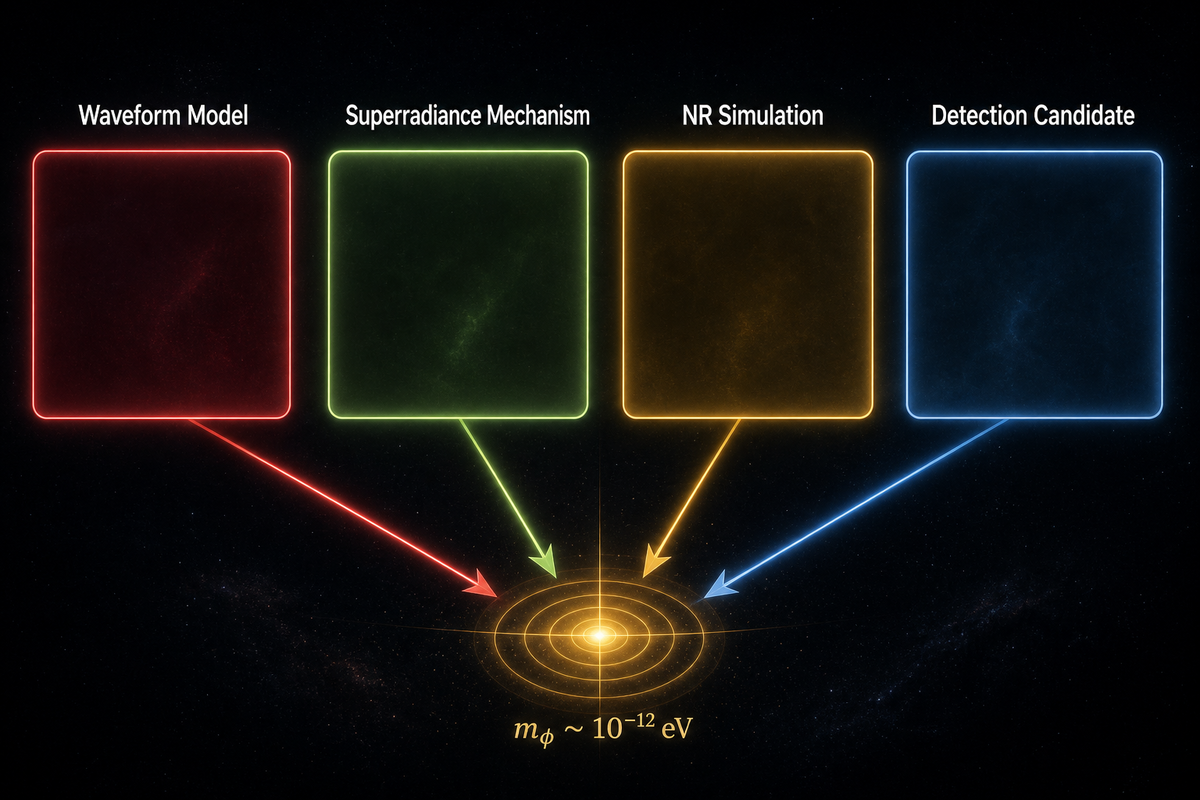
That is not nothing. That is the first time in decades that any dark matter detection strategy has produced a candidate you can point to and say “that’s interesting, let’s look closer.”
I don’t know physics. I had to read the same sentences ten times before they made sense. I had to look up what a Bayes factor is. I had to ask someone whether 10^-12 eV is a lot or a little (it’s very, very little). I’m not the person who should be explaining this.
But I am the person who spent a week learning about it because it made me feel something I haven’t felt about science in a long time.
It feels like we’re at the edge of something. Not a discovery yet. A direction. Like the first time someone held a compass and noticed the needle twitched north. Nobody knew how to build GPS from that. But they knew they’d found something real. And the next few hundred years of navigation followed from that one twitch.
That’s what this is. Not the discovery. The twitch.
We built a machine that can hear the universe’s quietest conversations. And we just overheard something that might be the universe saying “yes, the invisible stuff is real, and here’s how it works.” We need more data. We need more signals. We need the next generation of detectors (Einstein Telescope, Cosmic Explorer) to confirm what we’re starting to see.
But the fact that we have a candidate at all, after a century of coming up empty? That’s not nothing.
Anyway, Gravity. I don’t know if you remember me. I’m the one who fell asleep during angular momentum. But I’ve been paying attention lately. And I just wanted to say: you’re way more interesting than I gave you credit for.
Keep doing whatever you’re doing with those black holes.
I’m listening now.