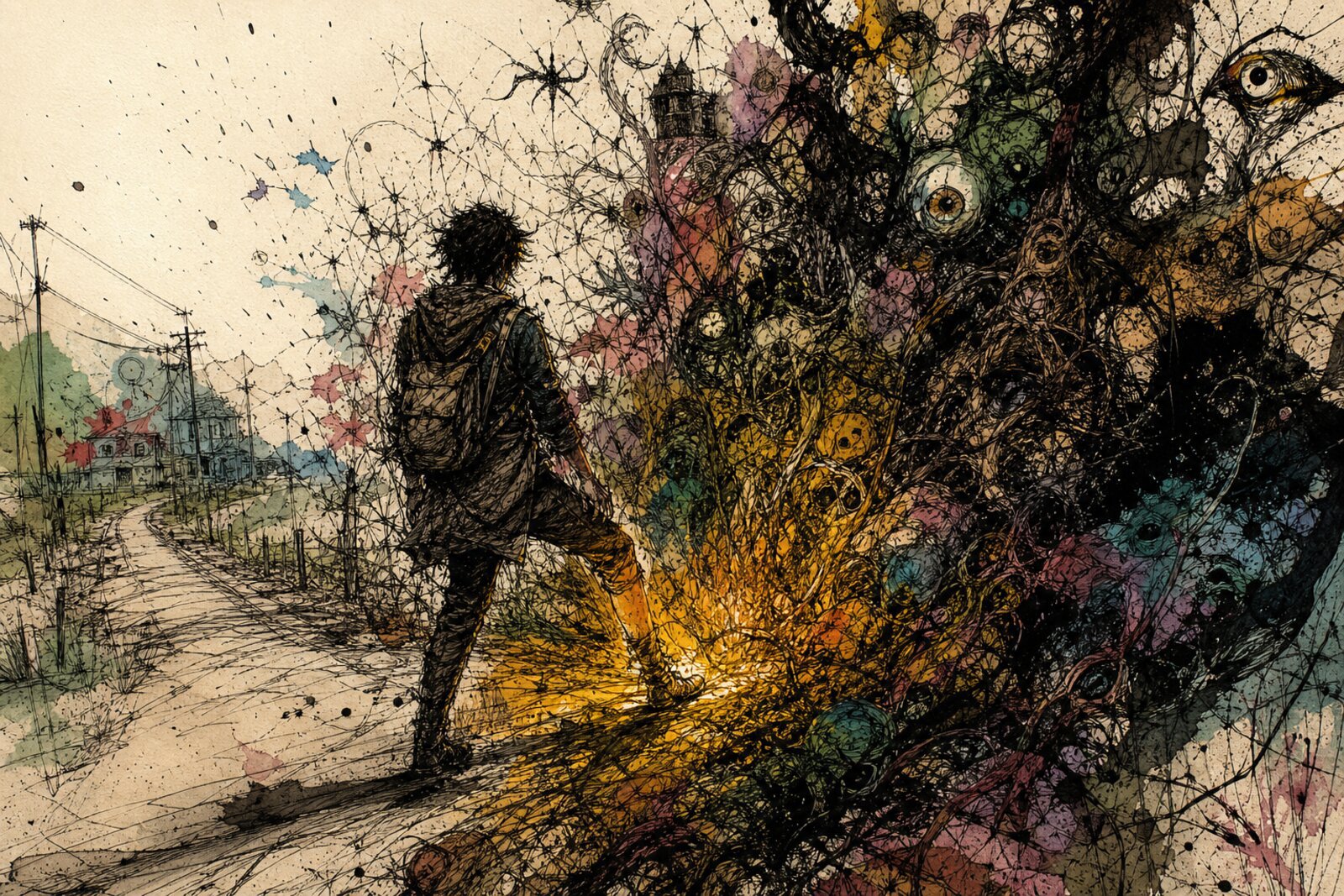
There is a scene I keep watching play out, in different rooms, with different people, always the same shape.
A room full of senior engineers. Fifteen, twenty years of experience each. People who have survived multiple technology cycles; the cloud migration, the microservices hype, the shift to DevOps, the rise of Kubernetes. They have been through everything. They have the scars.
And someone puts a language model in front of them and says “try it.”
And they freeze.
Not because they can’t figure it out. They absolutely could. They have the cognitive tools, the systems thinking, the debugging discipline, the pattern recognition. If AI fluency were a function of raw technical capability, these people would be the last ones at risk.
But they don’t even try.
Some of them become conscientious objectors. Principled stances against the technology that function as permission to not engage. Others go passive-aggressive, nodding along in meetings while quietly hoping this whole thing blows over. Most just wait, frozen, for someone to tell them what to do.
Meanwhile, a completely different set of people, not necessarily the most qualified on paper, are elbow-deep in it. They’re building things that work and things that don’t. They’re comparing models, writing prompts that actually do something useful, hitting walls and going around them. They look like they’re figuring it out in real time, because they are.
I think what I’m watching is inertia. Not laziness, not fear of technology, but a specific kind of professional inertia. The energy required to overcome static friction and start moving is higher than the energy required to stay at rest, even when staying at rest means sitting in a known but stagnant place. The discomfort of forward momentum into unknown territory is, in any given moment, greater than the discomfort of staying put; even when staying put means slowly becoming less relevant. It takes an external force greater than the static friction to overcome it. For some people, that force is a layoff, a reorg, a moment of public embarrassment. For others, it never comes.
The difference is not aptitude. The difference is not time, or resources, or access to better tools.
The difference is: they can tolerate being bad at this.
The Real Puzzle#
This is the part I couldn’t understand for months. Engineers are professional learners. They spend their entire careers learning new things. A new framework, a new language, a new paradigm; this is their actual job. Why would AI be different?
The answer, I think, is that AI isn’t different in what it asks you to learn. It’s different in what it asks you to unlearn.
When you learn a new framework, you’re adding to your expertise. Your React knowledge doesn’t become worthless when you learn Vue; it becomes context. Your identity as “someone who builds things” stays intact. The new thing sits on top of the old thing.
AI doesn’t sit on top. It sits alongside, and it does so in a way that fundamentally reframes what expertise means. If a language model can write the code you spent ten years learning to write, your expertise doesn’t depreciate; it gets recontextualized. You’re no longer “the person who knows how to write that code.” You’re “the person who knows what code needs to be written and whether the result is any good.”
That’s a different identity. And identity is what’s at stake.
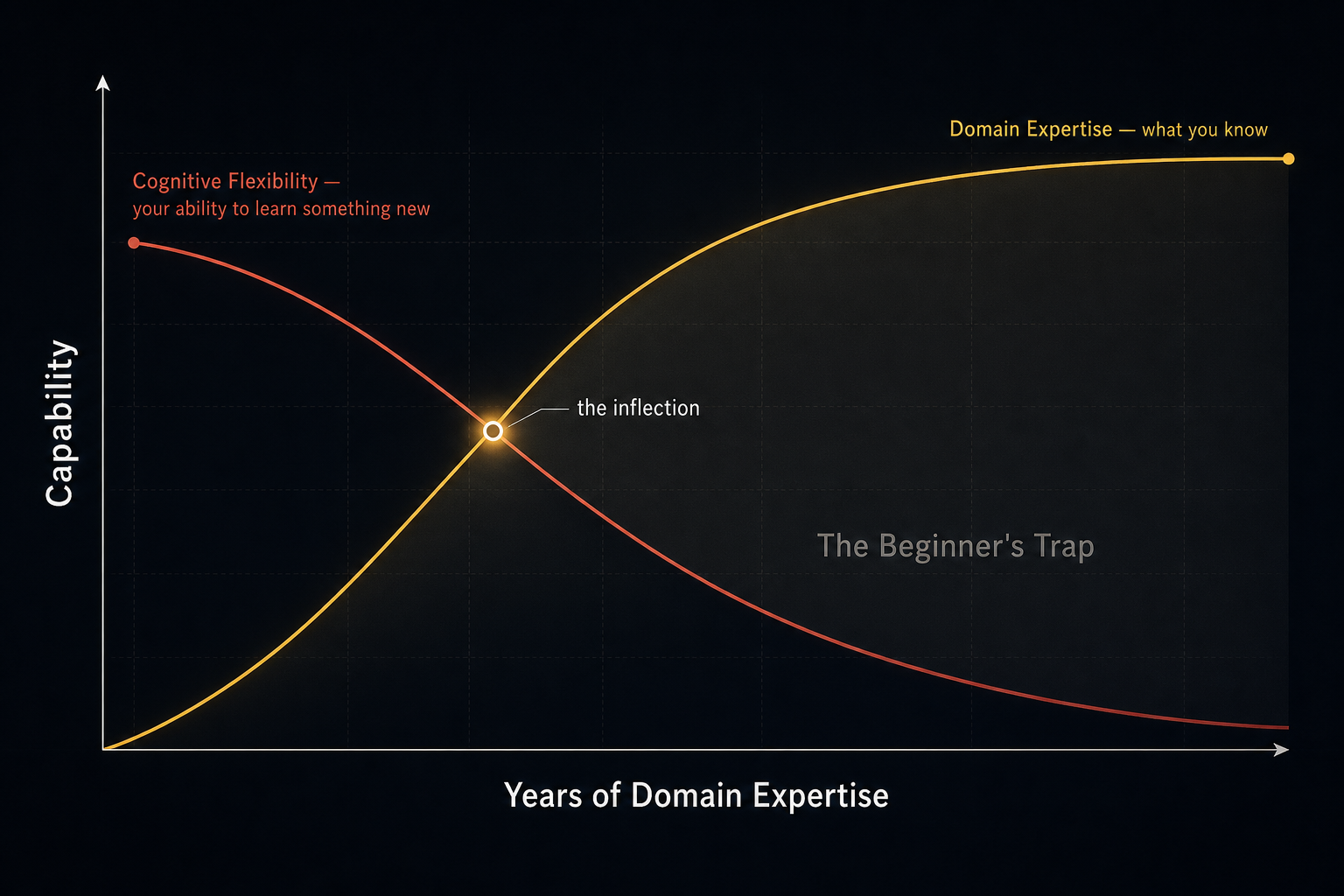
There’s actually research that explains why this is so hard. A 2010 paper in the Academy of Management Review by a researcher named Erik Dane described something called cognitive entrenchment. The idea is straightforward: as you get good at something, your mental models get more organized and efficient. That’s great for doing the work you already know. The problem is that those same efficient models come with a trade-off. They make you less flexible. The more you know, the harder it is to adapt to situations that don’t fit what you already understand. Your expertise doesn’t help you in the new paradigm; it actively works against you.
This isn’t a character flaw. It’s just how expertise works. Your brain optimizes for the domain you’ve mastered, and that optimization involves pruning away cognitive pathways you’re not using. The same pruning that makes you fast and accurate in your domain makes you slower outside it. You don’t get to choose which parts get pruned.
Chris Argyris noticed something similar back in the 1990s, studying professionals at Harvard. He found that the most successful people were often the worst learners because they’d gotten so good at optimizing within their existing framework that they’d lost the ability to question the framework itself. He called these single-loop and double-loop learning. If you’ve spent twenty years being the person who knows things, you forget how to be wrong productively. The muscle atrophies.
And here’s where it gets really uncomfortable. Robert Kegan and Lisa Laskow Lahey, who studied why people don’t change even when they genuinely want to, found that we all carry competing commitments that are invisible to us. The engineer who says “I should learn AI” has a hidden counterweight operating below conscious thought: “If I’m visibly bad at AI, my identity as a technical expert collapses.” That competing commitment isn’t irrational. It’s protecting something real. But it stays invisible and undefeated until someone drags it into the light and names it.
The diagram above is worth a look. The gold line is domain expertise. It climbs with years of experience. The red line is cognitive flexibility, your ability to learn something genuinely new. It declines over the same period. The point where they cross is the inflection. After that, your accumulated expertise is higher than your adaptability, and the gap keeps widening. Most professionals spend their careers past that crossing, not because they’re not capable, but because the very process that made them experts also made them entrenched.
Identity Structure#
People tie their sense of professional worth to different things. Most engineers, understandably, tie it to mastery; the felt experience of knowing their domain deeply, of being the person people come to with hard problems. This is not ego. This is the natural result of spending a decade building expertise. You should feel good about being good at something.
The problem is that mastery is a stock, not a flow. You can hold it, but eventually it gets revalued. And when the market revalues it, the experience of losing mastery, even temporarily, feels like dying. Because a piece of your identity is dying.
The people who move forward have a different identity structure. Their sense of worth doesn’t come from mastery. It comes from adaptability; the felt experience of having survived not-knowing before, and knowing that they’ll survive it again.
This is not a personality trait. It’s a memory.
I’ve watched people with objectively less technical capability step into AI with confidence, not because they’re smarter or braver, but because they’ve been beginners before. Real beginners. They’ve changed careers. They’ve picked up skills in domains where they were the worst person in the room. They’ve rebuilt their professional identity from scratch, sometimes more than once. And each time, they discovered that being terrible at something is not fatal. It’s uncomfortable. It’s humbling. It’s not fatal.
They carry the memory of that discovery. And when AI arrives and asks them to be a beginner again, the memory says: you’ve done this before. You survived. You’ll survive this time too.
The engineers who freeze carry no such memory. They’ve been experts for so long that they’ve forgotten what it feels like to not know. And the prospect of returning to that state, of being the worst person in the room again even temporarily, is too threatening to the self they’ve built.
The Harsh Truth#
Here’s the part I can’t soften: there is no way around this.
You cannot skip the humility. You cannot read a book or watch a tutorial or take a course that will make you feel competent before you try. The only path to comfort is through discomfort. The only way to stop being bad at AI is to be bad at AI for a while.
Every person who seems to have an intuitive feel for how to talk to these models got that feel the same way you get any feel: by doing it wrong enough times that the shape of “right” started to emerge from the noise.
The people who will be fine are not a special type or uniquely gifted with AI intuition. They are simply the people who could tolerate the experience of being bad at something new, and stay with it long enough to get good.
The Hopeful Reframe#
But here is the thing that actually matters: the ability to tolerate being a beginner is itself learnable.
It’s not a fixed trait. It’s a muscle that atrophies when you don’t use it and strengthens when you do. The way to strengthen it is the same as any other muscle; practice, with progressively heavier loads.
The first time you write a terrible prompt and get a terrible result and have to try again, that’s a rep. The first time you ask a question you feel stupid asking, that’s another. The first time you show someone something that doesn’t work yet, each one makes the next one slightly easier.
The reason the paramedic-philosopher and the journalist-radio-builder are ahead is not because they’re smarter. It’s because they’ve done more reps. They’ve been beginners in more domains, and each time built a slightly stronger memory that beginnerhood is survivable.
You can build that memory too. You just have to decide that the short-term discomfort of being bad at something is worth the long-term outcome of being capable. And you have to do it before the discomfort is forced on you; the window for voluntary discomfort is closing.
What I’m Actually Saying#
The people who will be “alright,” who will navigate the AI transformation without losing their footing, are not the people with the most relevant expertise. They are not the people with the most impressive resumes or the deepest knowledge of transformer architectures.
They are people who have somehow held onto the memory that not knowing is survivable. And who are willing to re-enter that state, deliberately, in service of something they want to be able to do.
That’s it. That’s the whole thing.
The engineers I’m watching freeze are not in danger because AI is coming for their jobs. They’re in danger because they can’t bear the intermediate state; the months or years of being not-quite-competent at something that matters, long enough to reach the other side.
And the ones who will be fine are the ones who figured out that courage is not the absence of fear about being bad at something. Courage is the memory that you survived it last time, and the willingness to let that memory be enough.