The first couple of hours of my workday happen in quiet. I live on the East Coast; my company is on Mountain Time, which means my coworkers are two hours behind me. That window is the part of the day I use for focused research. It is where I keep my own skills sharp, and where I think through new patterns I want my team to try out so they can grow.
I used to take medication for ADHD. It gave me a productivity window, and it burned me out. By mid-afternoon there was not enough of me left to enjoy my own life outside of work, aside from quiet solo hobbies. I stopped the ADHD meds a couple of years ago, and the rhythm of my day is better for it.
I still medicate for the other things. Medication gives me a baseline emotional state of joy and contentedness that I did not have in the first forty-plus years of my life. Protecting that floor is part of the work now.
This is a post for neurodivergent leaders, for neurodivergent people who want to become leaders, for people who work for us, and for people who have us working for them.
The diagnosis I did not have#
I was diagnosed as Autistic in adulthood. The ADHD diagnosis came later, though the two conditions had been in interaction my entire life. For most of the years before either diagnosis, mental health professionals had told me they knew something was off but could not put their finger on what. When the Autism diagnosis arrived, a lot of things clicked into place. When the ADHD diagnosis arrived, a lot more things clicked, and several things that had never quite fit the Autism frame finally made sense.
AuDHD is the informal but increasingly standard term for the co-occurrence of Autism and ADHD. It is not rare. Research estimates suggest 50 to 70 percent of Autistic people also have ADHD, and 20 to 50 percent of people with ADHD are also Autistic. For most of recent diagnostic history, you could not receive both diagnoses concurrently; the DSM-IV explicitly prohibited it on the assumption that the conditions overlapped too much to be distinct. The DSM-5, in 2013, removed that prohibition. Many adults diagnosed under the older criteria are walking around with an incomplete picture of their own neurology.
The AuDHD community is clear that the combination is not simply Autism plus ADHD. The two conditions interact, and the interaction produces a distinct profile with its own competing drives, its own masking dynamics, and its own shape of burnout. Try to understand an AuDHD person through only one of the two lenses and you miss most of the texture of their experience.
Competing drives#
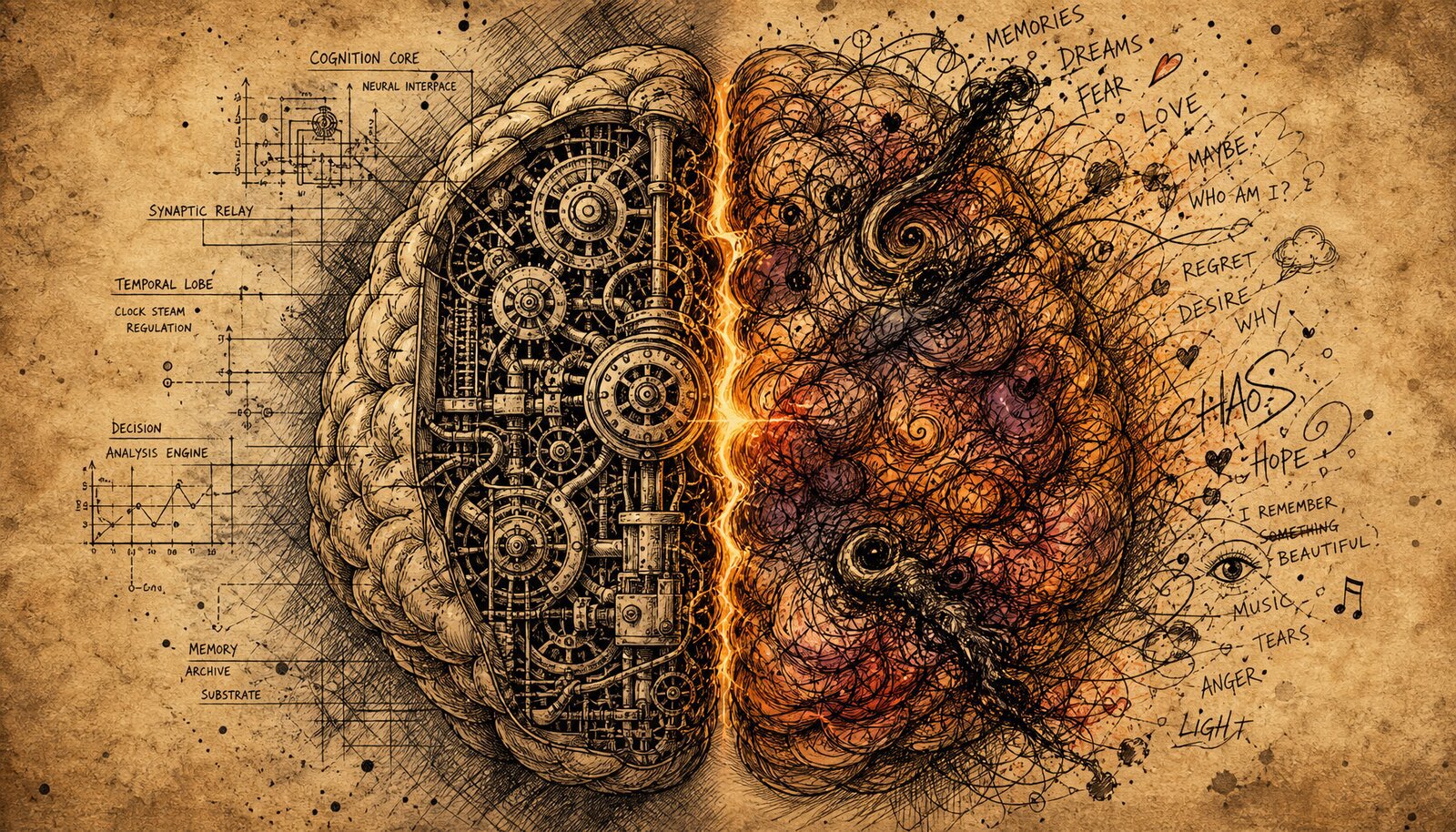
The sharpest daily feature of AuDHD is competing drives. Autism pulls toward predictability, routine, and depth within established domains; familiarity is regulating. ADHD pulls toward novelty, variety, and fresh stimulation; routine becomes intolerable. Neither drive wins. Both are real.
One place this shows up for me is hobbies. I like to say my hobbies have hobbies. If you walked into my home office, you would find strong evidence of 3D printing, hand drumming, hydroponic houseplants, photography, videography, and podcasting. There is a colony of poison dart frogs in a glass terrarium near my desk, and cultures of fruit flies on a shelf nearby to feed them. There are reptiles, electronics projects, home automation experiments, and books in quantities that exceed sensible. A pure-Autism profile might show one or two deep sustained special interests. A pure-ADHD profile might show breadth without much depth. AuDHD produces both: each interest is pursued to real competence, rotates when the novelty runs out, and sometimes returns years later with new intensity.
Another place it shows up is in how I travel. I enjoy long motorcycle rides with no plan. Parents of Autistic children know the pattern by its other name: elopement, the urge to wander. That urge does not go away in adulthood, and a few weeks of curiosity-led riding through the southeastern United States, with no destination fixed in advance, is one of the ways I feed it. The conventional picture of Autism assumes rigid advance planning; this kind of travel is the opposite, and it is exactly what AuDHD produces: ADHD novelty-seeking riding on top of Autistic solitude and sensory self-regulation. Neither alone would have produced it.
The work rhythm#
At work, the competing drives show up in a specific cognitive pattern. Where many of my neurotypical colleagues jump straight into a problem, I tend to study it, think about it, and circle around it for a while before starting anything visible. I often start later than the people around me. I often finish earlier.
The think-and-circle phase is not idleness. It is the period where I am building the mental model of the problem, mapping the interactions, identifying what is actually load-bearing. Autism contributes the depth and pattern-recognition. ADHD contributes the hyperfocus that engages once task-initiation resistance has been overcome. The combination produces a shape of output that looks different from, and in my experience consistently outperforms, the jump-in-and-iterate pattern most managers have been trained to reward.
The problem is that to a supervisor watching for visible activity, the think-and-circle phase is indistinguishable from doing nothing. It has all the hallmarks of procrastination to an observer, and, honestly, struggling to make the first concrete steps on a larger effort is a hallmark AuDHD behavior in its own right. What separates my pattern from actual procrastination is the delivery at the end. I did not get where I am in life by failing to show results. Employers who have given me the room to run this unusual pattern through have been rewarded for it. Employers who wanted the theater of appearing busy earlier in my cycle than what they were seeing are, well, ex-employers.
One of those ex-employers had a strong industry reputation for neuroinclusion. They had the language, the programs, the public commitments. But the organization was optimized for other neurocognitive profiles than mine, and as soon as my slow-start, rapid-completion pattern showed up, it became a problem they did not know how to be patient with. That was a formative lesson. A neuroinclusion posture is not the same thing as actual room for neurodivergent people to be themselves.
Other employers I have worked for had no formal neuroinclusion posture at all and still made room for me to be authentic. Even neurodiversity experts get this wrong, because every one of us is intensely individualized in our strengths and our needs. The experts, who are often neurodivergent themselves, cannot help but bring their own individualized biases and experiences into the interaction. The measurable differences in neurocognitive profiles between any two neurodivergent people are larger than between any two neurotypical ones. Perhaps counter-intuitively, I sometimes find it harder to work for another neurodivergent person than for a neurotypical-presenting boss.
There is a related dynamic I have learned to watch for. If I let myself run at full AuDHD capacity, peers who are used to the jump-in cadence sometimes read my output as unreasonable and undermine me politically. The rational response, which I regret but have repeatedly made, has been to intentionally slow down and dim my output to be non-threatening. The cost accrues to me; the lost productivity accrues to the organization. The only real fix is a working environment where full-capacity AuDHD performance is met with support rather than resentment, and when I have found such environments I have protected them carefully.
The candor is amplified#
The Autistic compulsion to tell the truth is real. I have a highly developed sense of right and wrong and a biological pull toward naming what I am seeing. Early in my career, this was a problem. I came on too strong. I was confrontational in ways I did not intend. I was, to put it charitably, a lot.
The straight-Autism framing is that this candor was a liability I learned to soften. The AuDHD framing is more honest. It was not only the candor that was sharp; it was the candor amplified by ADHD impulsivity. The Autistic truth-telling gave me something to say; the ADHD disinhibition made it come out unfiltered, at the wrong moment, often before my neurotypical peers had caught up with the point I was making. The combination is what made me hard to work with before I learned to calibrate.
The calibration I eventually found is simple, and I use it every day. I no longer walk into a meeting to name what is wrong. I walk in to name what I am seeing, and then ask what we can do about it together. “Here is what I’m seeing; what can we do to get better at this?” is the entire transformation. Senior leaders in the rooms I’ve worked in come to anticipate what some colleagues have taken to calling the “Magnus truth bomb” and lean in for it, because it has been calibrated over years to arrive not as complaint but as catalyst. The candor is still there. The impulse control that surrounds it is learned.
Hyper-empathy and the masking tax#
The stereotype that Autistic people lack empathy is wrong in my experience. A lot of us have the opposite problem: hyper-empathy that arrives without a container and accumulates faster than ordinary life can absorb. For me it presents as a near-involuntary awareness of the people in a conversation who are not speaking, who are not being heard, who would be affected by the decision under discussion but are not in the room. It does not show up as visible warmth. It shows up as structural behaviors: making space when a non-dominant voice is starting to speak, reaching out to the people who stayed quiet after a meeting, treating what is not being said as a load-bearing input rather than optional context.
The AuDHD layer on this is masking. Autistic masking, the effortful performance of neurotypical behavior, is already cognitively expensive. ADHD impulsivity constantly disrupts it. I am halfway through a carefully calibrated social interaction and a blurted unfiltered sentence slips out, and now I am spending additional cognitive resources to repair the mask and continue. Many AuDHD adults report that masking across both conditions is more expensive than either alone, and the compounding shows up over time as deeper burnout.
I learned the workplace version of a related insight from an unlikely place: fine art photography. Some of the most unmasked conversations I have had in my life happened in photography sessions where the subject had already chosen to be vulnerable, and a different quality of presence emerged. What it taught me is that masking is not an Autistic-specific behavior. Neurotypicals mask with each other constantly. What changes in an environment of genuine safety is that everyone stops performing. For a leader, the implication is structural and severe: the core work is creating a space where team members can be vulnerable without fear of that vulnerability being exploited. The everyday protection of that space is the highest-leverage behavior available to a manager, and the one most easily broken.
The speaking spectrum#
There is another AuDHD-specific feature of my working life that took me a long time to name. Spoken communication is a challenge for me. I know what I want to say, and the words do not always come out as well as I would like. This is strictly with spoken communication. Written communication is easier. Like many AuDHD people, I gravitate to Slack for some conversations because the keyboard is cognitively easier than the mouth.
There are Autistic cycles to speaking that run the full spectrum from hyperlexical brain dump at one end to selective mutism at the other. I have experienced both. In the middle range, which is most days, my speaking readiness varies more than a neurotypical speaker’s would, and I cannot always predict which version of myself will be in the meeting.
The practice I have built around this is active listening as a baseline. It has two functions. It gives me a consistent social behavior to role-model on days when my speaking readiness is variable, which stabilizes how I show up. It also creates room for the people I lead to contribute their own thinking to our shared sense of direction. The limitation I had to navigate became, in practice, a discipline that makes me more actively curious in the room than I would have been if speaking came easily to me.
On accommodation#
I have had workplaces that supported this kind of work and workplaces that did not. Without naming specific employers, I will say that accommodation conversations have been a real and recurring challenge across my career. I have been pattern-matched to a DSM-V diagnostic list on at least one performance review. I have gone through an HR investigation about discrimination against me, and I have learned in the process what Human Resources actually is: not the court system, not there to be impartial, structured to protect the company from liability. That is useful information to have before you need it.
The tactical move that has most reliably worked for me in accommodation conversations is framing. The same request delivered as a problem the manager needs to solve lands very differently from the same request delivered as an opportunity for better outcomes. “I get distracted by having my back to a busy walkway; I would be significantly more focused if I could move to the open desk against the far wall” is the identical request as “I cannot focus here, please fix it,” and it triggers a fundamentally different response. The underlying ask does not change. The framing does.
Framing is not a fix for a bad environment. If the environment is genuinely hostile, the correct move is to leave, and I have left several workplaces for exactly that reason. But most environments are not malicious; they are just not designed with AuDHD workers in mind. In those environments, speaking the language of productivity rather than of accommodation tends to unlock more than the formal process does.
Boredom is my nemesis#
There is a tension I still live with that I have not fully resolved, and it is worth naming honestly rather than pretending I have mastered it. The competing drives of AuDHD produce a specific occupational hazard: once a role is no longer novel, the ADHD drive starts pulling hard toward the next thing, even when the Autistic drive would happily stay and go deeper. Early in my career, before I had the language or the skill to have good conversations with my managers about career growth, my response to boredom was often to quit and find novelty somewhere else. That is how several of the short-tenure jobs on my resume got there, and I am not going to romanticize it: some of those exits were necessary, and some of them were just boredom winning.
What changed for me was the jump to the leadership track. Leadership roles gave me what the individual-contributor track rarely did: mobility to take on challenges outside my comfort zone without having to leave the company to find them. A scope expansion, a new problem domain, a team to rebuild: these keep me cognitively engaged in a way that running the same playbook for a third consecutive year does not. It turned out that I did not actually need to leave. I needed to keep the work genuinely new.
Even now, boredom is my nemesis. I have to guard against it with great vigilance, and I have had to be honest with myself about which career moves are real growth and which are dressed-up boredom with a cover story. Not every novelty impulse is a signal worth following. But the underlying pattern does not go away with a diagnosis or with experience, and pretending otherwise would be dishonest.
The leadership principles that came out of this#
The specific experience of being AuDHD inside organizations that were not designed for me has produced a set of leadership principles I now try to work by. They are not unique to AuDHD; they help everyone I have seen them applied to. But they were forged in response to failures that AuDHD made visible.
Be dogmatic about values. Be flexible about process. The competing drives of AuDHD create a specific sensitivity to rigid process: the Autistic drive wants stability, the ADHD drive wants variation, and the only thing that holds both together without tearing the person apart is a shared understanding of what the organization actually stands for. Codify the values. Write them down. Refer to them when there is disagreement. Leave genuine flexibility in how people get the work done. Process rigidity as a substitute for moral clarity produces high friction with the full range of human working styles, and the friction falls hardest on the neurodivergent people you cannot see.
Trust the think-and-circle phase. I have been cut off by managers during the phase of a problem where I was actually doing the most important work. Do not replicate this pattern. If someone on your team consistently starts later than peers and then delivers well, resist the urge to force a neurotypical cadence onto an AuDHD-shaped problem-solver. Judge by the quality of the output, not by the visibility of the activity that precedes it.
Protect vulnerability-safety as the most fragile and most expensive thing in your building. It is what allows people to bring their full capacity to the work. Masking is not an Autistic-specific behavior, and its cost is not an Autistic-specific cost; everyone is performing some version of themselves, and the working environment determines how much of that performance tax they pay. A leader’s core job is creating a space where team members can be vulnerable without fear of that vulnerability being exploited. Trust is difficult to earn, terribly easy to lose, and nearly impossible to regain once it has been betrayed.
Hire for culture expansion, not culture fit. Culture fit as a hiring criterion selects for sameness. What you want from the people you bring in is not that they resemble the culture you already have, but that they expand it in a direction it would not otherwise go. Every hire is a bet on whose thinking you want added to the mix.
Ask each person what they need to do their life’s best work here. Then provide it without requiring a doctor’s note. This is the 1:1 question I return to most often with direct reports. The answers are usually mundane and cheap to implement. Removing the medical-gatekeeping from the conversation is itself the inclusion move, because the people who need accommodations most are frequently the ones least able to navigate a formal accommodations process.
Build talent everyone wants to poach. Cultivate the environment no one wants to leave. These are two rules that are deliberately in tension. If you only invest in making your people externally marketable, they will leave; if you only invest in making the environment pleasant, people will stagnate. The combination is what makes staying an active choice people make repeatedly. I tell my direct reports to go interview for other jobs periodically, even when they are happy. Knowing you have options is what makes staying a free choice rather than a sentence.
Active listening as a leadership baseline. My own variable speaking readiness meant I had to invest heavily in active listening as the one social behavior I could always count on performing well. That investment has paid dividends in my leadership that I did not anticipate. Leaders who listen harder than they speak draw out better thinking from their teams, surface concerns earlier, and collect more information than leaders who start every meeting by telling people what they think. If you are AuDHD and your speaking varies, active listening is also an accommodation you can give yourself and present to the world as a leadership virtue, because that is what it is.
If you are AuDHD#
If you are Autistic and nothing ever quite explained you, look at ADHD. If you are ADHD and nothing ever quite explained you, look at Autism. The either-or framing that trained a generation of clinicians misses exactly the people most in need of the combined lens. The combination is not a separate and worse thing. It is a distinct neurology with its own texture, its own specific strengths, and its own specific costs. It is possible to build a life and a career around it rather than against it.
The harder and more important work is on yourself, not on the job. The work is in learning your own strengths in precise detail, learning your own needs with equal precision, and then re-defining the role you are in, or choosing the role you move into next, so that it leverages the strengths while structurally supporting the needs. Build the infrastructure for your own success. The alternative is spending your career trying to survive a role structure that was optimized for someone very different from you, and survival is not the same thing as leadership. Every downstream choice rests on doing that work: what you say in meetings, how you hire, what you accept, and what you leave.
If you work for a neurodivergent leader like me#
One more caution before I offer any advice here. I am one neurodivergent leader. I am not all of them. Every leader is different, and neurodivergent leaders are often very different, not only from a neurotypical baseline but from each other. The measurable variance in neurocognitive profiles between any two neurodivergent people is larger, in my experience, than between any two neurotypical people. So take what follows as a description of me and people wired similarly to me, not as a guide to working for neurodivergent leaders in general. Your actual boss is their own person, and you will still need to do the work of learning them. For those of us wired like me, though, a few handles tend to help.
Expect the pause. A quieter or slower response from me is not disengagement; it is the think-and-circle phase where I am building the full mental model of whatever you just brought to me. Resist the temptation to fill the silence. The answer that comes out the other side will usually be more considered than the one you would have gotten from a jump-in-and-iterate boss.
Expect the truth bomb, and lean in for it. When I tell you what I am seeing, it is not a political move or a power play. It is how I am made. What follows the truth bomb is the actual value: the question about what we can do about it together.
Use the channels that work for both of us. Slack and email cost me less than spoken meetings. A one-on-one with a clear agenda sent ahead costs me less than a freeform conversation I show up to cold. These are not preferences. They are how you get my best thinking on the problem you brought me.
Trust the values over the process. Rigid process is not where I go when I want stability; my stability comes from knowing what I stand for and why. When something does not make sense, asking what the values are behind it will almost always get you a clearer answer than asking why the process exists in its current form.
If you have a neurodivergent leader like me working for you#
The same caution applies. I am one leader. What helps me may not help the next neurodivergent leader you hire, and the range is wide. But for leaders wired the way I am, these are the things that have made the difference.
I am probably a higher-leverage employee than you realize. The tax I have paid to get to a leadership role is substantial, and the skills I built paying it tend to make me disproportionately effective once I am in the right environment.
Protect my rhythm. If your organization’s performance-management culture rewards visible busyness over delivered outcomes, I will either dim myself to survive it or leave. Neither outcome is what you wanted when you hired me.
Ask me what I need to do my life’s best work, and then provide it. Remove the medical-gatekeeping from the conversation. The things I ask for are usually mundane and cheap. The formal accommodations process is the thing that often breaks me, not the accommodations themselves.
If you are the first person in the chain who has protected me in a way my previous bosses did not, you will have earned a kind of loyalty most organizations do not know how to generate. If you turn out to be one more in the pattern of bosses I have had to leave, I will leave quietly, and you will not always know why.