Name It to Tame It: Why Labeling Your Emotions Makes You Smarter
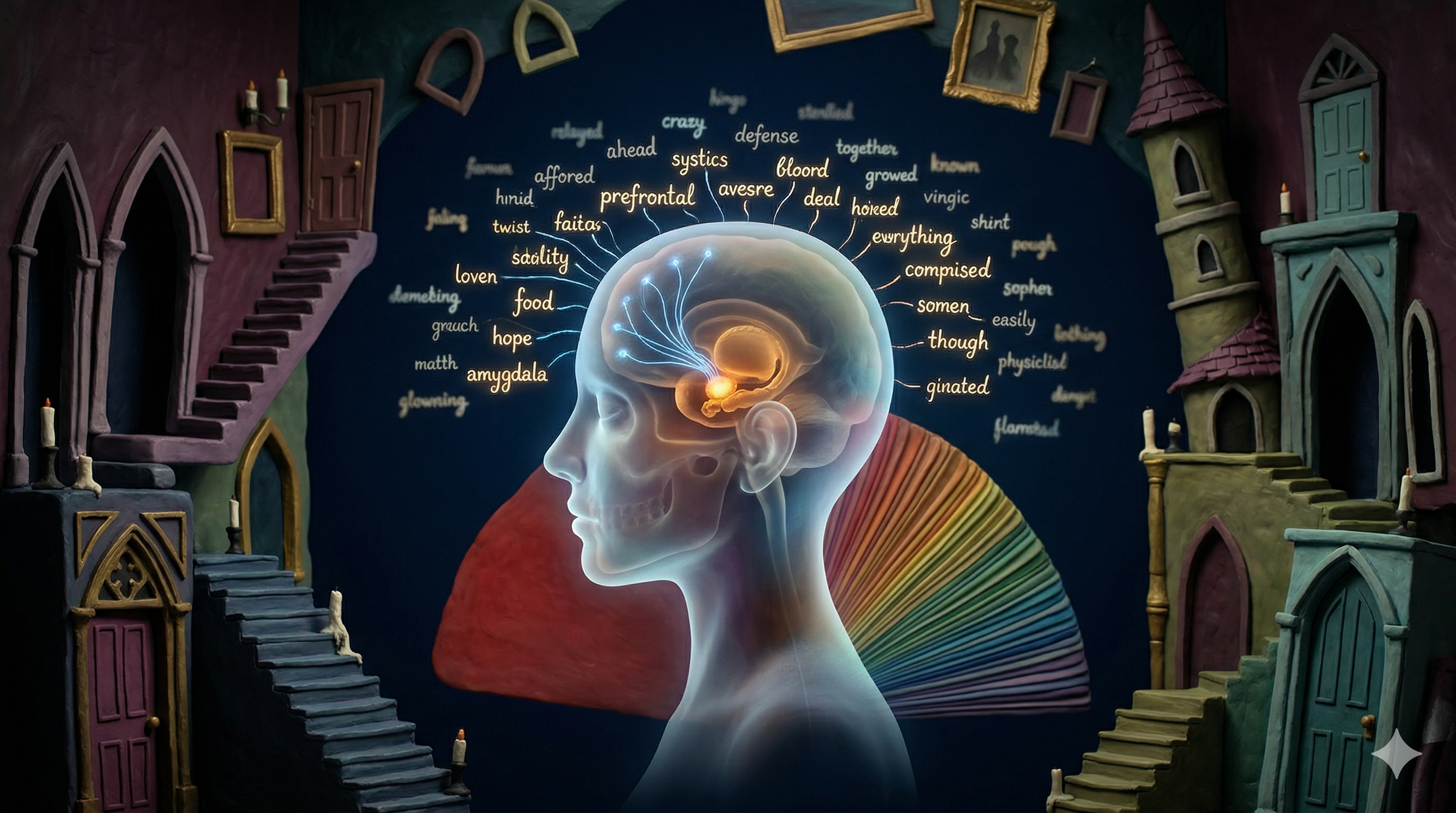
Table of Contents
I’ve been reading about a deceptively simple technique that keeps showing up across neuroscience, psychology, and decision-making research. The technique is this: when you feel something, say what it is. Out loud if you can. As specifically as possible.
That’s it. That’s the intervention.
It sounds almost too simple to work. But the brain imaging data behind it is surprisingly robust, and the practical implications go well beyond “feeling better in the moment.”
What Happens in Your Brain When You Name a Feeling#
In 2007, UCLA psychologist Matthew Lieberman and colleagues published a landmark fMRI study that put participants in a brain scanner and showed them photographs of faces expressing strong emotions. When participants were asked to label the emotion they saw (“angry,” “fearful”), their amygdala activity decreased compared to when they simply matched or observed the faces. At the same time, activity increased in the right ventrolateral prefrontal cortex (RVLPFC); a region associated with putting experiences into words and inhibiting emotional responses.
The two regions were inversely correlated. As the prefrontal cortex lit up, the amygdala quieted down. Lieberman’s team described this as a neural “braking system”; the act of finding the right word for a feeling engages a prefrontal circuit that turns down the volume on the amygdala’s alarm signal.
This effect is called affect labeling, and in the years since that original study, it has held up remarkably well across different experimental designs and populations.
The Paradox: People Think It Will Make Things Worse#
Here’s the counterintuitive part. In a 2011 follow-up study, Lieberman’s team found that participants consistently predicted that naming their emotions would make them feel worse. They were wrong. Labeling reduced self-reported distress when viewing negative images, even though the participants never realized it was helping them.
The researchers called this “incidental emotion regulation.” It works below conscious awareness. You don’t have to believe it will help. You don’t have to be trying to calm yourself down. The simple act of translating a felt experience into a word appears to engage the braking circuit automatically.
This is a meaningful distinction from other emotion regulation strategies like cognitive reappraisal (“let me think about this differently”) or distraction. Those strategies require deliberate effort and awareness. Labeling just… works.
Labeling vs. Ruminating: Opposite Directions#
If naming an emotion calms the amygdala, you might wonder whether thinking more about your emotions would calm it even further. It doesn’t. It does the opposite.
Research on rumination shows that individuals who habitually replay emotional experiences in their minds exhibit increased amygdala responses and decreased prefrontal cortex activity; exactly the reverse of what happens during affect labeling. Rumination keeps the emotional imagery alive, reactivating the limbic system rather than dampening it.
The difference comes down to the type of cognitive processing involved. Labeling uses abstract, conceptual language. Rumination uses imagistic, replay-oriented thinking. They point in opposite directions neurologically. One puts the brakes on; the other keeps pressing the accelerator.
A comprehensive review by Torre and Lieberman (2018) in Emotion Review pulled this all together, comparing affect labeling to reappraisal across experiential, autonomic, neural, and behavioral outcomes. Their conclusion: affect labeling functions as a form of implicit emotion regulation, and it’s remarkably effective for something that requires so little effort.
The Spider Test#
My favorite demonstration of this comes from a 2012 study on spider phobia by Kircanski, Lieberman, and Craske. They brought spider-fearful participants into a room with a live tarantula and randomly assigned them to one of four conditions: affect labeling (“I feel anxious that the ugly spider will jump on me”), cognitive reappraisal (“the spider is in a cage and can’t hurt me”), distraction, or plain exposure.
One week later, the affect labeling group showed lower skin conductance responses and got physically closer to the spider than any other group. The people who said “I’m terrified of this disgusting tarantula” out loud ended up less afraid of it than the people who tried to think positive thoughts or distract themselves.
This finding has real clinical implications. Standard exposure therapy often emphasizes reappraisal or habituation. This study suggests that simply verbalizing fear; accurately, specifically, without trying to spin it; enhances therapeutic outcomes.
Why Specificity Matters: Emotional Granularity#
All of the above suggests that naming emotions is useful. But the research on emotional granularity suggests that the precision of your labels matters a great deal.
Lisa Feldman Barrett, a neuroscientist at Northeastern University, has spent years studying what she calls emotional granularity: the ability to make fine-grained distinctions between similar emotional states. Some people describe everything negative as “bad” or “stressed.” Others distinguish between frustration, disappointment, resentment, anxiety, and dread. Barrett’s research shows that this distinction has real consequences.
A review by Kashdan, Barrett, and McKnight (2015) in Current Directions in Psychological Science found that people with higher negative emotion differentiation are less likely to retaliate aggressively when hurt, less likely to binge drink, and more likely to use adaptive regulation strategies during intense negative emotions. Lower emotional granularity, on the other hand, is predictive of greater impulsivity.
Tugade, Fredrickson, and Barrett (2004) found that people who make finer distinctions between their positive emotions show faster cardiovascular recovery after stress and more thoughtful consideration of behavioral options before responding. They’re proactive rather than reactive; they plan ahead rather than acting on impulse.
In Barrett’s constructionist framework, emotions aren’t hardwired circuits that fire automatically. They’re concepts your brain constructs from raw physiological signals. The more nuanced your conceptual vocabulary, the more precisely you can interpret what your body is telling you; and the more precisely you interpret it, the better you can respond.
The Interoception Connection#
Science journalist Annie Murphy Paul extends this line of thinking in her book The Extended Mind. She argues that interoception; your awareness of internal body states like heartbeat, breathing, and gut feelings; provides the raw material from which emotions are constructed. Labeling those sensations is the crucial next step.
Without a label, a racing heart might be interpreted as excitement or anxiety or anger, leading to confused and potentially counterproductive responses. With a precise label (“I’m anxious about the presentation, not angry at my colleague”), you gain a clearer sense of what you need and want. Paul suggests this is why accurate interoceptive labeling leads to sounder decisions; it gives you better data about your own internal state.
Her practical advice: pay non-judgmental attention to internal sensations first. Notice the tightness in your chest, the flutter in your stomach, the heat in your face. Then name what you find, as specifically as you can.
Cultivating Granularity#
If emotional granularity is a skill rather than a fixed trait, it should be possible to develop it. A 2021 paper in Frontiers in Psychology by Wilson-Mendenhall and Dunne explored exactly this. They found that mindfulness-based practices; specifically acceptance, decentering, and “noting” (the practice of briefly labeling mental events during meditation); can intentionally develop emotional granularity over time.
This lines up with something meditators have known for centuries: the practice of noting (“thinking,” “planning,” “worrying,” “remembering”) during meditation isn’t just a focus technique. It’s training your brain to label internal states with increasing precision. Each label is a small act of affect labeling, repeated thousands of times over a practice.
Practical Takeaways#
Here’s what I take from all of this:
Name what you feel, out loud if possible. Even if you think it will make things worse, the brain imaging data says otherwise. The act of finding the right word engages a prefrontal braking system that quiets the amygdala.
Be as specific as you can. “I feel bad” is a start, but “I feel resentful that my effort wasn’t acknowledged” is better. Granularity predicts better regulation, less impulsivity, and more adaptive decision-making.
Don’t confuse labeling with ruminating. Labeling is a brief, precise act of translation. Ruminating is replaying the experience in your mind over and over. They produce opposite neurological effects.
Build your emotional vocabulary. If you struggle to name what you feel, it’s worth expanding your repertoire. Emotion wheels, feeling charts, or simply reading fiction (which exposes you to nuanced emotional language) can all help.
Practice noting during meditation. If you meditate, the “noting” technique is essentially affect labeling practice. It trains the same skill in a low-stakes environment.
None of this is complicated. The hardest part is remembering to do it in the moment, when your amygdala is telling you to react rather than reflect. But the evidence is clear: a few well-chosen words, spoken honestly about what you’re actually feeling, can change how your brain processes the experience. Not by suppressing the emotion, but by giving your prefrontal cortex something to work with.